Page 376 of 519

For best results, a refueling pattern that avoids alternat-
ing between E-85 and unleaded gasoline is recom-
mended.
When you do switch fuel types it is recommended that:
•you do not add less than 5 gal (19 L) when refueling
•you drive the vehicle immediately after refueling for at
least 5 mi (8 km)
Observing these precautions will avoid possible hard
starting and/or significant deterioration in drivability
during warm up.
NOTE:Use seasonally adjusted E-85 fuel (ASTM
D5798). With non-seasonally adjusted E-85 fuel, you may
experience hard starting and rough idle following start
up even if the above recommendations are followed,
especially when the ambient temperature is below 32°F
(0°C).
Selection Of Engine Oil For Flexible Fuel Vehicles
(E-85) and Gasoline Vehicles
Whether operating the vehicle on an E-85 ethanol fuel or
unleaded gasoline, the engine oil requirements are the
same. Refer to “Maintenance Procedures” in Section 7 of
this manual for the proper quality and viscosity engine
oil.
Starting
The characteristics of E-85 fuel make it unsuitable for use
when ambient temperatures fall below 0°F (-18°C). In the
range of 0° to 32°F (-18° to 0°C), you may experience an
increase in the time it takes for your engine to start, and
a deterioration in drivability (sags and/or hesitations)
until the engine is fully warmed up.
Cruising Range
Because E-85 fuel contains less energy per gallon/liter
than gasoline, you will experience an increase in fuel
374 STARTING AND OPERATING
Page 415 of 519
MAINTAINING YOUR VEHICLE
CONTENTS
�Engine Compartment – 3.7L.............. 415
�Engine Compartment – 4.7L.............. 416
�Engine Compartment – 5.7L.............. 417
�Onboard Diagnostic System — OBD II....... 418
▫Loose Fuel Filler Cap Message........... 418
�Emissions Inspection And Maintenance
Programs............................ 419
�Replacement Parts..................... 421
�Dealer Service........................ 421�Maintenance Procedures................. 422
▫Engine Oil......................... 422
▫Engine Air Cleaner Filter............... 424
▫Maintenance-Free Battery............... 425
▫Air Conditioner Maintenance............ 426
▫Body Lubrication..................... 427
▫Windshield Wiper Blades............... 428
▫Adding Washer Fluid.................. 428
▫Exhaust System...................... 429
7
Page 417 of 519
ENGINE COMPARTMENT – 3.7L
1 — Engine Coolant Reservoir 6 — Washer Fluid Reservoir
2 — Power Distribution Center 7 — Engine Oil Dipstick
3 — Brake Fluid Reservoir 8 — Engine Oil Fill
4 — Integrated Power Module 9 — Coolant Pressure Cap
5 — Battery 10 — Air Cleaner FilterMAINTAINING YOUR VEHICLE 4157
Page 418 of 519
ENGINE COMPARTMENT – 4.7L
1 — Engine Coolant Reservoir 7 — Battery
2 — Automatic Transmission Dipstick 8 — Washer Fluid Reservoir
3 — Engine Oil Dipstick 9 — Engine Oil Fill
4 — Power Distribution Center 10 — Coolant Pressure Cap
5 — Brake Fluid Reservoir 11 — Air Cleaner Filter
6 — Integrated Power Module 416 MAINTAINING YOUR VEHICLE
Page 419 of 519
ENGINE COMPARTMENT – 5.7L
1 — Engine Coolant Reservoir 7 — Washer Fluid Reservoir
2 — Automatic Transmission Dipstick 8 — Engine Oil Dipstick
3 — Power Distribution Center 9 — Engine Oil Fill
4 — Brake Fluid Reservoir 10 — Coolant Pressure Cap
5 — Integrated Power Module 11 — Air Cleaner Filter
6 — BatteryMAINTAINING YOUR VEHICLE 4177
Page 424 of 519
MAINTENANCE PROCEDURES
The pages that follow contain therequiredmaintenance
services determined by the engineers who designed your
vehicle.
Besides the maintenance items for which there are fixed
maintenance intervals, there are other items that should
operate satisfactorily without periodic maintenance.
However, if a malfunction of these items does occur, it
could adversely affect the engine or vehicle performance.
These items should be inspected if a malfunction is
observed or suspected.
Engine Oil
Checking Oil Level
To assure proper engine lubrication, the engine oil must
be maintained at the correct level. Check the oil level at
regular intervals, such as every fuel stop. The best time tocheck the engine oil level is about five minutes after a
fully warmed engine is shut off, or before starting the
engine after it has sat overnight.
Checking the oil while the vehicle is on level ground will
improve the accuracy of the oil level readings. Maintain
the oil level in the SAFE level range. Adding 1 U.S. Quart
(0.95L) of oil when the level is at the bottom of the SAFE
range will result in the level being at the top of the SAFE
range.
CAUTION!
Overfilling or underfilling the crankcase will cause
aeration or loss of oil pressure. This could damage
your engine.
Change Engine Oil
Refer to the “Maintenance Schedule” in Section 8 for the
proper maintenance intervals.
422 MAINTAINING YOUR VEHICLE
Page 425 of 519
Engine Oil Selection
For best performance and maximum protection for all
engines under all types of operating conditions, the
manufacturer recommends engine oils that are API Cer-
tified and meet the requirements of Chrysler Material
Standard MS-6395.
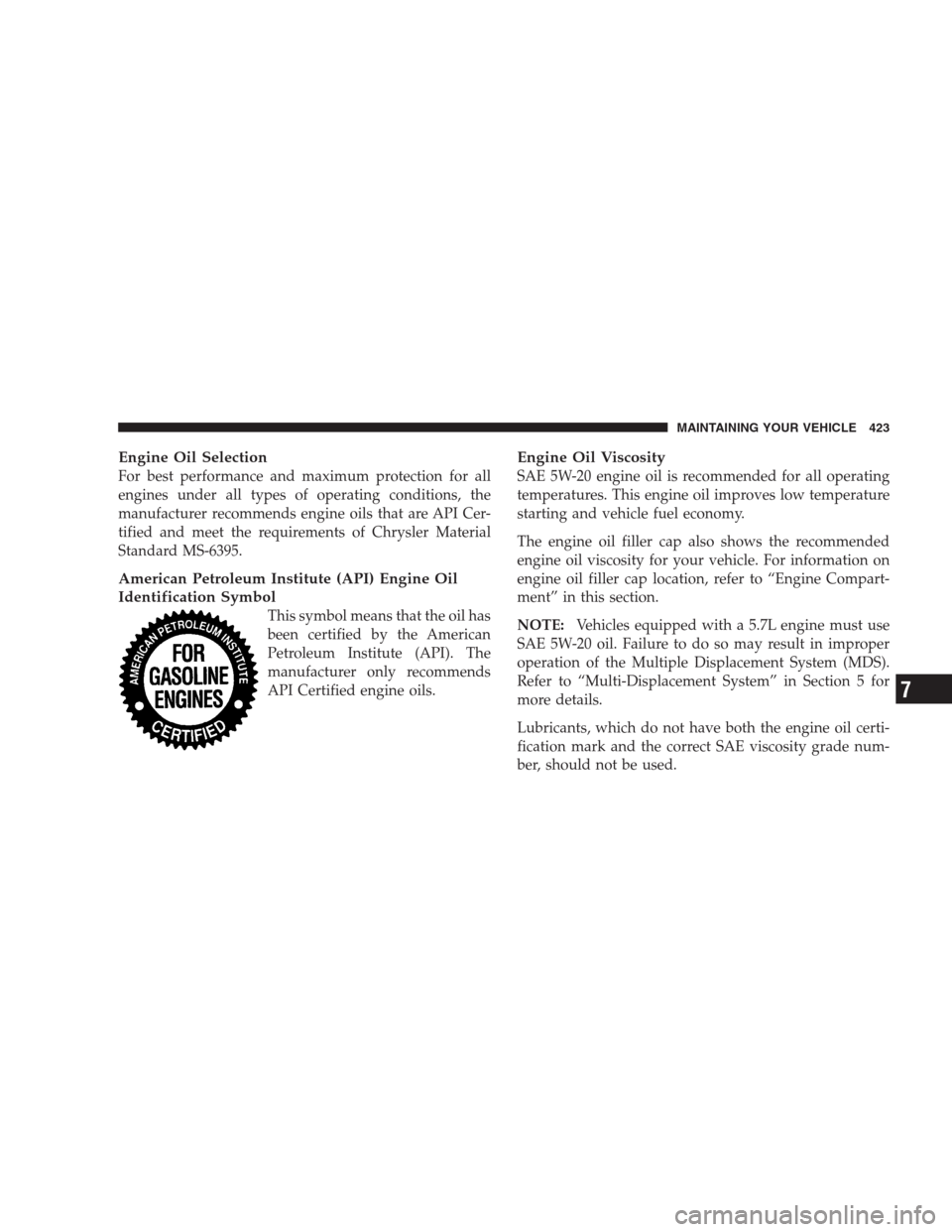
American Petroleum Institute (API) Engine Oil
Identification Symbol
This symbol means that the oil has
been certified by the American
Petroleum Institute (API). The
manufacturer only recommends
API Certified engine oils.
Engine Oil Viscosity
SAE 5W-20 engine oil is recommended for all operating
temperatures. This engine oil improves low temperature
starting and vehicle fuel economy.
The engine oil filler cap also shows the recommended
engine oil viscosity for your vehicle. For information on
engine oil filler cap location, refer to “Engine Compart-
ment” in this section.
NOTE:Vehicles equipped with a 5.7L engine must use
SAE 5W-20 oil. Failure to do so may result in improper
operation of the Multiple Displacement System (MDS).
Refer to “Multi-Displacement System” in Section 5 for
more details.
Lubricants, which do not have both the engine oil certi-
fication mark and the correct SAE viscosity grade num-
ber, should not be used.
MAINTAINING YOUR VEHICLE 423
7
Page 426 of 519

Synthetic Engine Oils
You may use synthetic engine oils if the recommended oil
quality requirements are met, and the recommended
maintenance intervals for oil and filter changes are
followed.
Materials Added to Engine Oils
The manufacturerstrongly recommendsagainst the ad-
dition of any additives (other than leak detection dyes) to
the engine oil. Engine oil is an engineered product and its
performance may be impaired by supplemental
additives.
Disposing of Used Engine Oil and Oil Filters
Care should be taken in disposing of used engine oil and
oil filters from your vehicle. Used oil and oil filters,
indiscriminately discarded, can present a problem to theenvironment. Contact your local authorized dealer, ser-
vice station, or governmental agency for advice on how
and where used oil and oil filters can be safely discarded
in your area.
Engine Oil Filter
The engine oil filter should be replaced with a new filter
at every oil change.
Engine Oil Filter Selection
The manufacturer’s engines have a full-flow type dispos-
able oil filter. Use a filter of this type for replacement. The
quality of replacement filters varies considerably. Only
high-quality filters should be used to assure most effi-
cient service. MOPAR�engine oil filters are high-quality
oil filters and are recommended.
Engine Air Cleaner Filter
Refer to the Maintenance Schedule in Section 8 for the
proper maintenance intervals.
424 MAINTAINING YOUR VEHICLE