Page 379 of 519

Loose Fuel Filler Cap Message
If the vehicle diagnostic system determines that the fuel
filler cap is loose, improperly installed, or damaged, a
“CHECK GASCAP” message will be displayed in the
EVIC (Electronic Vehicle Information Center). Refer to
“Electronic Vehicle Information Center” in Section 4 of
this manual. Tighten the fuel filler cap until a “clicking”
sound is heard. This is an indication that the fuel filler
cap is properly tightened. Refer to “Onboard Diagnostic
System — OBDII” in Section 7 of this manual for more
information.
WARNING!
A fire may result if gasoline is pumped into a
portable container that is inside of a vehicle. You
could be burned. Always place gas containers on the
ground while filling.
CAUTION!
Damage to the fuel system or emission control sys-
tem could result from using an improper fuel tank
filler cap (gas cap). A poorly fitting cap could let
impurities into the fuel system.
WARNING!
•Never add fuel when the engine is running.
•Never have any smoking materials lit in or near
the vehicle when the fuel cap is removed or the
tank filled.
STARTING AND OPERATING 377
5
Page 381 of 519

Tire Size
The tire size on the label represents the actual tire size on
your vehicle. Replacement tires must be equal to the load
capacity of this tire size.
Rim Size
This is the rim size that is appropriate for the tire size
listed.
Inflation Pressure
This is the cold tire inflation pressure for your vehicle for
all loading conditions up to full GAWR.
Curb Weight
The curb weight of a vehicle is defined as the total weight
of the vehicle with all fluids, including vehicle fuel, at full
capacity conditions, and with no occupants or cargo
loaded into the vehicle. The front and rear curb weight
values are determined by weighing your vehicle on a
commercial scale before any occupants or cargo are
added.
Loading
The actual total weight and the weight of the front and
rear of your vehicle at the ground can best be determined
by weighing it when it is loaded and ready for operation.
The entire vehicle should first be weighed on a commer-
cial scale to ensure that the GVWR has not been ex-
ceeded. The weight on the front and rear of the vehicle
should then be determined separately to be sure that the
load is properly distributed over front and rear axle.
Weighing the vehicle may show that the GAWR of either
the front or rear axles has been exceeded, but the total
load is within the specified GVWR. If so, weight must be
shifted from front to rear, or rear to front, as appropriate
until the specified weight limitations are met. Store the
heavier items down low and be sure that the weight is
distributed equally. Stow all loose items securely before
driving.
STARTING AND OPERATING 379
5
Page 415 of 519
MAINTAINING YOUR VEHICLE
CONTENTS
�Engine Compartment – 3.7L.............. 415
�Engine Compartment – 4.7L.............. 416
�Engine Compartment – 5.7L.............. 417
�Onboard Diagnostic System — OBD II....... 418
▫Loose Fuel Filler Cap Message........... 418
�Emissions Inspection And Maintenance
Programs............................ 419
�Replacement Parts..................... 421
�Dealer Service........................ 421�Maintenance Procedures................. 422
▫Engine Oil......................... 422
▫Engine Air Cleaner Filter............... 424
▫Maintenance-Free Battery............... 425
▫Air Conditioner Maintenance............ 426
▫Body Lubrication..................... 427
▫Windshield Wiper Blades............... 428
▫Adding Washer Fluid.................. 428
▫Exhaust System...................... 429
7
Page 420 of 519

ONBOARD DIAGNOSTIC SYSTEM — OBD II
Your vehicle is equipped with a sophisticated onboard
diagnostic system called OBD II. This system monitors
the performance of the emissions, engine, and automatic
transmission control systems. When these systems are
operating properly, your vehicle will provide excellent
performance and fuel economy, as well as engine emis-
sions well within current government regulations.
If any of these systems require service, the OBD II system
will turn on the “Malfunction Indicator Light.” It will
also store diagnostic codes and other information to
assist your service technician in making repairs. Al-
though your vehicle will usually be drivable and not
need towing, see your authorized dealer for service as
soon as possible.CAUTION!
•Prolonged driving with the “Malfunction Indica-
tor Light” on could cause further damage to the
emission control system. It could also affect fuel
economy and drivability. The vehicle must be
serviced before any emissions tests can be per-
formed.
•If the “Malfunction Indicator Light” is flashing
while the engine is running, severe catalytic con-
verter damage and power loss will soon occur.
Immediate service is required.
Loose Fuel Filler Cap Message
After fuel is added, the vehicle diagnostic system can
determine if the fuel filler cap is loose, improperly
installed, or damaged. A “CHECK GASCAP” message
will be displayed in the EVIC (Refer to Section 4 of this
418 MAINTAINING YOUR VEHICLE
Page 421 of 519

manual). Tighten the gas cap until a�clicking�sound is
heard. This is an indication that the gas cap is properly
tightened.
The message will remain displayed until the vehicle
diagnostic system can retest the fuel system. The test will
perform the next time the vehicle is started, if the vehicle
was keyed off above 40°F (4°C) outside temperature and
the following vehicle start is above 40°F (4°C) outside
temperature. It may be possible to have a message that
will not clear due to the test being disabled due to low
outside temperatures. If the test is performed and the
problem is gone, the message will disappear.
If the problem persists, the message will appear the next
time the vehicle is started. This might indicate a damaged
cap. If the problem is detected twice in a row, the system
will turn on the Malfunction Indicator Light (MIL).
Resolving the problem will turn the MIL light off. See
your authorized dealer for service.EMISSIONS INSPECTION AND MAINTENANCE
PROGRAMS
In some localities, it may be a legal requirement to pass
an inspection of your vehicle’s emissions control system.
Failure to pass could prevent vehicle registration.
For states that require an Inspection and Mainte-
nance (I/M), this check verifies the Malfunction
Indicator Light (MIL) is functioning and is not on
when the engine is running, and that the OBD II system
is ready for testing.
Normally, the OBD II system will be ready. The OBD II
system maynotbe ready if your vehicle was recently
serviced, recently had a dead battery or a battery replace-
ment. If the OBD II system should be determined not
ready for the I/M test, your vehicle may fail the test.
MAINTAINING YOUR VEHICLE 419
7
Page 425 of 519
Engine Oil Selection
For best performance and maximum protection for all
engines under all types of operating conditions, the
manufacturer recommends engine oils that are API Cer-
tified and meet the requirements of Chrysler Material
Standard MS-6395.
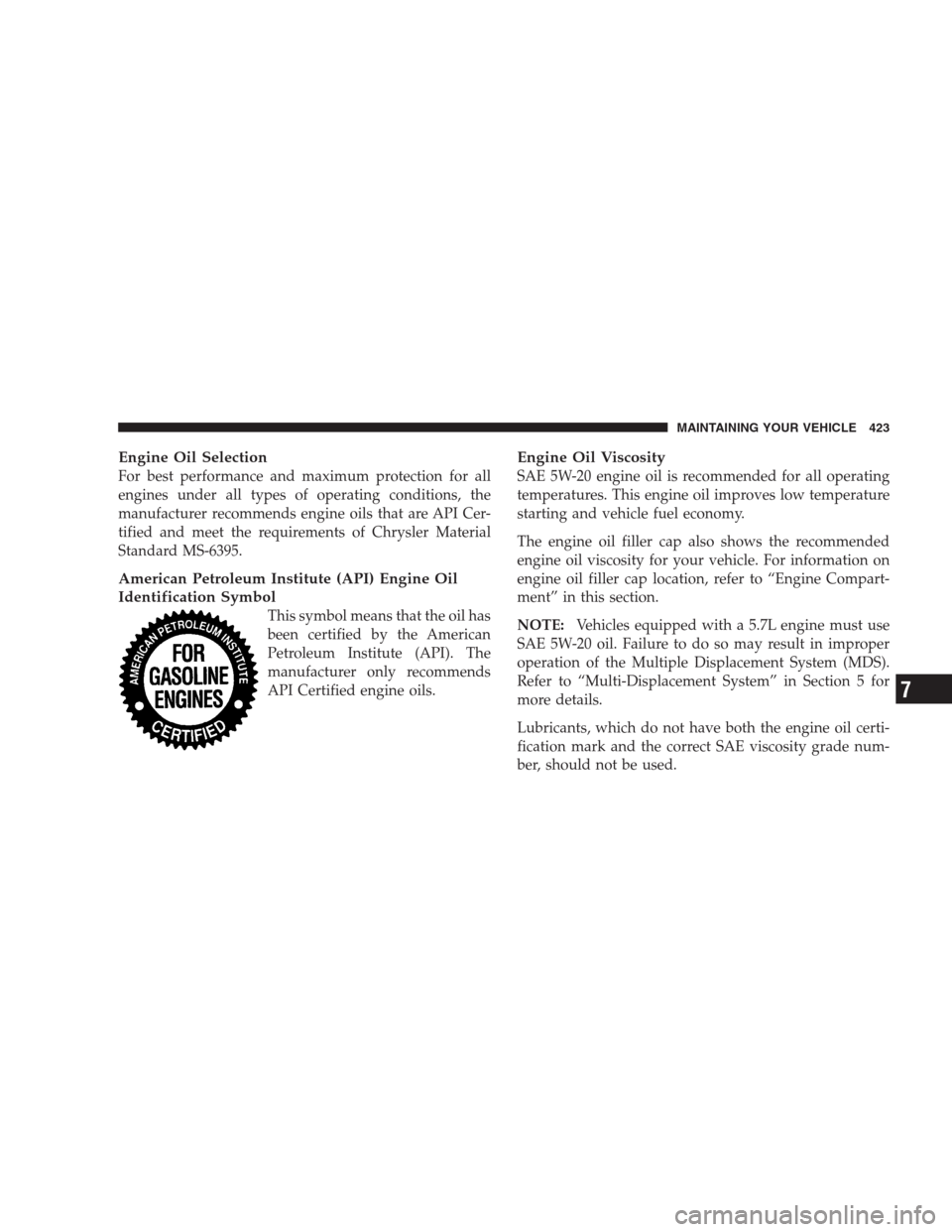
American Petroleum Institute (API) Engine Oil
Identification Symbol
This symbol means that the oil has
been certified by the American
Petroleum Institute (API). The
manufacturer only recommends
API Certified engine oils.
Engine Oil Viscosity
SAE 5W-20 engine oil is recommended for all operating
temperatures. This engine oil improves low temperature
starting and vehicle fuel economy.
The engine oil filler cap also shows the recommended
engine oil viscosity for your vehicle. For information on
engine oil filler cap location, refer to “Engine Compart-
ment” in this section.
NOTE:Vehicles equipped with a 5.7L engine must use
SAE 5W-20 oil. Failure to do so may result in improper
operation of the Multiple Displacement System (MDS).
Refer to “Multi-Displacement System” in Section 5 for
more details.
Lubricants, which do not have both the engine oil certi-
fication mark and the correct SAE viscosity grade num-
ber, should not be used.
MAINTAINING YOUR VEHICLE 423
7
Page 445 of 519

To prevent dirt and water from entering the transmission
after checking or replenishing fluid, make certain that the
dipstick cap is properly reseated. It is normal for the
dipstick cap to spring back slightly from its fully seated
position, as long as its seal remains engaged in the
dipstick tube.
Maintenance After Off-Road Driving
After extended operation in mud, sand or water, or
similar dirty conditions, have your brake discs, brake
linings, and axle joints inspected and cleaned as soon as
possible. This will prevent any abrasive material from
causing excessive wear or unpredictable braking action.
After driving off-road, completely inspect the underbody
of your vehicle. Check the tires, body structure, steering,
suspension and exhaust system for damage. Checkthreaded fasteners for looseness, particularly on the
chassis, drivetrain components, steering and suspension.
Retighten, if required, to torque values specified in the
Service Manual. Also check for accumulations of vegeta-
tion or brush that could become a fire hazard, or conceal
damage to fuel lines, brake hoses, axle pinion seals, and
propeller shafts.CAUTION!
Under frequent heavy-duty driving conditions,
change all lubricants, and lubricate body compo-
nents, all driveline joints and steering linkage more
often than in normal service, to prevent excessive
wear.
MAINTAINING YOUR VEHICLE 443
7
Page 467 of 519
FLUIDS AND CAPACITIES
U.S. Metric
Fuel (Approximate)21 Gallons 79 Liters
Engine Oil with Filter
3.7 Liter Engine (SAE 5W-20, API Certified) 5 Quarts 4.7 Liters
4.7 Liter Engine (SAE 5W-20, API Certified) 6 Quarts 5.7 Liters
5.7 Liter Engine (SAE 5W-20, API Certified) 7 Quarts 6.6 Liters
Cooling System *
3.7 Liter Engine (MOPAR�Engine Coolant/Antifreeze 5
Year/100,000 Mile Formula)9 Quarts 8.5 Liters
4.7 Liter Engine (MOPAR�Engine Coolant/Antifreeze 5
Year/100,000 Mile Formula)14.5 Quarts 13.7 Liters
5.7 Liter Engine (MOPAR�Engine Coolant/Antifreeze 5
Year/100,000 Mile Formula)14.5 Quarts 13.7 Liters
* Includes heater and coolant recovery bottle filled to MAX level.
MAINTAINING YOUR VEHICLE 465
7