2009 Hyundai Santa Fe spare wheel
[x] Cancel search: spare wheelPage 174 of 269
2
DRIVING YOUR HYUNDAI
29
!
C190F01A-DAT Trailer and Vehicle Towing Tips
1. Before towing, check towbar and
safety chain connections as well as proper operation of the trailer running lights, brake lights and turn signals.
2. Always drive your vehicle at a mod- erate speed (Less than 100 km/h).
3. Trailer towing requires more fuel than
normal conditions.
4. To maintain engine braking efficiency and electrical charging performance, do not use fifth gear (manualtransaxle) or overdrive (automatic transaxle).
5. Always secure items in the trailer to prevent load shift while driving.
6. Check the condition and air pressure
of all tyres on the trailer and your car. Low tyre pressure can seriously af- fect the handling. Also check the spare tyre.
7. The vehicle/trailer combination is more affected by crosswind and buf-feting. When being passed by alarge vehicle, keep a constant speed and steer straight ahead. If there is too much wind buffeting, slow downto get out of the other vehicle's air turbulence. 8. When parking your car and trailer,
especially on a hill, be sure to follow all the normal precautions. Turn your front wheel into the curb, set the parking brake firmly, and put thetransaxle in 1st or Reverse (manual) or Park (automatic). In addition, place wheel chocks at each of the trailer'styres.
9. If the trailer has electric brakes, drive
your vehicle with the trailer attached,and then apply the trailer brakes by hand. This test confirms the opera- tion of the trailer brakes and alsochecks your electrical connection at the same time.
10. During your trip, check occasionally to be sure that the load is secure,and that the lights and any trailer brakes are still working.
11. Avoid jerky starts, sudden accel- eration or sudden stops.
12. Avoid sharp turns and rapid lane changes.
13. Avoid holding the brake pedal down
too long or too frequently. This couldcause the brakes to overheat, re- sulting in reduced braking efficiency.
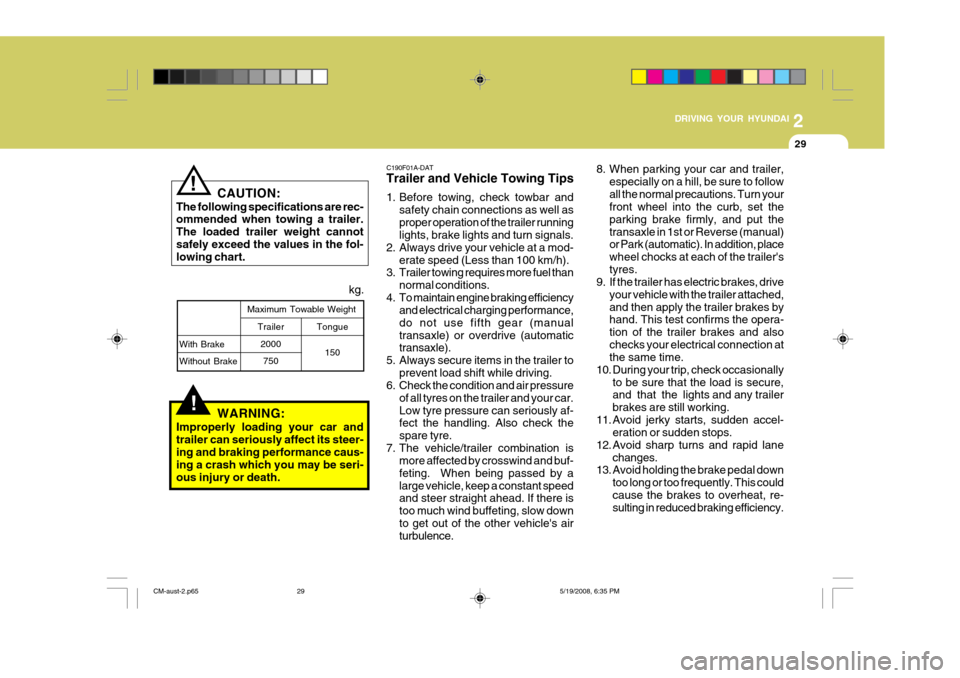
CAUTION:
The following specifications are rec-ommended when towing a trailer. The loaded trailer weight cannotsafely exceed the values in the fol- lowing chart.
!
Maximum Towable Weight kg.
With Brake Without Brake
WARNING:
Improperly loading your car and trailer can seriously affect its steer-ing and braking performance caus- ing a crash which you may be seri- ous injury or death.
Tongue
150
Trailer
2000750
CM-aust-2.p65 5/19/2008, 6:35 PM
29
Page 176 of 269
3
If the Engine Will Not Start ........................................... 3-2
Jump Starting ............................................................... 3-3
If the Engine Overheats ............................................... 3-4
Spare Tyre ................................................................... 3-5
Wheel and Tyre Changing ........................................... 3-7
If Your Vehicle Must Be Towed ..................................3-11
Emergency Towing ..................................................... 3-12
If You Lose Your K eys ................................................ 3-14
WHAT TO DO IN AN EMERGENCY
3
CM-aust-3.p65
5/19/2008, 6:35 PM
1
Page 181 of 269
3WHAT TO DO IN AN EMERGENCY
6
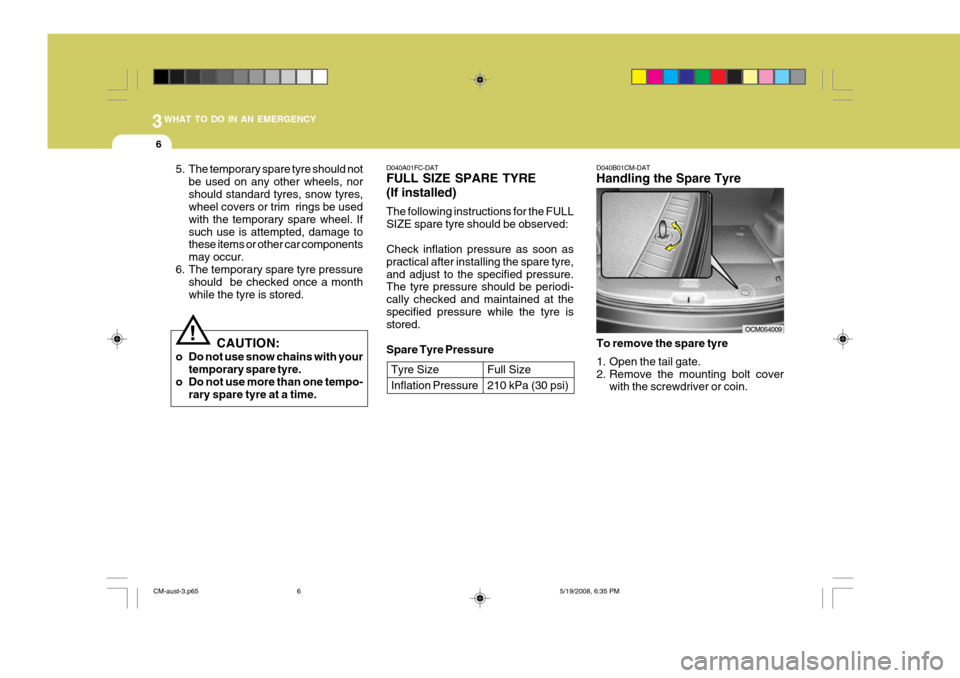
D040A01FC-DAT FULL SIZE SPARE TYRE (If installed) The following instructions for the FULL SIZE spare tyre should be observed: Check inflation pressure as soon as practical after installing the spare tyre,and adjust to the specified pressure. The tyre pressure should be periodi- cally checked and maintained at thespecified pressure while the tyre is stored. Spare Tyre Pressure
Full Size 210 kPa (30 psi)
Tyre Size Inflation Pressure D040B01CM-DAT Handling the Spare Tyre
To remove the spare tyre
1. Open the tail gate.
2. Remove the mounting bolt cover with the screwdriver or coin.
OCM054009
5. The temporary spare tyre should not
be used on any other wheels, nor should standard tyres, snow tyres, wheel covers or trim rings be used with the temporary spare wheel. Ifsuch use is attempted, damage to these items or other car components may occur.
6. The temporary spare tyre pressure should be checked once a monthwhile the tyre is stored.! CAUTION:
o Do not use snow chains with your temporary spare tyre.
o Do not use more than one tempo-
rary spare tyre at a time.
CM-aust-3.p65 5/19/2008, 6:35 PM
6
Page 182 of 269
3
WHAT TO DO IN AN EMERGENCY
7
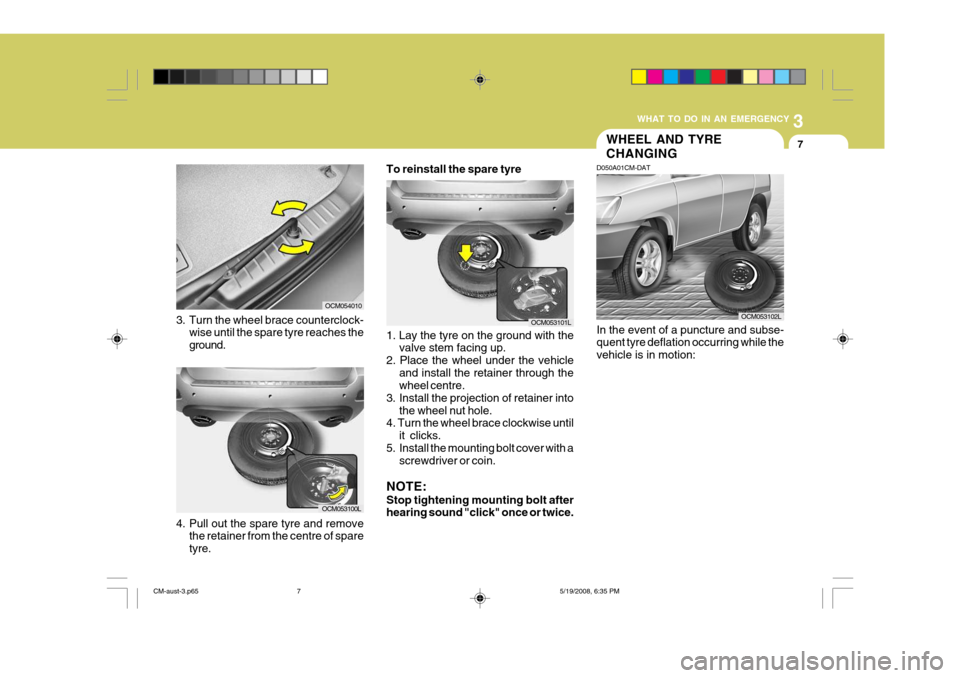
3. Turn the wheel brace counterclock-
wise until the spare tyre reaches the ground.
OCM054010
4. Pull out the spare tyre and removethe retainer from the centre of spare tyre.
OCM053100L
1. Lay the tyre on the ground with thevalve stem facing up.
2. Place the wheel under the vehicle and install the retainer through the wheel centre.
3. Install the projection of retainer into the wheel nut hole.
4. Turn the wheel brace clockwise until
it clicks.
5. Install the mounting bolt cover with a screwdriver or coin.
NOTE: Stop tightening mounting bolt after hearing sound "click" once or twice.
OCM053101L
To reinstall the spare tyre
WHEEL AND TYRE CHANGING
D050A01CM-DAT In the event of a puncture and subse- quent tyre deflation occurring while the vehicle is in motion:
OCM053102L
CM-aust-3.p65 5/19/2008, 6:35 PM
7
Page 183 of 269
3WHAT TO DO IN AN EMERGENCY
8
!
1VQA4023
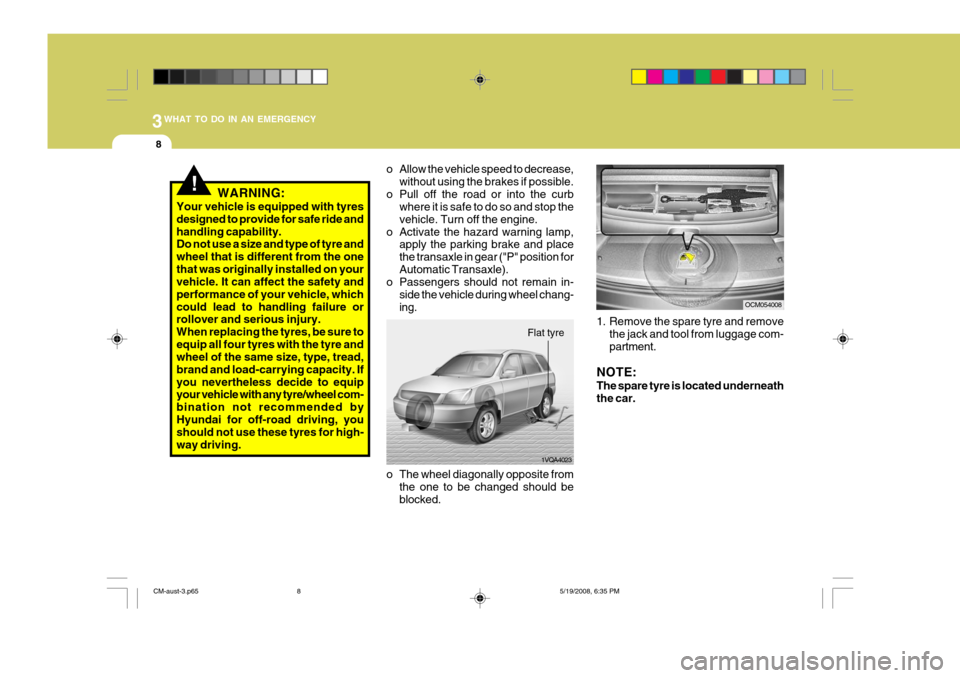
o The wheel diagonally opposite from the one to be changed should be blocked. 1. Remove the spare tyre and remove
the jack and tool from luggage com-partment.
NOTE: The spare tyre is located underneath the car.
WARNING:
Your vehicle is equipped with tyresdesigned to provide for safe ride andhandling capability. Do not use a size and type of tyre and wheel that is different from the onethat was originally installed on your vehicle. It can affect the safety and performance of your vehicle, whichcould lead to handling failure or rollover and serious injury. When replacing the tyres, be sure toequip all four tyres with the tyre and wheel of the same size, type, tread, brand and load-carrying capacity. Ifyou nevertheless decide to equip your vehicle with any tyre/wheel com- bination not recommended byHyundai for off-road driving, you should not use these tyres for high- way driving. o Allow the vehicle speed to decrease,
without using the brakes if possible.
o Pull off the road or into the curb where it is safe to do so and stop thevehicle. Turn off the engine.
o Activate the hazard warning lamp, apply the parking brake and placethe transaxle in gear ("P" position forAutomatic Transaxle).
o Passengers should not remain in-
side the vehicle during wheel chang-ing.
OCM054008
Flat tyre
CM-aust-3.p65 5/19/2008, 6:35 PM
8
Page 186 of 269
3
WHAT TO DO IN AN EMERGENCY
11
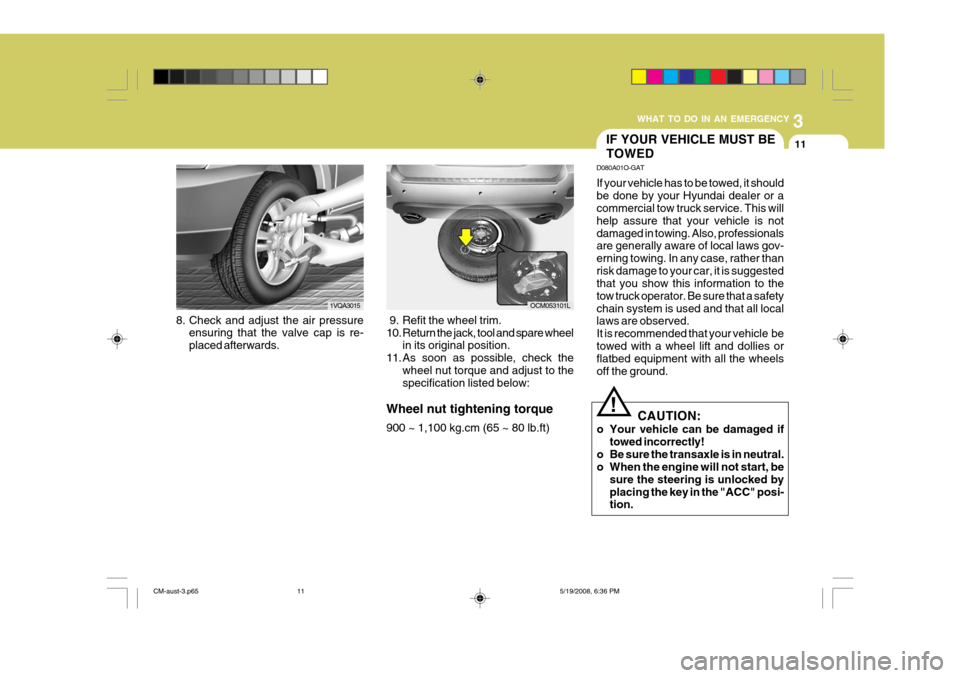
8. Check and adjust the air pressure
ensuring that the valve cap is re- placed afterwards. 1VQA3015
IF YOUR VEHICLE MUST BE TOWED
D080A01O-GAT If your vehicle has to be towed, it should be done by your Hyundai dealer or a commercial tow truck service. This will help assure that your vehicle is notdamaged in towing. Also, professionals are generally aware of local laws gov- erning towing. In any case, rather thanrisk damage to your car, it is suggested that you show this information to the tow truck operator. Be sure that a safetychain system is used and that all local laws are observed. It is recommended that your vehicle betowed with a wheel lift and dollies or flatbed equipment with all the wheels off the ground.
! CAUTION:
o Your vehicle can be damaged if towed incorrectly!
o Be sure the transaxle is in neutral.
o When the engine will not start, be
sure the steering is unlocked by placing the key in the "ACC" posi- tion.
9. Refit the wheel trim.
10. Return the jack, tool and spare wheel
in its original position.
11. As soon as possible, check the wheel nut torque and adjust to the specification listed below:
Wheel nut tightening torque 900 ~ 1,100 kg.cm (65 ~ 80 lb.ft)
OCM053101L
CM-aust-3.p65 5/19/2008, 6:36 PM
11
Page 212 of 269
6
DO-IT-YOURSELF MAINTENANCE
5GENERAL CHECKS
G020A03A-AAT
Engine Compartment
The following should be checked regu- larly:
o Engine oil level and condition
o Transaxle fluid level and condition
o Brake fluid level
o Engine coolant level
o Windshield washer fluid level
o Accessory drive belt condition
o Engine coolant hose condition
o Fluid leaks (on or below compo- nents)
o Power steering fluid level
o Battery condition
o Air cleaner filter condition G020B01A-DAT
Vehicle Exterior
The following should be checked
monthly:
o Overall appearance and condition
o Wheel condition and wheel nut
torque
o Exhaust system condition
o Light condition and operation
o Windshield glass condition
o Wiper blade condition
o Paint condition and body corrosion
o Fluid leaks
o Door and bonnet lock condition
o Tyre pressure and condition (including spare tyre) G020C01A-DAT Vehicle Interior The following should be checked each time when the vehicle is driven:
o Lights operation
o Windshield wiper operation
o Horn operation
o Demister, heating system operation
(and air conditioning, if installed)
o Steering operation and condition
o Mirror condition and operation
o Turn signal light operation
o Accelerator pedal operation
o Brake operation, including parking
brake
o Manual transaxle operation, includ-
ing clutch operation
o Automatic transaxle operation, in- cluding "Park" mechanism opera-tion
o Seat control condition and operation
o Seat belt condition and operation
o Sun visor operation If you notice anything that does not operate correctly or appears to befunctioning incorrectly, inspect it care- fully and seek assistance from your Hyundai dealer if service is needed.
CM-aust-6.p65 5/19/2008, 6:37 PM
5
Page 256 of 269
8CONSUMER INFORMATION
4
!
CAUTION:
Always observe the following:
o Check pressures when the tyres are cold. That is, after the car has been parked for at least threehours and hasn't been driven more than 1.6 km or one mile since starting up.
o Check the pressure of your spare tyre each time you check the pres-sure of other tyres.
o Never overload your car. Be espe- cially careful about overloading if you equip your car with a lug- gage rack or car top carrier. I040A01S-DAT
SNOW TYRES
If you equip your car with snow tyres,
they should be the same size and have the same load capacity as the original tyres. Snow tyres should beinstalled on all four wheels; otherwise, poor handling may result.
Snow tyres should carry 28 kPa (4 psi)
more air pressure than the pressure recommended for the standard tyreson the tyre label on the drive side centre pillar outer panel, or up to the maximum pressure shown on the tyresidewall whichever is less.
Do not drive faster than 120 km/h (75
mph) when your car is equipped withsnow tyres.
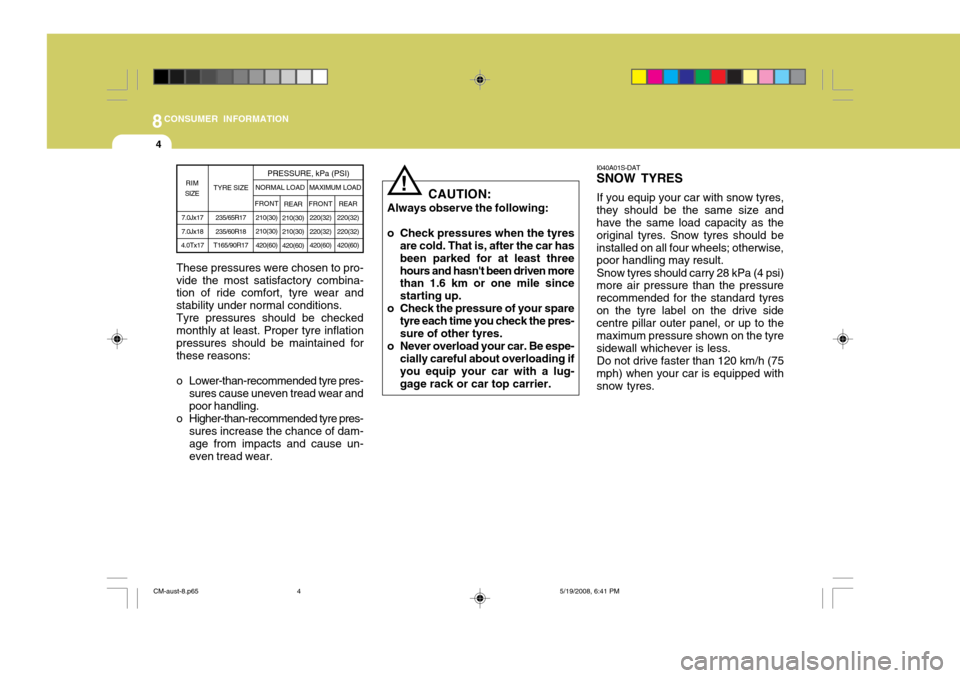
These pressures were chosen to pro-vide the most satisfactory combina- tion of ride comfort, tyre wear and stability under normal conditions.Tyre pressures should be checkedmonthly at least. Proper tyre inflationpressures should be maintained for these reasons:
o Lower-than-recommended tyre pres-
sures cause uneven tread wear and poor handling.
o Higher-than-recommended tyre pres-
sures increase the chance of dam- age from impacts and cause un- even tread wear.
7.0Jx17 7.0Jx18
4.0Tx17 TYRE SIZE
RIM
SIZE PRESSURE, kPa (PSI)
235/65R17235/60R18
T165/90R17 REAR
210(30)210(30)420(60) FRONT
220(32)220(32) 420(60)
NORMAL LOAD
MAXIMUM LOAD
REAR
220(32) 220(32) 420(60)
FRONT
210(30) 210(30)420(60)
CM-aust-8.p65 5/19/2008, 6:41 PM
4