2009 Hyundai H-1 (Grand Starex) sensor
[x] Cancel search: sensorPage 2 of 303
Introduction
2
1
A010000ATQ-UK
This Owners Manual is designed to help
vehicle users derive the greatest possi-
ble amount of enjoyment and satisfaction
from driving the HYUNDAI H-1/i800. It isstrongly recommended that the entire
manual is read in order that all of the fea-
tures, safety systems and maintenancerequirements are understood.
To minimise the RISK of death or injury,
the "WARNING" and "CAUTION" state-
ments must be read and understood
before operating the vehicle.
Illustrations are used throughout the
manual to complement written descrip-
tions intended to best explain how to
enjoy using the vehicle.
Reading this manual will assist the vehi-
cle user to learn about and understand
the features, important safety informa-
tion, and driving recommendations.
The general layout of the manual is pro-
vided in the Table of Contents. The index
has an alphabetical listing of all the infor-
mation contained in the manual. The
manual has nine sections plus an index.
Each section begins with a brief list ofcontents to easily identify at a glance if
that section contains the informationbeing sought. "WARNING", "CAUTION", and "NOTICE"
information is provided to enhance the
personal safety of the vehicle user. This
information must be carefully read and
followed.
✽✽
NOTICE
A NOTICE indicates interesting or help-
ful information is being provided.
Petrol engine A020101AEN-UK
Unleaded
Your new HYUNDAI vehicle is designed
to use only unleaded fuel having an
Octane Rating of RON (Research
Octane Number) 91 / AKI (Anti-Knock
Index) 87 or higher.
Your new vehicle is designed to obtain
maximum performance with UNLEADED
FUEL, as well as minimise exhaust emis-
sions and spark plug fouling.
HOW TO USE THIS MANUAL
CAUTION
NEVER USE LEADED FUEL. The use of leaded fuel is detrimental to
the catalytic converter and will damage the engine control sys-tem’s oxygen sensor and affectemission control.
Never add any fuel system cleaningagents to the fuel tank other thanwhat has been specified. (Consult a HYUNDAI authorised repairer fordetails.)
FUEL REQUIREMENTS
WARNING
A WARNING indicates a situation in
which harm, serious bodily injury ordeath could result if the warning isignored.
CAUTION
A CAUTION indicates a situation in which damage to your vehicle could result if the caution is ignored.
Page 46 of 303
Safety features of your vehicle
36
3
C040900ATQ
How does the air bag system operate
Air bags are activated (able to inflate if
necessary) only when the ignition
switch is turned to the ON or STARTposition.
Air bags inflate instantly in the event of a serious frontal collision in order to
help protect the occupants from seri-
ous physical injury.
There is no single speed at which the air bags will inflate.
Generally, air bags are designed to
inflate based upon the severity of a col-
lision and its direction. These two fac-
tors determine whether the sensors
produce an electronic deployment/inflation signal.
Air bag deployment depends on a number of factors including vehicle speed, angles of impact and the densi-
ty and stiffness of the vehicles or
objects which your vehicle hits in the
collision. The determining factors are
not limited to those mentioned above.
The front air bags will completely inflate and deflate in an instant.
It is virtually impossible for you to see
the air bags inflate during an accident. It is much more likely that you will sim-ply see the deflated air bags hanging
out of their storage compartments afterthe collision.
In order to help provide protection in a severe collision, the air bags must
inflate rapidly. The speed of air baginflation is a consequence of the
extremely short time in which a collisionoccurs and the need to inflate the air
bag between the occupant and the
vehicle structures before the occupant
impacts those structures. This speed of
inflation reduces the risk of serious or
life-threatening injuries in a severe col-
lision and is thus a necessary part of airbag design.
However, air bag inflation can also
cause injuries which can include facial
abrasions, bruises and broken bonesbecause the inflation speed also caus-
es the air bags to expand with a great
deal of force.
There are even circumstances under which contact with the steer-
ing wheel air bag can cause fatal
injuries, especially if the occupant
is positioned excessively close tothe steering wheel.
WARNING
To avoid severe personal injury or death caused by deploying air
bags in a collision, the driver
should sit as far back from the
steering wheel air bag as possi-
ble (at least 10 inches (250 mm)
away). The front passengers
should always move their seats
as far back as possible and sit
back in their seat.
Air bags inflate instantly in the event of collision, and passen-
gers may be injured by the air bag
expansion force if they are not in
proper position.
Air bag inflation may cause injuries including facial or bodily
abrasions, injuries from broken
glasses or burns.
Page 49 of 303
339
Safety features of your vehicle
C040100ATQ-UK SRS components and functions
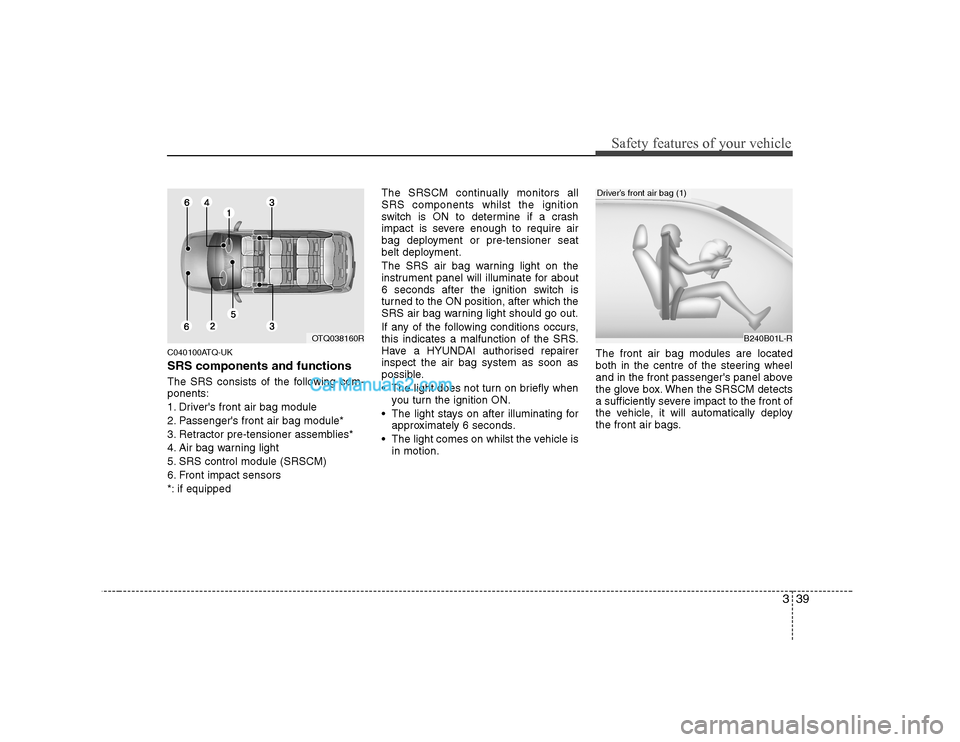
The SRS consists of the following com- ponents:
1. Driver's front air bag module
2. Passenger's front air bag module*
3. Retractor pre-tensioner assemblies*
4. Air bag warning light
5. SRS control module (SRSCM)
6. Front impact sensors
*: if equippedThe SRSCM continually monitors all SRS components whilst the ignition
switch is ON to determine if a crash
impact is severe enough to require air
bag deployment or pre-tensioner seat
belt deployment.
The SRS air bag warning light on the
instrument panel will illuminate for about
6 seconds after the ignition switch is
turned to the ON position, after which the
SRS air bag warning light should go out.
If any of the following conditions occurs,
this indicates a malfunction of the SRS.
Have a HYUNDAI authorised repairerinspect the air bag system as soon as
possible.
The light does not turn on briefly when
you turn the ignition ON.
The light stays on after illuminating for approximately 6 seconds.
The light comes on whilst the vehicle is in motion. The front air bag modules are located
both in the centre of the steering wheel
and in the front passenger's panel above
the glove box. When the SRSCM detects
a sufficiently severe impact to the front of
the vehicle, it will automatically deploy
the front air bags.
B240B01L-R
Driver’s front air bag (1)
OTQ038160R
Page 55 of 303
345
Safety features of your vehicle
C040800ATQ-UK
Air bag system operation (deploy-
ment/non deployment)
There are many types of situations in
which an air bag would not provide
additional protection to the vehicleoccupants.
These include rear impacts, second or
third collisions in multiple impact
accidents, low speed impacts, offset
collisions and vehicle roll over. It is
therefore important to understand
that the level of damage suffered by a
vehicle as a result of impact is not
indicative of whether air bag deploy-
ment was warranted by a primary, or
subsequent, impact.
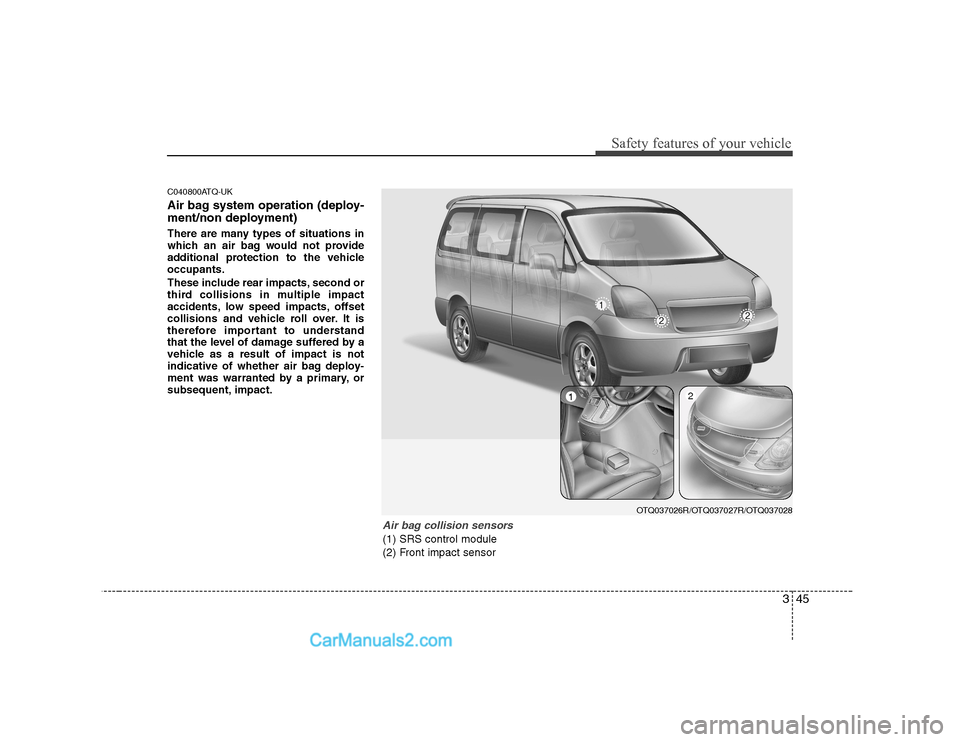
Air bag collision sensors
(1) SRS control module
(2) Front impact sensor
OTQ037026R/OTQ037027R/OTQ037028
12
Page 56 of 303
Safety features of your vehicle
46
3
C040801ATQ
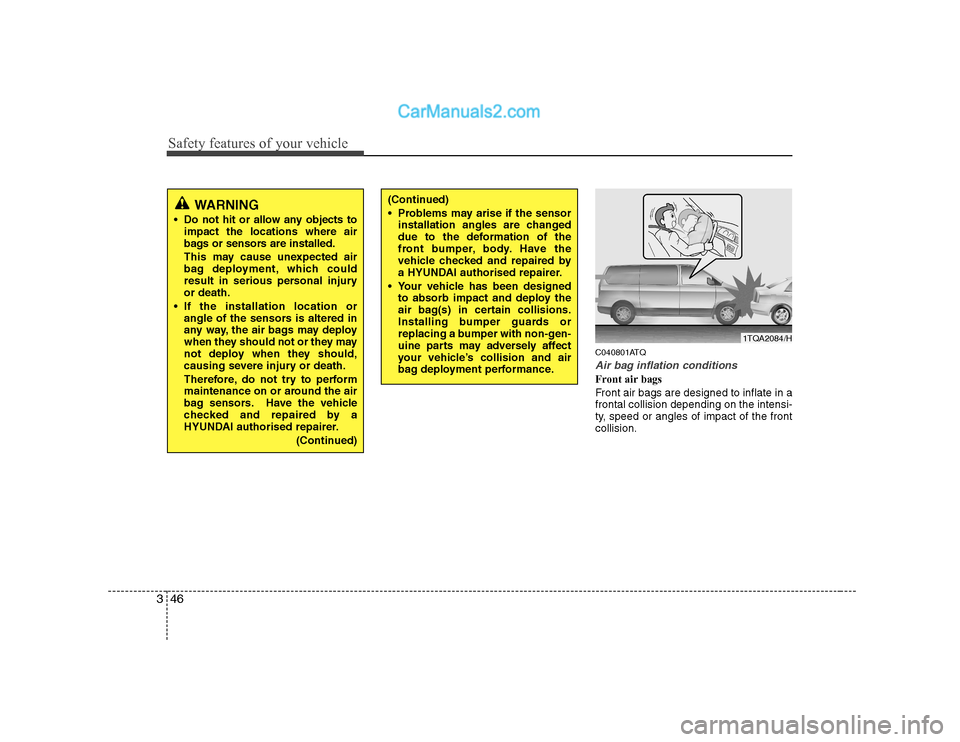
Air bag inflation conditions
Front air bags
Front air bags are designed to inflate in a frontal collision depending on the intensi-
ty, speed or angles of impact of the frontcollision.
1TQA2084/H
(Continued)
Problems may arise if the sensor
installation angles are changed
due to the deformation of the
front bumper, body. Have the
vehicle checked and repaired by
a HYUNDAI authorised repairer.
Your vehicle has been designed to absorb impact and deploy the
air bag(s) in certain collisions.
Installing bumper guards or
replacing a bumper with non-gen-
uine parts may adversely affect
your vehicle’s collision and air
bag deployment performance.WARNING
Do not hit or allow any objects to impact the locations where air
bags or sensors are installed.
This may cause unexpected air
bag deployment, which could
result in serious personal injuryor death.
If the installation location or angle of the sensors is altered in
any way, the air bags may deploy
when they should not or they may
not deploy when they should,
causing severe injury or death.
Therefore, do not try to perform
maintenance on or around the air
bag sensors. Have the vehicle
checked and repaired by a
HYUNDAI authorised repairer.
(Continued)
Page 57 of 303
347
Safety features of your vehicle
Although the front air bags (driver’s and
front passenger’s air bags) are designed
to inflate only in frontal collisions, they
also may inflate in other types of colli-sions if the front impact sensors detect asufficient impact.
If the vehicle chassis is impacted by
bumps or objects on unimproved roads,
the air bags may deploy. Drive carefully
on unimproved roads or on surfaces not
designed for vehicle traffic to prevent
unintended air bag deployment.C040802ATQ
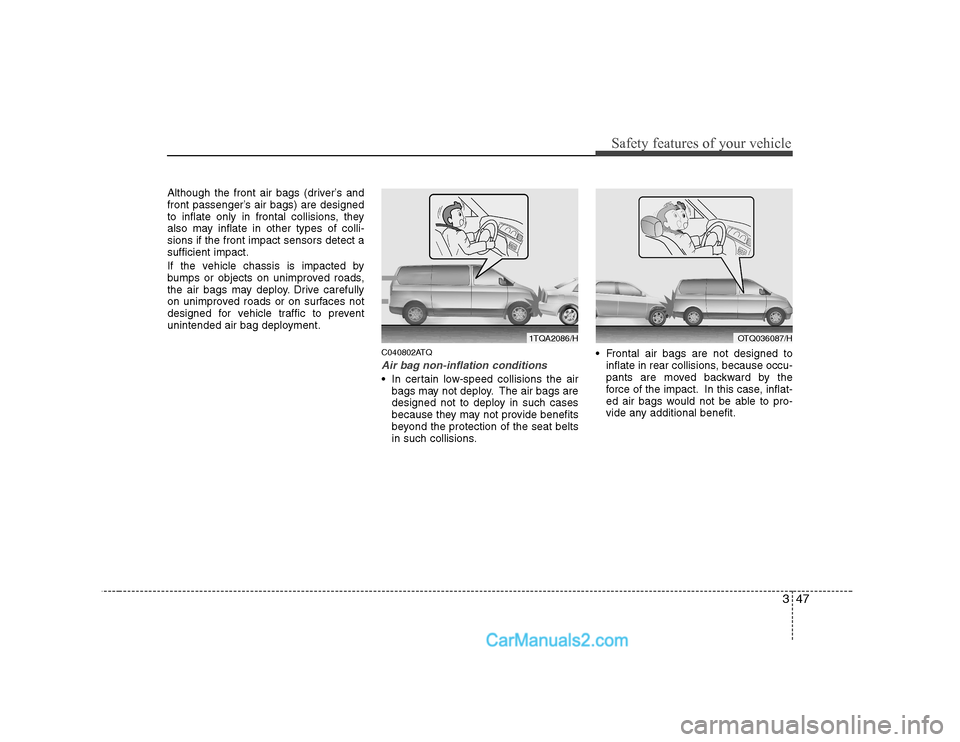
Air bag non-inflation conditions
In certain low-speed collisions the airbags may not deploy. The air bags are
designed not to deploy in such cases
because they may not provide benefits
beyond the protection of the seat belts
in such collisions. Frontal air bags are not designed to
inflate in rear collisions, because occu-
pants are moved backward by the
force of the impact. In this case, inflat-
ed air bags would not be able to pro-
vide any additional benefit.
1TQA2086/HOTQ036087/H
Page 58 of 303
Safety features of your vehicle
48
3
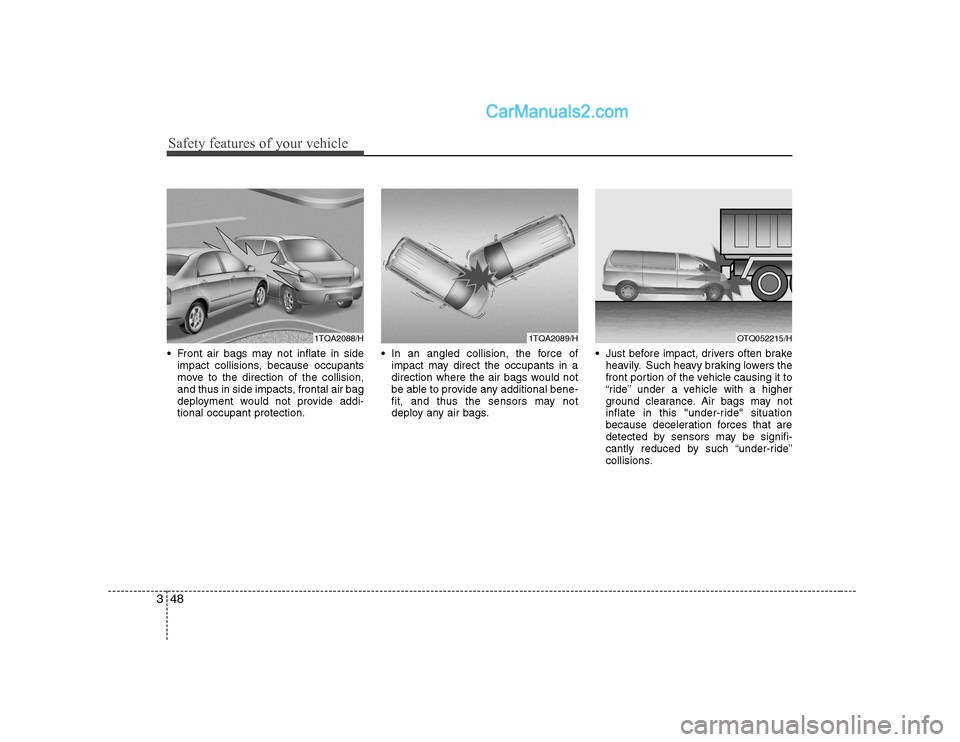
Front air bags may not inflate in side
impact collisions, because occupants
move to the direction of the collision,
and thus in side impacts, frontal air bag
deployment would not provide addi-tional occupant protection. In an angled collision, the force of
impact may direct the occupants in a
direction where the air bags would not
be able to provide any additional bene-
fit, and thus the sensors may not
deploy any air bags. Just before impact, drivers often brake
heavily. Such heavy braking lowers the
front portion of the vehicle causing it to
“ride” under a vehicle with a higher
ground clearance. Air bags may not
inflate in this "under-ride" situation
because deceleration forces that are
detected by sensors may be signifi-
cantly reduced by such “under-ride”
collisions.
1TQA2089/H1TQA2088/HOTQ052215/H
Page 59 of 303
349
Safety features of your vehicle
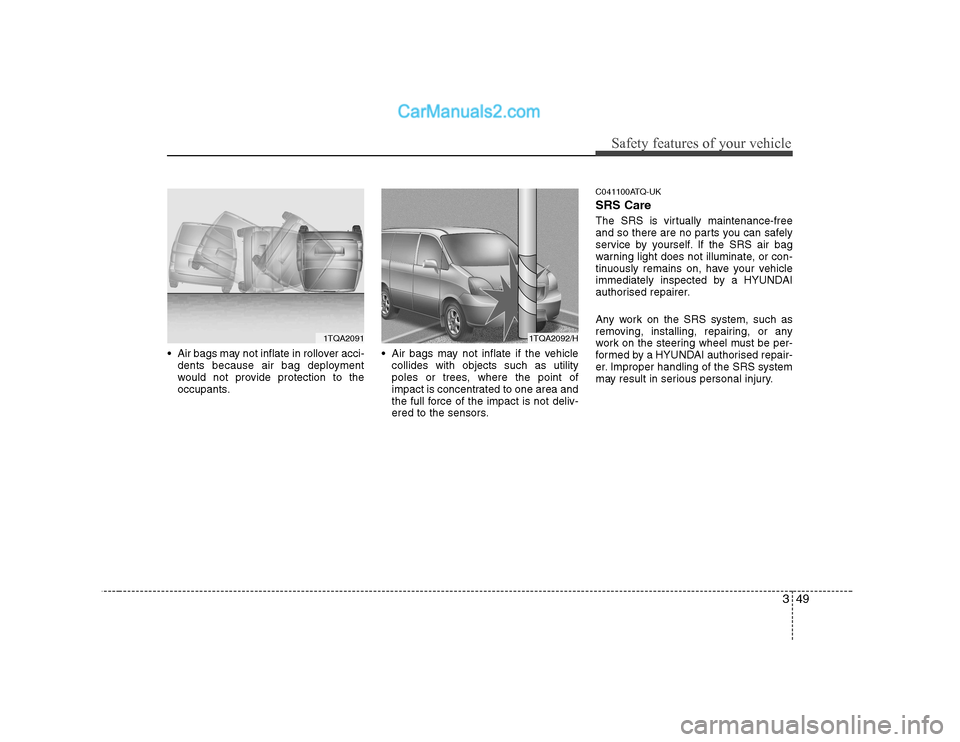
Air bags may not inflate in rollover acci-dents because air bag deployment
would not provide protection to the
occupants. Air bags may not inflate if the vehicle
collides with objects such as utility
poles or trees, where the point of
impact is concentrated to one area and
the full force of the impact is not deliv-
ered to the sensors. C041100ATQ-UK SRS Care
The SRS is virtually maintenance-free
and so there are no parts you can safely
service by yourself. If the SRS air bag
warning light does not illuminate, or con-
tinuously remains on, have your vehicle
immediately inspected by a HYUNDAI
authorised repairer.
Any work on the SRS system, such as
removing, installing, repairing, or any
work on the steering wheel must be per-
formed by a HYUNDAI authorised repair-
er. Improper handling of the SRS system
may result in serious personal injury.
1TQA20911TQA2092/H