2009 Hyundai H-1 (Grand Starex) oil temperature
[x] Cancel search: oil temperaturePage 4 of 303
Introduction
4
1
A020105AUN-UK
Do not use methanol
Fuels containing methanol (wood alco-
hol) should not be used. This type of fuel
can reduce vehicle performance anddamage components of the fuel system.
A020106AUN-UK
Fuels for cleaner air
To help contribute to cleaner air,
HYUNDAI recommends use of fuels
treated with detergent additives, which
help to prevent deposit formation in the
engine. These fuels will help the engines
run cleaner and increase the Emission
Control System performance.
A020107AUN-UK
Operation in foreign countries
Drivers of vehicles which are to be oper-
ated in foreign countries must satisfy
themselves that:
The vehicle meets all local regulations
with respect to insurance, specifica- tions etc..
The correct types and grades of fuel are available for satisfactory operation
of the vehicle. Diesel engine
A020201AUN-UK
Diesel fuel
Diesel engines must be operated only on
commercially available diesel fuel that
complies with EN 590 or comparable
standard. (EN stands for "European
Norm"). Do not use marine diesel fuel,
heating oils, or non-approved fuel addi-
tives, these will increase wear and causedamage to the engine and fuel system.
The use of non-approved fuels and / or
fuel additives will invalidate the New
Vehicle Warranty.
Diesel fuel of 52 to 54 cetane must be
used in HYUNDAI diesel engined vehi-
cles. If two types of diesel fuel are avail-
able, use summer or winter fuel properly
according to the following temperature
conditions.
Above -5°C(23°F) ... Summer type
diesel fuel.
Below -5°C(23°F) ... Winter type diesel
fuel.
Watch the fuel gauge very carefully : If
the engine stops due to fuel failure, the
circuits must be completely purged to
permit restarting.
CAUTION
Do not allow petrol or water to enter the fuel tank. If this happens, thetank should be completely drainedand the fuel lines must all be
cleaned out to prevent the fuel pump from becoming contaminat-ed.
Page 207 of 303
What to do in an emergency
6
6
IF THE ENGINE OVERHEATS
F050000AFD-UK
If your temperature gauge indicates over-
heating, you experience a loss of power,
or hear loud pinging or knocking, the
engine is probably too hot. If this hap-
pens, you should:
1. Pull off the road and stop as soon as it is safe to do so.
2. Place the gear selector lever in P (automatic transmission) or neutral
(manual transmission) and set the
parking brake. If the air conditioning is
on, turn it off.
3. If engine coolant is running out under the car or steam is coming out from
the bonnet, stop the engine. Do notopen the bonnet until the coolant has
stopped running or the steaming has
stopped. If there is no visible loss of
engine coolant and no steam, leave
the engine running and check to be
sure the engine cooling fan is operat-
ing. If the fan is not running, turn the
engine off.
4. Check to see if the water pump drive belt is missing. If it is not missing,
check to see that it is tight. If the drive
belt seems to be satisfactory, check
for coolant leaking from the radiator,
hoses or under the car. (If the air con-
ditioning had been in use, it is normal
for cold water to be draining from it
when you stop). 5. If the water pump drive belt is broken
or engine coolant is leaking out, stop the engine immediately and call the
nearest HYUNDAI authorised repairer
for assistance. 6. If the cause of the overheating cannot
be found, wait until the engine temper-
ature has returned to normal. Then, ifcoolant has been lost, carefully add
coolant to the reservoir to bring the
fluid level in the reservoir up to the
base of the radiator fill opening. Fill the
coolant expansion tank to the halfway
mark. To ensure the correct water to
coolant mix is obtained after top up,
testing by an authorised repairer isrequired.
7. Proceed with caution until it is estab- lished that the engine is operating nor-
mally. If the engine overheats repeat-
edly, the advice of a HYUNDAI autho-
rised repairer should be sought.
CAUTION
Serious loss of coolant indicates
there is a leak in the cooling systemand this should be checked as soonas possible by a HYUNDAI autho- rised repairer.
WARNING
Whilst the engine is running, keep
hair, hands and clothing away from
moving parts such as the fan and
drive belts to prevent injury.
WARNING
Do not remove the radiator cap when the engine is hot since steam
and boiling water may be ejected
from the radiator resulting in burnsor scalding.
Page 231 of 303
Maintenance
12
7
ENGINE OIL
G060100AEN
Checking the engine oil level
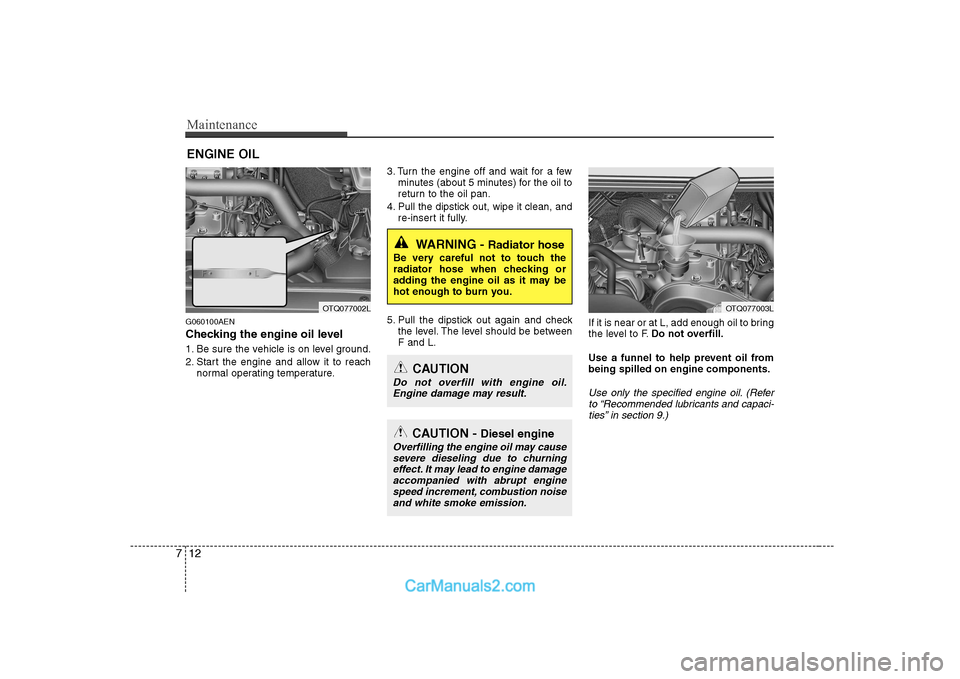
1. Be sure the vehicle is on level ground.
2. Start the engine and allow it to reach normal operating temperature. 3. Turn the engine off and wait for a few
minutes (about 5 minutes) for the oil to
return to the oil pan.
4. Pull the dipstick out, wipe it clean, and re-insert it fully.
5. Pull the dipstick out again and check the level. The level should be betweenF and L. If it is near or at L, add enough oil to bring
the level to F.
Do not overfill.
Use a funnel to help prevent oil frombeing spilled on engine components.
Use only the specified engine oil. (Refer to “Recommended lubricants and capaci- ties” in section 9.)
WARNING - Radiator hose
Be very careful not to touch the
radiator hose when checking or
adding the engine oil as it may be
hot enough to burn you.
OTQ077002LOTQ077003L
CAUTION - Diesel engine
Overfilling the engine oil may cause
severe dieseling due to churning effect. It may lead to engine damageaccompanied with abrupt engine speed increment, combustion noiseand white smoke emission.
CAUTION
Do not overfill with engine oil. Engine damage may result.
Page 238 of 303
719
Maintenance
✽✽NOTICE
“C” (COLD) range is for reference only
and should NOT be used to determinetransmission fluid level. ✽
✽
NOTICE
New automatic transmission fluid
should be red. The red dye is added sothe assembly plant can identify it asautomatic transmission fluid and distin-
guish it from engine oil or antifreeze.
The red dye, which is not an indicator of
fluid quality, is not permanent. As thevehicle is driven, the automatic trans-
mission fluid will begin to look darker.
The colour may eventually appear light
brown. Therefore, have a HYUNDAI
authorised repairer change the auto-matic transmission fluid according tothe Scheduled Maintenance.
Use only the specified automatic trans-
mission fluid. (Refer to “Recommended
lubricants and capacities” in section 9.) G100200AFD-UK Changing the automatic transmis- sion fluid
Have automatic transmission fluid
changed by a HYUNDAI authorisedrepairer according to the Maintenance
Schedule.
WARNING - Transmission fluid
The transmission fluid level should
be checked when the engine is at
normal operating temperature. This
means that the engine, radiator,
radiator hose and exhaust system
etc., are very hot. Exercise great
care not to burn yourself during
this procedure.
WARNING - Parking brake
To avoid sudden movement of the
vehicle, apply parking brake and
depress the brake pedal before
moving the shift lever.
CAUTION
Low fluid level causes transmis- sion slippage. Overfilling cancause foaming, loss of fluid and transmission malfunction.
The use of a non-specified fluid could result in transmission mal-function and failure.
Page 248 of 303
729
Maintenance
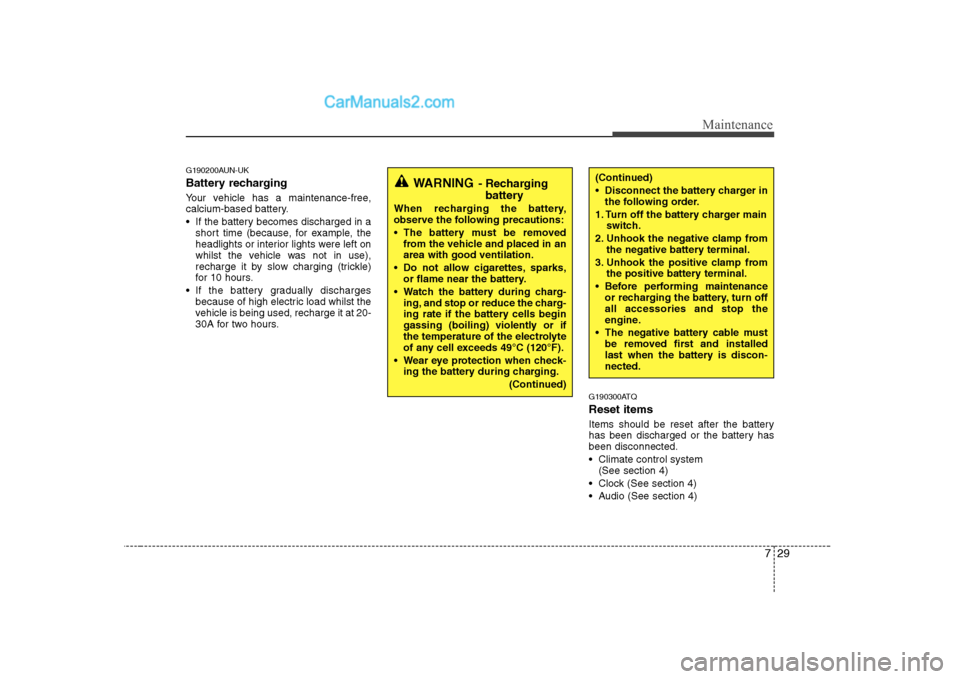
G190200AUN-UK
Battery recharging
Your vehicle has a maintenance-free,
calcium-based battery.
If the battery becomes discharged in ashort time (because, for example, the
headlights or interior lights were left on
whilst the vehicle was not in use),
recharge it by slow charging (trickle)
for 10 hours.
If the battery gradually discharges because of high electric load whilst the
vehicle is being used, recharge it at 20-
30A for two hours.
G190300ATQ Reset items
Items should be reset after the battery
has been discharged or the battery hasbeen disconnected.
Climate control system (See section 4)
Clock (See section 4)
Audio (See section 4)(Continued)
Disconnect the battery charger in the following order.
1. Turn off the battery charger main switch.
2. Unhook the negative clamp from the negative battery terminal.
3. Unhook the positive clamp from the positive battery terminal.
Before performing maintenance or recharging the battery, turn off all accessories and stop the
engine.
The negative battery cable must be removed first and installed
last when the battery is discon-nected.WARNING - Recharging
battery
When recharging the battery,
observe the following precautions:
The battery must be removed from the vehicle and placed in an area with good ventilation.
Do not allow cigarettes, sparks, or flame near the battery.
Watch the battery during charg- ing, and stop or reduce the charg-
ing rate if the battery cells begin
gassing (boiling) violently or if
the temperature of the electrolyte
of any cell exceeds 49°C (120°F).
Wear eye protection when check- ing the battery during charging.
(Continued)
Page 292 of 303
Specifications
6
9
I040100BUN-UK Recommended SAE viscosity
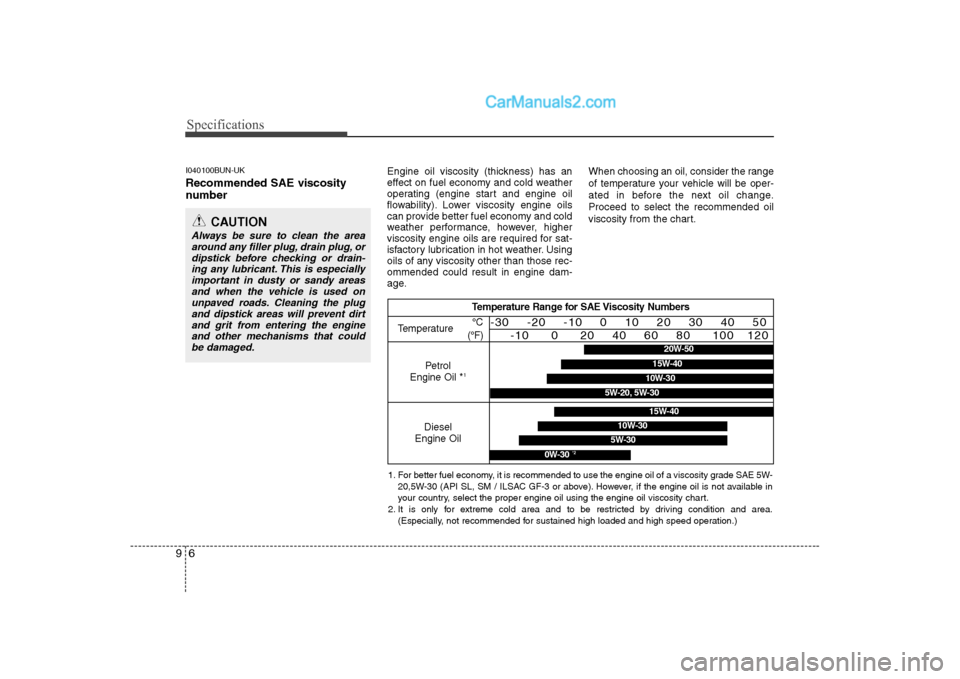
number Engine oil viscosity (thickness) has an
effect on fuel economy and cold weather
operating (engine start and engine oil
flowability). Lower viscosity engine oils
can provide better fuel economy and cold
weather performance, however, higher
viscosity engine oils are required for sat-
isfactory lubrication in hot weather. Using
oils of any viscosity other than those rec-ommended could result in engine dam-
age.When choosing an oil, consider the range
of temperature your vehicle will be oper-
ated in before the next oil change.Proceed to select the recommended oil
viscosity from the chart.
CAUTION
Always be sure to clean the area
around any filler plug, drain plug, or dipstick before checking or drain- ing any lubricant. This is especially
important in dusty or sandy areasand when the vehicle is used on unpaved roads. Cleaning the plugand dipstick areas will prevent dirt
and grit from entering the engineand other mechanisms that could be damaged.
Temperature Range for SAE Viscosity Numbers
Temperature
Petrol
Engine Oil *
1
°C
(°F)-30 -20 -10 0 10 20 30 40 50 -10 0 20 40 60 80 100 120
Diesel
Engine Oil
5W-30
15W-40
10W-30
0W-30 *2
1. For better fuel economy, it is recommended to use the engine oil of a viscosity grade SAE 5W-
20,5W-30 (API SL, SM / ILSAC GF-3 or above). However, if the engine oil is not available in
your country, select the proper engine oil using the engine oil viscosity chart.
2. It is only for extreme cold area and to be restricted by driving condition and area. (Especially, not recommended for sustained high loaded and high speed operation.)
20W-50
10W-30
15W-40
5W-20, 5W-30