2009 Hyundai Elantra wheel
[x] Cancel search: wheelPage 221 of 308
613
What to do in an emergency
The compact spare should be inflated to
420 kPa (60 psi).
✽✽NOTICE
Check the inflation pressure after
installing the spare tire. Adjust it to the
specified pressure, as necessary.
When using a compact spare tire,
observe the following precautions:
Under no circumstances should you exceed 80 km/h (50 mph); a higher
speed could damage the tire.
Ensure that you drive slowly enough for the road conditions to avoid all haz-
ards. Any road hazard, such as a pot-
hole or debris, could seriously damage
the compact spare.
Any continuous road use of this tire could result in tire failure, loss of vehi-
cle control, and possible personal
injury.
Do not exceed the vehicle’s maximum load rating or the load-carrying capaci-
ty shown on the sidewall of the com-
pact spare tire.
Avoid driving over obstacles. The com- pact spare tire diameter is smaller than
the diameter of a conventional tire and
reduces the ground clearance approxi-mately 25 mm (1 inch), which could
result in damage to the vehicle.
Do not take this vehicle through an automatic car wash while the compactspare tire is installed.
Do not use tire chains on the compact spare tire. Because of the smaller size,
a tire chain will not fit properly. This
could damage the vehicle and result inloss of the chain. The compact spare tire should not be
installed on the front axle if the vehicle
must be driven in snow or on ice.
Do not use the compact spare tire on any other vehicle because this tire has
been designed especially for your vehi-
cle.
The compact spare tire’s tread life is shorter than a regular tire. Inspect your
compact spare tire regularly and
replace worn compact spare tires with
the same size and design, mounted onthe same wheel.
The temporary spare tire should not be used on any other wheels, nor should
standard tires, snow tires, wheel cov-
ers or trim rings be used with the tem-
porary spare wheel. If such use isattempted, damage to these items or
other car components may occur.
Do not use more than one temporary spare tire at a time.
Do not tow a trailer while the temporary spare tire is installed.
WARNING
This spare tire should be used only
for VERY short distances. Compact
spares should NEVER be used for
long drives or extended distances.
Page 222 of 308
What to do in an emergency
14
6
TOWING
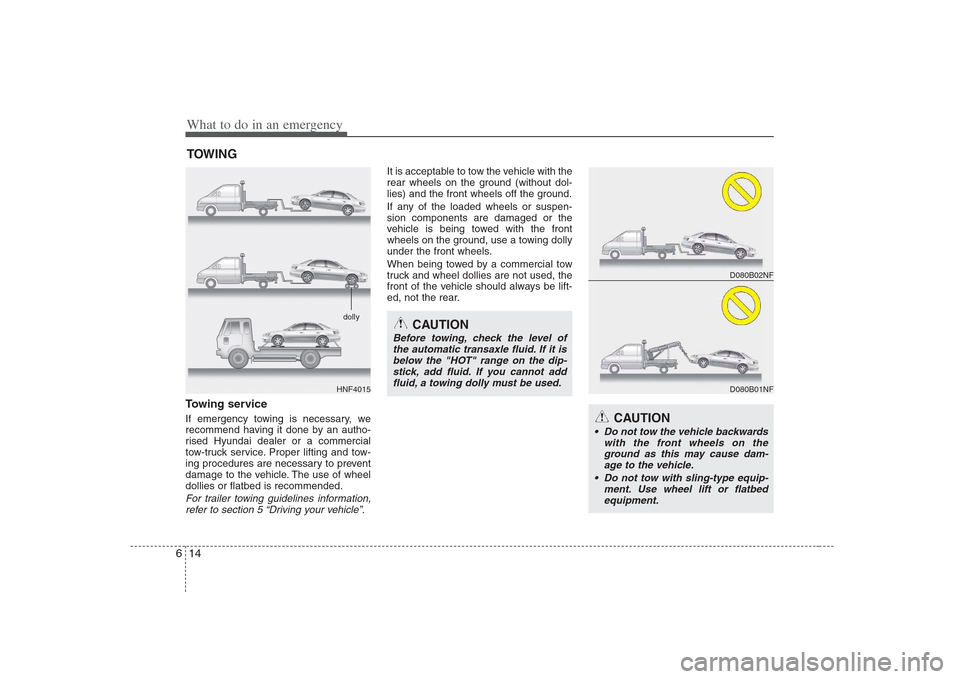
Towing service
If emergency towing is necessary, we
recommend having it done by an autho-
rised Hyundai dealer or a commercial
tow-truck service. Proper lifting and tow-
ing procedures are necessary to prevent
damage to the vehicle. The use of wheeldollies or flatbed is recommended.
For trailer towing guidelines information, refer to section 5 “Driving your vehicle”.
It is acceptable to tow the vehicle with the
rear wheels on the ground (without dol-
lies) and the front wheels off the ground.
If any of the loaded wheels or suspen- sion components are damaged or the
vehicle is being towed with the front
wheels on the ground, use a towing dolly
under the front wheels.
When being towed by a commercial tow
truck and wheel dollies are not used, the
front of the vehicle should always be lift-
ed, not the rear.
HNF4015
D080B02NF
D080B01NF
CAUTION
Do not tow the vehicle backwards
with the front wheels on theground as this may cause dam-age to the vehicle.
Do not tow with sling-type equip- ment. Use wheel lift or flatbed
equipment.
CAUTION
Before towing, check the level ofthe automatic transaxle fluid. If it isbelow the "HOT" range on the dip- stick, add fluid. If you cannot addfluid, a towing dolly must be used.
dolly
Page 223 of 308
615
What to do in an emergency
When towing your vehicle in an emer- gency without wheel dollies :
1. Set the ignition switch in the ACC posi-tion.
2. Place the transaxle shift lever in N (Neutral).
3. Release the hand brake.
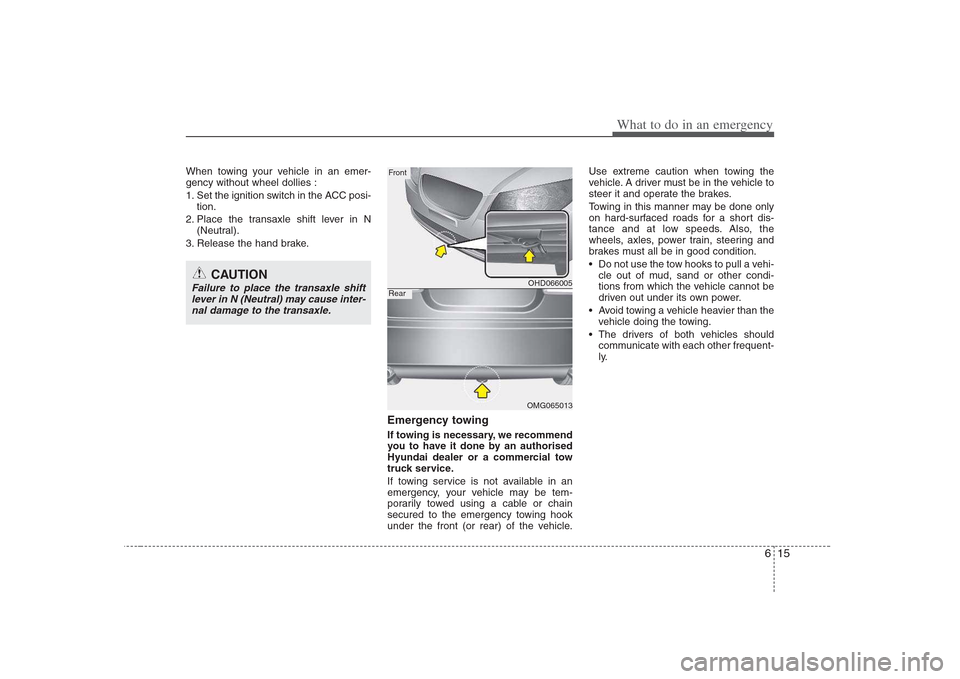
Emergency towing
If towing is necessary, we recommend
you to have it done by an authorised
Hyundai dealer or a commercial tow
truck service.
If towing service is not available in an
emergency, your vehicle may be tem-
porarily towed using a cable or chain
secured to the emergency towing hook
under the front (or rear) of the vehicle.Use extreme caution when towing the
vehicle. A driver must be in the vehicle to
steer it and operate the brakes.
Towing in this manner may be done only
on hard-surfaced roads for a short dis-
tance and at low speeds. Also, the
wheels, axles, power train, steering and
brakes must all be in good condition.
Do not use the tow hooks to pull a vehi-
cle out of mud, sand or other condi-
tions from which the vehicle cannot be
driven out under its own power.
Avoid towing a vehicle heavier than the vehicle doing the towing.
The drivers of both vehicles should communicate with each other frequent-
ly.
CAUTION
Failure to place the transaxle shift
lever in N (Neutral) may cause inter-nal damage to the transaxle.OHD066005
OMG065013
Front
Rear
Page 225 of 308
617
What to do in an emergency
Emergency towing precautions
Turn the ignition switch to ACC so thesteering wheel isn’t locked.
Place the transaxle shift lever in N (Neutral).
Release the hand bake.
Press the brake pedal with more force than normal since you will have
reduced brake performance.
More steering effort will be required because the power steering system
will be disabled.
If you are driving down a long hill, the brakes may overheat and brake per-
formance will be reduced. Stop often
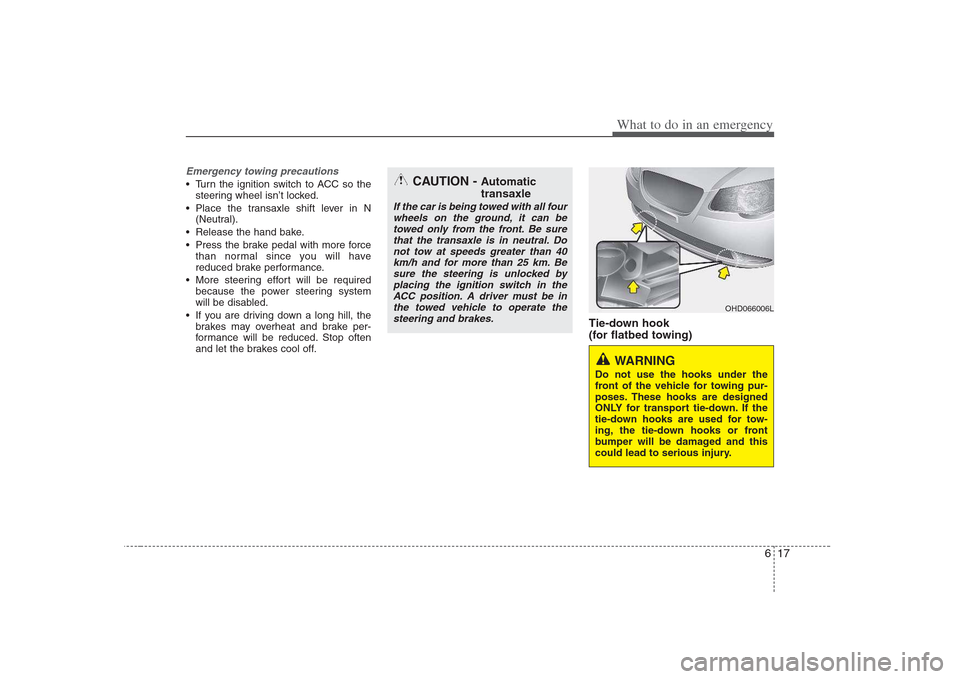
and let the brakes cool off. Tie-down hook
(for flatbed towing)
OHD066006L
WARNING
Do not use the hooks under the
front of the vehicle for towing pur-
poses. These hooks are designed
ONLY for transport tie-down. If the
tie-down hooks are used for tow-
ing, the tie-down hooks or front
bumper will be damaged and this
could lead to serious injury.
CAUTION - Automatic transaxle
If the car is being towed with all four
wheels on the ground, it can betowed only from the front. Be sure that the transaxle is in neutral. Do
not tow at speeds greater than 40km/h and for more than 25 km. Be sure the steering is unlocked byplacing the ignition switch in the
ACC position. A driver must be in the towed vehicle to operate thesteering and brakes.
Page 226 of 308
7
Engine compartment / 7-2 Maintenance services / 7-3
Owner maintenance / 7-4Scheduled maintenance service / 7-6Explanation of scheduled maintenance items / 7-13Engine oil / 7-16Engine coolant / 7-17Brake and clutch fluid / 7-19Automatic transaxle fluid / 7-20
Washer fluid / 7-22Hand brake / 7-22
Air cleaner / 7-23
Climate control air filter / 7-25
Wiper blades / 7-27Battery / 7-29
Tyres and wheels / 7-32 Fuses / 7-41 Light bulbs / 7-50
Appearance care / 7-56
Emission control system / 7-62
Maintenance
Page 229 of 308
Maintenance
4
7
OWNER MAINTENANCE
The following lists are vehicle checks and
inspections that should be performed by
the owner or an authorised Hyundaidealer at the frequencies indicated to
help ensure safe, dependable operation
of your vehicle.
Any adverse conditions should be
brought to the attention of your dealer as
soon as possible.
These Owner Maintenance Checks are
generally not covered by warranties and
you may be charged for labour, parts and
lubricants used. Owner maintenance schedule
When you stop for fuel:
Check the engine oil level.
Check coolant level in coolant reser-
voir.
Check the windshield washer fluid level.
Look for low or under-inflated tyres.
While operating your vehicle:
Note any changes in the sound of the exhaust or any smell of exhaust fumes
in the vehicle.
Check for vibrations in the steering wheel. Notice any increased steering
effort or looseness in the steering
wheel, or change in its straight-aheadposition.
Notice if your vehicle constantly turns slightly or “pulls” to one side when trav-
elling on smooth, level road.
When stopping, listen and check for unusual sounds, pulling to one side,
increased brake pedal travel or “hard-
to-push” brake pedal.
If any slipping or changes in the oper- ation of your transaxle occurs, check
the transaxle fluid level.
Check automatic transaxle P (Park) function.
Check hand brake.
Check for fluid leaks under your vehicle (water dripping from the air condition-
ing system during or after use is nor-mal).
WARNING
Be careful when checking your
engine coolant level when the
engine is hot. Scalding hot coolant
and steam may blow out under
pressure. This could cause burns
or other serious injury.
Page 230 of 308
75
Maintenance
At least monthly:
Check coolant level in the coolantrecovery reservoir.
Check the operation of all exterior lights, including the stoplights, turn sig-
nals and hazard warning flashers.
Check the inflation pressures of all tyres including the spare.
At least twice a year
(i.e., every Spring and Fall) :
Check radiator, heater and air condi- tioning hoses for leaks or damage.
Check windshield washer spray and wiper operation. Clean wiper blades
with clean cloth dampened with wash-er fluid.
Check headlight alignment.
Check muffler, exhaust pipes, shields and clamps.
Check the lap/shoulder belts for wear and function.
Check for worn tyres and loose wheel lug nuts.
At least once a year :
Clean body and door drain holes.
Lubricate door hinges and checks, and
bonnet hinges.
Lubricate door and bonnet locks and latches.
Lubricate door rubber weatherstrips.
Check the air conditioning system before the warm weather season.
Inspect and lubricate automatic transaxle linkage and controls.
Clean battery and terminals.
Check the brake (and clutch) fluid level.
Page 240 of 308
715
Maintenance
Manual transaxle fluid (if equipped)
Inspect the manual transaxle fluid
according to the maintenance schedule.
✽✽NOTICE
If the oil level is low, check for possible
leaks before adding oil. Do not overfill.
Automatic transaxle fluid (if equipped)
The fluid level should be in the "HOT"
range of the dipstick, after the engine
and transaxle are at normal operating
temperature. Check the automatic
transaxle fluid level with the engine run-
ning and the transaxle in neutral, with the
hand brake properly applied. Brake hoses and lines
Visually check for proper installation,
chafing, cracks, deterioration and any
leakage. Replace any deteriorated or
damaged parts immediately. Brake fluid
Check brake fluid level in the brake fluid
reservoir. The level should be between
“MIN” and “MAX” marks on the side of
the reservoir. Use only hydraulic brake
fluid conforming to DOT 3 or DOT 4. Hand brake
Inspect the hand brake system including
the hand brake lever and cables. For
detailed service procedures, refer to the
Shop Manual.
Brake pads, calipers and rotors
Check the pads for excessive wear, discs
for run out and wear, and calipers for fluid
leakage. Suspension mounting bolts
Check the suspension connections for
looseness or damage. Retighten to the
specified torque.
Steering gear box, linkage &
boots/lower arm ball joint
With the vehicle stopped and engine off,
check for excessive free-play in the
steering wheel.
Check the linkage for bends or damage.
Check the dust boots and ball joints for
deterioration, cracks, or damage.
Replace any damaged parts. Drive shafts and boots
Check the drive shafts, boots and clamps
for cracks, deterioration, or damage.
Replace any damaged parts and, if nec-
essary, repack the grease.
Air conditioning refrigerant (if equipped)
Check the air conditioning lines and con-
nections for leakage and damage. Check
air conditioning performance according
to the relevant shop manual if necessary.