Page 176 of 268
If Honda antif reeze/coolant is not
available, you may use another
major-brand non-silicate coolant as a
temporaryreplacement.Makesureit
is a high-quality coolant
recommended f or aluminum engines.
Continued use of any non-Honda
coolant can result in corrosion,
causingthecoolingsystemto
malf unction or f ail. Have the cooling
system f lushed and ref illed with
Honda antif reeze/coolant as soon as
possible.
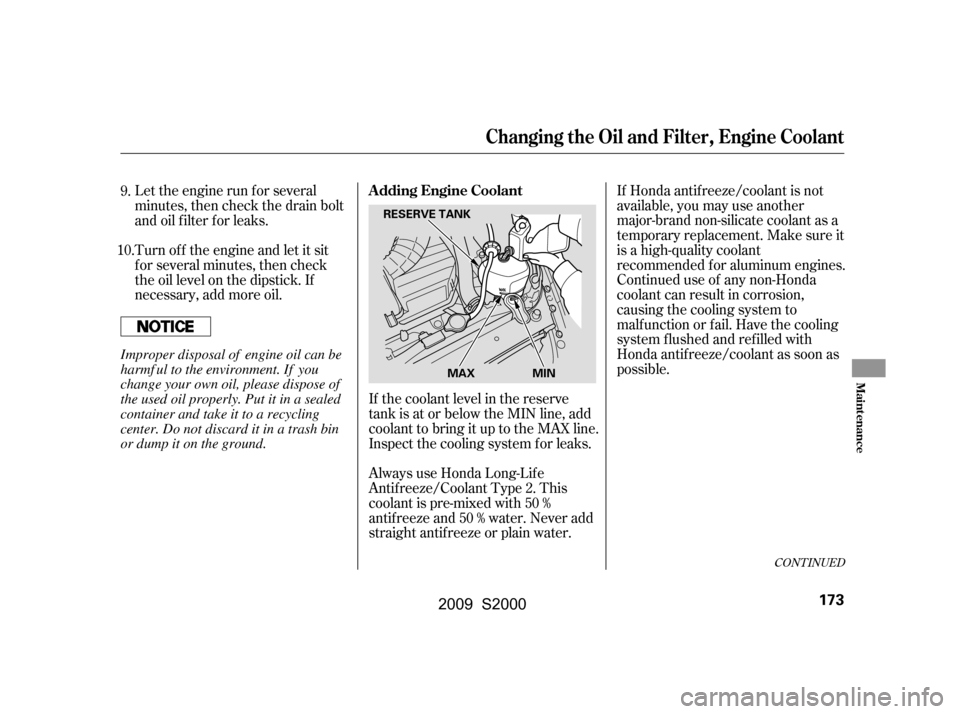
If the coolant level in the reserve
tank is at or below the MIN line, add
coolant to bring it up to the MAX line.
Inspect the cooling system f or leaks.
Turn of f the engine and let it sit
f or several minutes, then check
the oil level on the dipstick. If
necessary, add more oil.
Let the engine run f or several
minutes, then check the drain bolt
and oil f ilter f or leaks.
Always use Honda Long-Lif e
Antif reeze/Coolant Type 2. This
coolant is pre-mixed with 50 %
antif reeze and 50 % water. Never add
straight antif reeze or plain water.
9.
10.
CONT INUED
A dding Engine Coolant
Changing the Oil and Filter, Engine Coolant
Maint enance
173
RESERVE TANK
MAX MIN
Improper disposal of engine oil can be
harmf ul to the environment. If you
change your own oil, please dispose of
the used oil properly. Put it in a sealed
container and take it to a recycling
center. Do not discard it in a trash bin
or dump it on the ground.
2009 S2000
Page 177 of 268
If the reserve tank is completely
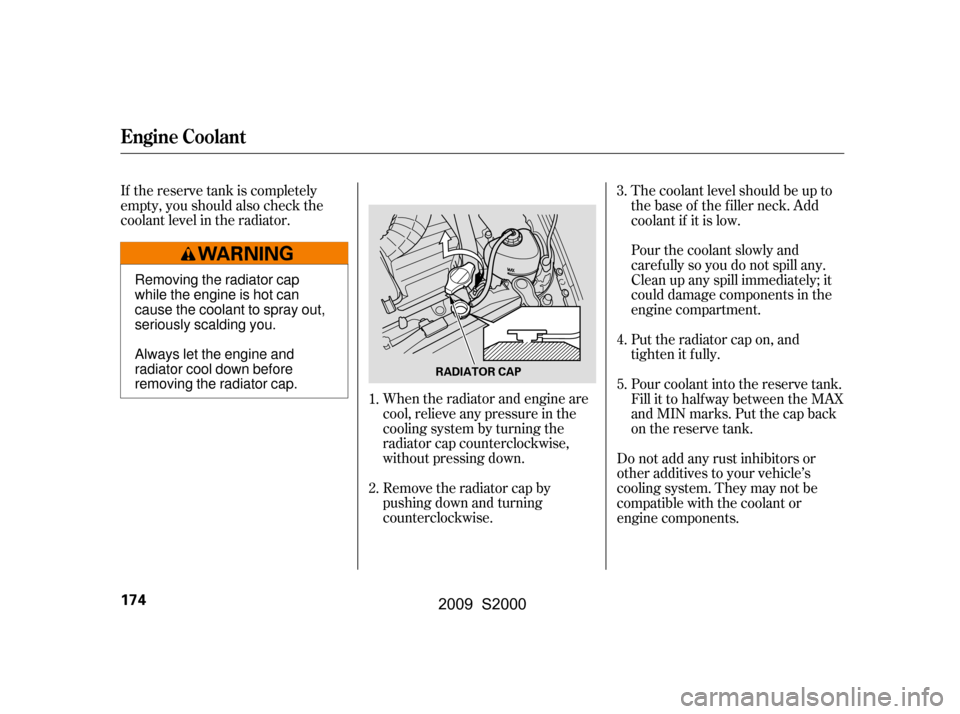
empty, you should also check the
coolant level in the radiator.When the radiator and engine are
cool, relieve any pressure in the
cooling system by turning the
radiator cap counterclockwise,
without pressing down.
Remove the radiator cap by
pushing down and turning
counterclockwise.The coolant level should be up to
the base of the f iller neck. Add
coolant if it is low.
Pourthecoolantslowlyand
caref ully so you do not spill any.
Clean up any spill immediately; it
could damage components in the
engine compartment.
Put the radiator cap on, and
tighten it fully.
Pour coolant into the reserve tank.
Fill it to half way between the MAX
and MIN marks. Put the cap back
on the reserve tank.
Do not add any rust inhibitors or
other additives to your vehicle’s
cooling system. They may not be
compatible with the coolant or
engine components.
2. 3.
4.
5.
1.
Engine Coolant
174
RADIATOR CAP
Removing the radiator cap
while the engine is hot can
cause the coolant to spray out,
seriously scalding you.
Always let the engine and
radiator cool down before
removing the radiator cap.
2009 S2000
Page 178 of 268
Check the f luid level by looking at
the level gauge attached to the cap.
Check the f luid level in the
windshield washer reservoir at least
monthly during normal use.Fill the reservoir with a good-quality
windshield washer f luid. This
increases the cleaning capability and
prevents f reezing in cold weather.
When you ref ill the reservoir, clean
the edges of the windshield wiper
blades with windshield washer f luid
on a clean cloth. This will help to
condition them.
Windshield Washers
Maint enance
175
LEVEL GAUGERESERVOIR CAP
Do not use engine antif reeze or a
vinegar/water solution in the
windshield washer reservoir. Antif reeze
can damage your vehicle’s paint, while
a vinegar/water solution can damage
the windshield washer pump. Use only
commercially-available windshield
washer f luid.
2009 S2000
Page 179 of 268
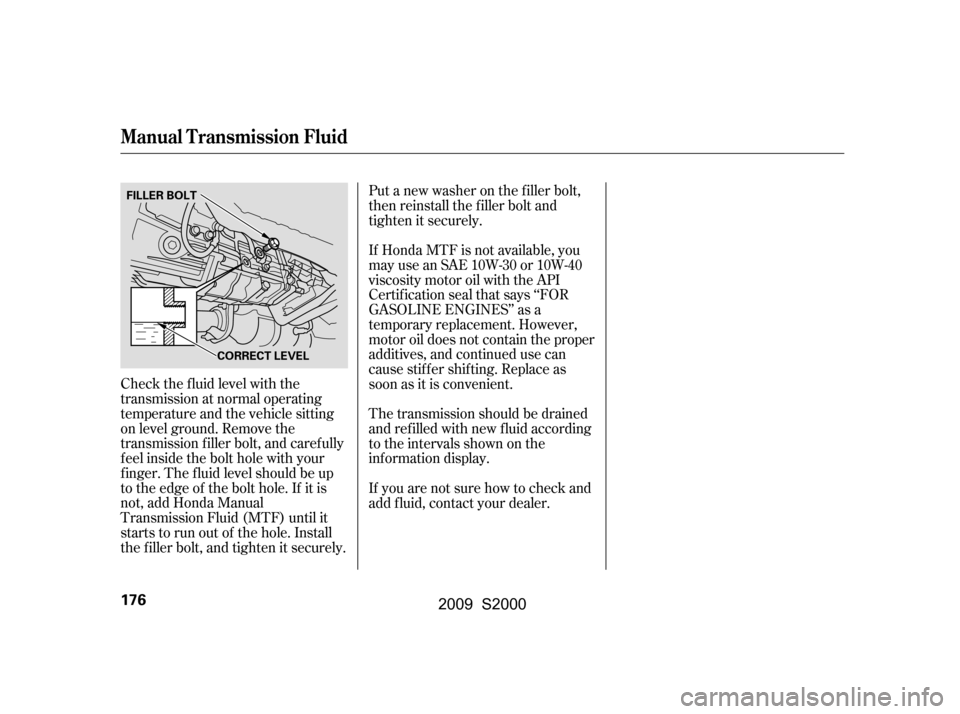
Check the f luid level with the
transmission at normal operating
temperature and the vehicle sitting
on level ground. Remove the
transmission f iller bolt, and caref ully
f eel inside the bolt hole with your
f inger. The f luid level should be up
to the edge of the bolt hole. If it is
not, add Honda Manual
Transmission Fluid (MTF) until it
starts to run out of the hole. Install
the f iller bolt, and tighten it securely.If you are not sure how to check and
add f luid, contact your dealer.
The transmission should be drained
and ref illed with new f luid according
to the intervals shown on the
inf ormation display.
If Honda MTF is not available, you
may use an SAE 10W-30 or 10W-40
viscosity motor oil with the API
Certif ication seal that says ‘‘FOR
GASOLINE ENGINES’’ as a
temporary replacement. However,
motor oil does not contain the proper
additives, and continued use can
cause stiffer shifting. Replace as
soon as it is convenient.
Put a new washer on the f iller bolt,
then reinstall the f iller bolt and
tighten it securely.
Manual T ransmission Fluid
176
CORRECT LEVEL
FILLER BOLT
2009 S2000
Page 184 of 268
If you are changing the bulb on
the driver’s side, start the engine,
turn the steering wheel all the way
to the right, then turn off the
engine. If you are changing the
bulb on the passenger’s side, turn
the steering wheel to the left.Use a f lat-tipped screwdriver to
remove the three holding clips
f rom the inner f ender.
Pull the inner f ender cover back.
Remove the socket from the
headlight assembly by turning it
one-quarter turn counterclockwise.
Pull the bulb straight out of its
socket.Insert the socket back into the
headlight assembly. Turn it
clockwise to lock it in place.
Install the new bulb in the socket.
Put the inner f ender cover in place.
Install the three holding clips.
Lock each clip in place by pushing
on the center.
Turn on the lights to make sure
the new bulb is working.
1.
2.
3.
4.
5.6.
7.
8.
9.
Replacing Front Turn Signal and
Side Marker/Parking L ight Bulbs
Lights
Maint enance
181
SOCKET
SOCKET BULB
BULB
2009 S2000
Page 195 of 268

You should not rotate your vehicle’s
tires. The f ront and rear tires are
dif f erent sizes, so they cannot be
rotated f ront-to-rear. The original-
equipment tires on your vehicle have
a unidirectional tread pattern, so
they cannot be rotated side-to-side.
The tires that came on your vehicle
were designed and constructed to
provide superior grip during
acceleration, braking, and cornering.
As a trade-of f , they will wear more
rapidly than tires used on ordinary
passenger vehicles. Because of the
vehicle’s weight distribution, and the
fact that the rear wheels are the
driving wheels, you can expect them
to wear more rapidly than the f ront
tires.Themileageyoucanexpectfrom
yourvehicletiresisthesameas
comparable mid-and rear-engine
sports cars, and it will vary greatly
with your driving habits.
If you drive moderately, the rear
tires could last more than 10,000
miles (16,000 km). However, the
mileage will be substantially less if
you tend to drive your vehicle at the
upper limits of its capabilities.
You should caref ully inspect your
vehicle’s tires f or wear, damage, and
proper inf lation every 7,500 miles
(12,000 km) or when tire inspection
is indicated on the inf ormation
display (see page ).
It is best to replace all f our tires at
thesametime.If thatisnotpossible
or necessary, replace the two f ront
tires or two rear tires as a pair.
Replacing just one tire can seriously
af f ect your vehicle’s handling.
Replace your tires with radial tires of
the same size, load range, speed
rating, and maximum cold tire
pressure rating (as shown on the
tire’s side wall).
Mixing radial and bias-ply tires on
your vehicle can reduce braking
ability, traction, and steering
accuracy. Using tires of a dif f erent
size or construction can cause the
anti-lock brake and the vehicle
stability assist systems to work
inconsistently.
168
Tires
Tire Rotation
Tire Wear Replacing T ires and Wheels
192
2009 S2000
Page 201 of 268

If you need to park your vehicle f or
an extended period (more than 1
month), there are several things you
should do to prepare it f or storage.
Proper preparation helps prevent
deterioration and makes it easier to
get your vehicle back on the road. If
possible, store your vehicle indoors.Fill the f uel tank. Block the rear wheels.
If the vehicle is to be stored f or a
longer period, it should be
supported on jackstands so the
tires are of f the ground.
Leave one window open slightly (if
the vehicle is being stored
indoors).
Disconnect the battery.Cover the vehicle with a
‘‘breathable’’ cover, one made
f rom a porous material such as
cotton. Non-porous materials, such
as plastic sheeting, trap moisture,
which can damage the paint.
Support the f ront wiper blade
arms with a f olded towel or rag so
they do not touch the windshield.
To minimize sticking, apply a
silicone spray lubricant to all door
and trunk seals. Also, apply a
vehiclebodywaxtothepainted
surfaces that mate with the door
and trunk seals. If possible, periodically run the
engine until it reaches f ull
operating temperature (the
cooling f an cycles on and of f
twice). Pref erably, do this once a
month.
Wash and dry the exterior
completely.
Cleantheinterior.Makesurethe
carpeting, floor mats, etc., are
completely dry.
Raise the convertible top cover.
Leave the parking brake off. Put
the transmission in reverse.
Vehicle Storage
198
2009 S2000
Page 202 of 268

This section covers the more
common problems that motorists
experience with their vehicles. It
gives you inf ormation about how to
safely evaluate the problem and what
to do to correct it. If the problem has
stranded you on the side of the road,
you may be able to get going again.
If not, you will also f ind instructions
on getting your vehicle towed.......................
Compact Spare Tire .200
....................
Changing a Flat Tire .201
....................
Repairing a Flat Tire .206
.............
If the Engine Won’t Start .212
................................
Jump Starting .214
..............
If the Engine Overheats .215
.........
Low Oil Pressure Indicator .218
..........
Charging System Indicator .218
.......
Malf unction Indicator Lamp .219
...............
Brake System Indicator .220
.......
Closing the Convertible Top .221
..............................................
Fuses .222
..........
Checking and Replacing .223
..............................
Fuse Locations .226
......................
Emergency Towing .228
..........
If Your Vehicle Gets Stuck .228
Taking Care of the Unexpected
T aking Care of t he Unexpect ed
199
2009 S2000