Page 441 of 578

Driving with varying tire or wheel
sizes may cause the VSA to
malf unction. When replacing tires,
make sure they are of the same size
and type as your original tires (see
page ).
If you install winter tires, make sure
they are the same size as those that
were originally supplied with your
vehicle. Exercise the same caution
during winter driving as you would if
your vehicle was not equipped with
VSA.Your vehicle is equipped with a hill
start assist f eature to help prevent
the vehicle f rom rolling on steep
inclines as you move your f oot f rom
the brake pedal to the accelerator.
This f eature operates f or up to 1.5
seconds in any drive gear position
(when f aced uphill) or in reverse
(when f aced downhill). This f eature
requires that the vehicle has come to
a complete stop bef ore it can work.
Hillstartassistmaynotholda
heavily loaded vehicle, such as when
your vehicle is connected to a trailer,
or prevent your vehicle f rom rolling
downhill on a very steep or slippery
slope.
506
VSA and Tire Sizes
Hill Start Assist
Vehicle Stability A ssist (VSA), aka Electronic Stability Control (ESC), System
Driving
437
�����—�����—�
���y�
�������������y���
�(�/���������y���������y
2009 Pilot
Page 451 of 578
�´
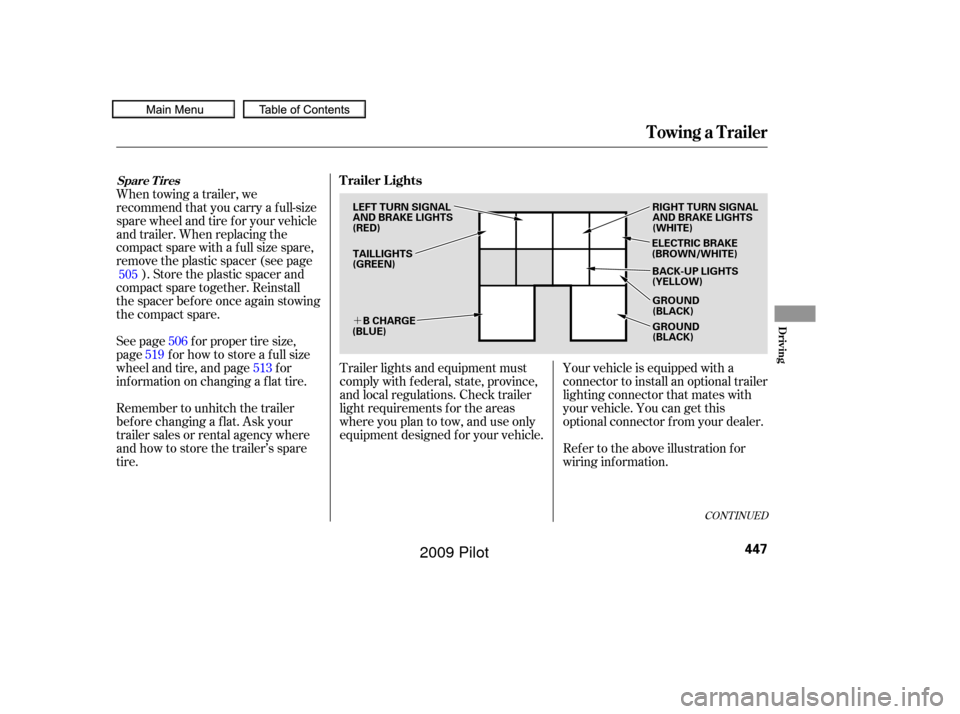
Your vehicle is equipped with a
connector to install an optional trailer
lighting connector that mates with
your vehicle. You can get this
optional connector f rom your dealer.
Ref er to the above illustration f or
wiring information.
Trailer lights and equipment must
comply with f ederal, state, province,
and local regulations. Check trailer
light requirements f or the areas
where you plan to tow, and use only
equipment designed f or your vehicle.
When towing a trailer, we
recommend that you carry a f ull-size
spare wheel and tire for your vehicle
and trailer. When replacing the
compact spare with a f ull size spare,
remove the plastic spacer (see page
). Store the plastic spacer and
compact spare together. Reinstall
thespacerbeforeonceagainstowing
the compact spare.
See page f or proper tire size,
page f or how to store a f ull size
wheel and tire, and page for
inf ormation on changing a f lat tire.
Remember to unhitch the trailer
bef ore changing a f lat. Ask your
trailer sales or rental agency where
and how to store the trailer’s spare
tire. 505
506 513
519
CONT INUED
Towing a Trailer
Trailer LightsSpare Tires
Driving
447
GROUND
(BLACK)
LEFT TURN SIGNAL
AND BRAKE LIGHTS
(RED)
TAILLIGHTS
(GREEN)
RIGHT TURN SIGNAL
AND BRAKE LIGHTS
(WHITE)
ELECTRIC BRAKE
(BROWN/WHITE)
BACK-UP LIGHTS
(YELLOW)
GROUND
(BLACK)
B CHARGE
(BLUE)
�����—�����—�
���y�
�������������y���
�(�/���������y���������y
2009 Pilot
Page 456 of 578

When climbing hills, closely watch
your temperature gauge. If it nears
the red (Hot) mark, turn the air
conditioning of f , reduce speed and, if
necessary, pull to the side of the
road to let the engine cool.Always drive slowly and have
someone guide you when backing up.
Grip the of the steering wheel,
then turn the wheel to the left to get
the trailer to move to the lef t. Turn
the wheel to the right to move the
trailer to the right.
Follow all normal precautions when
parking, including putting the
transmission in Park and f irmly
setting the parking brake. Also, place
wheel chocks at each of the trailer’s
tires. Crosswinds and air turbulence
caused by passing trucks can disrupt
your steering and cause the trailer to
sway. When being passed by a large
vehicle, keep a constant speed, and
steer straight ahead. Do not try to
make quick steering or braking
corrections.If the vehicle’s tires slip when
retrieving a boat f rom the water,
shif t to f irst gear, and turn on VTM-4
lock (see page ). Disengage
VTM-4 lock as soon as the boat is
out of the water to prevent damage
to the VTM-4 system.
Your vehicle is not designed to be
towed behind a motor home. If your
vehicle needs to be towed in an
emergency, see page .
If the automatic transmission shif ts
f requently while going up a hill, shif t
to D .
When driving down hills, reduce
your speed and shif t down to D . Do
not ‘‘ride’’ the brakes. If you must stop when f acing uphill,
use the f oot brake or parking brake.
Do not try to hold the vehicle in
placebypressingontheaccelerator,
as this can cause the automatic
transmission to overheat.
535
422
bottom
3
3
Driving on Hills Handling Crosswinds and Buf f et ing
Backing UpParking Ret rieving a Boat
Towing a Trailer
Towing Your Vehicle
Remember, it
takes longer to slow down and
stop when towing a trailer.
452
�����—�����—�
���y�
�������������y���
�(�/���������y���������y
2009 Pilot
Page 458 of 578

Before you leave the pavement, be
sure to do all scheduled maintenance
and service, and inspect your vehicle
f or any problems. Pay special
attention to the condition of the tires,
and check the tire pressures.
After you return to the pavement,
caref ully inspect your vehicle to
make sure there is no damage that
could make driving it unsaf e.
Recheck the condition of the tires
and the tire pressures.
The route presents limits (too steep
or bumpy roads). You have limits
(driving skill and comfort). And your
vehicle has limits (traction, stability,
and power).
Driving of f -highway can be
hazardous if you f ail to recognize
limits and take the proper
precautions.Forbettertractiononallsurfaces,
accelerate slowly and gradually build
up speed. If you try to start too fast
on wet soil, mud, snow, or ice, you
might not have enough traction to
get underway, and you may dig
yourself a hole. Starting with the
shif t lever in D position will help you
have a smoother start on snow or ice.
Keep in mind that you will usually
need more time and distance to
brake to a stop on unpaved surf aces.
Avoid hard braking. Do not ‘‘pump’’
the brakes; let the anti-lock braking
system pump them f or you.
Debris in the road can damage your
suspension or other components.
Because your vehicle has a high
center of gravity, driving over a large
obstacle, or allowing a wheel to drop
into a deep hole can cause your
vehicle to tip or roll over.
If you can’t clearly see all conditions
or obstacles on a slope, walk the
slope bef ore you drive on it. If you
have any doubt whether or not you
can saf ely drive on the slope, don’t
do it. Find another route.
If you are driving up a hill and f ind
that you cannot continue,
. Your vehicle could roll
over. Slowly back down the hill,
f ollowing the same route you took up
the hill.
do not try to
turn around
Check Out Your Vehicle
Remember A ccelerating and Braking
A voiding Obstacles
Driving on Slopes
Of f -Highway Driving Guidelines
454
�����—�����—�
���y�
�������������y���
�(�/���������y���������y
2009 Pilot
Page 459 of 578

If you get stuck, engage the VTM-4
Lock (see page ). Caref ully try to
go in the direction (f orward or
reverse) that you think will get you
unstuck. Do not spin the tires at high
speeds. It will not help you get out
and may cause damage to the
transmission or VTM-4 system.
If you are still unable to f ree yourself ,
your vehicle is equipped with f ront
and rear tow hooks designed f or this
purpose.
Bef ore driving through water, stop,
get out if necessary, and make sure
that:
If the water is deeper than the wheel
hubs, some additional service may
be required. This service is not
covered by your warranties. After driving through water, test
your brakes. If they got wet, gently
‘‘pump’’ them while driving slowly
until they operate normally. If you decide it is saf e to drive
through water, choose a suitable
speed and engage the VTM-4 Lock.
Proceed without shif ting or changing
speeds, and do not stop the vehicle
or shut of f the engine.The banks and surf ace under the
water provide good traction. The
water may hide hazards such as
rocks, holes, or mud.
The water is not f lowing too f ast.
Deep rushing water can sweep you
downstream. Even very shallow
rushingwatercanwashthe
ground f rom under your tires and
cause you to lose traction and
possibly roll over. The banks are sloped so you can
drive out. The water is not deep enough to
cover your wheel hubs, axles, or
exhaust pipe. You could stall and
not be able to restart your engine.
The water can also damage
important vehicle components. 422
Of f -Highway Driving Guidelines
If You Get Stuck
Crossing a Stream
Driving
455
�����—�����—�
���y�
���������
���y���
�(�/���������y���������y
2009 Pilot
Page 467 of 578
�Û�Ý
�Û�Ý
Press the select/reset knob f or
about 10 seconds. The engine oil
lif e and the maintenance item
code(s) will blink.Press the select/reset knob f or
another 5 seconds. The
maintenance item code(s) will
disappear, and the engine oil lif e
will reset to ‘‘100.’’To see the current engine oil lif e,
turn the ignition switch to the ON
(II) position, and push and release
the INFO ( / ) button on the
steering wheel repeatedly, until the
engine oil lif e is displayed (see page
).
3.
4.
86
CONT INUED
On Touring models
Maintenance Minder
Maint enance
463
ENGINE OIL
LIFE DISPLAYSEL/RESET BUTTON
INFO ( / )
BUTTON
U.S. model is shown.
U.S. model is shown.
U.S. model is shown.
�����—�����—�
���y�
���������
���y���
�(�/���������y���������y
2009 Pilot
Page 468 of 578
�Û�Ý
When the remaining engine oil lif e is
15 percent or less, the display shows
a ‘‘SERVICE DUE SOON’’ message
along with the maintenance item
code(s) f or other scheduled
maintenance items needing service. The system message indicator on
the instrument panel will also come
on, and a beeper will sound.
To cancel the system message, press
and release the INFO ( / ) button
on the steering wheel. At this time,
the system message indicator will
also be turned of f . Then the display
will change to the engine oil lif e
display. You will see the
maintenance item code(s) along with
the engine oil lif e on the multi-
inf ormation display.
Maintenance Minder
464
MAINTENANCE ITEM CODE(S)
SYSTEM MESSAGE INDICATOR
U.S. model is shown.
�����—�����—�
���y�
�������������y���
�(�/���������y���������y
2009 Pilot
Page 470 of 578
�Û�ÝYou will also see the system
message every time you turn the
ignition switch to the ON (II)
position until your vehicle have the
indicated maintenance perf ormed by
your dealer.
To cancel the system message, press
and release the INFO ( / ) button
on the steering wheel. At this time,
the system message indicator will
also be turned of f . Then the display
will change to the engine oil lif e
display. You will see a ‘‘SERVICE’’
message and along with the
maintenance item code(s) on the
multi-inf ormation display. If the indicated maintenance service
is not done and the engine oil lif e
reaches to 0 percent, you will see a
‘‘SERVICE PAST DUE’’ message
along with the maintenance item
code(s) on the multi-inf ormation
display.
Maintenance Minder
466
U.S. model is shown.
U.S. model is shown.
�����—�����—�
���y�
�������������y���
�(�/���������y�������
�y
2009 Pilot