Page 523 of 578
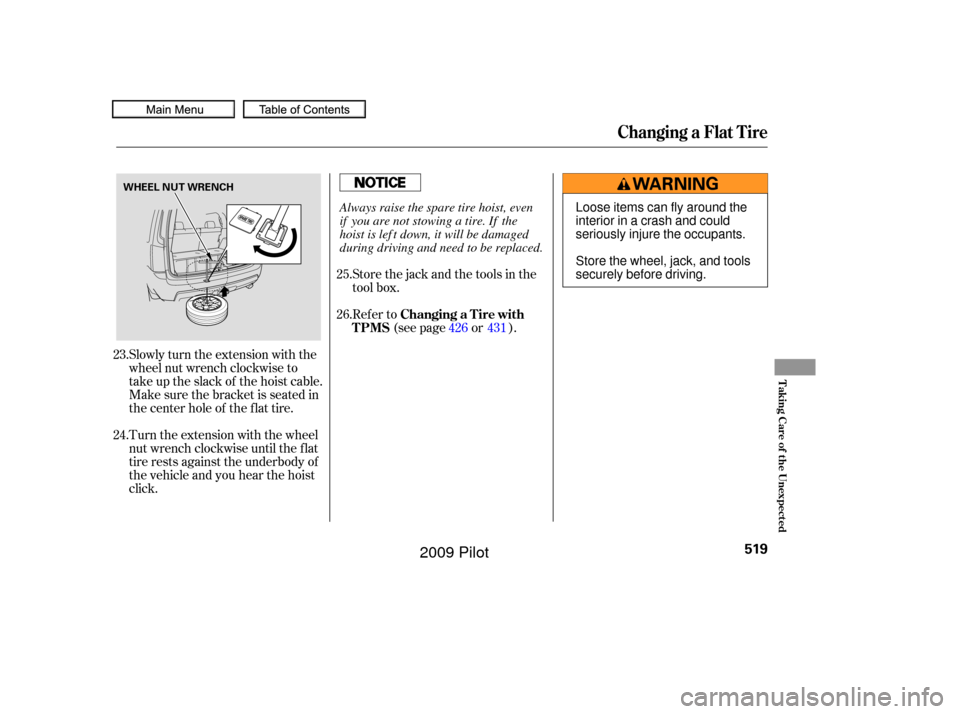
Slowly turn the extension with the
wheel nut wrench clockwise to
take up the slack of the hoist cable.
Make sure the bracket is seated in
the center hole of the flat tire.
Turn the extension with the wheel
nut wrench clockwise until the f lat
tire rests against the underbody of
the vehicle and you hear the hoist
click.Store the jack and the tools in the
tool box.
Refer to
(see page or ). 426 431
23.
24. 25.
26.
Changing a Flat Tire
Changing a T ire with
TPMS
T aking Care of t he Unexpect ed
519
WHEEL NUT WRENCH
Loose items can fly around the
interiorinacrashandcould
seriously injure the occupants.
Store the wheel, jack, and tools
securely before driving.
Always raise the spare tire hoist, even
if you are not stowing a tire. If the
hoist is lef t down, it will be damaged
during driving and need to be replaced.
�����—�����—�
���y�
�������������y���
�(�/���������y���������y
2009 Pilot
Page 531 of 578
However, if the brake pedal does not
f eel normal, you should take
immediate action. A problem in one
part of the system’s dual circuit
design will still give you braking at
two wheels. You will f eel the brake
pedal go down much f arther bef ore
the vehicle begins to slow down, and
you will have to press harder on the
pedal.
The brake system
indicator normally
comes on when you turn the ignition
switch to the ON (II) position, and as
a reminder to check the parking
brake. It will stay on if you do not
f ully release the parking brake.
If the brake system indicator comes
on while driving, the brake f luid level
is probably low. Press lightly on the
brake pedal to see if it f eels normal.
If it does, check the brake f luid level
thenexttimeyoustopataservice
station (see page ). If the f luid level is low, take your
vehicle to a dealer, and have the
brake system inspected f or leaks or
worn brake pads.
Slow down by shif ting to a lower
gear, and pull to the side of the road
when it is saf e. Because of the long
distance needed to stop, it is
hazardous to drive the vehicle. You
should have it towed, and repaired as
soon as possible (see
on page ).
If you must drive the vehicle a short
distance in this condition, drive
slowly and caref ully.
If the ABS indicator and the VSA
system indicator come on with the
brake system indicator, have your
vehicle inspected by your dealer
immediately.
You will also see a ‘‘LOW BRAKE
FLUID’’ message on the multi-
inf ormation display (see page ). You will also see a ‘‘CHECK BRAKE
SYSTEM’’ message on the multi-
inf ormation display (see page ).
485
93 93535
On Touring models
On Touring models
Emergency
Towing
Brake System Indicator
T aking Care of t he Unexpect ed
527
U.S. Canada
�����—�����—�
���y�
�����������
�y���
�(�/���������y���������y
2009 Pilot
Page 540 of 578
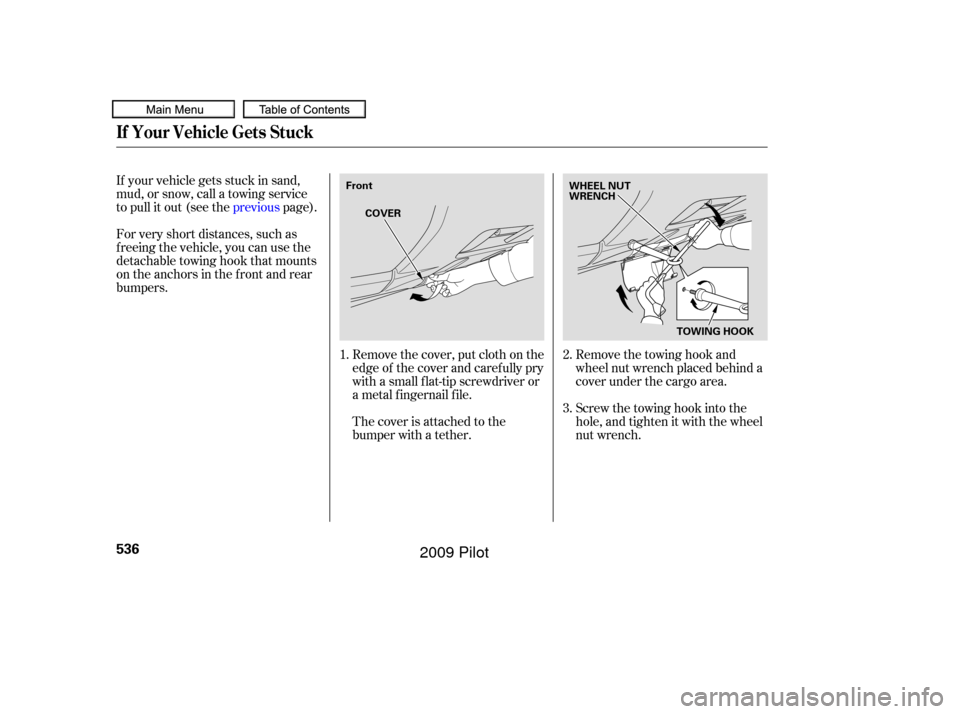
If your vehicle gets stuck in sand,
mud, or snow, call a towing service
to pull it out (see thepreviouspage).
For very short distances, such as
f reeing the vehicle, you can use the
detachable towing hook that mounts
on the anchors in the front and rear
bumpers.
Remove the cover, put cloth on the
edge of the cover and caref ully pry
with a small f lat-tip screwdriver or
a metal fingernail file.Remove the towing hook and
wheel nut wrench placed behind a
cover under the cargo area.
Screw the towing hook into the
hole, and tighten it with the wheel
nut wrench.
The cover is attached to the
bumper with a tether.
1.
2.
3.
If Your Vehicle Gets Stuck
536
Front
COVER WHEEL NUT
WRENCH
TOWING HOOK
�����—�����—�
���y�
�������������y���
�(�/���������y�������
�y
2009 Pilot
Page 546 of 578

�µ�µ�Î
�Î
�Î�Î
�Î
�Î�Î
�Î �Î
�Î
�Î
�Î�Î
�Î
Specif ications
542
Seating Capacities Air Conditioning Dimensions
Capacities
Weights 1.98 US gal (7.5
)
2.48 US gal (9.4)
4.5 US qt (4.3
)
4.2 US qt (4.0
)
5.3 US qt (5.0
)
190.9 in (4,850 mm)
78.5 in (1,995 mm)
70.9 in (1,802 mm)
21.00 US gal (79.5
)
Total
Front
Second
Third 3 3
2
8
Refrigerant type
Charge quantity
Lubricant type
ND-OIL8
21.2 22.9 oz (600 650 g) HFC-134a (R-134a)
The GCWR must be reduced 2 percent for every 1,000 feet (305
meters) of elevation. See the tire information label atta-
ched to the driver’s doorjamb.
8,466 lbs (3,840 kg)
Length
Width
Height
Wheelbase
Track
67.5 in (1,715 mm) 67.7 in (1,720 mm)
109.3 in (2,775 mm)
Excluding the oil remaining in the engine
0.214 US gal (0.81
)
Including the coolant in the reserve tank and that remaining in the
engine
Reserve tank capacity: 4.2 US qt (4.0
)
Fuel tank
Engine
coolant
Engine oil
Automatic
transmission
fluid
Rear
differential
fluid (4WD)
Transfer
assembly
fluid (4WD)
Windshield
washer
reservoir
6.9 US qt (6.5)
72.7 in (1,846 mm)
9,579 lbs (4,345 kg)
3.6 US qt (3.4
)
8.6 US qt (8.1)
3.6 US qt (3.4)
8.6 US qt (8.1)
2.79 US qt (2.64)
3.01 US qt (2.85)
0.45 US qt (0.43
)
0.48 US qt (0.45)
Gross vehicle weight rating
Gross combined weight
rating (GCWR) Approx.
Front
Rear
1:
2:U.S. vehicles
Canadian
vehicles
1 :
2 : Except U.S. LX models
U.S. LX models
2WD models
1:
2:
3: 4WDmodels 2WD
4WDChange
Total
Change
Including
filter
Without
filter
Total
Change
Total
Change
Total
Change
Total
Change
Total
1 1
2
2
31
2
�����—�����—�����y�
�������������y���
�(�/���������y���������y
2009 Pilot
Page 549 of 578

Warning: The temperature grade f or
this tire is established f or a tire that
is properly inf lated and not
overloaded. Excessive speed,
underinf lation, or excessive loading,
either separately or in combination,
can cause heat buildup and possible
tire f ailure.
The temperature grades are A (the
highest), B, and C, representing the
tire’s resistance to the generation of
heat and its ability to dissipate heat
when tested under controlled
conditions on a specif ied indoor
laboratory test wheel. Sustained high
temperature can cause the material
of the tire to degenerate and reduce
tire life, and excessive temperature
can lead to sudden tire f ailure. The
grade C corresponds to a level of
perf ormance which all passenger car
tires must meet under the Federal
Motor Vehicle Saf ety Standard No.
109. Grades B and A represent
higher levels of perf ormance on the
laboratory test wheel than the
minimum required by law.
DOT Tire Quality Grading (U.S. Vehicles)
Temperature
Technical Inf ormation
545
�����—�����—�
���y�
�������������y���
�(�/���������y���������y
2009 Pilot
Page 553 of 578
�µ
Always check the TPMS malf unction
telltale af ter replacing one or more
tires or wheels on your vehicle to
ensure that the replacement or
alternate tires and wheels allow the
TPMS to continue to f unction
properly.
Your vehicle has also been equipped
with a TPMS malf unction indicator
to indicate when the system is not
operating properly. The TPMS
malf unction indicator is provided by
a separate telltale, which displays the
symbol ‘‘TPMS’’ when illuminated.
TPMS malf unctions may occur f or a
variety of reasons, including the
installation of replacement or
alternate tires or wheels on the
vehicle that prevent the TPMS f rom
f unctioning properly. When the malf unction indicator is
illuminated,
the system may not be able to detect
or signal low tire pressure as
intended.Except Touring models
Tire Pressure Monitoring System (TPMS) Required Federal Explanation
Technical Inf ormation
549
�����—�����—�
���y�
������
��
���y���
�(�/���������y���������y
2009 Pilot
Page 554 of 578

�µ
TPMS malf unctions may occur f or a
variety of reasons, including the
installation of replacement or
alternate tires or wheels on the
vehicle that prevent the TPMS f rom
f unctioning properly.
Always check the TPMS malf unction
telltale af ter replacing one or more
tires or wheels on your vehicle to
ensure that the replacement or
alternate tires and wheels allow the
TPMS to continue to f unction
properly.
When the malf unction indicator is
illuminated, the system may not be
able to detect or signal low tire
pressure as intended. Your vehicle has also been equipped
with a TPMS malf unction indicator
to indicate when the system is not
operating properly. The TPMS
malf unction indicator is combined
with the low tire pressure telltale.
When the system detects a
malf unction, the telltale will f lash f or
approximately one minute and then
remain continuously illuminated.
This sequence will continue upon
subsequent vehicle start-ups as long
as the malfunction exists.On Touring models
Tire Pressure Monitoring System (TPMS) Required Federal Explanation
550
�����—�����—�
���y�
������
��
���y���
�(�/���������y���������y
2009 Pilot
Page 574 of 578

CONT INUED
..........
SRS, Additional Inf ormation . 24
...
Additional Safety Precautions . 35
.............................
Airbag Service .35
......
Airbag System Components . 24
..
How the SRS Indicator Works . 33
How Your Front Airbags .........................................
Work .27
...
How Your Side Airbags Work . 30
How Your Side Curtain Airbags .........................................
Work .32
.............................
SRS Indicator .33 ,70
..
START (Ignition Key Position) . 135
.......................
Starting the Engine .415
...................
Auto Control Mode . 415
In Cold Weather at High ..................................
Altitude .416
................
With a Dead Battery . 521
........
Steam Coming f rom Engine . 523
Steering Wheel ................................
Adjustment .131
...........
Anti-thef t Column Lock . 135
......................
Buttons .309, 348,361
Stereo Sound ...............
System . 206,207,224,250
..................
Storage Compartment . 180
....................
Storing Your Vehicle .510 ........................
Sunglasses Holder .181
........................................
Sun Visor .182
Supplemental Restraint System ......................................
Servicing .35
.........................
SRS Indicator .33 ,70
...................
System Components . 24
..................................
Synthetic Oil .477
.....................................
Tachometer .80
..........................................
Tailgate .142
...............................
Glass Hatch .146
......................
Open Indicator .11, 93
...............................
Opening the .142
.........................................
Power .143
......
Taillights, Changing Bulbs in . 490
.
Taking Care of the Unexpected . 511
Technical Descriptions ......
DOT Tire Quality Grading . 544
.....
Emissions Control Systems . 551
Three Way Catalytic ...............................
Converter .553
.......................
Temperature Gauge .80
........
Temperature, Inside Sensor . 205
....................
Temperature, Outside . 88...................
Tensioners, Seat Belts . 22
..............
Tether Anchorage Points . 53
................
Thef t Protection, Radio . 311
..
Three Way Catalytic Converter . 553
.
Tilt/Telescopic Steering Wheel . 131
....................................
Timing Belt .486
....................................
Tire Chains .507
.........
Tire, How to Change a Flat . 513
.................................
Tire Labeling .546
Tire Pressure Monitoring ............
System (TPMS) . 424,548
Low Tire Pressure ...........................
Indicator .72, 427
.......
Tire Pressure Monitor . 89,428
Index
INDEX
T
IX
�����—�����—�
���y�
�������������y���
�(�/���������y���������y
2009 Pilot