Page 486 of 578
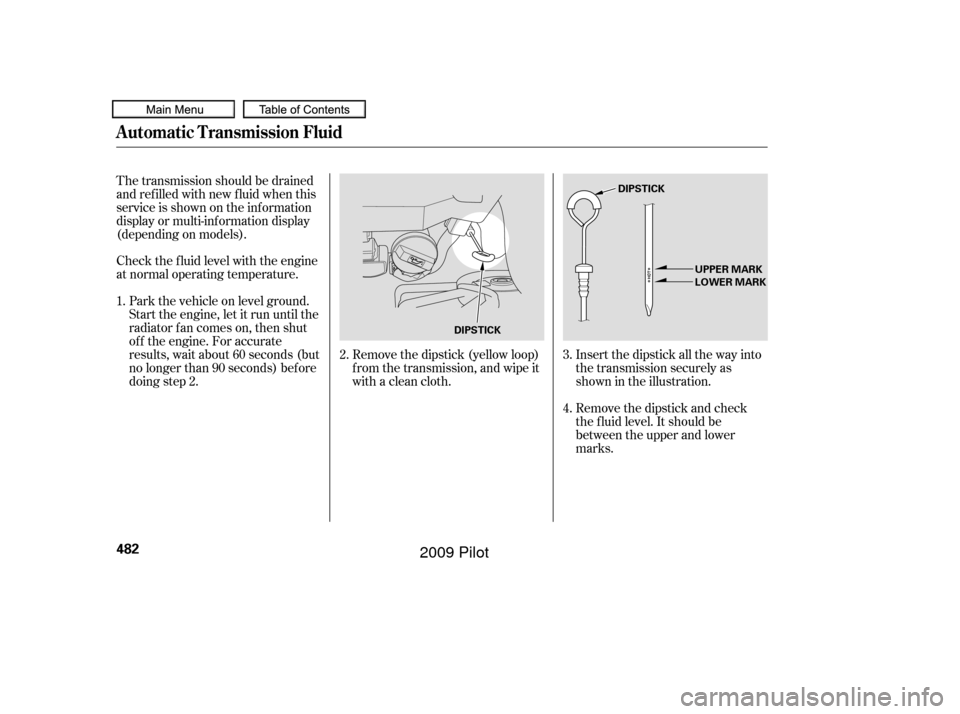
Remove the dipstick (yellow loop)
f rom the transmission, and wipe it
with a clean cloth.Insert the dipstick all the way into
the transmission securely as
shown in the illustration.
Remove the dipstick and check
the f luid level. It should be
between the upper and lower
marks.
Check the f luid level with the engine
at normal operating temperature.
Park the vehicle on level ground.
Start the engine, let it run until the
radiator f an comes on, then shut
of f the engine. For accurate
results, wait about 60 seconds (but
no longer than 90 seconds) bef ore
doing step 2.
The transmission should be drained
and ref illed with new f luid when this
service is shown on the inf ormation
display or multi-inf ormation display
(depending on models).
1.
2.3.
4.
Automatic Transmission Fluid
482
DIPSTICKDIPSTICK
UPPER MARK
LOWER MARK
�����—�����—�
���y�
�������������y���
�(�/���������y���������y
2009 Pilot
Page 487 of 578

If the level is below the lower
mark, add f luid into the dipstick
hole to bring it to the level
between the upper and lower
marks.
Pour the f luid slowly and caref ully
so you do not spill any. Clean up
any spill immediately; it could
damage components in the engine
compartment.The transmission should be drained
and ref illed with new f luid when this
service is shown on a maintenance
message in the multi-inf ormation
display.
If you are not sure how to add f luid,
contact your dealer.
Always use Honda Genuine
ATF-Z1 (automatic transmission
f luid).
Insert the dipstick all the way back
into the transmission securely as
shown in the illustration.
Make sure the rubber cap on the
dipstick f its in the dipstick guide
and that you push the dipstick in
all the way.
5.
6.
Automatic Transmission Fluid
Maint enance
483
Use only Honda Genuine ATF-Z1
(Automatic Transmission Fluid). Do
not mix with other transmission f luids.
Using transmission f luid other than
Honda Genuine ATF-Z1 may cause
deterioration in transmission operation
and durability, and could result in
damage to the transmission.
Damage resulting f rom the use of
transmission f luid other than Honda
Genuine ATF-Z1 is not covered by the
Honda new vehicle warranty.
�����—�����—�
���y�
�������������y���
�(�/���������y���������y
2009 Pilot
Page 514 of 578

If you need to park your vehicle f or
an extended period (more than 1
month), there are several things you
should do to prepare it f or storage.
Proper preparation helps prevent
deterioration and makes it easier to
get your vehicle back on the road. If
possible, store your vehicle indoors.Fill the f uel tank. Block the rear wheels.
If the vehicle is to be stored f or a
longer period, it should be
supported on jackstands so the
tires are of f the ground.
Leave one window open slightly (if
the vehicle is being stored
indoors).
Disconnect the battery.
Support the f ront and rear wiper
blade arms with a f olded towel or
ragsotheydonottouchthe
windshield.
To minimize sticking, apply a
silicone spray lubricant to all door
and tailgate seals. Also, apply a
vehiclebodywaxtothepainted
surfaces that mate with the door
and tailgate seals.Cover the vehicle with a
‘‘breathable’’ cover, one made
f rom a porous material such as
cotton. Non-porous materials, such
as plastic sheeting, trap moisture,
which can damage the paint.
If possible, periodically run the
engine until it reaches f ull
operating temperature (the
cooling f ans cycle on and of f
twice). Pref erably, do this once a
month.
Wash and dry the exterior
completely.
Cleantheinterior.Makesurethe
carpeting, floor mats, etc., are
completely dry.
Leave the parking brake off. Put
the transmission in Park.
Vehicle Storage
510
�����—�����—�
���y�
�������������y���
�(�/���������y�����
���y
2009 Pilot
Page 517 of 578
If you have a f lat tire while driving,
stop in a saf e place to change it.
Drive slowly along the shoulder until
you get to an exit or an area to stop
that is far away from the traffic lanes.Park the vehicle on f irm, level, and
non-slippery ground. Put the
transmission in Park. Apply the
parking brake. Turn on the hazard warning lights,
and turn the ignition switch to the
LOCK (0) position. Have all
passengers get out of the vehicle
while you change the tire.
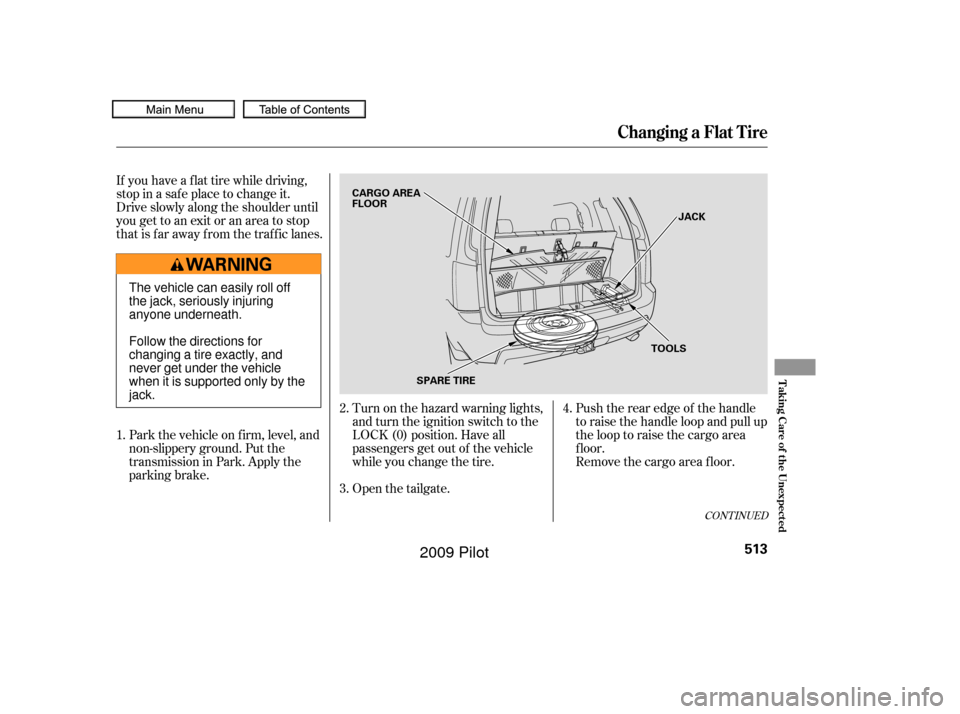
Open the tailgate.Push the rear edge of the handle
to raise the handle loop and pull up
the loop to raise the cargo area
f loor.
Remove the cargo area floor.
2.
1.
3.4.
CONT INUED
Changing a Flat Tire
T aking Care of t he Unexpect ed
513
JACK
TOOLS
SPARE TIRE
CARGO AREA
FLOOR
The vehicle can easily roll off
the jack, seriously injuring
anyone underneath.
Follow the directions for
changing a tire exactly, and
never get under the vehicle
when it is supported only by the
jack.
�����—�����—�
���y�
�������������y���
�(�/���������y�����
���y
2009 Pilot
Page 524 of 578

Diagnosing why the engine won’t
start f alls into two areas, depending
on what you hear when you turn the
ignition switch to the START (III)
position:You hear nothing, or almost
nothing. The engine’s starter
motor does not operate at all, or
operates very slowly.
You can hear the starter motor
operating normally, or the starter
motor sounds like it is spinning
f aster than normal, but the engine
does not start up and run.
When you turn the ignition switch to
the START (III) position, you do not
hear the normal noise of the engine
trying to start. You may hear a
clicking sound, a series of clicks, or
nothing at all. If the headlights dim noticeably or
go out when you try to start the
engine, either the battery is
discharged or the connections are
corroded. Check the condition of
the battery and terminal connec-
tions (see page ). You can
then try jump starting the vehicle
f rom a booster battery (see page
).
In this case, the starter motor’s
speed sounds normal, or even f aster
than normal, when you turn the
ignition switch to the START (III)
position, but the engine does not run. Are you using a properly coded
key? An improperly coded key will
cause the immobilizer system
indicator in the instrument panel
to blink rapidly (see page ).
Check these things:
Check the transmission interlock.
The transmission must be in Park
or neutral or the starter will not
operate.
Turn the ignition switch to the ON
(II) position. Turn on the
headlights, and check their
brightness. If the headlights are
very dim or do not come on at all,
the battery is discharged. See on page .
Turn the ignition switch to the
START (III) position. If the
headlights do not dim, check the
condition of the f uses. If the f uses
areOK,thereisprobably
something wrong with the
electrical circuit for the ignition
switch or starter motor. You will
need a qualif ied technician to
determine the problem. See on page .521
535 508
521
76
Nothing Happens or the Starter
Motor Operates Very Slowly T he Starter Operates Normally
Jump Starting
Emergency T owing
If theEngineWon’tStart
520
�����—�����—�
���y�
���������
���y���
�(�/���������y���������y
2009 Pilot
Page 525 of 578

Are you using the proper starting
procedure? Ref er toon page .
Do you have f uel? Check the f uel
gauge; the warning indicator may
not be working.
There may be an electrical
problem, such as no power to the
f uel pump. Check all the f uses
(see page ).
If youfindnothingwrong,youwill
need a qualif ied technician to f ind
the problem. See on page . Although this seems like a simple
procedure, you should take several
precautions.
You cannot start your vehicle by
pushing or pulling it.
Put the transmission in neutral or
Park, and set the parking brake. Turn of f all the electrical acces-
sories: heater, A/C, climate
control, audio system, lights, etc. Open the hood, and check the
physical condition of the battery.
In very cold weather, check the
condition of the electrolyte. If it
seems slushy or f rozen, do not try
jump starting until it thaws.
1.
2.
415
529 535
CONT INUED
Starting the
Engine
Emergency
Towing Jump Starting
To Jump Start Your Vehicle:
If the Engine Won’t Start, Jump Starting
T aking Care of t he Unexpect ed
521
A battery can explode if you do
not follow the correct procedure,
seriously injuring anyone
nearby.
Keep all sparks, open flames,
and smoking materials away
from the battery.
If a battery sits in extreme cold, the
electrolyte inside can f reeze.
Attempting to jump start with a f rozen
battery can cause it to rupture.
�����—�����—�
���y�
�������������y���
�(�/���������y���������y
2009 Pilot
Page 527 of 578

If you see steam and/or spray
coming f rom under the hood, turn
of f the engine. Wait until you see
no more signs of steam or spray,
then open the hood.
If you do not see steam or spray,
leave the engine running and
watch the temperature gauge. If
the high heat is due to overloading,
the engine should start to cool
down almost immediately. If it
does, wait until the temperature
gauge comes down to the midpoint,
then continue driving.
The pointer of your vehicle’s
temperature gauge should stay in
the midrange under most conditions.
If it climbs to the red mark, you
should determine the reason (hot
day, driving up a steep hill, etc.).
If the vehicle overheats, you should
take immediate action. The only
indication may be the temperature
gauge climbing to or above the red
mark. Or you may see steam or
spray coming f rom under the hood.
Saf ely pull to the side of the road.
Put the transmission in Park, and
set the parking brake. Turn of f all
accessories, and turn on the
hazard warning indicators.
1.
2.
3.
CONT INUED
If theEngineOverheats
T aking Care of t he Unexpect ed
523
Steam and spray from an
overheated engine can
seriously scald you.
Do not open the hood if steam
is coming out.
Driving with the temperature gauge
pointer at the red mark can cause
serious damage to the engine.
�����—�����—�
���y�
�������������y���
�(�/���������y���������y
2009 Pilot
Page 545 of 578
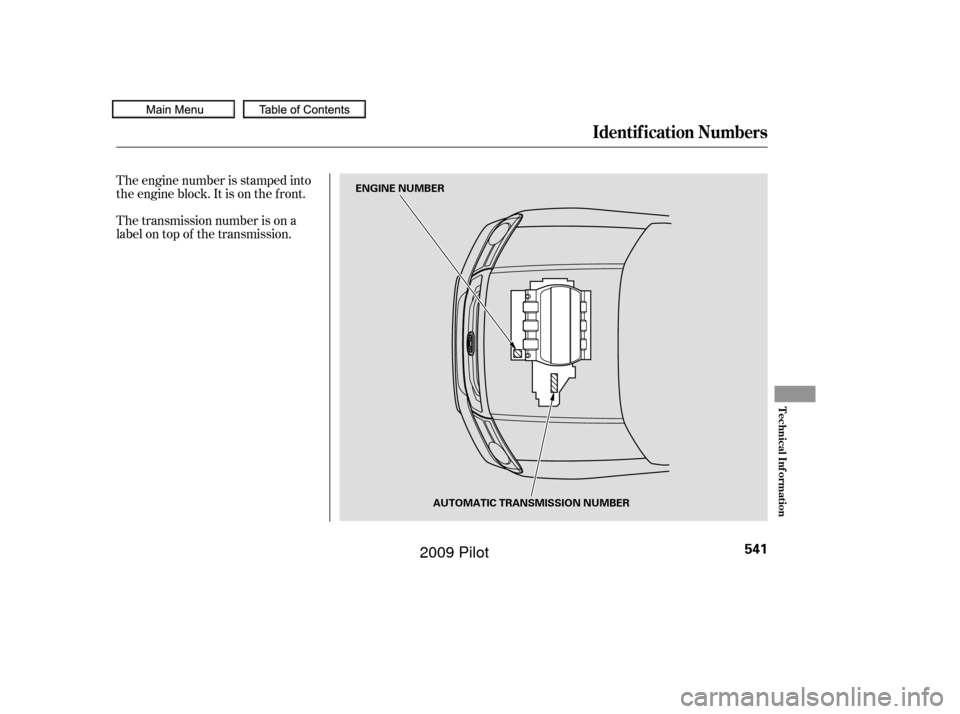
The engine number is stamped into
the engine block. It is on the f ront.
The transmission number is on a
label on top of the transmission.
Identif ication Numbers
Technical Inf ormation
541
ENGINE NUMBERAUTOMATIC TRANSMISSION NUMBER
�����—�����—�
���y�
�������������y���
�(�/���������y���������y
2009 Pilot