2009 GMC CANYON airbag off
[x] Cancel search: airbag offPage 153 of 414
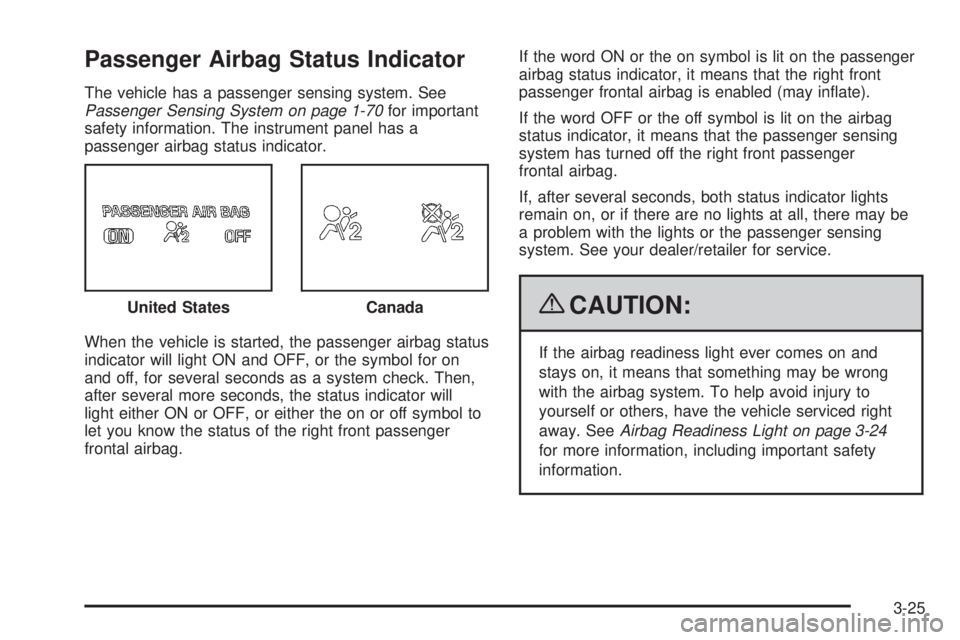
Passenger Airbag Status Indicator
The vehicle has a passenger sensing system. See
Passenger Sensing System on page 1-70for important
safety information. The instrument panel has a
passenger airbag status indicator.
When the vehicle is started, the passenger airbag status
indicator will light ON and OFF, or the symbol for on
and off, for several seconds as a system check. Then,
after several more seconds, the status indicator will
light either ON or OFF, or either the on or off symbol to
let you know the status of the right front passenger
frontal airbag.If the word ON or the on symbol is lit on the passenger
airbag status indicator, it means that the right front
passenger frontal airbag is enabled (may inate).
If the word OFF or the off symbol is lit on the airbag
status indicator, it means that the passenger sensing
system has turned off the right front passenger
frontal airbag.
If, after several seconds, both status indicator lights
remain on, or if there are no lights at all, there may be
a problem with the lights or the passenger sensing
system. See your dealer/retailer for service.
{CAUTION:
If the airbag readiness light ever comes on and
stays on, it means that something may be wrong
with the airbag system. To help avoid injury to
yourself or others, have the vehicle serviced right
away. SeeAirbag Readiness Light on page 3-24
for more information, including important safety
information. United States
Canada
3-25
Page 202 of 414
Skidding
In a skid, a driver can lose control of the vehicle.
Defensive drivers avoid most skids by taking reasonable
care suited to existing conditions, and by not overdriving
those conditions. But skids are always possible.
The three types of skids correspond to your vehicle’s
three control systems. In the braking skid, the wheels are
not rolling. In the steering or cornering skid, too much
speed or steering in a curve causes tires to slip and lose
cornering force. And in the acceleration skid, too much
throttle causes the driving wheels to spin.
If your vehicle starts to slide, ease your foot off the
accelerator pedal and quickly steer the way you want
the vehicle to go. If you start steering quickly enough,
your vehicle may straighten out. Always be ready
for a second skid if it occurs.
Of course, traction is reduced when water, snow, ice,
gravel, or other material is on the road. For safety, you
want to slow down and adjust your driving to these
conditions. It is important to slow down on slippery
surfaces because stopping distance is longer and
vehicle control more limited.While driving on a surface with reduced traction, try
your best to avoid sudden steering, acceleration, or
braking, including reducing vehicle speed by shifting to a
lower gear. Any sudden changes could cause the tires to
slide. You might not realize the surface is slippery until
your vehicle is skidding. Learn to recognize warning
clues — such as enough water, ice, or packed snow on
the road to make a mirrored surface —and slow down
when you have any doubt.
Remember: Any Antilock Brake System (ABS) helps
avoid only the braking skid.
Off-Road Driving
Vehicles with four-wheel drive can be used for off-road
driving. Vehicles without four-wheel drive should not
be driven off-road except on a level, solid surface.
The airbag system is designed to work properly under a
wide range of conditions, including off-road usage.
Always wear your safety belt and observe safe driving
speeds, especially on rough terrain.
4-12
Page 252 of 414
California Proposition 65 Warning
Most motor vehicles, including this one, contain and/or
emit chemicals known to the State of California to cause
cancer and birth defects or other reproductive harm.
Engine exhaust, many parts and systems (including
some inside the vehicle), many uids, and some
component wear by-products contain and/or emit
these chemicals.
California Perchlorate Materials
Requirements
Certain types of automotive applications, such as
airbag initiators, seat belt pretensioners, and lithium
batteries contained in remote keyless transmitters,
may contain perchlorate materials. Special handling
may be necessary. For additional information, see
www.dtsc.ca.gov/hazardouswaste/perchlorate.
Doing Your Own Service Work
{CAUTION:
You can be injured and the vehicle could be
damaged if you try to do service work on a vehicle
without knowing enough about it.
Be sure you have sufficient knowledge,
experience, the proper replacement parts,
and tools before attempting any vehicle
maintenance task.
Be sure to use the proper nuts, bolts, and other
fasteners. English and metric fasteners can
be easily confused. If the wrong fasteners are
used, parts can later break or fall off. You could
be hurt.
5-4
Page 361 of 414
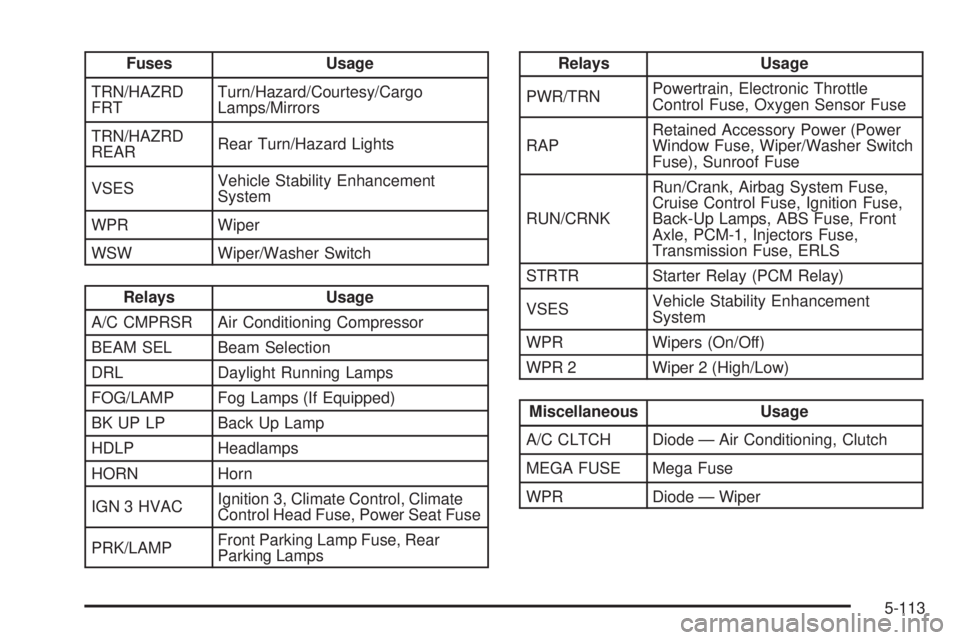
Fuses Usage
TRN/HAZRD
FRTTurn/Hazard/Courtesy/Cargo
Lamps/Mirrors
TRN/HAZRD
REARRear Turn/Hazard Lights
VSESVehicle Stability Enhancement
System
WPR Wiper
WSW Wiper/Washer Switch
Relays Usage
A/C CMPRSR Air Conditioning Compressor
BEAM SEL Beam Selection
DRL Daylight Running Lamps
FOG/LAMP Fog Lamps (If Equipped)
BK UP LP Back Up Lamp
HDLP Headlamps
HORN Horn
IGN 3 HVACIgnition 3, Climate Control, Climate
Control Head Fuse, Power Seat Fuse
PRK/LAMPFront Parking Lamp Fuse, Rear
Parking Lamps
Relays Usage
PWR/TRNPowertrain, Electronic Throttle
Control Fuse, Oxygen Sensor Fuse
RAPRetained Accessory Power (Power
Window Fuse, Wiper/Washer Switch
Fuse), Sunroof Fuse
RUN/CRNKRun/Crank, Airbag System Fuse,
Cruise Control Fuse, Ignition Fuse,
Back-Up Lamps, ABS Fuse, Front
Axle, PCM-1, Injectors Fuse,
Transmission Fuse, ERLS
STRTR Starter Relay (PCM Relay)
VSESVehicle Stability Enhancement
System
WPR Wipers (On/Off)
WPR 2 Wiper 2 (High/Low)
Miscellaneous Usage
A/C CLTCH Diode — Air Conditioning, Clutch
MEGA FUSE Mega Fuse
WPR Diode — Wiper
5-113
Page 399 of 414
Event Data Recorders
This vehicle has an Event Data Recorder (EDR). The
main purpose of an EDR is to record, in certain crash or
near crash-like situations, such as an airbag deployment
or hitting a road obstacle, data that will assist in
understanding how a vehicle’s systems performed. The
EDR is designed to record data related to vehicle
dynamics and safety systems for a short period of time,
typically 30 seconds or less. The EDR in this vehicle is
designed to record such data as:
How various systems in your vehicle were operating
Whether or not the driver and passenger safety belts
were buckled/fastened
How far, if at all, the driver was pressing the
accelerator and/or brake pedal
How fast the vehicle was traveling
This data can help provide a better understanding of the
circumstances in which crashes and injuries occur.Important:EDR data is recorded by your vehicle only if
a non-trivial crash situation occurs; no data is recorded
by the EDR under normal driving conditions and no
personal data (e.g., name, gender, age, and crash
location) is recorded. However, other parties, such as law
enforcement, could combine the EDR data with the type
of personally identifying data routinely acquired during a
crash investigation.
To read data recorded by an EDR, special equipment is
required, and access to the vehicle or the EDR is needed.
In addition to the vehicle manufacturer, other parties,
such as law enforcement, that have the special
equipment, can read the information if they have access
to the vehicle or the EDR.
GM will not access this data or share it with others
except: with the consent of the vehicle owner or, if the
vehicle is leased, with the consent of the lessee; in
response to an official request of police or similar
government office; as part of GM’s defense of litigation
through the discovery process; or, as required by law.
Data that GM collects or receives may also be used for
GM research needs or may be made available to others
for research purposes, where a need is shown and the
data is not tied to a specic vehicle or vehicle owner.
7-17
Page 409 of 414

Mirrors
Automatic Dimming Rearview........................2-37
Manual Rearview Mirror................................2-37
Outside Convex Mirror.................................2-40
Outside Manual Mirrors................................2-39
Outside Power Mirrors..................................2-40
MP3 .............................................................3-54
MyGMLink.com................................................ 7-5
N
Navigation System, Privacy..............................7-18
New Vehicle Break-In......................................2-18
O
Odometer......................................................3-22
Odometer, Trip...............................................3-22
Off-Road Driving.............................................4-12
Off-Road Recovery..........................................4-11
Oil
Engine.......................................................5-15
Pressure Light.............................................3-32
Oil, Engine Oil Life System..............................5-18Older Children, Restraints................................1-35
Online Owner Center........................................ 7-5
OnStar, Privacy..............................................7-18
OnStar
®System, see OnStar®Manual...............2-41
Outlet Adjustment............................................3-20
Outlets
Accessory Power.........................................3-17
Outside
Convex Mirror.............................................2-40
Manual Mirrors............................................2-39
Power Mirrors.............................................2-40
Owner Checks and Services.............................. 6-8
Owners, Canadian............................................... ii
P
Paint, Damage..............................................5-106
Park
Shifting Into................................................2-32
Shifting Out of............................................2-34
Park Brake....................................................2-31
Parking
Over Things That Burn.................................2-35
Parking Your Vehicle.......................................2-34
Passenger Airbag Status Indicator.....................3-25
9