2009 GMC CANYON tailgate
[x] Cancel search: tailgatePage 17 of 414
Safety Belts
Safety Belts: They Are for Everyone
This part of the manual tells you how to use safety
belts properly. It also tells you some things you should
not do with safety belts.
{CAUTION:
Do not let anyone ride where a safety belt cannot
be worn properly. In a crash, if you or your
passenger(s) are not wearing safety belts, the
injuries can be much worse. You can hit things
inside the vehicle harder or be ejected from the
vehicle. You and your passenger(s) can be
seriously injured or killed. In the same crash, you
might not be, if you are buckled up. Always fasten
your safety belt, and check that your passenger(s)
are restrained properly too.
{CAUTION:
People riding on the tailgate (if equipped) can
easily lose their balance and fall even when the
vehicle is operated at low speeds. Falling from a
moving vehicle may result in serious injuries or
death.
{CAUTION:
It is extremely dangerous to ride in a cargo area,
inside or outside of a vehicle. In a collision, people
riding in these areas are more likely to be seriously
injured or killed. Do not allow people to ride in any
area of your vehicle that is not equipped with seats
and safety belts. Be sure everyone in your vehicle is
in a seat and using a safety belt properly.
Your vehicle has indicators as a reminder to buckle your
safety belts. SeeSafety Belt Reminders on page 3-23.
1-13
Page 83 of 414

Keys...............................................................2-3
Remote Keyless Entry (RKE) System................2-4
Remote Keyless Entry (RKE) System
Operation...................................................2-4
Doors and Locks.............................................2-6
Door Locks....................................................2-6
Power Door Locks..........................................2-7
Programmable Automatic Door Locks................2-7
Rear Door Security Locks (Crew Cab)...............2-8
Lockout Protection..........................................2-8
Rear Doors (Extended Cab).............................2-9
Tailgate........................................................2-9
Windows........................................................2-11
Manual Windows..........................................2-12
Power Windows............................................2-12
Sliding Rear Window.....................................2-13
Sun Visors...................................................2-13
Theft-Deterrent Systems..................................2-14
Content Theft-Deterrent.................................2-14
Passlock
®(U.S. Only)...................................2-15
PASS-Key®III+ Electronic Immobilizer.............2-16
PASS-Key®III+ Electronic Immobilizer
Operation (Canada Only)............................2-16Starting and Operating Your Vehicle................2-18
New Vehicle Break-In....................................2-18
Ignition Positions..........................................2-18
Retained Accessory Power (RAP)...................2-19
Starting the Engine.......................................2-20
Engine Coolant Heater..................................2-21
Automatic Transmission Operation...................2-22
Manual Transmission Operation......................2-25
Four-Wheel Drive..........................................2-26
Parking Brake..............................................2-31
Shifting Into Park (Automatic
Transmission)...........................................2-32
Shifting Out of Park (Automatic
Transmission)...........................................2-34
Parking the Vehicle (Manual
Transmission)...........................................2-34
Parking Over Things That Burn.......................2-35
Engine Exhaust............................................2-35
Running the Vehicle While Parked..................2-36
Section 2 Features and Controls
2-1
Page 85 of 414
Keys
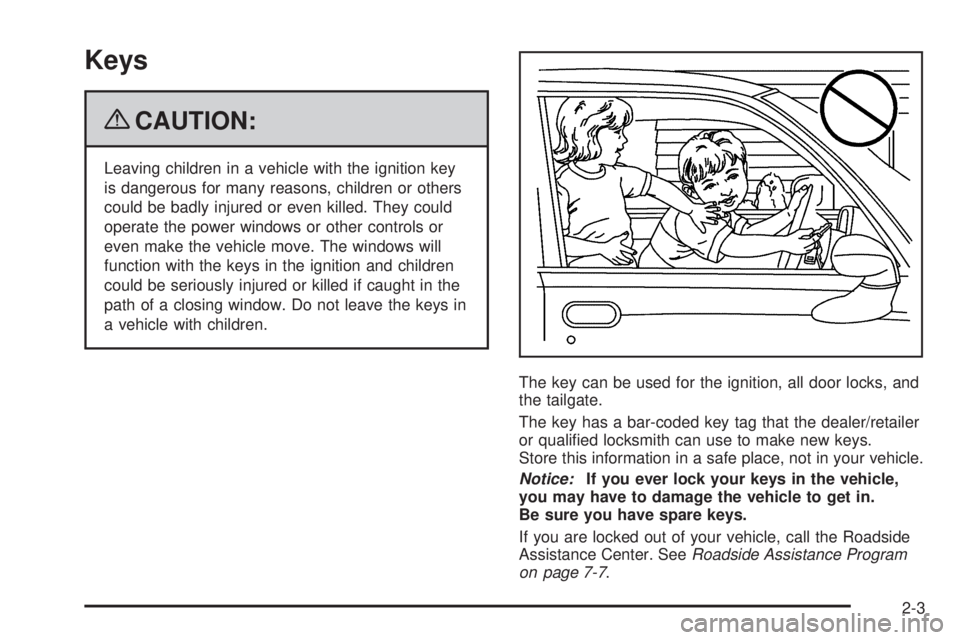
{CAUTION:
Leaving children in a vehicle with the ignition key
is dangerous for many reasons, children or others
could be badly injured or even killed. They could
operate the power windows or other controls or
even make the vehicle move. The windows will
function with the keys in the ignition and children
could be seriously injured or killed if caught in the
path of a closing window. Do not leave the keys in
a vehicle with children.
The key can be used for the ignition, all door locks, and
the tailgate.
The key has a bar-coded key tag that the dealer/retailer
or qualied locksmith can use to make new keys.
Store this information in a safe place, not in your vehicle.
Notice:If you ever lock your keys in the vehicle,
you may have to damage the vehicle to get in.
Be sure you have spare keys.
If you are locked out of your vehicle, call the Roadside
Assistance Center. SeeRoadside Assistance Program
on page 7-7.
2-3
Page 91 of 414
Rear Doors (Extended Cab)
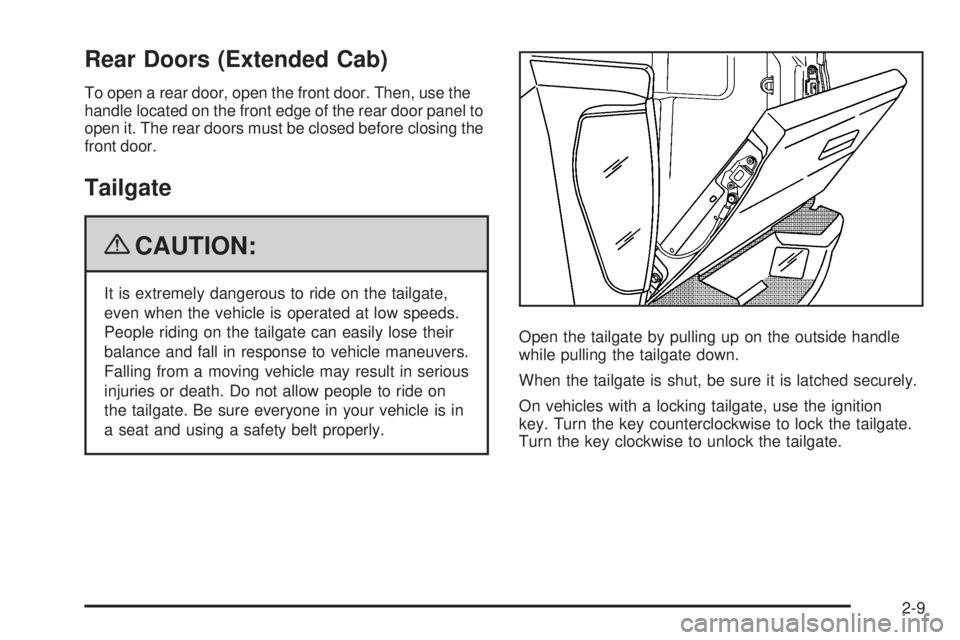
To open a rear door, open the front door. Then, use the
handle located on the front edge of the rear door panel to
open it. The rear doors must be closed before closing the
front door.
Tailgate
{CAUTION:
It is extremely dangerous to ride on the tailgate,
even when the vehicle is operated at low speeds.
People riding on the tailgate can easily lose their
balance and fall in response to vehicle maneuvers.
Falling from a moving vehicle may result in serious
injuries or death. Do not allow people to ride on
the tailgate. Be sure everyone in your vehicle is in
a seat and using a safety belt properly.Open the tailgate by pulling up on the outside handle
while pulling the tailgate down.
When the tailgate is shut, be sure it is latched securely.
On vehicles with a locking tailgate, use the ignition
key. Turn the key counterclockwise to lock the tailgate.
Turn the key clockwise to unlock the tailgate.
2-9
Page 92 of 414
Removing the Tailgate
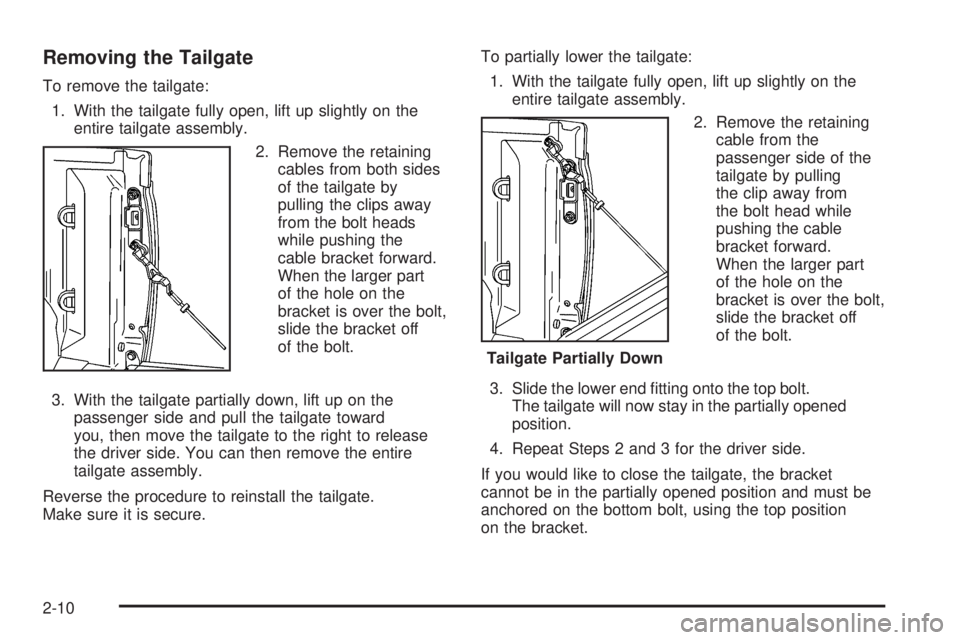
To remove the tailgate:
1. With the tailgate fully open, lift up slightly on the
entire tailgate assembly.
2. Remove the retaining
cables from both sides
of the tailgate by
pulling the clips away
from the bolt heads
while pushing the
cable bracket forward.
When the larger part
of the hole on the
bracket is over the bolt,
slide the bracket off
of the bolt.
3. With the tailgate partially down, lift up on the
passenger side and pull the tailgate toward
you, then move the tailgate to the right to release
the driver side. You can then remove the entire
tailgate assembly.
Reverse the procedure to reinstall the tailgate.
Make sure it is secure.To partially lower the tailgate:
1. With the tailgate fully open, lift up slightly on the
entire tailgate assembly.
2. Remove the retaining
cable from the
passenger side of the
tailgate by pulling
the clip away from
the bolt head while
pushing the cable
bracket forward.
When the larger part
of the hole on the
bracket is over the bolt,
slide the bracket off
of the bolt.
3. Slide the lower end tting onto the top bolt.
The tailgate will now stay in the partially opened
position.
4. Repeat Steps 2 and 3 for the driver side.
If you would like to close the tailgate, the bracket
cannot be in the partially opened position and must be
anchored on the bottom bolt, using the top position
on the bracket.
Tailgate Partially Down
2-10
Page 298 of 414
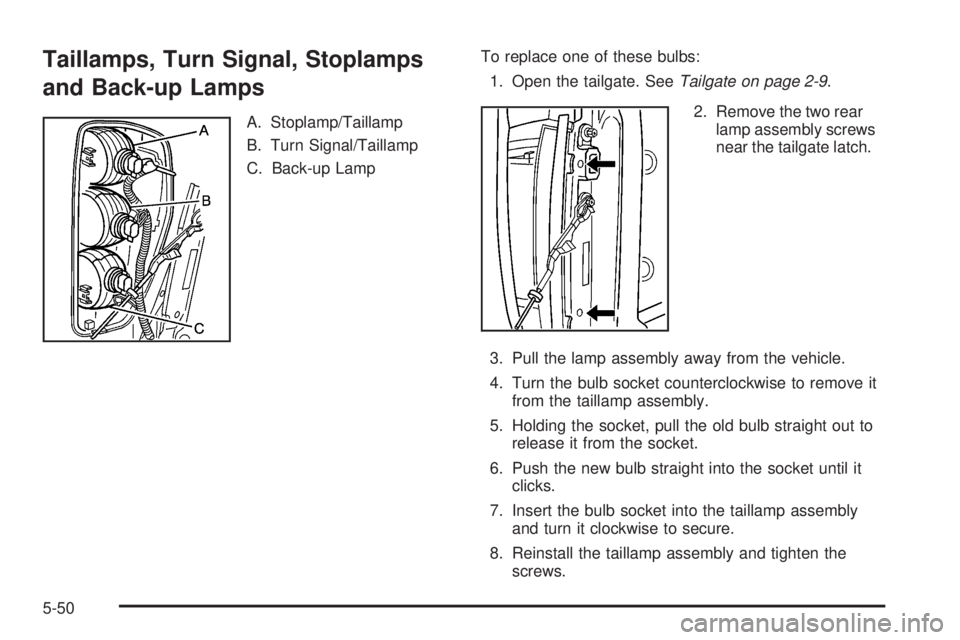
Taillamps, Turn Signal, Stoplamps
and Back-up Lamps
A. Stoplamp/Taillamp
B. Turn Signal/Taillamp
C. Back-up LampTo replace one of these bulbs:
1. Open the tailgate. SeeTailgate on page 2-9.
2. Remove the two rear
lamp assembly screws
near the tailgate latch.
3. Pull the lamp assembly away from the vehicle.
4. Turn the bulb socket counterclockwise to remove it
from the taillamp assembly.
5. Holding the socket, pull the old bulb straight out to
release it from the socket.
6. Push the new bulb straight into the socket until it
clicks.
7. Insert the bulb socket into the taillamp assembly
and turn it clockwise to secure.
8. Reinstall the taillamp assembly and tighten the
screws.
5-50
Page 371 of 414
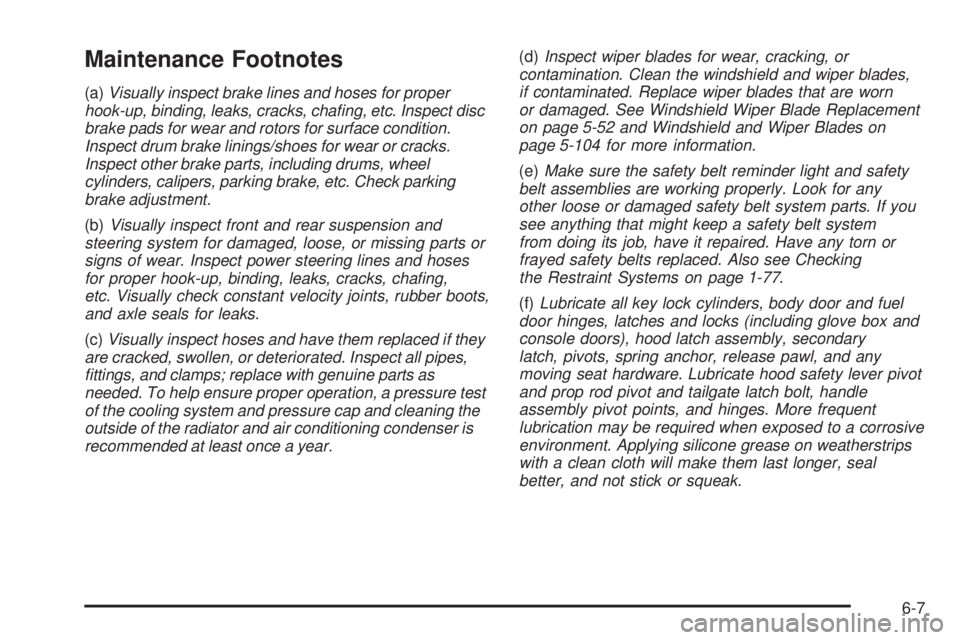
Maintenance Footnotes
(a)Visually inspect brake lines and hoses for proper
hook-up, binding, leaks, cracks, chafing, etc. Inspect disc
brake pads for wear and rotors for surface condition.
Inspect drum brake linings/shoes for wear or cracks.
Inspect other brake parts, including drums, wheel
cylinders, calipers, parking brake, etc. Check parking
brake adjustment.
(b)Visually inspect front and rear suspension and
steering system for damaged, loose, or missing parts or
signs of wear. Inspect power steering lines and hoses
for proper hook-up, binding, leaks, cracks, chafing,
etc. Visually check constant velocity joints, rubber boots,
and axle seals for leaks.
(c)Visually inspect hoses and have them replaced if they
are cracked, swollen, or deteriorated. Inspect all pipes,
fittings, and clamps; replace with genuine parts as
needed. To help ensure proper operation, a pressure test
of the cooling system and pressure cap and cleaning the
outside of the radiator and air conditioning condenser is
recommended at least once a year.(d)Inspect wiper blades for wear, cracking, or
contamination. Clean the windshield and wiper blades,
if contaminated. Replace wiper blades that are worn
or damaged. See Windshield Wiper Blade Replacement
on page 5-52 and Windshield and Wiper Blades on
page 5-104 for more information.
(e)Make sure the safety belt reminder light and safety
belt assemblies are working properly. Look for any
other loose or damaged safety belt system parts. If you
see anything that might keep a safety belt system
from doing its job, have it repaired. Have any torn or
frayed safety belts replaced. Also see Checking
the Restraint Systems on page 1-77.
(f)Lubricate all key lock cylinders, body door and fuel
door hinges, latches and locks (including glove box and
console doors), hood latch assembly, secondary
latch, pivots, spring anchor, release pawl, and any
moving seat hardware. Lubricate hood safety lever pivot
and prop rod pivot and tailgate latch bolt, handle
assembly pivot points, and hinges. More frequent
lubrication may be required when exposed to a corrosive
environment. Applying silicone grease on weatherstrips
with a clean cloth will make them last longer, seal
better, and not stick or squeak.
6-7
Page 377 of 414
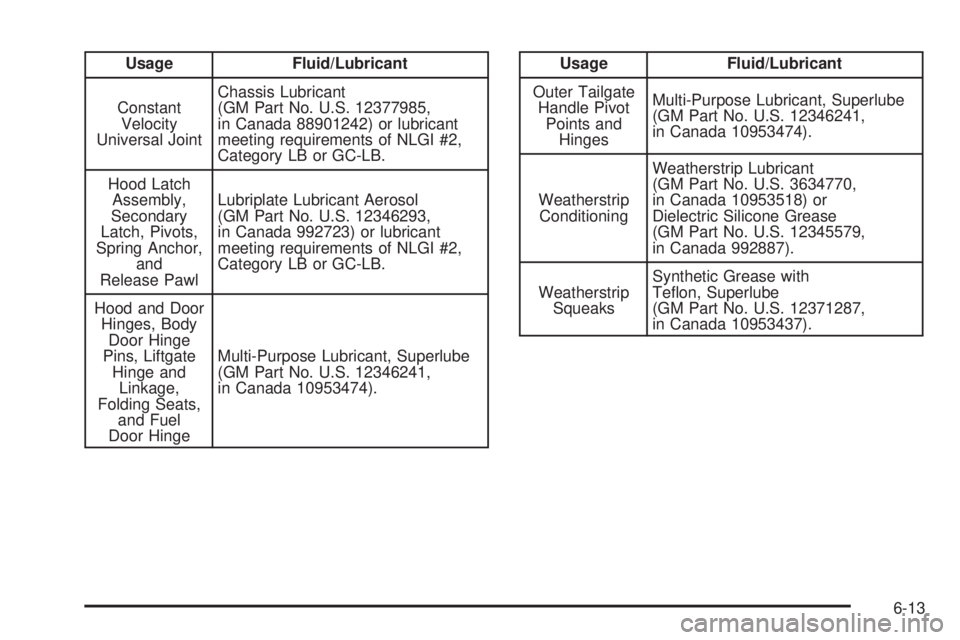
Usage Fluid/Lubricant
Constant
Velocity
Universal JointChassis Lubricant
(GM Part No. U.S. 12377985,
in Canada 88901242) or lubricant
meeting requirements of NLGI #2,
Category LB or GC-LB.
Hood Latch
Assembly,
Secondary
Latch, Pivots,
Spring Anchor,
and
Release PawlLubriplate Lubricant Aerosol
(GM Part No. U.S. 12346293,
in Canada 992723) or lubricant
meeting requirements of NLGI #2,
Category LB or GC-LB.
Hood and Door
Hinges, Body
Door Hinge
Pins, Liftgate
Hinge and
Linkage,
Folding Seats,
and Fuel
Door HingeMulti-Purpose Lubricant, Superlube
(GM Part No. U.S. 12346241,
in Canada 10953474).Usage Fluid/Lubricant
Outer Tailgate
Handle Pivot
Points and
HingesMulti-Purpose Lubricant, Superlube
(GM Part No. U.S. 12346241,
in Canada 10953474).
Weatherstrip
ConditioningWeatherstrip Lubricant
(GM Part No. U.S. 3634770,
in Canada 10953518) or
Dielectric Silicone Grease
(GM Part No. U.S. 12345579,
in Canada 992887).
Weatherstrip
SqueaksSynthetic Grease with
Teon, Superlube
(GM Part No. U.S. 12371287,
in Canada 10953437).
6-13