2009 FORD SUPER DUTY check engine
[x] Cancel search: check enginePage 3 of 103
Important notice
Ford vehicles are suitable for producing ambulances only if equipped
with the Ford ambulance preparation package. In addition, Ford urges
ambulance manufacturers to follow the recommendation of theFord
Incomplete Vehicle Manual, Ford Truck Body Builder’s Layout Book
(and pertinent supplements) and theQualified Vehicle Modifiers
Guidelines.Using a Ford vehicle without the Ford ambulance
preparation package to produce an ambulance voids the Ford warranty
and could result in elevated underbody temperatures, fuel
overpressurization and the risk of fuel expulsion and fires. To determine
whether the vehicle is equipped with the Ford ambulance preparation
package, inspect the information plate on the driver’s side door pillar.
Contact the manufacturer of your vehicle to determine whether the
ambulance manufacturer’s followed Ford’s recommendations.
WARNINGS
Throughout this guide, you will find warnings identified by the
symbol
. Warnings remind you to be especially careful to reduce the
risk of personal injury.
NEW VEHICLE BREAK-IN
Your vehicle does not need an extensive break-in. Try not to drive
continuously at the same speed for the first 1,000 miles (1,600 km) of
new vehicle operation. Vary your speed to allow parts to adjust
themselves to other parts.
Drive your new vehicle at least 500 miles (800 km) before towing a
trailer. Make sure you use the specified engine oil by checking the engine
oil specification chart underEngine oilin theMaintenance and
Specificationschapter.
Do not add friction modifier compounds or special break-in oils during
the first few thousand miles (kilometers) of operation, since these
additives may prevent piston ring seating. SeeEngine oilin the
Maintenance and Specificationschapter of this supplement for more
information on oil usage.
DIESEL ENGINE INFORMATION
The Diesel engine fuel system consists of:
•On E-Series vehicles (6.0L engine),a Diesel Fuel Conditioner
Module (DFCM) mounted on the driver-side frame rail next to the
transmission
2009 Econoline(eco)
Supplement, 1st Printing
USA(fus)
Introduction
3
Page 9 of 103
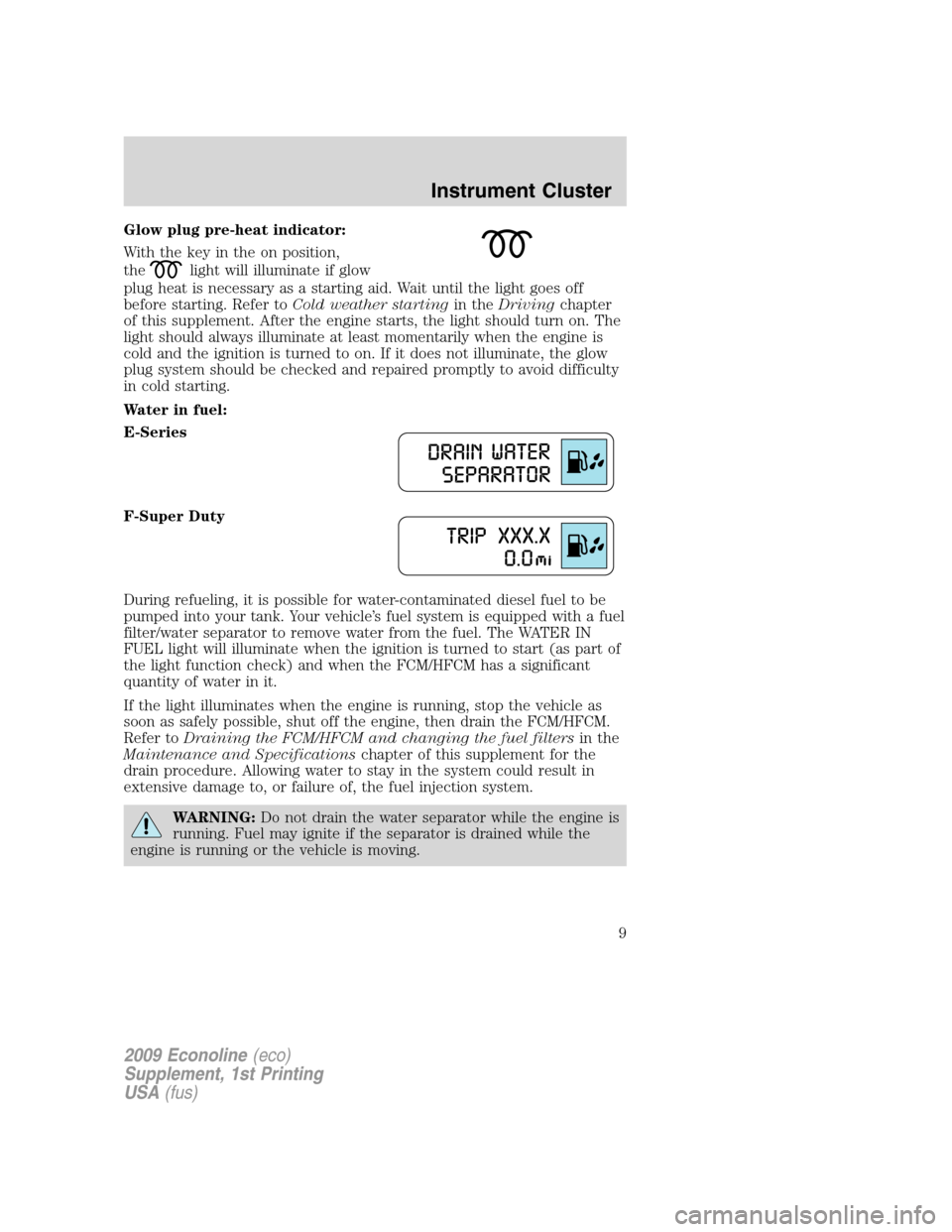
Glow plug pre-heat indicator:
With the key in the on position,
the
light will illuminate if glow
plug heat is necessary as a starting aid. Wait until the light goes off
before starting. Refer toCold weather startingin theDrivingchapter
of this supplement. After the engine starts, the light should turn on. The
light should always illuminate at least momentarily when the engine is
cold and the ignition is turned to on. If it does not illuminate, the glow
plug system should be checked and repaired promptly to avoid difficulty
in cold starting.
Water in fuel:
E-Series
F-Super Duty
During refueling, it is possible for water-contaminated diesel fuel to be
pumped into your tank. Your vehicle’s fuel system is equipped with a fuel
filter/water separator to remove water from the fuel. The WATER IN
FUEL light will illuminate when the ignition is turned to start (as part of
the light function check) and when the FCM/HFCM has a significant
quantity of water in it.
If the light illuminates when the engine is running, stop the vehicle as
soon as safely possible, shut off the engine, then drain the FCM/HFCM.
Refer toDraining the FCM/HFCM and changing the fuel filtersin the
Maintenance and Specificationschapter of this supplement for the
drain procedure. Allowing water to stay in the system could result in
extensive damage to, or failure of, the fuel injection system.
WARNING:Do not drain the water separator while the engine is
running. Fuel may ignite if the separator is drained while the
engine is running or the vehicle is moving.
2009 Econoline(eco)
Supplement, 1st Printing
USA(fus)
Instrument Cluster
9
Page 14 of 103
Your vehicle is also equipped with a bypass relief valve, located in the
fuel tank pick-up boot, which provides fuel flow to the engine if the fuel
pickup should become plugged by ice or wax. To allow the bypass valve
to function and avoid engine fuel starvation, it is recommended that,
during cold weather operation 32°F (0°C) or below, the fuel level in your
tank should not be allowed to drop below
14full. This will help prevent
air from entering the fuel system and stalling the engine.
In cold weather below 32°F (0°C), the engine will slowly increase to a
higher idle speed if left idling in P (Park). As the engine warms-up, the
engine sound level will decrease due to the activation of PCM-controlled
sound reduction features.
If your vehicle is operated in a heavy snow storm or blowing snow
conditions, the engine air induction may become partially clogged with
snow and/or ice. If this occurs, the engine may experience a significant
reduction in power output. At the earliest opportunity, clear all the snow
and/or ice away from inside the air filter assembly. Take the top off the
assembly, leaving the air filter in, and remove any snow or ice.
In order to operate the engine in temperatures of 32°F (0°C) or lower,
read the following instructions:
•Make sure that the batteries are of sufficient size and are fully
charged. Check other electrical components to make sure they are in
optimum condition.
•Use Motorcraft Premium Gold Engine Coolant solution at the
concentration recommended to protect the engine against damage
from freezing.
•Try to keep the fuel tank full as much as possible at the end of
operation to prevent condensation in the fuel system.
•Make sure you use proper cold weather engine oil and that it is at its
proper level. Also, if necessary, make sure to follow the engine oil and
filter change schedule found under theSpecial operating conditions
section in thescheduled maintenance guideinformation.
•At temperatures of -10°F (-23°C) or below, it is recommended that
you use an engine block heater to improve cold engine starting.
•If operating in arctic temperatures of -20°F (-29°C) or lower, consult
your truck dealer for information about special cold weather
equipment and precautions.
Note:Idling in cold weather will not heat the engine to its normal
operating temperature. Long periods of idling in cold weather can cause
a buildup of heavy deposits of carbon and rust on valve stems causing
them to stick, which in turn, can cause valve train damage.
2009 Econoline(eco)
Supplement, 1st Printing
USA(fus)
Driving
14
Page 16 of 103
produce “coking” or “wet stacking”, which is common to all diesel
engines when idling for extended periods during cold ambient
temperatures.
•Your vehicle may have a factory option for a Stationary Elevated Idle
Control (SEIC) through dash-mounted Upfitter switches will allow the
operator to elevate the idle rpm for extended idle periods, as well as
aftermarket equipment such as PTO operation. This feature must be
configured even if ordered from the factory. See your authorized
dealer for required upfitting.
Operation in snow
Vehicle operation in heavy snowfall or extreme rain conditions may feed
excessive amounts of snow/water into the air intake system. This could
plug/soak the air filter with snow and may cause the engine to lose
power and possibly shut down.
Either of these conditions may cause the CHECK AIR FILTER message
to appear in the message center.
You may not need to change the air filter and the vehicle may be driven
up to 200 miles (320 km) under the following conditions:
•Snow:At the earliest opportunity, open the hood and clear all the
snow and ice from the air filter housing inlet (do NOT remove the air
filter) and reset the air filter restriction gauge.
•Wet:The air filter will dry after about 15–30 minutes at highway
speeds. At the earliest opportunity, open the hood and reset the air
filter restriction gauge.
Refer toAir filter and restriction gaugein theMaintenance and
Specificationschapter of this supplement for more information.
Operation in standing water
Ingestion of water into the diesel engine can result in immediate and
severe damage to the engine. If driving through water, slow down to
avoid splashing water into the intake. If the engine stalls, and ingestion
of water into the engine is suspected, do not try to restart the engine.
Consult your dealer for service immediately.
2009 Econoline(eco)
Supplement, 1st Printing
USA(fus)
Driving
16
Page 41 of 103
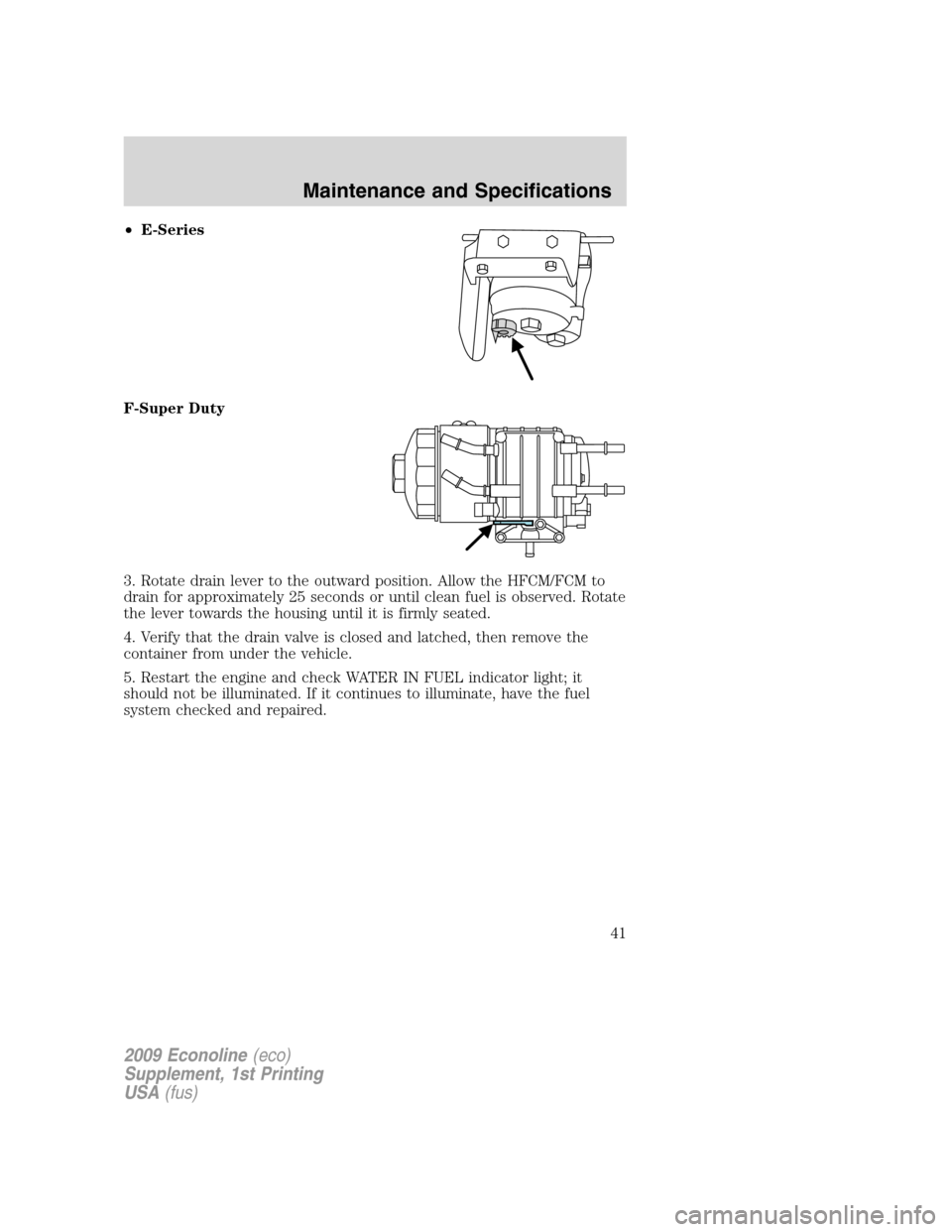
•E-Series
F-Super Duty
3. Rotate drain lever to the outward position. Allow the HFCM/FCM to
drain for approximately 25 seconds or until clean fuel is observed. Rotate
the lever towards the housing until it is firmly seated.
4. Verify that the drain valve is closed and latched, then remove the
container from under the vehicle.
5. Restart the engine and check WATER IN FUEL indicator light; it
should not be illuminated. If it continues to illuminate, have the fuel
system checked and repaired.
2009 Econoline(eco)
Supplement, 1st Printing
USA(fus)
Maintenance and Specifications
41
Page 44 of 103
Installation - both
The engine will not run properly if the fuel filter is not installed
in housing.
1. Install the new fuel filter and cap seal into the fuel filter housing.
Refer toMotorcraft Part Numberslater in this chapter for the fuel filter
part number.
2. Tighten cap onto fuel filter housing slowly, allowing fuel to soak into
the fuel filter element. Tighten cap until it contacts the housing.
Turn the ignition key to on for 30 seconds, then turn it to off. Do this a
total of six times in a row to purge any trapped air from the fuel system.
Replace the filter bowl O-ring with new seal (included in filter kit) every
time you service the filter.
After filter service, a no start or rough running engine may indicate that
air is entering the system through the filter bowl seal or drain. Make sure
the drain lever is pointing rearward and stowed against the HFCM case.
Using a fuel which has more than average impurities may require
the fuel filter to be replaced more frequently than the service
interval specifies.
ENGINE OIL
Checking the engine oil level
Because it is normal to add some oil between oil changes, check your
engine oil level each time you stop for fuel. To check the engine oil level
consistently and accurately, the following procedure is recommended:
1. Have engine at normal operating temperature (at least into the
NORMAL range on the engine coolant temperature gauge).
2. Park the vehicle on a level surface, then turn off the engine and open
the hood.
3. Allow at least20 minutesafter engine shutdown to ensure that the
oil contained in the upper parts of the engine has returned to the oil
pan.
4. Protecting yourself from engine heat, pull out the dipstick, wipe it
clean and reinsert fully.
5. Read oil level on both sides of dipstick and use highest level (reading)
for the actual engine oil level.
6. Maintain the oil level between MIN and MAX or the ADD and
OPERATING RANGE on the dipstick by adding oil as required. The
2009 Econoline(eco)
Supplement, 1st Printing
USA(fus)
Maintenance and Specifications
44
Page 48 of 103
•use of biodiesel, up to and including 5% Biodiesel (B5)
•use of high sulfur diesel fuel
If you are operating your vehicle under any of these conditions, change
engine oil and filter every 5,000 miles (8,000 km).
AIR FILTER RESTRICTION GAUGE AND AIR FILTER
REPLACEMENT
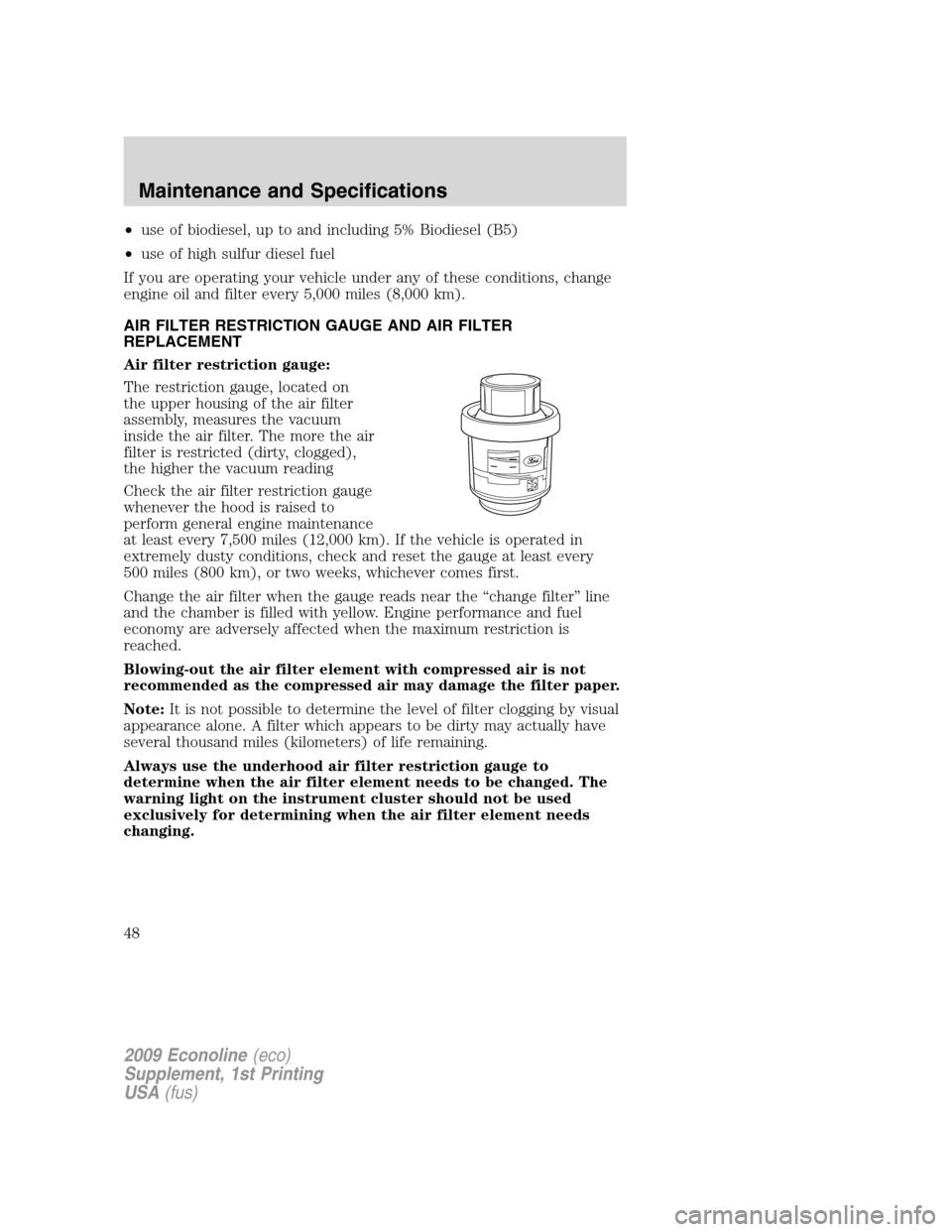
Air filter restriction gauge:
The restriction gauge, located on
the upper housing of the air filter
assembly, measures the vacuum
inside the air filter. The more the air
filter is restricted (dirty, clogged),
the higher the vacuum reading
Check the air filter restriction gauge
whenever the hood is raised to
perform general engine maintenance
at least every 7,500 miles (12,000 km). If the vehicle is operated in
extremely dusty conditions, check and reset the gauge at least every
500 miles (800 km), or two weeks, whichever comes first.
Change the air filter when the gauge reads near the “change filter” line
and the chamber is filled with yellow. Engine performance and fuel
economy are adversely affected when the maximum restriction is
reached.
Blowing-out the air filter element with compressed air is not
recommended as the compressed air may damage the filter paper.
Note:It is not possible to determine the level of filter clogging by visual
appearance alone. A filter which appears to be dirty may actually have
several thousand miles (kilometers) of life remaining.
Always use the underhood air filter restriction gauge to
determine when the air filter element needs to be changed. The
warning light on the instrument cluster should not be used
exclusively for determining when the air filter element needs
changing.
2009 Econoline(eco)
Supplement, 1st Printing
USA(fus)
Maintenance and Specifications
48
Page 49 of 103
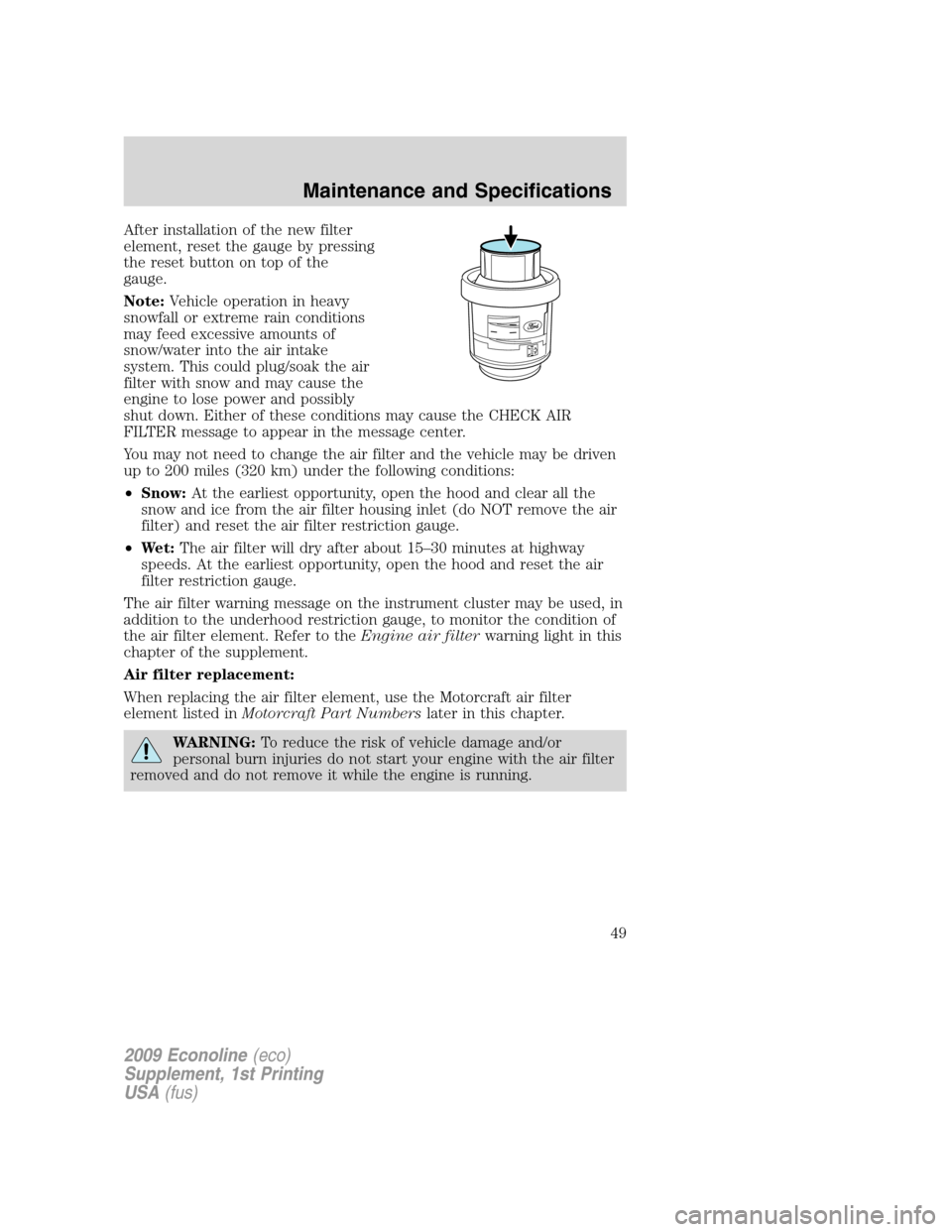
After installation of the new filter
element, reset the gauge by pressing
the reset button on top of the
gauge.
Note:Vehicle operation in heavy
snowfall or extreme rain conditions
may feed excessive amounts of
snow/water into the air intake
system. This could plug/soak the air
filter with snow and may cause the
engine to lose power and possibly
shut down. Either of these conditions may cause the CHECK AIR
FILTER message to appear in the message center.
You may not need to change the air filter and the vehicle may be driven
up to 200 miles (320 km) under the following conditions:
•Snow:At the earliest opportunity, open the hood and clear all the
snow and ice from the air filter housing inlet (do NOT remove the air
filter) and reset the air filter restriction gauge.
•Wet:The air filter will dry after about 15–30 minutes at highway
speeds. At the earliest opportunity, open the hood and reset the air
filter restriction gauge.
The air filter warning message on the instrument cluster may be used, in
addition to the underhood restriction gauge, to monitor the condition of
the air filter element. Refer to theEngine air filterwarning light in this
chapter of the supplement.
Air filter replacement:
When replacing the air filter element, use the Motorcraft air filter
element listed inMotorcraft Part Numberslater in this chapter.
WARNING:To reduce the risk of vehicle damage and/or
personal burn injuries do not start your engine with the air filter
removed and do not remove it while the engine is running.
2009 Econoline(eco)
Supplement, 1st Printing
USA(fus)
Maintenance and Specifications
49