2009 FORD SUPER DUTY check engine
[x] Cancel search: check enginePage 54 of 103
Do not remove or alter the original equipment floor covering or
insulation between it and the metal floor of the vehicle. The floor
covering and insulation protect occupants of the vehicle from the engine
and exhaust system heat and noise. On vehicles with no original
equipment floor covering insulation, do not carry passengers in a manner
that permits prolonged skin contact with the metal floor. Provide
adequate insulation.
NOISE EMISSIONS WARRANTY, PROHIBITED TAMPERING ACTS
AND MAINTENANCE
On January 1, 1978, Federal regulation became effective governing the
noise emission on trucks over 10,000 lbs. (4,536 kg) GVWR (Gross
Vehicle Weight Rating). The following statements concerning prohibited
tampering acts and maintenance, and the noise warranty found in the
Warranty Guide, are applicable to complete chassis cabs over
10,000 lbs. (4,536 kg) GVWR.
Tampering with noise control system prohibited
Federal law prohibits the following acts or the causing thereof: (1) The
removal or rendering inoperative by any person other than for purposes
of maintenance, repair or replacement of any device or element of design
incorporated into any new vehicle for the purpose of noise control prior
to its sale or delivery to the ultimate purchaser or while it is in use, or
(2) the use of the vehicle after such device or element of design has
been removed or rendered inoperative by any person.
Among those acts which the U.S. Environmental Protection Agency may
presume to constitute tampering are the acts listed below:
•Removal of hood blanket, fender apron absorbers, fender apron
barriers, underbody noise shields or acoustically absorptive material.
•Tampering or rendering inoperative the engine speed governor, so as
to allow engine speed to exceed manufacturer’s specifications.
The complexity of the diesel engine makes it so the owner is discouraged
from attempting to perform maintenance other than the services
described in this supplement.
If you experience difficult starting, rough idling, excessive exhaust
smoke, a decrease in engine performance or excess fuel consumption,
perform the following checks:
•a plugged air inlet system or engine air filter element.
•water in the fuel filter/water separator.
•a clogged fuel filter.
2009 Econoline(eco)
Supplement, 1st Printing
USA(fus)
Maintenance and Specifications
54
Page 55 of 103
•contaminated fuel.
•air in the fuel system, due to loose connections.
•an open or pinched sensor hose.
•low engine oil level.
•wrong fuel or oil viscosity for climactic conditions.
If these checks do not help you correct the engine performance problem
you are experiencing, consult an authorized dealer.
FUELING
WARNING:Do not use starting fluid such as ether or gasoline
in the diesel air intake system. Such fluids can cause immediate
explosive damage to the engine and possible personal injury.
If you fuel your vehicle at a truck stop, you may notice that the fuel
nozzle may shut off every 5–10 seconds. This is due to the flow rates
being designed for larger heavy duty trucks. You may have to fuel at a
slower rate (don’t depress the nozzle trigger fully).
Do not run your diesel vehicle out of fuel as this will allow air to enter
the fuel system which will make restarting difficult. The engine is
designed to run roughly as the fuel tank nears Empty. This is a warning
to the driver to add fuel as soon as possible. Longer engine cranking
time may be required once air is in the fuel system. If air enters the fuel
system (either through running the fuel tank(s) empty or during a fuel
filter change), the engine will self-purge the trapped air once it starts
running. The engine may run roughly and produce white smoke while air
is in the fuel system; this is normal and should stop after a short time.
MINOR TROUBLESHOOTING GUIDE
Air purge procedure
Turn the key on for 30 seconds, then turn off. Repeat procedure four or
five times.
If the engine won’t crank
Turn on the headlights. If the lights are dim, do not go on at all or when
the ignition is turned to START the lights become dim or go out, the
battery connections may be loose or corroded, or the battery may be
discharged. If there is a clicking or stuttering sound coming from the
engine compartment when you turn the key to START, this may also
indicate a loose or corroded battery connection.
2009 Econoline(eco)
Supplement, 1st Printing
USA(fus)
Maintenance and Specifications
55
Page 56 of 103
Check the battery connections at the battery posts, cable connection to
the engine grounding point and at the starter connection.
If a discharged battery is suspected, have it checked and corrected.
WARNING:Battery posts, terminals and related accessories
contain lead and lead compounds.Wash hands after handling.
•For vehicles with manual transmissions,the clutch pedalmustbe
fully depressed in order for the starter to operate.
•For vehicles with automatic transmissions,the gearshift lever
must be in P (Park) or N (Neutral) in order for the starter to operate.
•Try operating the starter switch several times. Should the switch be
corroded, this operation may clean the contacts or make the switch
temporarily operable until you can reach the dealer.
•If all electrical connections are tight and you need assistance to start,
refer toJump startingin theRoadside Emergencieschapter of your
Owner’s Guide(F-Super Duty) or refer to theJump startingsection
in theRoadside Emergencieschapter of this supplement (E-Series).
If engine cranks but won’t start
Prolonged starter cranking (in excess of 30 seconds) could cause
damage to the starter motor.
•Check the fuel gauge. You may be out of fuel. If the gauge shows that
there is fuel in the tank, the trouble may be in the electrical system or
the fuel system. If equipped with an auxiliary tank, be sure that the
tank control switch is set for the tank with fuel and not on an empty
tank.
•Leaving the ignition key turned to ON for over two minutes without
starting may make starting difficult because the glow plugs will cease
activation. Reset the system by turning the ignition key to OFF and
then back to ON again.
If the engine runs hot
The following could cause the engine to overheat:
•Lack of coolant.
•Dirty cooling system.
•Plugged radiator fins, charge air cooler, A/C condenser and/or oil
cooler.
•Driving with frozen coolant.
2009 Econoline(eco)
Supplement, 1st Printing
USA(fus)
Maintenance and Specifications
56
Page 57 of 103
•Sticking thermostat.
•Overloading or pulling heavy trailers during hot weather.
•Grill or radiator air blockage.
•Slipping or missing drive belt.
•Plugged or very dirty air filter.
If fuses burn out
Burned-out or blown fuses usually indicate an electrical short-circuit,
although a fuse may occasionally burn out from vibration. Insert a second
fuse. If this fuse immediately burns out and you cannot locate the cause,
return your vehicle to your dealer for a circuit check.
WARNING:Replacement fuses and circuit breakers must always
be the same rating as the original equipment shown. Never
replace a fuse or circuit breaker with one of a higher rating. Higher
rated fuses or circuit breakers could allow circuit overloading in the
event of a circuit malfunction, resulting in severe vehicle damage or
personal injury due to fire.
Refer to theOwner’s Guidefor replacement of fuses.
MOTORCRAFT PART NUMBERS
Item Ford Part Number
Engine oil filter FL-2016
Air filter - E-Series* FA-1804
Air filter - F-Super Duty* FA-1886
Fuel filter kit - E-Series
(2 included - engine and frame rail
mounted)FD-4606
Fuel filter kit - F-Super Duty
(2 included - engine and frame rail
mounted )FD-4609
Battery (2 Required) BXT-65-750
* Always use the authorized Motorcraft air filter listed.Failure to use
the correct air filter may result in severe engine damage.
2009 Econoline(eco)
Supplement, 1st Printing
USA(fus)
Maintenance and Specifications
57
Page 61 of 103
scheduled maintenance and should only be done using the same fluid
required to finish the maintenance procedure, or a Ford approved
flushing chemical.
Engine Emissions label
Emissions information appears on the Engine Emissions label on the
engine valve cover. This decal identifies engine displacement and
provides certain engine specifications.
Any modification of the emissions control system could create liability
under federal law (U.S.) if made prior to sale and registration, under the
laws of some states if made thereafter. Further, federal law prohibits
vehicle manufacturers, dealers and other persons engaged in the
business of repairing, servicing, selling, leasing or trading motor vehicles
as well as fleet operations from knowingly removing or rendering an
emissions control system inoperative after sale and delivery to an
ultimate purchaser. In Canada, modifications of the emissions control
system could create liability under applicable federal or provincial laws.
Genuine Ford Parts and Service
When planning your maintenance services, consider your Ford dealership
for all your vehicle’s needs.
Get the most from your service and maintenance visits
There are a lot of reasons why your Ford dealership is a great way to
help keep your vehicle running great.
Convenience
To make your service visit even more convenient, in many cases, you’ll
find extended evening hours and Saturday hours. How’s that for quality
service?
Factory-trained Technicians
Ford service technicians participate in extensive factory-sponsored
training to help them become the experts on the operation of your
vehicle. Many participate in Ford-sponsored training to become certified.
Ask your dealer about the training and certification their technicians
have received.
Factory Authorized Systems Checks
In the event that your vehicle experiences a component related concern,
please contact your Ford dealership. The Ford Motor Company Trained
Technicians who work at Ford dealerships are specifically trained to
understand your vehicle.
2009 Econoline(eco)
Supplement, 1st Printing
USA(fus)
Scheduled Maintenance: General Information
61
Page 62 of 103
A proper repair begins with a thorough system check. A Factory
Authorized Systems Check can ONLY be found at a Ford dealership. In
some circumstances, the technician may need to request your
authorization to perform additional operations to determine the final
diagnosis. The technician’s goal is to ensure that your vehicle is fixed
right the first time, at the best value to you.
The following list represents several of the Factory Authorized Systems
Checks available at participating Ford dealers:
•Air Conditioning
•Service Engine Soon Light
•All Wheel Drive and4X4
•Automatic Transmission
•Engine Cooling and Cabin Heating
•Steering and Suspension
•Charge/Start/Battery
•Wheel Alignment
•Anti-Lock Brake System
Genuine Ford and Motorcraft Replacement Parts
Ford dealerships stock Ford and Motorcraft branded replacement parts.
These parts meet or exceed Ford Motor Company’s specifications, and
we stand behind them. Maintenance parts installed at your Ford
dealership carry a nationwide, 12 months, 12,000 mile (20,000 km) parts
and labor limited warranty. Your dealer can give you details.
Value Shopping for Your Vehicle’s Maintenance Needs
Your dealership recognizes the competitive landscape of maintenance and
light repair automotive services. With factory-trained technicians, and
one-stop service from routine maintenance like oil changes and tire
rotations to repairs like brake service, check out the value your Ford
dealers can offer.
WHICH MAINTENANCE SCHEDULE SHOULD YOU FOLLOW?
Owner Checks and Services
Refer to Mileage Intervals for Additional Checks and Services
Certain basic maintenance checks and inspections should be performed
by the owner or a service technician at the intervals indicated. Service
information and supporting specifications are provided in theOwner’s
Guide.
2009 Econoline(eco)
Supplement, 1st Printing
USA(fus)
Scheduled Maintenance: General Information
62
Page 63 of 103
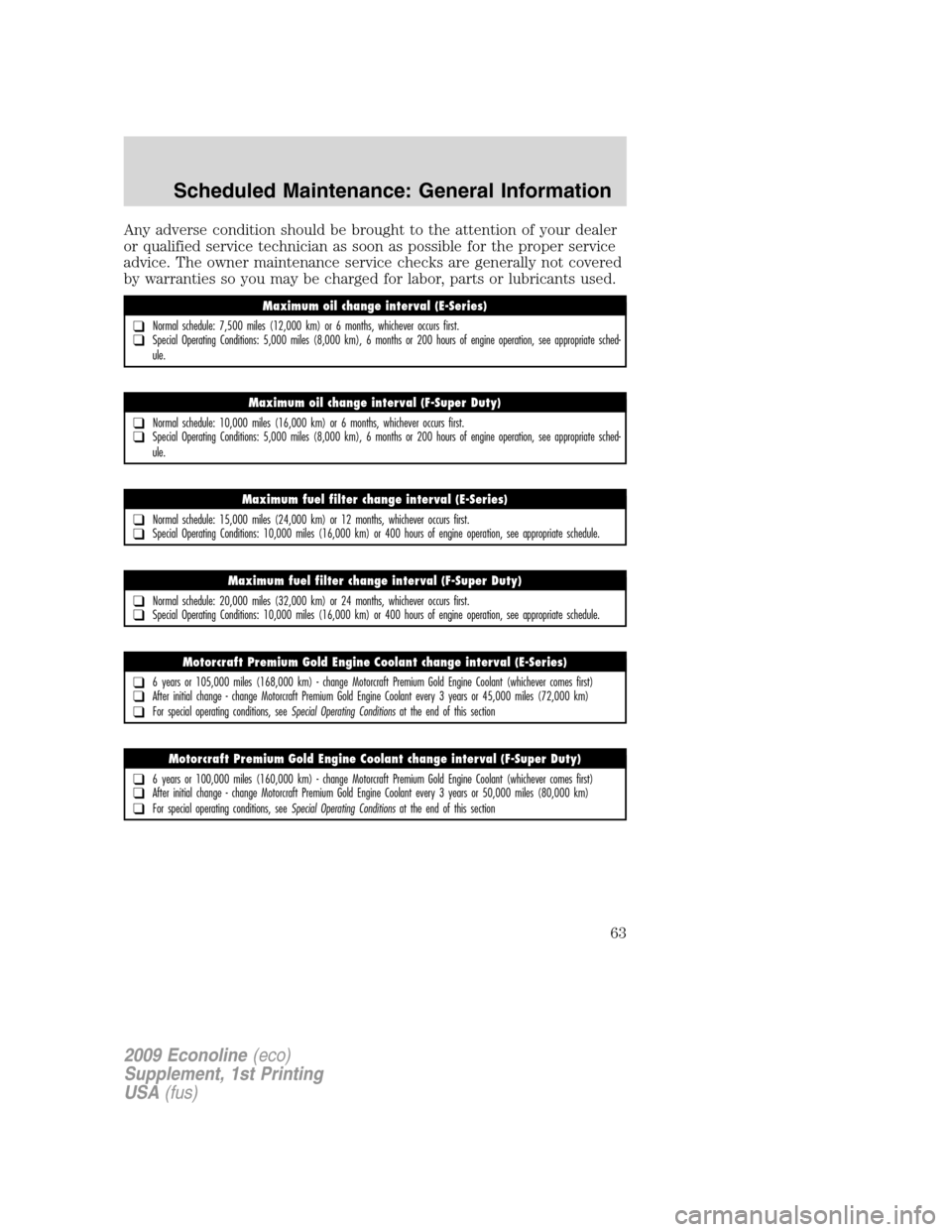
Any adverse condition should be brought to the attention of your dealer
or qualified service technician as soon as possible for the proper service
advice. The owner maintenance service checks are generally not covered
by warranties so you may be charged for labor, parts or lubricants used.
Maximum oil change interval (E-Series)
❑Normal schedule: 7,500 miles (12,000 km) or 6 months, whichever occurs first.❑Special Operating Conditions: 5,000 miles (8,000 km), 6 months or 200 hours of engine operation, see appropriate sched-
ule.
Maximum oil change interval (F-Super Duty)
❑Normal schedule: 10,000 miles (16,000 km) or 6 months, whichever occurs first.❑Special Operating Conditions: 5,000 miles (8,000 km), 6 months or 200 hours of engine operation, see appropriate sched-
ule.
Maximum fuel filter change interval (E-Series)
❑Normal schedule: 15,000 miles (24,000 km) or 12 months, whichever occurs first.❑Special Operating Conditions: 10,000 miles (16,000 km) or 400 hours of engine operation, see appropriate schedule.
Maximum fuel filter change interval (F-Super Duty)
❑Normal schedule: 20,000 miles (32,000 km) or 24 months, whichever occurs first.❑Special Operating Conditions: 10,000 miles (16,000 km) or 400 hours of engine operation, see appropriate schedule.
Motorcraft Premium Gold Engine Coolant change interval (E-Series)
❑6 years or 105,000 miles (168,000 km) - change Motorcraft Premium Gold Engine Coolant (whichever comes first)❑After initial change - change Motorcraft Premium Gold Engine Coolant every 3 years or 45,000 miles (72,000 km)
❑For special operating conditions, seeSpecial Operating Conditionsat the end of this section
Motorcraft Premium Gold Engine Coolant change interval (F-Super Duty)
❑6 years or 100,000 miles (160,000 km) - change Motorcraft Premium Gold Engine Coolant (whichever comes first)❑After initial change - change Motorcraft Premium Gold Engine Coolant every 3 years or 50,000 miles (80,000 km)
❑For special operating conditions, seeSpecial Operating Conditionsat the end of this section
2009 Econoline(eco)
Supplement, 1st Printing
USA(fus)
Scheduled Maintenance: General Information
63
Page 64 of 103
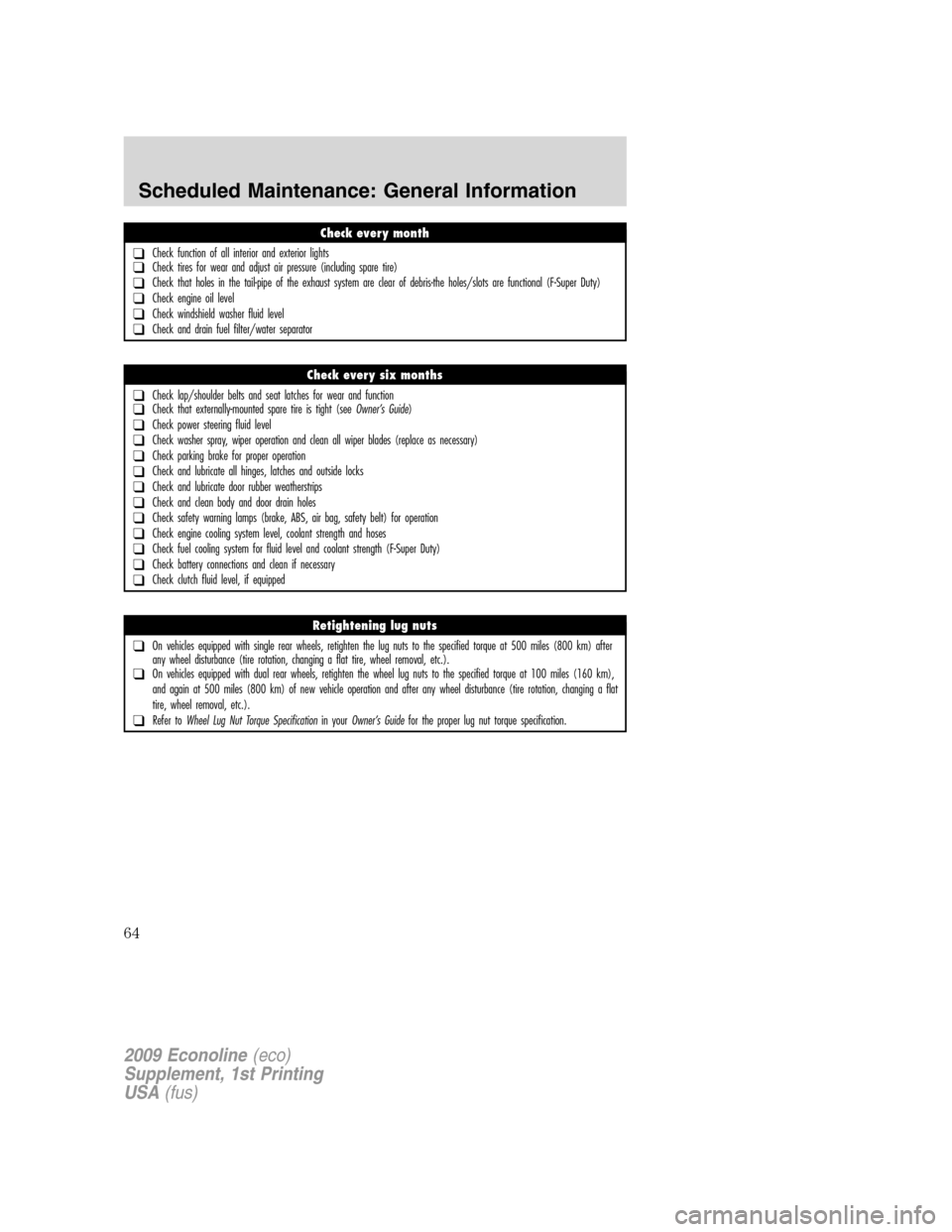
Check every month
❑Check function of all interior and exterior lights❑Check tires for wear and adjust air pressure (including spare tire)
❑Check that holes in the tail-pipe of the exhaust system are clear of debris-the holes/slots are functional (F-Super Duty)
❑Check engine oil level
❑Check windshield washer fluid level
❑Check and drain fuel filter/water separator
Check every six months
❑Check lap/shoulder belts and seat latches for wear and function❑Check that externally-mounted spare tire is tight (seeOwner’s Guide)
❑Check power steering fluid level
❑Check washer spray, wiper operation and clean all wiper blades (replace as necessary)
❑Check parking brake for proper operation
❑Check and lubricate all hinges, latches and outside locks
❑Check and lubricate door rubber weatherstrips
❑Check and clean body and door drain holes
❑Check safety warning lamps (brake, ABS, air bag, safety belt) for operation
❑Check engine cooling system level, coolant strength and hoses
❑Check fuel cooling system for fluid level and coolant strength (F-Super Duty)
❑Check battery connections and clean if necessary
❑Check clutch fluid level, if equipped
Retightening lug nuts
❑On vehicles equipped with single rear wheels, retighten the lug nuts to the specified torque at 500 miles (800 km) after
any wheel disturbance (tire rotation, changing a flat tire, wheel removal, etc.).
❑On vehicles equipped with dual rear wheels, retighten the wheel lug nuts to the specified torque at 100 miles (160 km),
and again at 500 miles (800 km) of new vehicle operation and after any wheel disturbance (tire rotation, changing a flat
tire, wheel removal, etc.).
❑Refer toWheel Lug Nut Torque Specificationin yourOwner’s Guidefor the proper lug nut torque specification.
2009 Econoline(eco)
Supplement, 1st Printing
USA(fus)
Scheduled Maintenance: General Information
64