2009 FORD SUPER DUTY automatic transmission
[x] Cancel search: automatic transmissionPage 8 of 103
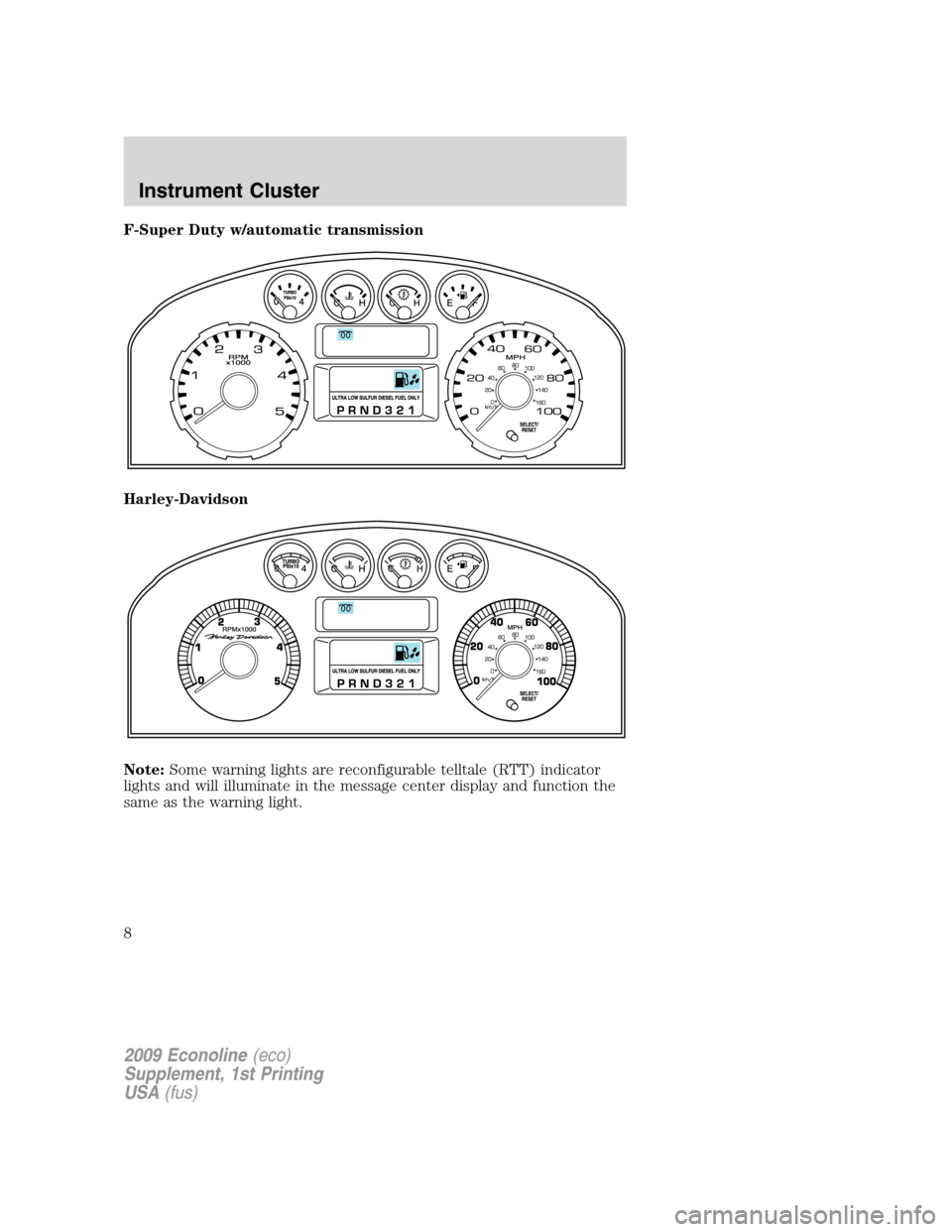
F-Super Duty w/automatic transmission
Harley-Davidson
Note:Some warning lights are reconfigurable telltale (RTT) indicator
lights and will illuminate in the message center display and function the
same as the warning light.
2009 Econoline(eco)
Supplement, 1st Printing
USA(fus)
Instrument Cluster
8
Page 11 of 103
STARTING THE ENGINE
Read all starting instructions carefully before you start your vehicle.
For temperatures below 32°F (0°C), the use of the correct grade engine
oil is essential for proper operation. Refer toEngine oil specifications
in theMaintenance and Specificationschapter for more information.
Your vehicle may be equipped with a cold weather starting strategy that
prevents severe engine damage by assisting in engine lubrication
warm-up. In extremely cold ambient temperatures, this strategy activates
and prevents the accelerator pedal from being used for 30 seconds after
starting the vehicle. By not allowing the accelerator pedal to be used, the
engine oil is allowed to properly lubricate the bearings preventing engine
damage due to lack of proper lubrication. After the 30 second warm-up
period, the accelerator pedal will be operational again as long as the
pedal is not being pressed when the 30 second time limit expires. When
starting the engine in extremely cold temperatures (-15°F [–26°C]), it is
recommended to allow the engine to idle for several minutes before
driving the vehicle.
If your vehicle is equipped with a manual transmission,make sure
the parking brake is fully set before you turn the key. Depress the clutch
pedal and place the gearshift in the neutral position. The clutch must be
fully depressed in order to operate the starter. Do not press the
accelerator during starting.
If your vehicle is equipped with an automatic transmission,ensure
the gearshift lever is in P (Park) and the parking brake is fully set before
you turn the key. Do not press the accelerator during starting.
Engine-driven cooling fan (fan clutch)
Your vehicle is equipped with an engine driven cooling fan drive (also
called a fan clutch). This fan drive changes the fan speed to match the
vehicle’s changing cooling air flow requirements. Fan speed, fan noise
level and fuel consumption all will increase based on the driving
conditions that include trailer towing, hill climbing, heavy loads, high
speed and high ambient temperature, individually or in combination. The
fan drive is designed to provide the minimum fan speed (and resulting
fan noise and fuel consumption) required to meet the ever changing
vehicle cooling air flow requirements. You will hear the amount of fan
noise increasing and decreasing as the engine power requirements and
vehicle driving conditions change as you drive. This is to be expected as
being normal to the operation of your vehicle. High levels of fan noise
might also be heard when your engine is first started, and should
normally decrease after driving for a short time.
2009 Econoline(eco)
Supplement, 1st Printing
USA(fus)
Driving
11
Page 15 of 103
The following cold weather idling guidelines must be followed:
•Avoid idling the engine for more than 10 minutes at a time.
•Use Motorcraft Cetane improvers or non alcohol-based Cetane
improvers from a reputable manufacturer.
•Maintain the engine cooling system properly.
•Do not shut the engine down after an extensive idling period
(10 minutes or more). Drive the vehicle for several miles with the
engine at normal operating temperatures under a moderate load to
burn off any accumulated carbon and varnish.
•Consider using an engine block heater.
•For extended idle times use an approved idle speed increase device.
Winter operating tips for Arctic operation -20°F (-29°C) and below
The following information is provided as a guideline only, and is not
intended to be the only source of possible solutions in resolving extreme
cold temperature issues.
Starting aids:
The use of the factory engine block heater (refer toEngine block heater
[if equipped]in theDrivingchapter of theOwner’s Guide) and oil pan
heaters (aftermarket) will assist in engine starting, in extreme cold
ambient temperatures.
WARNING:Do not use starting fluid, such as ether, in the air
intake system (see air filter decal). Such fluid could cause
immediate explosive damage to the engine and possible personal injury.
Idle control:
For periods of extended idle, the throttle should be set at an rpm that is
sufficient to keep the engine at normal operating temperatures. This
action can reduce the amount of engine damaging deposits.
•The engine contains a unique “Cold Weather - Idle up feature”
calibration strategy within the PCM. Under the appropriate conditions,
the strategy will automatically elevate the engine idle speed after
130 seconds of idling in cold ambient temperatures. For this feature to
be activated, the truck must be in P (Park) (for automatic
transmission), in neutral (for manual transmission) with the parking
brake applied and engine oil temperature below 158°F (70°C). This
strategy raises the rpm to a level that reduces the potential to
2009 Econoline(eco)
Supplement, 1st Printing
USA(fus)
Driving
15
Page 20 of 103
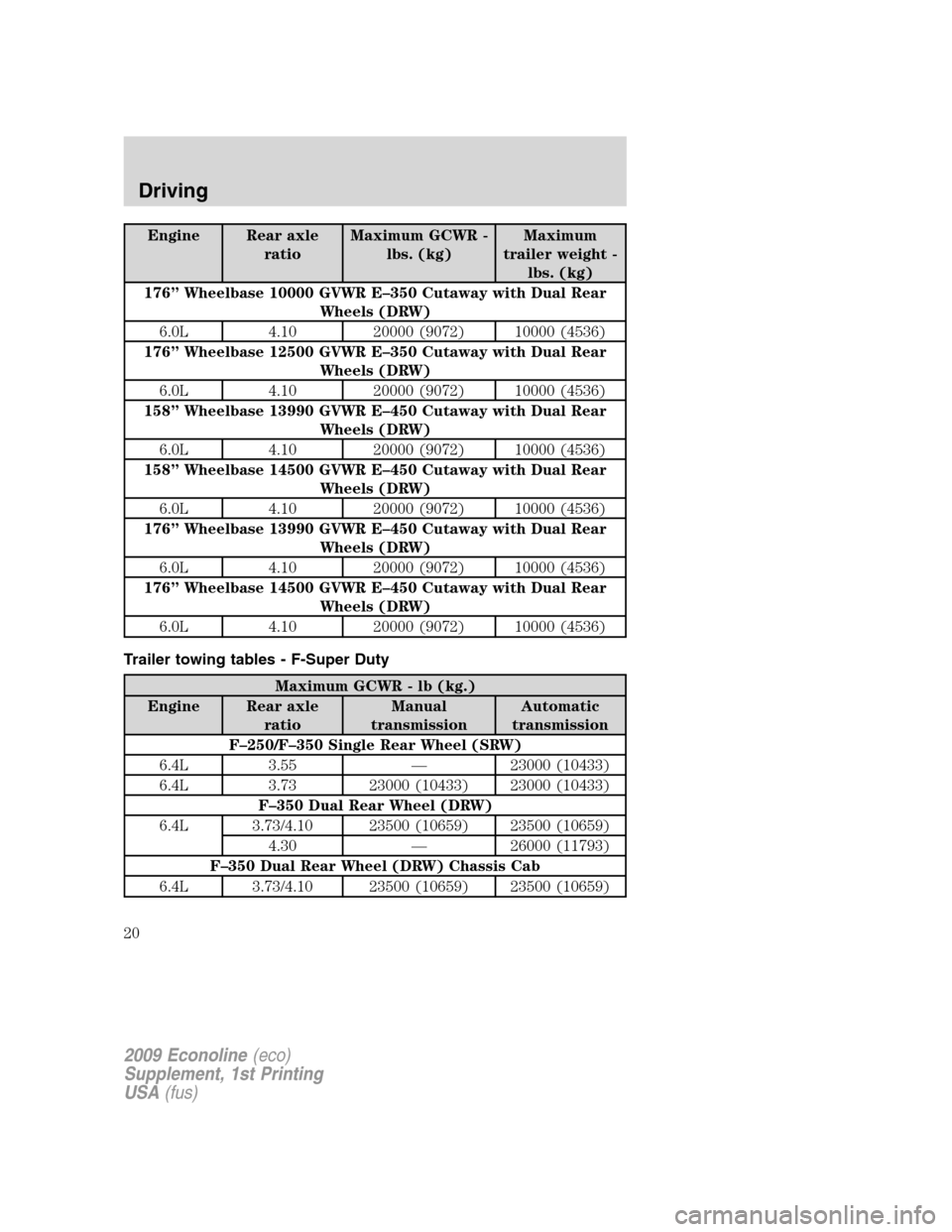
Engine Rear axle
ratioMaximum GCWR -
lbs. (kg)Maximum
trailer weight -
lbs. (kg)
176” Wheelbase 10000 GVWR E–350 Cutaway with Dual Rear
Wheels (DRW)
6.0L 4.10 20000 (9072) 10000 (4536)
176” Wheelbase 12500 GVWR E–350 Cutaway with Dual Rear
Wheels (DRW)
6.0L 4.10 20000 (9072) 10000 (4536)
158” Wheelbase 13990 GVWR E–450 Cutaway with Dual Rear
Wheels (DRW)
6.0L 4.10 20000 (9072) 10000 (4536)
158” Wheelbase 14500 GVWR E–450 Cutaway with Dual Rear
Wheels (DRW)
6.0L 4.10 20000 (9072) 10000 (4536)
176” Wheelbase 13990 GVWR E–450 Cutaway with Dual Rear
Wheels (DRW)
6.0L 4.10 20000 (9072) 10000 (4536)
176” Wheelbase 14500 GVWR E–450 Cutaway with Dual Rear
Wheels (DRW)
6.0L 4.10 20000 (9072) 10000 (4536)
Trailer towing tables - F-Super Duty
Maximum GCWR - lb (kg.)
Engine Rear axle
ratioManual
transmissionAutomatic
transmission
F–250/F–350 Single Rear Wheel (SRW)
6.4L 3.55 — 23000 (10433)
6.4L 3.73 23000 (10433) 23000 (10433)
F–350 Dual Rear Wheel (DRW)
6.4L 3.73/4.10 23500 (10659) 23500 (10659)
4.30 — 26000 (11793)
F–350 Dual Rear Wheel (DRW) Chassis Cab
6.4L 3.73/4.10 23500 (10659) 23500 (10659)
2009 Econoline(eco)
Supplement, 1st Printing
USA(fus)
Driving
20
Page 21 of 103
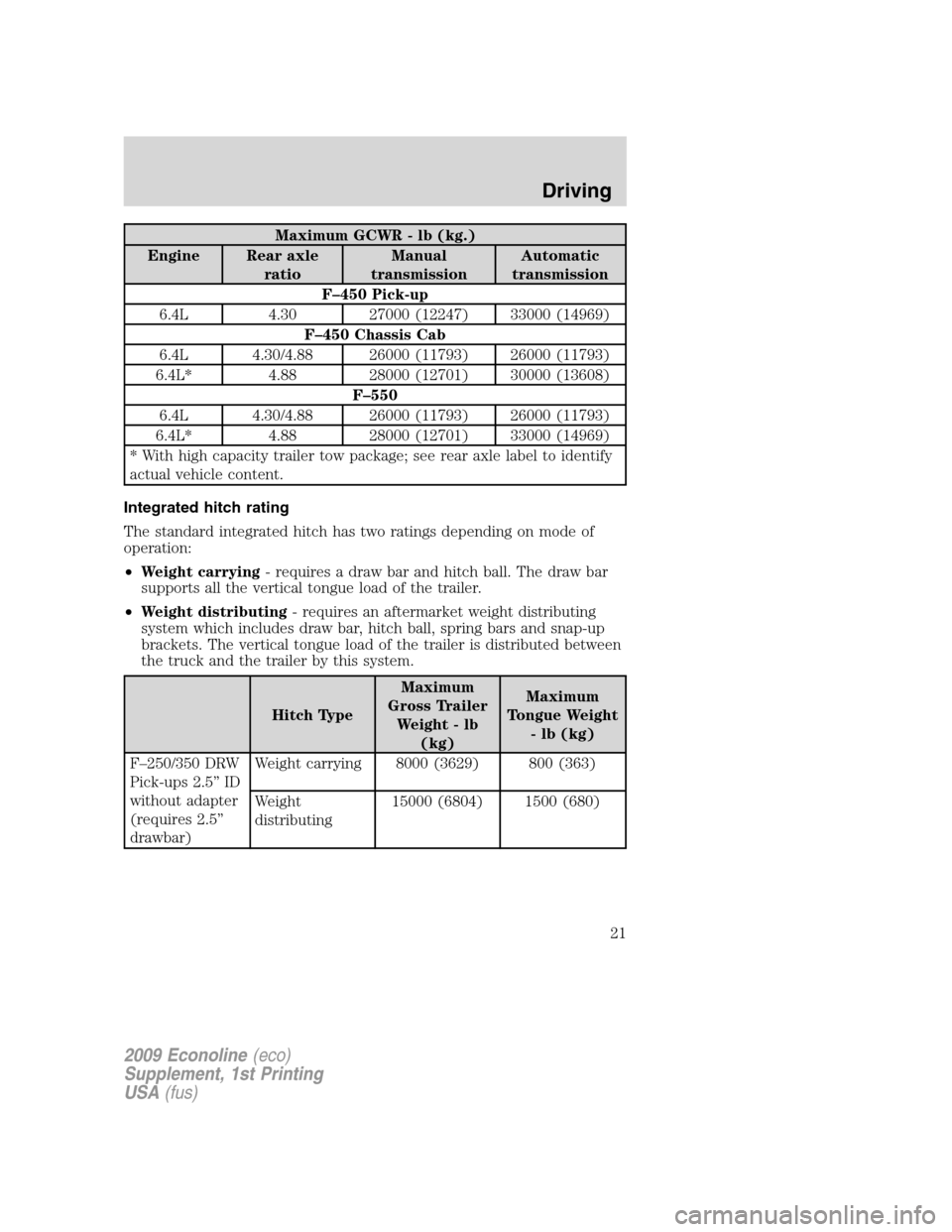
Maximum GCWR - lb (kg.)
Engine Rear axle
ratioManual
transmissionAutomatic
transmission
F–450 Pick-up
6.4L 4.30 27000 (12247) 33000 (14969)
F–450 Chassis Cab
6.4L 4.30/4.88 26000 (11793) 26000 (11793)
6.4L* 4.88 28000 (12701) 30000 (13608)
F–550
6.4L 4.30/4.88 26000 (11793) 26000 (11793)
6.4L* 4.88 28000 (12701) 33000 (14969)
* With high capacity trailer tow package; see rear axle label to identify
actual vehicle content.
Integrated hitch rating
The standard integrated hitch has two ratings depending on mode of
operation:
•Weight carrying- requires a draw bar and hitch ball. The draw bar
supports all the vertical tongue load of the trailer.
•Weight distributing- requires an aftermarket weight distributing
system which includes draw bar, hitch ball, spring bars and snap-up
brackets. The vertical tongue load of the trailer is distributed between
the truck and the trailer by this system.
Hitch TypeMaximum
Gross Trailer
Weight-lb
(kg)Maximum
Tongue Weight
- lb (kg)
F–250/350 DRW
Pick-ups 2.5” ID
without adapter
(requires 2.5”
drawbar)Weight carrying 8000 (3629) 800 (363)
Weight
distributing15000 (6804) 1500 (680)
2009 Econoline(eco)
Supplement, 1st Printing
USA(fus)
Driving
21
Page 23 of 103
JUMP STARTING YOUR VEHICLE (E-SERIES ONLY)
The following procedure is for E-Series vehicles only. F-Super
Duty vehicles equipped with the 6.4L diesel engine can be jump
started using the same procedure as a gasoline engine; refer to
yourOwner’s Guidefor the jump starting procedure.
WARNING:The gases around the battery can explode if
exposed to flames, sparks, or lit cigarettes. An explosion could
result in injury or vehicle damage.
WARNING:Batteries contain sulfuric acid which can burn skin,
eyes and clothing, if contacted.
Do not attempt to push-start your vehicle. Automatic
transmissions do not have push-start capability; damage to the
automatic transmission may result.
Preparing your vehicle
When the batteries are disconnected or new batteries are installed, the
transmission must relearn its shift strategy. As a result, the transmission
may have firm and/or soft shifts. This operation is considered normal and
will not affect function or durability of the transmission. Over time, the
adaptive learning process will fully update transmission operation.
1.Use only a 12–volt supply to start your vehicle.
2. Do not disconnect the batteries of the disabled vehicle as this could
damage the vehicle’s electrical system.
3. Park the booster vehicle close to the passenger side of the disabled
vehicle making sure the two vehiclesdo nottouch. Set the parking
brake on both vehicles.
Note:This vehicle has two frame-mounted batteries located on the
passenger side frame rail, behind the front passenger door. A battery
positive (+) jumper stud is located on the frame rail behind the rear
most battery box.
2009 Econoline(eco)
Supplement, 1st Printing
USA(fus)
Roadside Emergencies
23
Page 32 of 103
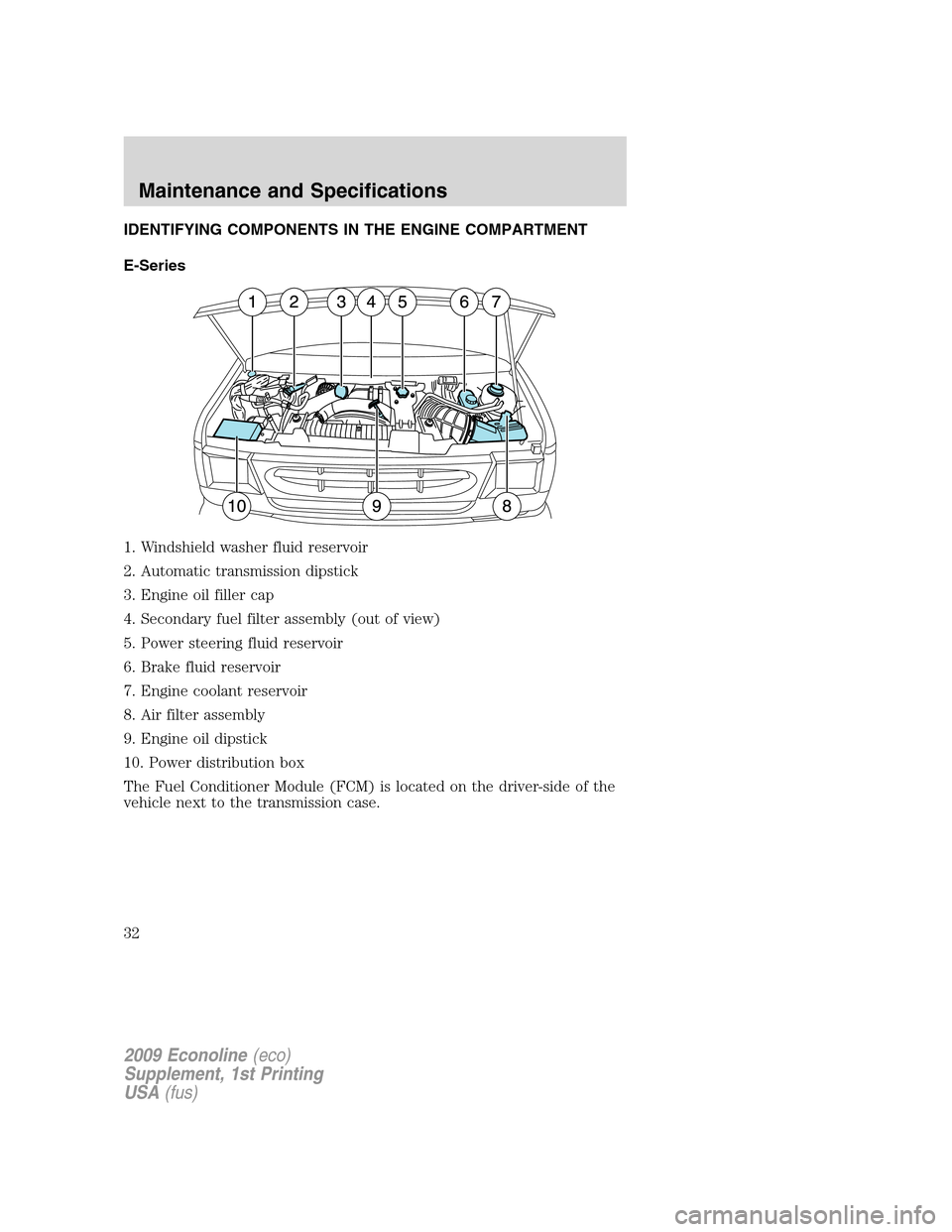
IDENTIFYING COMPONENTS IN THE ENGINE COMPARTMENT
E-Series
1. Windshield washer fluid reservoir
2. Automatic transmission dipstick
3. Engine oil filler cap
4. Secondary fuel filter assembly (out of view)
5. Power steering fluid reservoir
6. Brake fluid reservoir
7. Engine coolant reservoir
8. Air filter assembly
9. Engine oil dipstick
10. Power distribution box
The Fuel Conditioner Module (FCM) is located on the driver-side of the
vehicle next to the transmission case.
2009 Econoline(eco)
Supplement, 1st Printing
USA(fus)
Maintenance and Specifications
32
Page 33 of 103
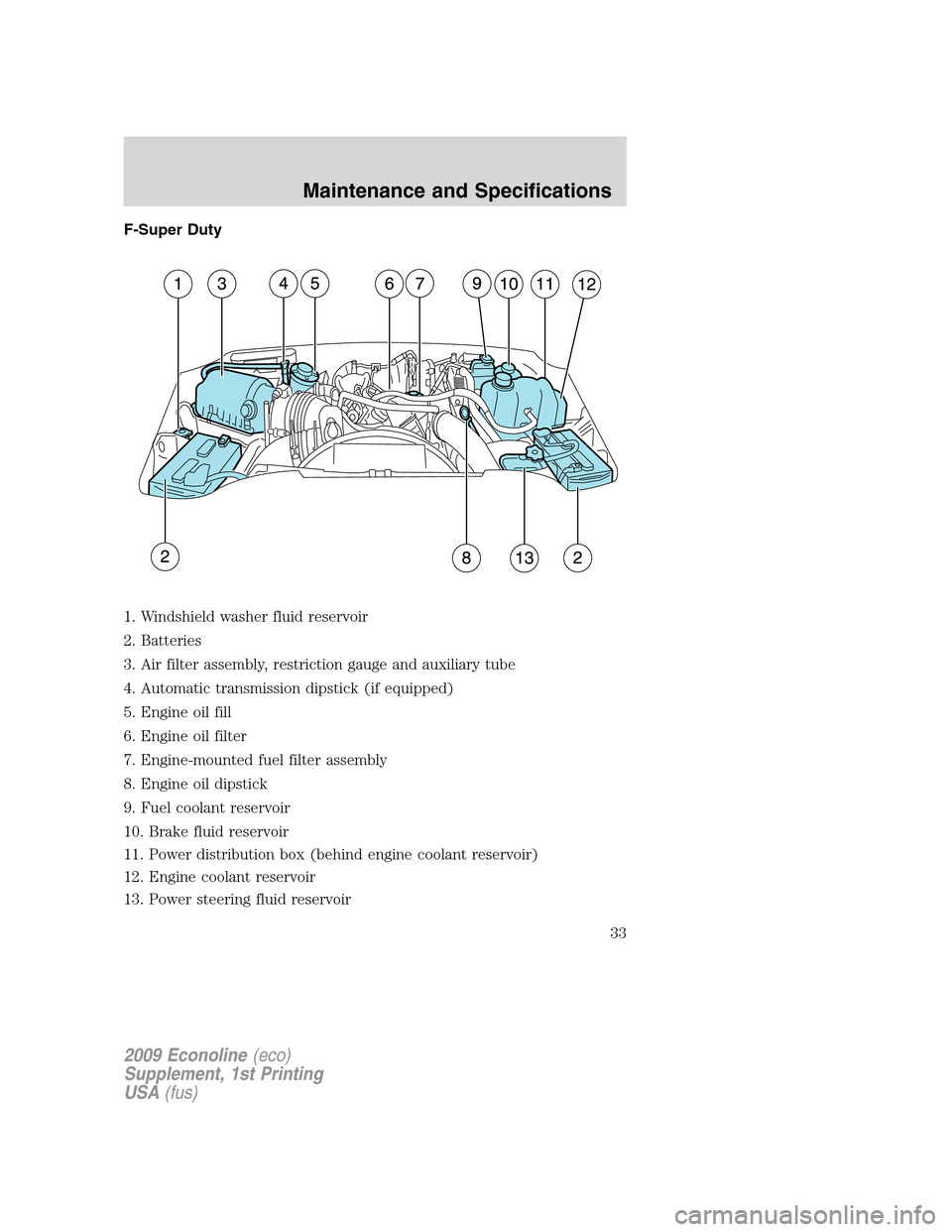
F-Super Duty
1. Windshield washer fluid reservoir
2. Batteries
3. Air filter assembly, restriction gauge and auxiliary tube
4. Automatic transmission dipstick (if equipped)
5. Engine oil fill
6. Engine oil filter
7. Engine-mounted fuel filter assembly
8. Engine oil dipstick
9. Fuel coolant reservoir
10. Brake fluid reservoir
11. Power distribution box (behind engine coolant reservoir)
12. Engine coolant reservoir
13. Power steering fluid reservoir
2009 Econoline(eco)
Supplement, 1st Printing
USA(fus)
Maintenance and Specifications
33