2009 FORD SUPER DUTY warning
[x] Cancel search: warningPage 49 of 103
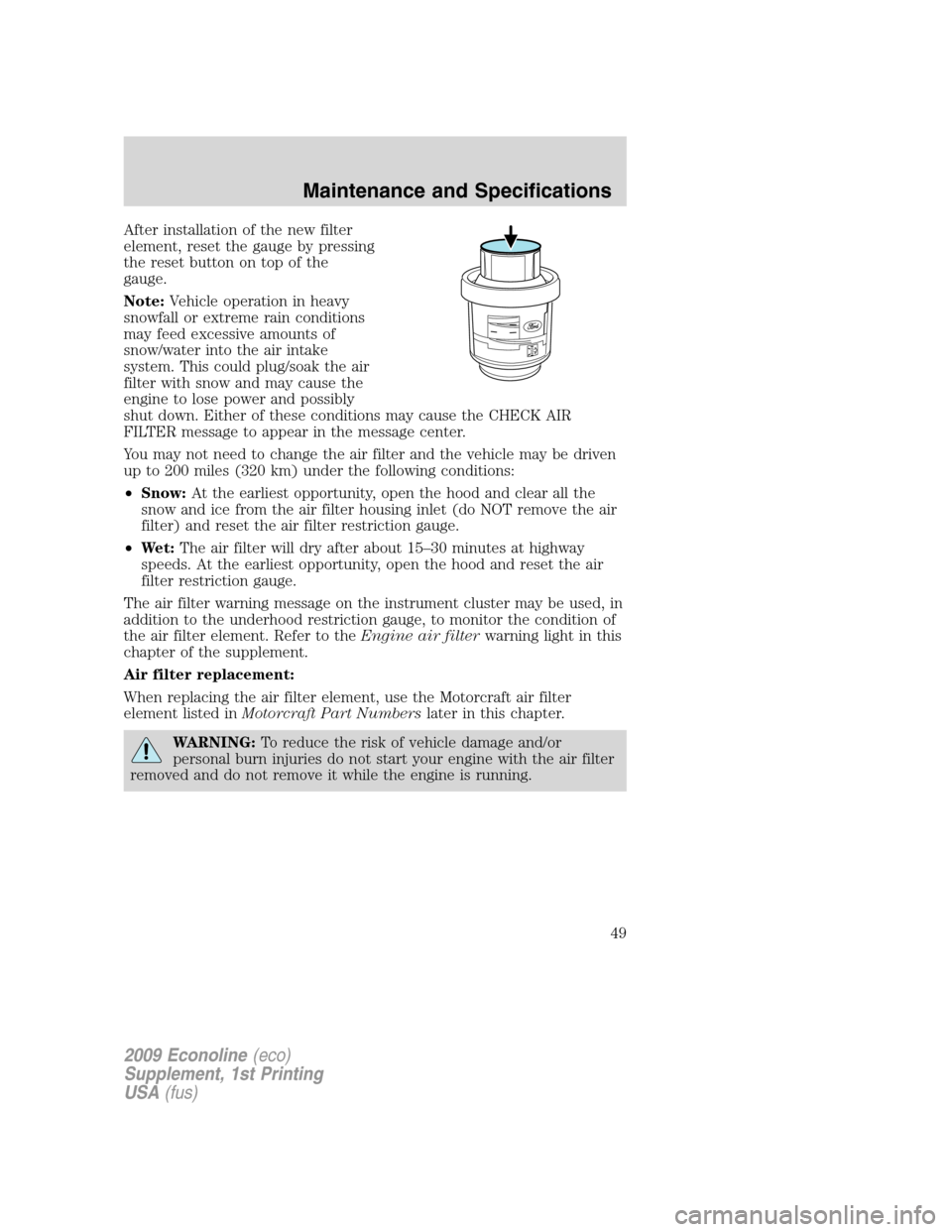
After installation of the new filter
element, reset the gauge by pressing
the reset button on top of the
gauge.
Note:Vehicle operation in heavy
snowfall or extreme rain conditions
may feed excessive amounts of
snow/water into the air intake
system. This could plug/soak the air
filter with snow and may cause the
engine to lose power and possibly
shut down. Either of these conditions may cause the CHECK AIR
FILTER message to appear in the message center.
You may not need to change the air filter and the vehicle may be driven
up to 200 miles (320 km) under the following conditions:
•Snow:At the earliest opportunity, open the hood and clear all the
snow and ice from the air filter housing inlet (do NOT remove the air
filter) and reset the air filter restriction gauge.
•Wet:The air filter will dry after about 15–30 minutes at highway
speeds. At the earliest opportunity, open the hood and reset the air
filter restriction gauge.
The air filter warning message on the instrument cluster may be used, in
addition to the underhood restriction gauge, to monitor the condition of
the air filter element. Refer to theEngine air filterwarning light in this
chapter of the supplement.
Air filter replacement:
When replacing the air filter element, use the Motorcraft air filter
element listed inMotorcraft Part Numberslater in this chapter.
WARNING:To reduce the risk of vehicle damage and/or
personal burn injuries do not start your engine with the air filter
removed and do not remove it while the engine is running.
2009 Econoline(eco)
Supplement, 1st Printing
USA(fus)
Maintenance and Specifications
49
Page 53 of 103
right rear tire(s) are functional. The holes need to be kept clear of
mud/debris or foreign material to maintain proper function of the
exhaust system. Clean and remove debris or foreign material if present
as needed. Spraying with a hose during regular washing of vehicle should
help keep holes clean and clear of debris or foreign material.
Note:Additions of aftermarket devices or modifications to the exhaust
system can reduce the effectiveness of the exhaust system as well as
cause damage to the exhaust system and/or engine. These actions may
also affect the vehicle’s warranty. See the vehicle’s warranty guide for
more information.
WARNING:Failure to maintain the functional holes, in the
tailpipe section of the exhaust, clean and free of debris or
foreign material may result in the holes becoming blocked or plugged.
Do not modify or remove the tail-pipe section. Blocked or plugged
holes or removal/modification of the system could result in elevated
exhaust gas temperatures which may result in vehicle/property damage
or personal injury.
WARNING:The normal operating temperature of the exhaust
system is very high. Never work around or attempt to repair any
part of the exhaust system until it has cooled. Use special care when
working around the diesel oxidation catalytic converter and/or the
diesel particulate filter (DPF). The diesel oxidation catalytic converter
and/or the DPF heats up to a high temperature after only a short
period of engine operation and can stay hot even after the engine is
turned off. Failure to follow these instructions may result in personal
injury.
EMISSION CONTROL SYSTEM(S) LAWS
Federal law prohibits vehicle manufacturers, dealers and other persons
engaged in the business of repairing, servicing, selling, leasing or trading
motor vehicles as well as fleet operations from unknowingly removing or
rendering emission control system(s) inoperative. Further, modifications
of the emission control system(s) could create liability on the part of the
individual owners under the laws of some states. In Canada,
modifications of the emission control system(s) could create liability
under applicable Federal or Provincial laws.
2009 Econoline(eco)
Supplement, 1st Printing
USA(fus)
Maintenance and Specifications
53
Page 55 of 103
•contaminated fuel.
•air in the fuel system, due to loose connections.
•an open or pinched sensor hose.
•low engine oil level.
•wrong fuel or oil viscosity for climactic conditions.
If these checks do not help you correct the engine performance problem
you are experiencing, consult an authorized dealer.
FUELING
WARNING:Do not use starting fluid such as ether or gasoline
in the diesel air intake system. Such fluids can cause immediate
explosive damage to the engine and possible personal injury.
If you fuel your vehicle at a truck stop, you may notice that the fuel
nozzle may shut off every 5–10 seconds. This is due to the flow rates
being designed for larger heavy duty trucks. You may have to fuel at a
slower rate (don’t depress the nozzle trigger fully).
Do not run your diesel vehicle out of fuel as this will allow air to enter
the fuel system which will make restarting difficult. The engine is
designed to run roughly as the fuel tank nears Empty. This is a warning
to the driver to add fuel as soon as possible. Longer engine cranking
time may be required once air is in the fuel system. If air enters the fuel
system (either through running the fuel tank(s) empty or during a fuel
filter change), the engine will self-purge the trapped air once it starts
running. The engine may run roughly and produce white smoke while air
is in the fuel system; this is normal and should stop after a short time.
MINOR TROUBLESHOOTING GUIDE
Air purge procedure
Turn the key on for 30 seconds, then turn off. Repeat procedure four or
five times.
If the engine won’t crank
Turn on the headlights. If the lights are dim, do not go on at all or when
the ignition is turned to START the lights become dim or go out, the
battery connections may be loose or corroded, or the battery may be
discharged. If there is a clicking or stuttering sound coming from the
engine compartment when you turn the key to START, this may also
indicate a loose or corroded battery connection.
2009 Econoline(eco)
Supplement, 1st Printing
USA(fus)
Maintenance and Specifications
55
Page 56 of 103
Check the battery connections at the battery posts, cable connection to
the engine grounding point and at the starter connection.
If a discharged battery is suspected, have it checked and corrected.
WARNING:Battery posts, terminals and related accessories
contain lead and lead compounds.Wash hands after handling.
•For vehicles with manual transmissions,the clutch pedalmustbe
fully depressed in order for the starter to operate.
•For vehicles with automatic transmissions,the gearshift lever
must be in P (Park) or N (Neutral) in order for the starter to operate.
•Try operating the starter switch several times. Should the switch be
corroded, this operation may clean the contacts or make the switch
temporarily operable until you can reach the dealer.
•If all electrical connections are tight and you need assistance to start,
refer toJump startingin theRoadside Emergencieschapter of your
Owner’s Guide(F-Super Duty) or refer to theJump startingsection
in theRoadside Emergencieschapter of this supplement (E-Series).
If engine cranks but won’t start
Prolonged starter cranking (in excess of 30 seconds) could cause
damage to the starter motor.
•Check the fuel gauge. You may be out of fuel. If the gauge shows that
there is fuel in the tank, the trouble may be in the electrical system or
the fuel system. If equipped with an auxiliary tank, be sure that the
tank control switch is set for the tank with fuel and not on an empty
tank.
•Leaving the ignition key turned to ON for over two minutes without
starting may make starting difficult because the glow plugs will cease
activation. Reset the system by turning the ignition key to OFF and
then back to ON again.
If the engine runs hot
The following could cause the engine to overheat:
•Lack of coolant.
•Dirty cooling system.
•Plugged radiator fins, charge air cooler, A/C condenser and/or oil
cooler.
•Driving with frozen coolant.
2009 Econoline(eco)
Supplement, 1st Printing
USA(fus)
Maintenance and Specifications
56
Page 57 of 103
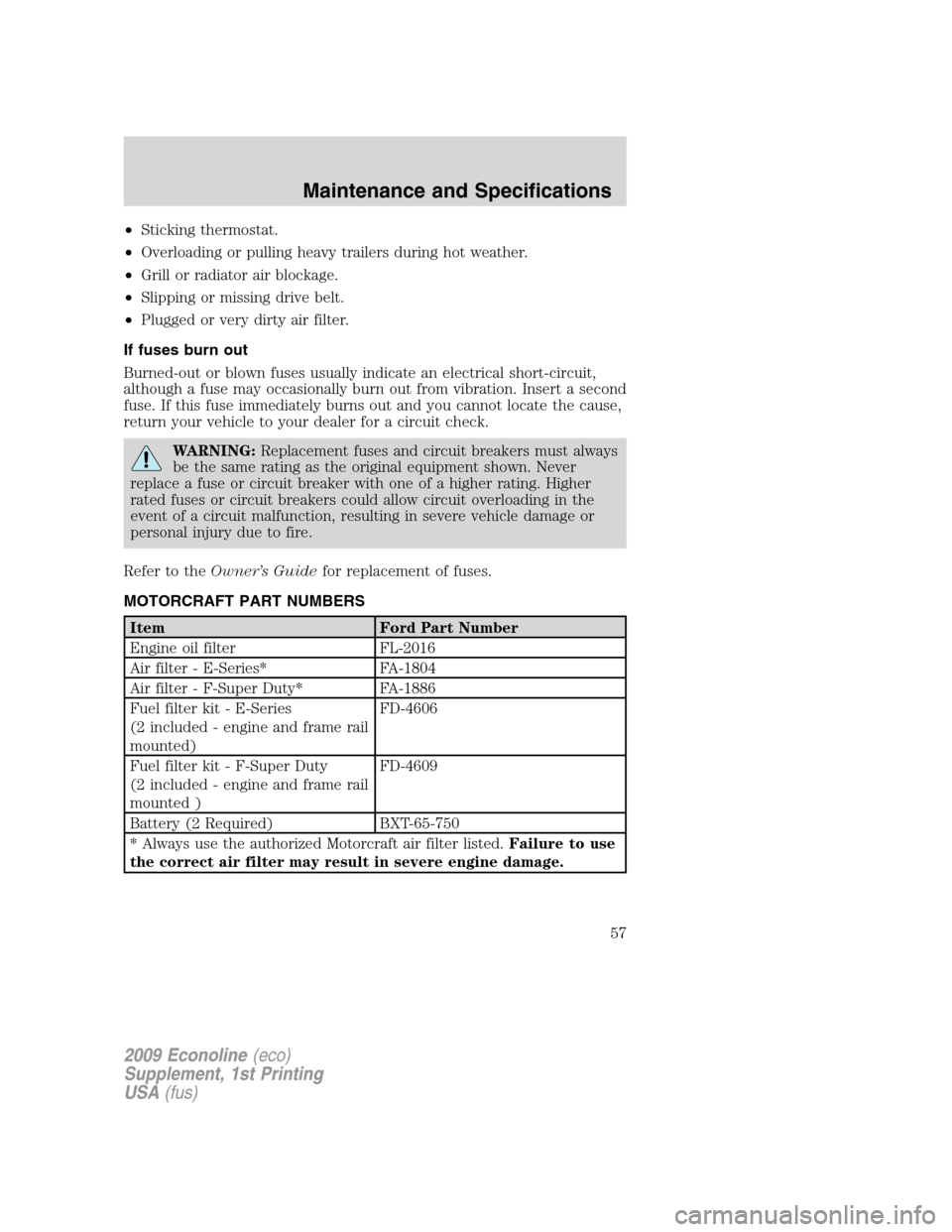
•Sticking thermostat.
•Overloading or pulling heavy trailers during hot weather.
•Grill or radiator air blockage.
•Slipping or missing drive belt.
•Plugged or very dirty air filter.
If fuses burn out
Burned-out or blown fuses usually indicate an electrical short-circuit,
although a fuse may occasionally burn out from vibration. Insert a second
fuse. If this fuse immediately burns out and you cannot locate the cause,
return your vehicle to your dealer for a circuit check.
WARNING:Replacement fuses and circuit breakers must always
be the same rating as the original equipment shown. Never
replace a fuse or circuit breaker with one of a higher rating. Higher
rated fuses or circuit breakers could allow circuit overloading in the
event of a circuit malfunction, resulting in severe vehicle damage or
personal injury due to fire.
Refer to theOwner’s Guidefor replacement of fuses.
MOTORCRAFT PART NUMBERS
Item Ford Part Number
Engine oil filter FL-2016
Air filter - E-Series* FA-1804
Air filter - F-Super Duty* FA-1886
Fuel filter kit - E-Series
(2 included - engine and frame rail
mounted)FD-4606
Fuel filter kit - F-Super Duty
(2 included - engine and frame rail
mounted )FD-4609
Battery (2 Required) BXT-65-750
* Always use the authorized Motorcraft air filter listed.Failure to use
the correct air filter may result in severe engine damage.
2009 Econoline(eco)
Supplement, 1st Printing
USA(fus)
Maintenance and Specifications
57
Page 64 of 103
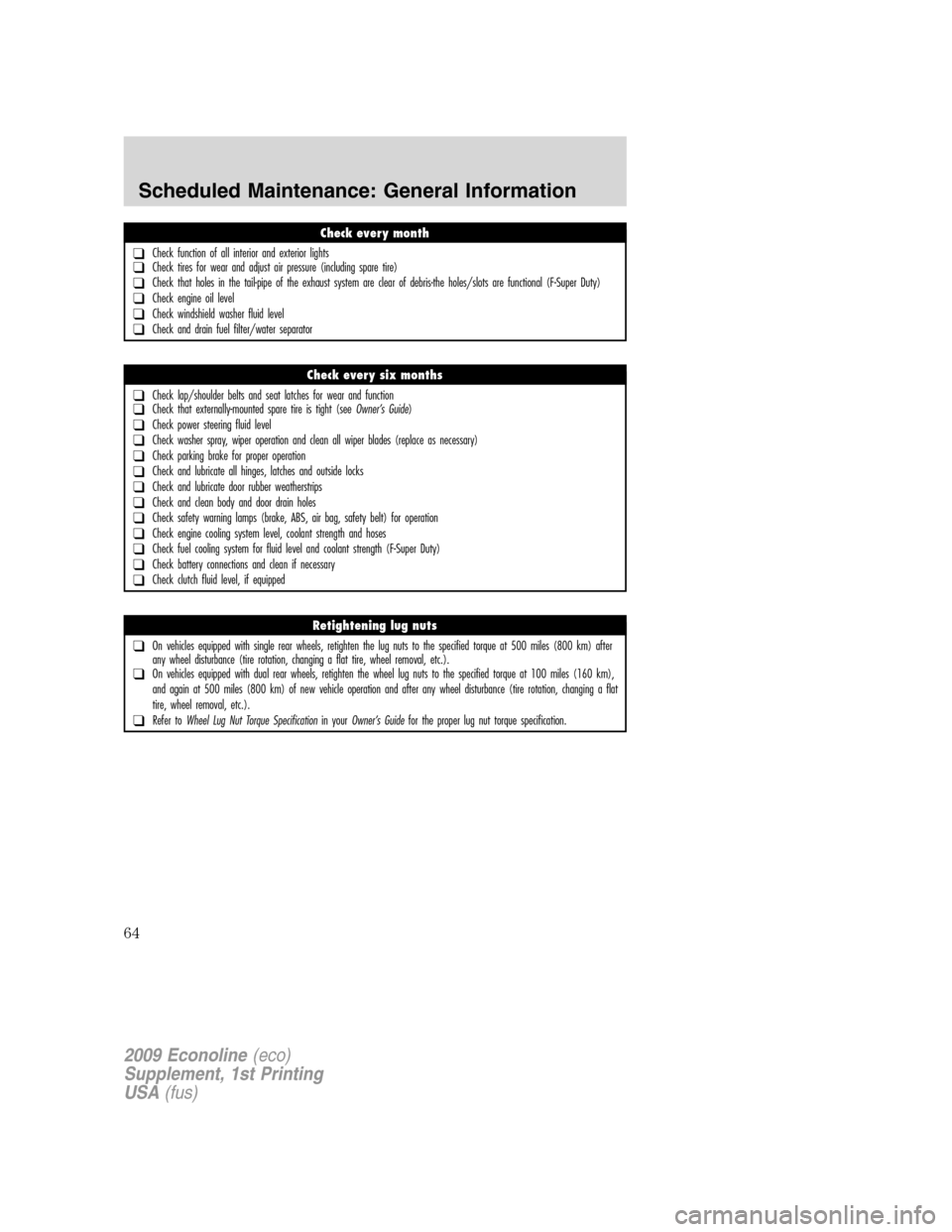
Check every month
❑Check function of all interior and exterior lights❑Check tires for wear and adjust air pressure (including spare tire)
❑Check that holes in the tail-pipe of the exhaust system are clear of debris-the holes/slots are functional (F-Super Duty)
❑Check engine oil level
❑Check windshield washer fluid level
❑Check and drain fuel filter/water separator
Check every six months
❑Check lap/shoulder belts and seat latches for wear and function❑Check that externally-mounted spare tire is tight (seeOwner’s Guide)
❑Check power steering fluid level
❑Check washer spray, wiper operation and clean all wiper blades (replace as necessary)
❑Check parking brake for proper operation
❑Check and lubricate all hinges, latches and outside locks
❑Check and lubricate door rubber weatherstrips
❑Check and clean body and door drain holes
❑Check safety warning lamps (brake, ABS, air bag, safety belt) for operation
❑Check engine cooling system level, coolant strength and hoses
❑Check fuel cooling system for fluid level and coolant strength (F-Super Duty)
❑Check battery connections and clean if necessary
❑Check clutch fluid level, if equipped
Retightening lug nuts
❑On vehicles equipped with single rear wheels, retighten the lug nuts to the specified torque at 500 miles (800 km) after
any wheel disturbance (tire rotation, changing a flat tire, wheel removal, etc.).
❑On vehicles equipped with dual rear wheels, retighten the wheel lug nuts to the specified torque at 100 miles (160 km),
and again at 500 miles (800 km) of new vehicle operation and after any wheel disturbance (tire rotation, changing a flat
tire, wheel removal, etc.).
❑Refer toWheel Lug Nut Torque Specificationin yourOwner’s Guidefor the proper lug nut torque specification.
2009 Econoline(eco)
Supplement, 1st Printing
USA(fus)
Scheduled Maintenance: General Information
64
Page 65 of 103
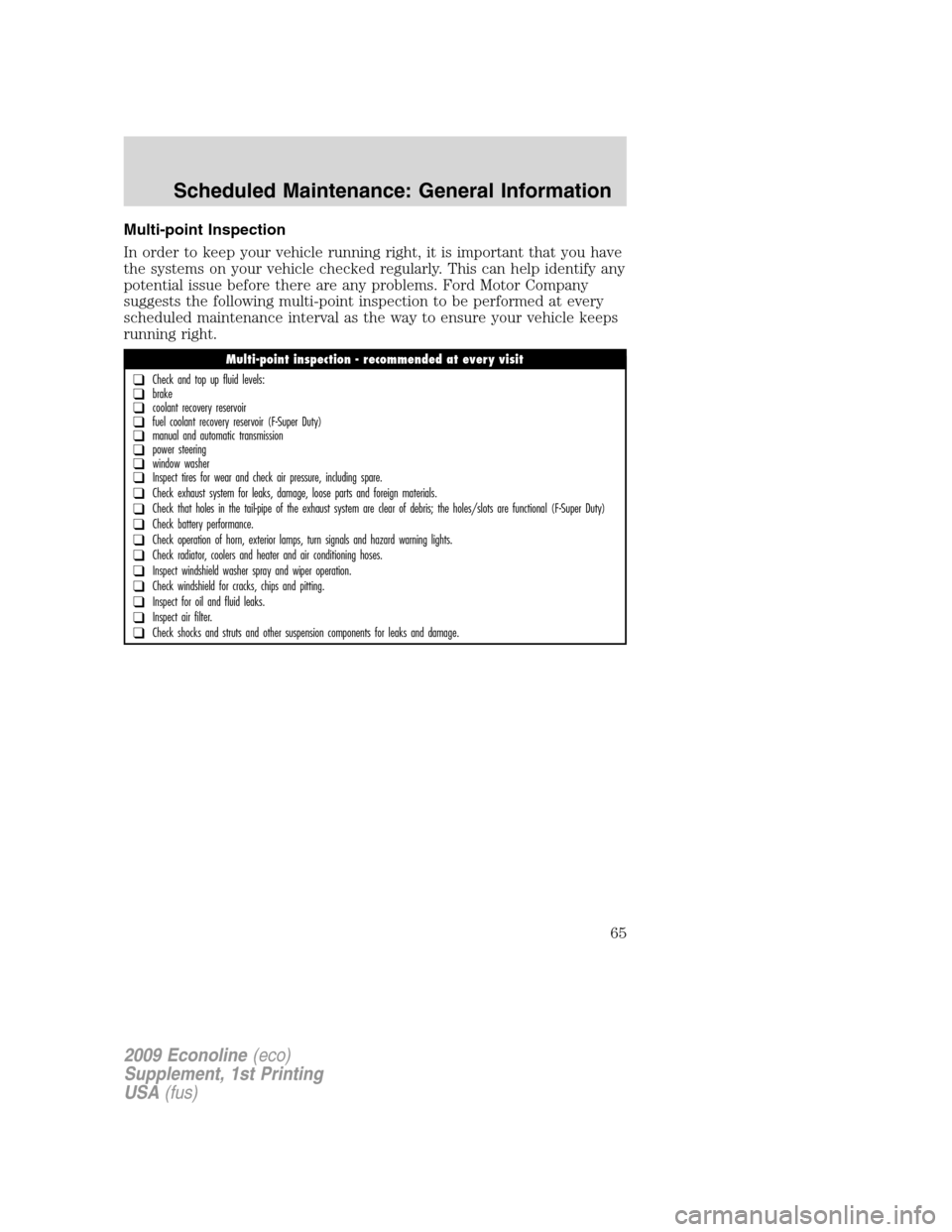
Multi-point Inspection
In order to keep your vehicle running right, it is important that you have
the systems on your vehicle checked regularly. This can help identify any
potential issue before there are any problems. Ford Motor Company
suggests the following multi-point inspection to be performed at every
scheduled maintenance interval as the way to ensure your vehicle keeps
running right.
Multi-point inspection - recommended at every visit
❑Check and top up fluid levels:❑brake❑coolant recovery reservoir❑fuel coolant recovery reservoir (F-Super Duty)❑manual and automatic transmission❑power steering❑window washer❑Inspect tires for wear and check air pressure, including spare.
❑Check exhaust system for leaks, damage, loose parts and foreign materials.
❑Check that holes in the tail-pipe of the exhaust system are clear of debris; the holes/slots are functional (F-Super Duty)
❑Check battery performance.
❑Check operation of horn, exterior lamps, turn signals and hazard warning lights.
❑Check radiator, coolers and heater and air conditioning hoses.
❑Inspect windshield washer spray and wiper operation.
❑Check windshield for cracks, chips and pitting.
❑Inspect for oil and fluid leaks.
❑Inspect air filter.
❑Check shocks and struts and other suspension components for leaks and damage.
2009 Econoline(eco)
Supplement, 1st Printing
USA(fus)
Scheduled Maintenance: General Information
65