2009 FORD SUPER DUTY transmission
[x] Cancel search: transmissionPage 2 of 103
CALIFORNIA Proposition 65 Warning
WARNING:Engine exhaust, some of its constituents, and
certain vehicle components contain or emit chemicals known to
the State of California to cause cancer and birth defects or other
reproductive harm. In addition, certain fluids contained in vehicles and
certain products of component wear contain or emit chemicals known
to the State of California to cause cancer and birth defects or other
reproductive harm.
Your new diesel engine will feel, drive and function somewhat differently
than a gasoline engine. Therefore it is very important that you read and
thoroughly familiarize yourself and others operating the vehicle with this
guide.A special procedure for turning off the diesel engine is in
theDrivingchapter. It is important to read and understand this
material in order to maintain the best service life for your
engine.
This guide will acquaint you with the Power Stroke diesel engine. It
provides recommendations on engine care and operating procedures. For
complete vehicle information, also refer to theOwner’s Guideincluded
with the vehicle. It also describes equipment and gives specifications for
equipment that was in effect when this guide was approved for printing,
and should be considered a permanent part of the vehicle.
Some aftermarket products may cause severe engine/transmission
and/or exhaust system damage; refer to theWhat is not covered
section inThe new vehicle limited warranty for your vehicle
chapter of your vehicle’sWarranty Guidefor more information.
Your vehicle’s Powertrain Control Systems can detect and store
information about vehicle modifications that increase horsepower
and torque output such as whether or not performance-enhancing
powertrain components commonly referred to as “performance
chips” have been used. This information cannot be erased and
will stay in the system’s memory even if the modification is
removed. The Information can be retrieved by Ford Motor
Company, Ford of Canada, and service and repair facilities when
servicing your vehicle. This information may be used to determine
if repairs will be covered by warranty.
Ford may discontinue models or change specifications without any notice
and without incurring obligations.
2009 Econoline(eco)
Supplement, 1st Printing
USA(fus)
Introduction
2
Page 3 of 103
Important notice
Ford vehicles are suitable for producing ambulances only if equipped
with the Ford ambulance preparation package. In addition, Ford urges
ambulance manufacturers to follow the recommendation of theFord
Incomplete Vehicle Manual, Ford Truck Body Builder’s Layout Book
(and pertinent supplements) and theQualified Vehicle Modifiers
Guidelines.Using a Ford vehicle without the Ford ambulance
preparation package to produce an ambulance voids the Ford warranty
and could result in elevated underbody temperatures, fuel
overpressurization and the risk of fuel expulsion and fires. To determine
whether the vehicle is equipped with the Ford ambulance preparation
package, inspect the information plate on the driver’s side door pillar.
Contact the manufacturer of your vehicle to determine whether the
ambulance manufacturer’s followed Ford’s recommendations.
WARNINGS
Throughout this guide, you will find warnings identified by the
symbol
. Warnings remind you to be especially careful to reduce the
risk of personal injury.
NEW VEHICLE BREAK-IN
Your vehicle does not need an extensive break-in. Try not to drive
continuously at the same speed for the first 1,000 miles (1,600 km) of
new vehicle operation. Vary your speed to allow parts to adjust
themselves to other parts.
Drive your new vehicle at least 500 miles (800 km) before towing a
trailer. Make sure you use the specified engine oil by checking the engine
oil specification chart underEngine oilin theMaintenance and
Specificationschapter.
Do not add friction modifier compounds or special break-in oils during
the first few thousand miles (kilometers) of operation, since these
additives may prevent piston ring seating. SeeEngine oilin the
Maintenance and Specificationschapter of this supplement for more
information on oil usage.
DIESEL ENGINE INFORMATION
The Diesel engine fuel system consists of:
•On E-Series vehicles (6.0L engine),a Diesel Fuel Conditioner
Module (DFCM) mounted on the driver-side frame rail next to the
transmission
2009 Econoline(eco)
Supplement, 1st Printing
USA(fus)
Introduction
3
Page 6 of 103
Fuel and turbocharger cooling system (F-Super Duty only)
The fuel and turbocharger cooling system contains a cooler which is
mounted on the turbo interstage U-tube on the left side of the engine.
The cooler’s function is to regulate engine fuel temperature and cool the
electronics that support the turbocharger. You may hear the auxiliary
coolant pump running up to 10 minutes after the ignition is turned off in
hot weather or if you are towing heavy loads. This is to control the
temperature of the turbocharger.
Engine governed speed
The engine governor is controlled by the PCM. The PCM controls fuel
input to limit maximum engine speed. It will not, however, prevent
engine overspeeding resulting from downshifting at high vehicle speed or
by descending steep grades at too high a vehicle speed for the selected
transmission gear.
If your vehicle is equipped with a manual transmission,refer to
Manual transmission shift speedsin theDrivingchapter of your
Owner’s Guidefor maximum vehicle shift speeds in various gears. Do
not exceed 4,000 rpm. Maximum engine governed speed is 3,700 rpm.
Excessive rpm can only be achieved by manually downshifting at too
high of a vehicle speed.
Operating the engine beyond the governed speed can cause
severe engine damage.
Speed control (F-Super Duty)
If vehicle speed goes outside a predetermined range from the set speed,
the RES (Resume) function will not reset vehicle speed. Vehicle speed
will need to be reset with the SET +/- button after reaching desired
speed using accelerator pedal.
2009 Econoline(eco)
Supplement, 1st Printing
USA(fus)
Introduction
6
Page 7 of 103
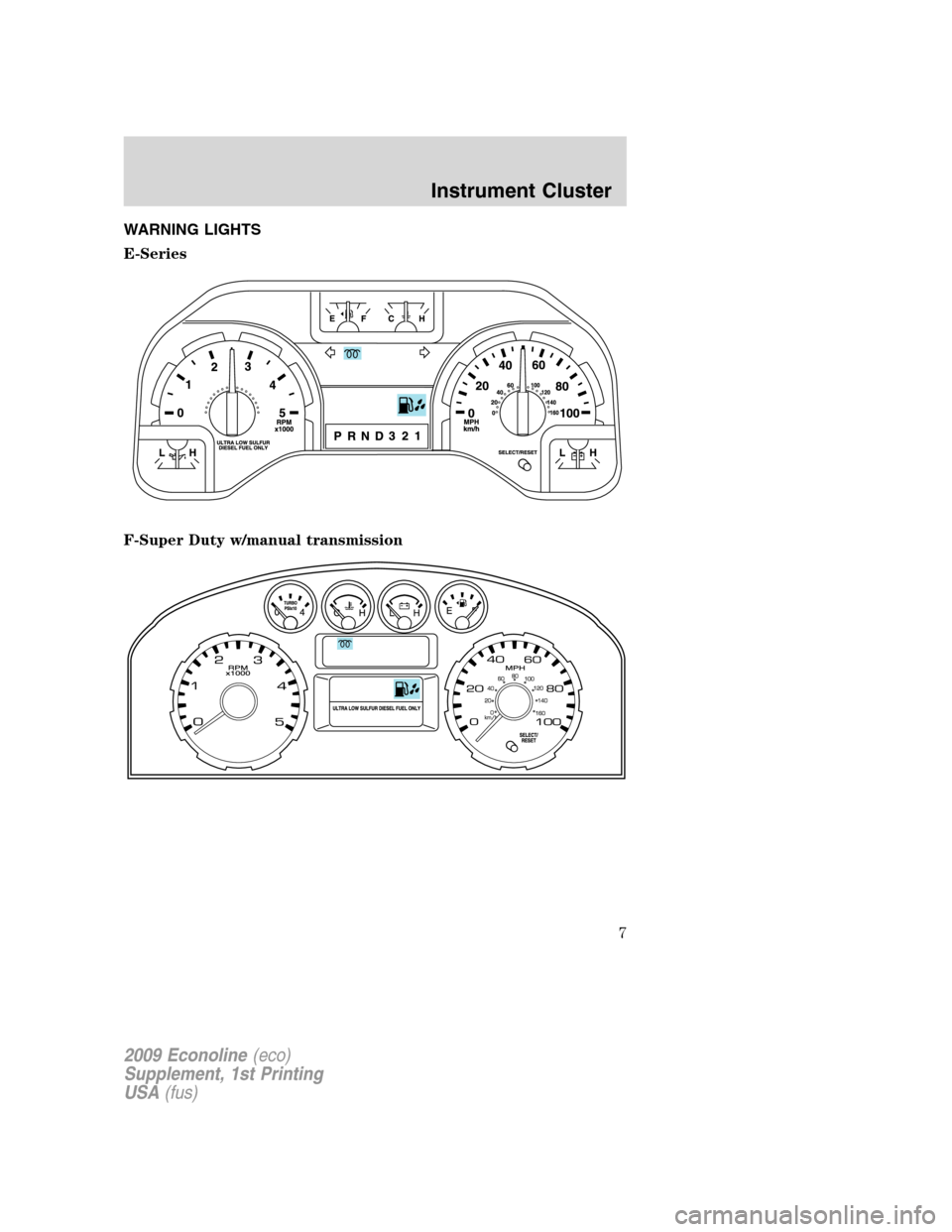
WARNING LIGHTS
E-Series
F-Super Duty w/manual transmission
2009 Econoline(eco)
Supplement, 1st Printing
USA(fus)
Instrument Cluster
7
Page 8 of 103
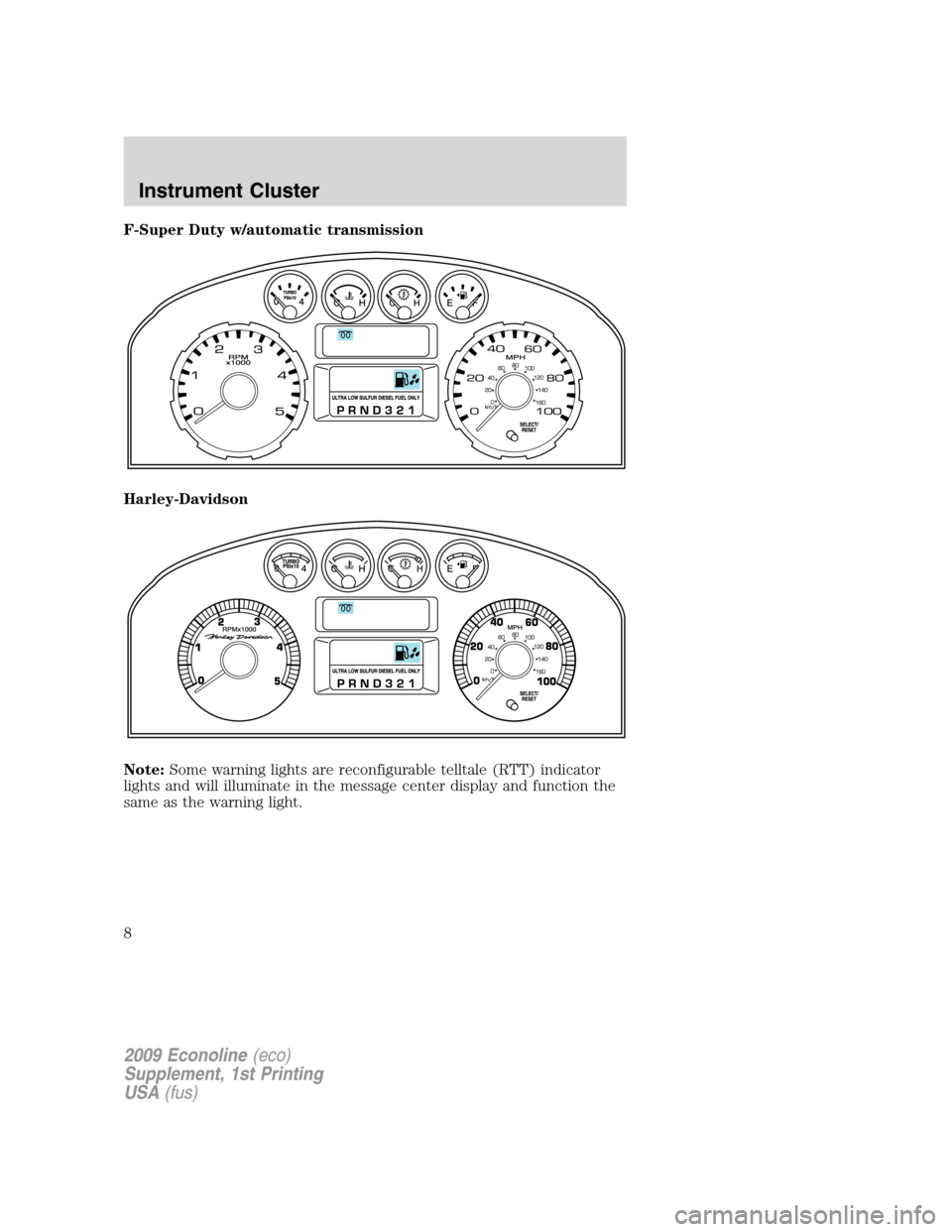
F-Super Duty w/automatic transmission
Harley-Davidson
Note:Some warning lights are reconfigurable telltale (RTT) indicator
lights and will illuminate in the message center display and function the
same as the warning light.
2009 Econoline(eco)
Supplement, 1st Printing
USA(fus)
Instrument Cluster
8
Page 11 of 103
STARTING THE ENGINE
Read all starting instructions carefully before you start your vehicle.
For temperatures below 32°F (0°C), the use of the correct grade engine
oil is essential for proper operation. Refer toEngine oil specifications
in theMaintenance and Specificationschapter for more information.
Your vehicle may be equipped with a cold weather starting strategy that
prevents severe engine damage by assisting in engine lubrication
warm-up. In extremely cold ambient temperatures, this strategy activates
and prevents the accelerator pedal from being used for 30 seconds after
starting the vehicle. By not allowing the accelerator pedal to be used, the
engine oil is allowed to properly lubricate the bearings preventing engine
damage due to lack of proper lubrication. After the 30 second warm-up
period, the accelerator pedal will be operational again as long as the
pedal is not being pressed when the 30 second time limit expires. When
starting the engine in extremely cold temperatures (-15°F [–26°C]), it is
recommended to allow the engine to idle for several minutes before
driving the vehicle.
If your vehicle is equipped with a manual transmission,make sure
the parking brake is fully set before you turn the key. Depress the clutch
pedal and place the gearshift in the neutral position. The clutch must be
fully depressed in order to operate the starter. Do not press the
accelerator during starting.
If your vehicle is equipped with an automatic transmission,ensure
the gearshift lever is in P (Park) and the parking brake is fully set before
you turn the key. Do not press the accelerator during starting.
Engine-driven cooling fan (fan clutch)
Your vehicle is equipped with an engine driven cooling fan drive (also
called a fan clutch). This fan drive changes the fan speed to match the
vehicle’s changing cooling air flow requirements. Fan speed, fan noise
level and fuel consumption all will increase based on the driving
conditions that include trailer towing, hill climbing, heavy loads, high
speed and high ambient temperature, individually or in combination. The
fan drive is designed to provide the minimum fan speed (and resulting
fan noise and fuel consumption) required to meet the ever changing
vehicle cooling air flow requirements. You will hear the amount of fan
noise increasing and decreasing as the engine power requirements and
vehicle driving conditions change as you drive. This is to be expected as
being normal to the operation of your vehicle. High levels of fan noise
might also be heard when your engine is first started, and should
normally decrease after driving for a short time.
2009 Econoline(eco)
Supplement, 1st Printing
USA(fus)
Driving
11
Page 15 of 103
The following cold weather idling guidelines must be followed:
•Avoid idling the engine for more than 10 minutes at a time.
•Use Motorcraft Cetane improvers or non alcohol-based Cetane
improvers from a reputable manufacturer.
•Maintain the engine cooling system properly.
•Do not shut the engine down after an extensive idling period
(10 minutes or more). Drive the vehicle for several miles with the
engine at normal operating temperatures under a moderate load to
burn off any accumulated carbon and varnish.
•Consider using an engine block heater.
•For extended idle times use an approved idle speed increase device.
Winter operating tips for Arctic operation -20°F (-29°C) and below
The following information is provided as a guideline only, and is not
intended to be the only source of possible solutions in resolving extreme
cold temperature issues.
Starting aids:
The use of the factory engine block heater (refer toEngine block heater
[if equipped]in theDrivingchapter of theOwner’s Guide) and oil pan
heaters (aftermarket) will assist in engine starting, in extreme cold
ambient temperatures.
WARNING:Do not use starting fluid, such as ether, in the air
intake system (see air filter decal). Such fluid could cause
immediate explosive damage to the engine and possible personal injury.
Idle control:
For periods of extended idle, the throttle should be set at an rpm that is
sufficient to keep the engine at normal operating temperatures. This
action can reduce the amount of engine damaging deposits.
•The engine contains a unique “Cold Weather - Idle up feature”
calibration strategy within the PCM. Under the appropriate conditions,
the strategy will automatically elevate the engine idle speed after
130 seconds of idling in cold ambient temperatures. For this feature to
be activated, the truck must be in P (Park) (for automatic
transmission), in neutral (for manual transmission) with the parking
brake applied and engine oil temperature below 158°F (70°C). This
strategy raises the rpm to a level that reduces the potential to
2009 Econoline(eco)
Supplement, 1st Printing
USA(fus)
Driving
15
Page 20 of 103
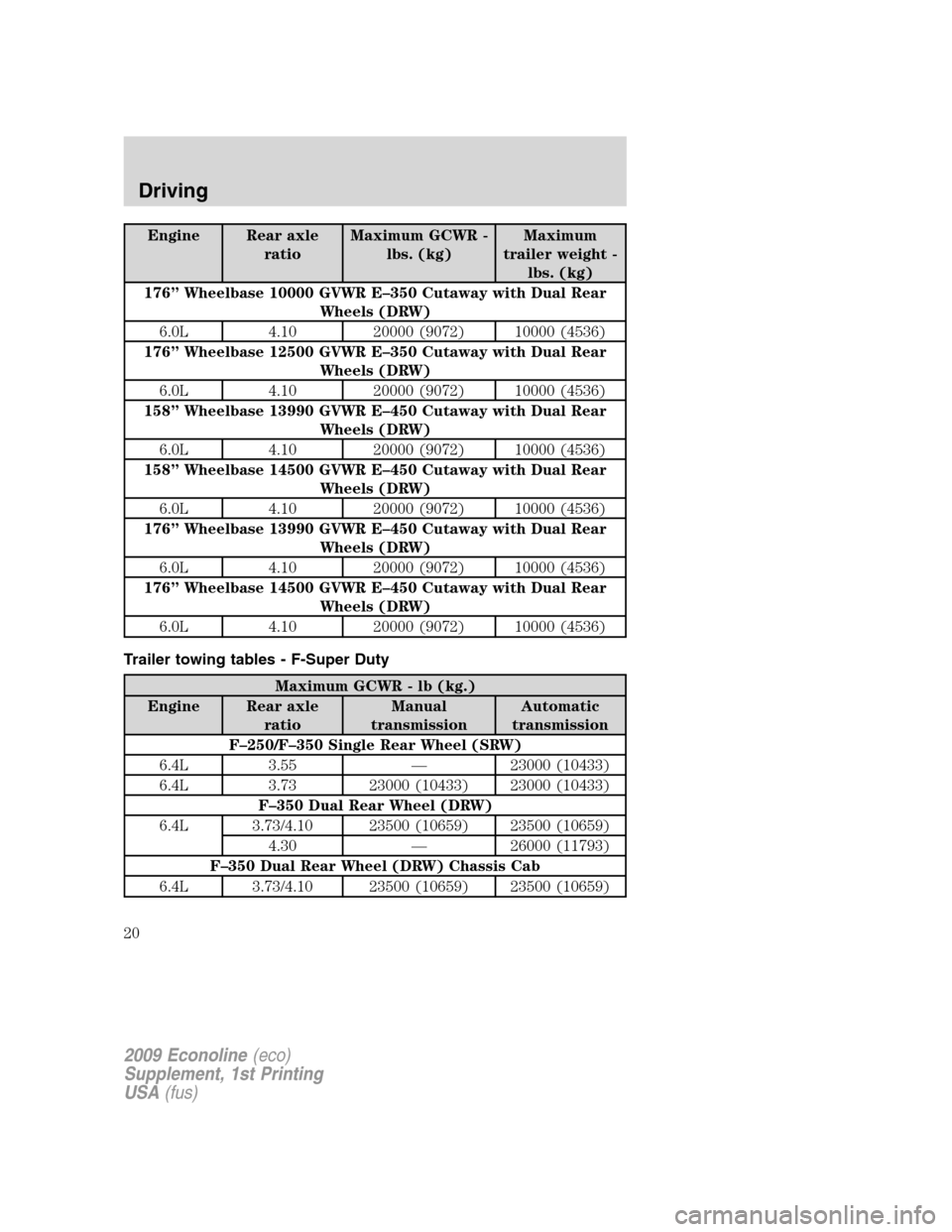
Engine Rear axle
ratioMaximum GCWR -
lbs. (kg)Maximum
trailer weight -
lbs. (kg)
176” Wheelbase 10000 GVWR E–350 Cutaway with Dual Rear
Wheels (DRW)
6.0L 4.10 20000 (9072) 10000 (4536)
176” Wheelbase 12500 GVWR E–350 Cutaway with Dual Rear
Wheels (DRW)
6.0L 4.10 20000 (9072) 10000 (4536)
158” Wheelbase 13990 GVWR E–450 Cutaway with Dual Rear
Wheels (DRW)
6.0L 4.10 20000 (9072) 10000 (4536)
158” Wheelbase 14500 GVWR E–450 Cutaway with Dual Rear
Wheels (DRW)
6.0L 4.10 20000 (9072) 10000 (4536)
176” Wheelbase 13990 GVWR E–450 Cutaway with Dual Rear
Wheels (DRW)
6.0L 4.10 20000 (9072) 10000 (4536)
176” Wheelbase 14500 GVWR E–450 Cutaway with Dual Rear
Wheels (DRW)
6.0L 4.10 20000 (9072) 10000 (4536)
Trailer towing tables - F-Super Duty
Maximum GCWR - lb (kg.)
Engine Rear axle
ratioManual
transmissionAutomatic
transmission
F–250/F–350 Single Rear Wheel (SRW)
6.4L 3.55 — 23000 (10433)
6.4L 3.73 23000 (10433) 23000 (10433)
F–350 Dual Rear Wheel (DRW)
6.4L 3.73/4.10 23500 (10659) 23500 (10659)
4.30 — 26000 (11793)
F–350 Dual Rear Wheel (DRW) Chassis Cab
6.4L 3.73/4.10 23500 (10659) 23500 (10659)
2009 Econoline(eco)
Supplement, 1st Printing
USA(fus)
Driving
20