Page 267 of 351
Fuse/Relay
LocationFuse Amp
RatingProtected Circuits
6 20A Door unlock/lock
7 15A Trailer tow stop/turn lamps
8 15A Ignition switch power, PATS, Cluster
9 2A 6-speed transmission/PCM (Ignition
RUN/START), Fuel pump relay
10 5A Front wiper RUN/ACC (relay in PDB)
11 5A Radio start
12 5A Radio, Trailer tow battery charge
(relay in PDB)
13 15A Heated mirror
14 20A Horn
15 10A Reverse lamps
16 10A Trailer tow reverse lamps
17 10A RCM (restraints), Passenger
occupancy
18 10A IVD switch, IVD, 4x4 module, 4x4
switch, Heated seat switches,
Compass, Electrochromatic mirror,
Reverse park aid
19 — Not used
20 10A Manual climate control, DEATC, Brake
shift
21 — Not used
22 15A Brake switch, Stop lamps, Turn lamps
23 15A Interior lamps, Puddle lamps, Cargo
lamp, Battery saver, Instrument
illumination
24 10A Instrument cluster, Theft LED
25 15A Trailer tow park lamps
26 15A License plate lamps, Rear park lamps,
Front park lamps, Manual climate
control
2009 07+ Explorer Sport Trac(esp)
Owners Guide, 2nd Printing
USA(fus)
Roadside Emergencies
267
Page 269 of 351
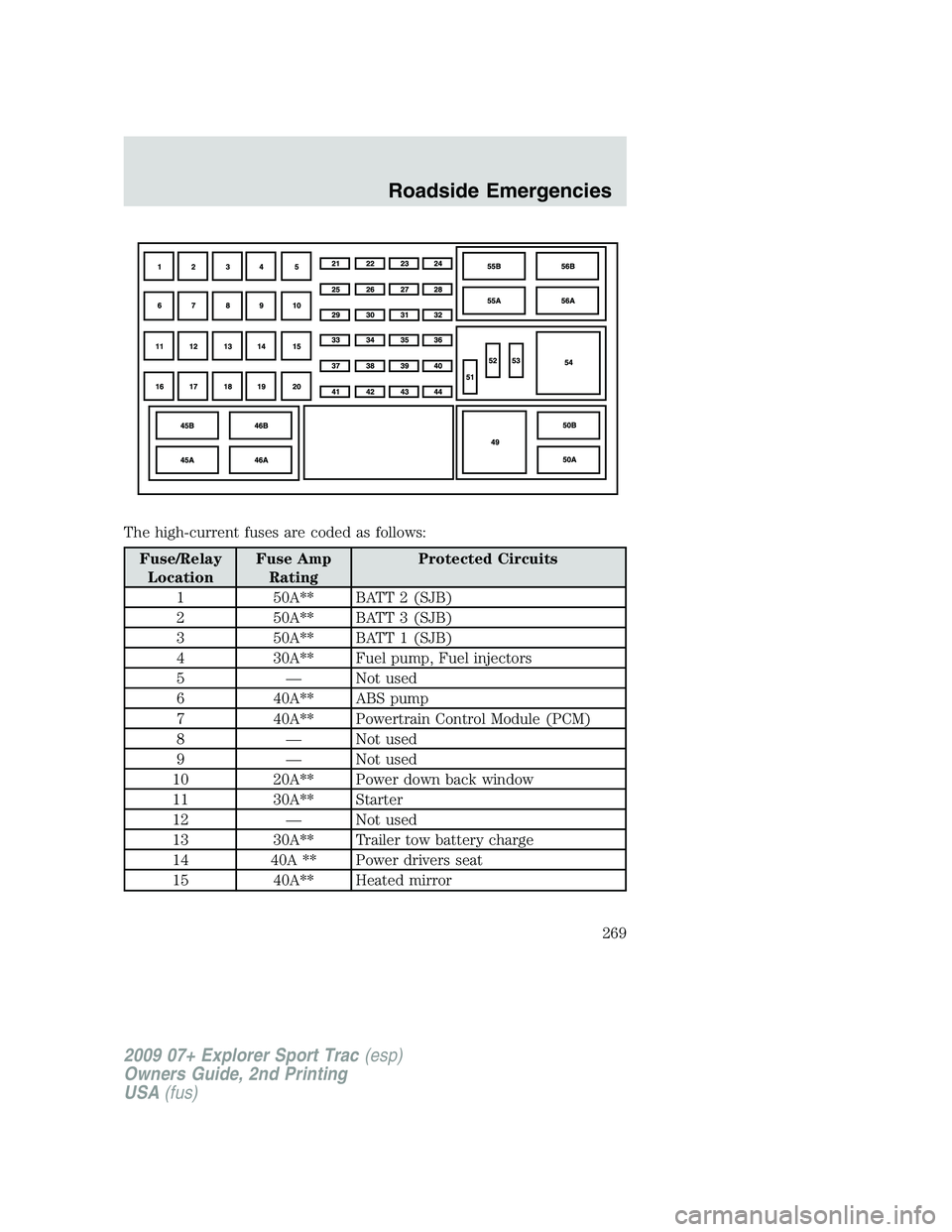
The high-current fuses are coded as follows:
Fuse/Relay
LocationFuse Amp
RatingProtected Circuits
1 50A** BATT 2 (SJB)
2 50A** BATT 3 (SJB)
3 50A** BATT 1 (SJB)
4 30A** Fuel pump, Fuel injectors
5 — Not used
6 40A** ABS pump
7 40A** Powertrain Control Module (PCM)
8 — Not used
9 — Not used
10 20A** Power down back window
11 30A** Starter
12 — Not used
13 30A** Trailer tow battery charge
14 40A ** Power drivers seat
15 40A** Heated mirror
2009 07+ Explorer Sport Trac(esp)
Owners Guide, 2nd Printing
USA(fus)
Roadside Emergencies
269
Page 270 of 351
Fuse/Relay
LocationFuse Amp
RatingProtected Circuits
16 40A** Blower motor
17 30A** Trailer tow electronic brakes
18 — Not used
19 — Not used
20 30A** Front wiper motor
21 20A* Rear of console power point
22 20A* Subwoofer
23 20A* 4x4 module
24 10A* Powertrain Control Module (PCM)
Keep Alive Power, Canister vent
25 20A* Front of console power point/Cigar
lighter
26 20A* 4x4 module, AWD module
27 20A* 6–speed transmission control module
(TCM) (4.6L engine only)
28 20A* Heated seats
29 15A* Right high/low beam headlamp
30 20A* Cargo bed power point
31 15A* Fog lamps
32 5A* Power mirrors
33 30A* ABS valves
34 15A* Left high/low beam headlamp
35 10A* AC clutch
36 20A* Console bin power point
37 30A* Driver window motor
38 15A* 5–speed transmission (4.0L engine
only)
39 15A* PCM power
40 15A* Fan clutch, PCV valve, AC clutch
relay
41 15A* SDARS, DVD, SYNC
2009 07+ Explorer Sport Trac(esp)
Owners Guide, 2nd Printing
USA(fus)
Roadside Emergencies
270
Page 271 of 351
Fuse/Relay
LocationFuse Amp
RatingProtected Circuits
42 15A* Speed control deactivation switch,
EVMV, MAFS, HEGO, EVR, CMS,
(VCT1, VCT2, CMCV on 4.6L only)
43 15A* Coil on plug (4.6L engine), Coil tower
(4.0L engine)
44 15A* Fuel injectors
45B — Not used
45A — Not used
46B — Not used
46A — Not used
49 — Fuel pump relay
50B — A/C clutch relay
50A — Fog lamps relay
51 — Not used
52 — Not used
53 — One Touch Integrated Start (OTIS)
(diode)
54 — Trailer tow battery charge relay
55B — Front wiper relay
55A — PCM relay
56B — Starter relay
56A — Climate control blower relay
* Mini Fuses ** Cartridge Fuses
CHANGING THE TIRES
If you get a flat tire while driving:
•do not brake heavily.
•gradually decrease the vehicle’s speed.
•hold the steering wheel firmly.
•slowly move to a safe place on the side of the road.
Note:The tire pressure monitoring system (TPMS) indicator light will
illuminate when the spare is in use. To restore the full functionality of
the monitoring system, all road wheels equipped with tire pressure
monitoring sensors must be mounted on the vehicle.
2009 07+ Explorer Sport Trac(esp)
Owners Guide, 2nd Printing
USA(fus)
Roadside Emergencies
271
Page 272 of 351
Have a flat serviced by an authorized dealer in order to prevent damage
to the TPMS sensor, refer toChanging tires with TPMSin theTires,
Wheels and Loadingchapter. Replace the spare tire with a road tire as
soon as possible.
WARNING:The use of tire sealants may damage your Tire
Pressure Monitoring System and should not be used.
WARNING:Refer toTire Pressure Monitoring System (TPMS)
in theTires, Wheels and Loadingchapter for important
information. If the tire pressure monitor sensor becomes damaged, it
will no longer function.
Dissimilar spare tire/wheel information
WARNING:Failure to follow these guidelines could result in an
increased risk of loss of vehicle control, injury or death.
If you have a dissimilar spare tire/wheel, then it is intended for
temporary use only. This means that if you need to use it, you should
replace it as soon as possible with a road tire/wheel that is the same size
and type as the road tires and wheels that were originally provided by
Ford. If the dissimilar spare tire or wheel is damaged, it should be
replaced rather than repaired.
A dissimilar spare tire/wheel is defined as a spare tire and/or wheel that
is different in brand, size or appearance from the road tires and wheels
and can be one of three types:
1.T-type mini-spare:This spare tire begins with the letter “T” for tire
size and may have “Temporary Use Only” molded in the sidewall
2.Full-size dissimilar spare with label on wheel:This spare tire has
a label on the wheel that states: “THIS TIRE AND WHEEL FOR
TEMPORARY USE ONLY”
When driving with one of the dissimilar spare tires listed above,do not:
•Exceed 50 mph (80 km/h)
•Load the vehicle beyond maximum vehicle load rating listed on the
Safety Compliance Label
•Tow a trailer
•Use snow chains on the end of the vehicle with the dissimilar spare
tire
2009 07+ Explorer Sport Trac(esp)
Owners Guide, 2nd Printing
USA(fus)
Roadside Emergencies
272
Page 273 of 351
•Use more than one dissimilar spare tire at a time
•Use commercial car washing equipment
•Try to repair the dissimilar spare tire
Use of one of the dissimilar spare tires listed above at any one wheel
location can lead to impairment of the following:
•Handling, stability and braking performance
•Comfort and noise
•Ground clearance and parking at curbs
•Winter weather driving capability
•Wet weather driving capability
3.Full-size dissimilar spare without label on wheel
When driving with the full-size dissimilar spare tire/wheel,do not:
•Exceed 70 mph (113 km/h)
•Use more than one dissimilar spare tire/wheel at a time
•Use commercial car washing equipment
•Use snow chains on the end of the vehicle with the dissimilar spare
tire/wheel
The usage of a full-size dissimilar spare tire/wheel can lead to
impairment of the following:
•Handling, stability and braking performance
•Comfort and noise
•Ground clearance and parking at curbs
•Winter weather driving capability
•Wet weather driving capability
•All-Wheel driving capability (if applicable)
•Load leveling adjustment (if applicable)
When driving with the full-size dissimilar spare tire/wheel additional
caution should be given to:
•Towing a trailer
•Driving vehicles equipped with a camper body
•Driving vehicles with a load on the cargo rack
Drive cautiously when using a full-size dissimilar spare tire/wheel and
seek service as soon as possible.
2009 07+ Explorer Sport Trac(esp)
Owners Guide, 2nd Printing
USA(fus)
Roadside Emergencies
273
Page 287 of 351
On 4x2 vehicles, it is acceptable to tow the vehicle with the front wheels
on the ground (without dollies) and the rear wheels off the ground.
On 4x4/AWD vehicles, it is required that your vehicle be towed with a
wheel lift and dollies or flatbed equipment with all the wheels off the
ground.
If the vehicle is towed by other means or incorrectly, vehicle
damage may occur.
Ford Motor Company produces a towing manual for all authorized tow
truck operators. Have your tow truck operator refer to this manual for
proper hook-up and towing procedures for your vehicle.
Emergency towing
In case of a roadside emergency with a disabled vehicle (without access
to wheel dollies, car hauling trailer, or flatbed transport vehicle) your
vehicle (regardless of transmission powertrain configuration) can be flat
towed (all wheels on the ground) under the following conditions:
•Vehicle is facing forward so that it is being towed in a forward
direction.
•Place the transmission in N (Neutral). Refer toBrake shift interlock
in theDrivingchapter for specific instructions if you cannot move the
gear shift lever into N (Neutral).
•Maximum speed is not to exceed 35 mph (56 km/h).
•Maximum distance is 50 miles (80 km).
2009 07+ Explorer Sport Trac(esp)
Owners Guide, 2nd Printing
USA(fus)
Roadside Emergencies
287
Page 329 of 351

•Revving the engine before turning it off may reduce fuel economy.
•Using the air conditioner or defroster may reduce fuel economy.
•You may want to turn off the speed control in hilly terrain if
unnecessary shifting between the top gears occurs. Unnecessary
shifting of this type could result in reduced fuel economy.
•Warming up a vehicle on cold mornings is not required and may
reduce fuel economy.
•Resting your foot on the brake pedal while driving may reduce fuel
economy.
•Combine errands and minimize stop-and-go driving.
Maintenance
•Keep tires properly inflated and use only recommended size.
•Operating a vehicle with the wheels out of alignment will reduce fuel
economy.
•Use recommended engine oil. Refer toMaintenance product
specifications and capacitiesin this chapter.
•Perform all regularly scheduled maintenance items. Follow the
recommended maintenance schedule and owner maintenance checks
found inscheduled maintenance information.
Conditions
•Heavily loading a vehicle or towing a trailer may reduce fuel economy
at any speed.
•Carrying unnecessary weight may reduce fuel economy (approximately
1 mpg [0.4 km/L] is lost for every 400 lb [180 kg] of weight carried).
•Adding certain accessories to your vehicle (for example; bug
deflectors, rollbars/light bars, running boards, ski/luggage racks) may
reduce fuel economy.
•Fuel economy may decrease with lower temperatures during the first
8–10 miles (12–16 km) of driving.
•Driving on flat terrain offers improved fuel economy as compared to
driving on hilly terrain.
•Transmissions give their best fuel economy when operated in the top
cruise gear and with steady pressure on the gas pedal.
•Four-wheel-drive operation (if equipped) is less fuel efficient than
two-wheel-drive operation.
•Close windows for high speed driving.
2009 07+ Explorer Sport Trac(esp)
Owners Guide, 2nd Printing
USA(fus)
Maintenance and Specifications
329