162
POWER-ASSISTED BRAKES
Your vehicle has power-assisted brakes. If
power assistance is lost due to a stalled
engine or other failures, the system is still
fully operational on reserve power and
you can bring the vehicle to a complete
stop by pressing the brake pedal once and
holding it down. The reserve power is
partly used up when you depress the
brake pedal and reduces each time the
pedal is pressed. Apply smooth and even
pressure to the pedal. Do not pump the
pedal.ANTI-LOCK BRAKE SYSTEM
(ABS)
(for versions/markets, where provided)
ABS will help you avoid skidding by elec-
tronically controlling braking pressure. It
will also help you maintain steering con-
trol when braking on slippery surfaces or
when braking hard.
The ABS works automatically, so you do
not need any special braking technique.
Just push the brake pedal down without
pumping. The ABS will operate whenev-
er it senses that the wheels are locking up.
You may feel the brake pedal moves a lit-
tle while the ABS is operating.
NOTE The ABS will not work if vehicle
speed is under about 6 km/h (4 mph).
If water gets into the brake
drums, brake performance
may become poor and unpredictable.
After driving through water or wash-
ing the underside of the vehicle, test
the brakes while driving at a slow
speed to see if they have maintained
their normal effectiveness. If the
brakes are less effective than normal,
dry them by repeatedly applying the
brakes while driving slowly until the
brakes have regained their normal ef-
fectiveness.
WARNING
Even without reserve power
in the brake system, you can
still stop the vehicle by pressing the
brake pedal harder than normally re-
quired. However, the stopping dis-
tance may be longer.
WARNING
Brake Assist System
When you slam the brakes on, the brake
assist system judges as an emergency stop
and provides more powerful braking for a
driver who cannot hold down the brake
pedal firmly.
NOTE If you quickly and forcefully de-
press the brakes, you may hear a clicking
sound in the brake pedal. This is normal
and indicates that the brake assist system
is activated properly.
149-168 SEDICI LUM FL GB 1E 19-06-2009 13:33 Pagina 162
237
❒If you do not find a leak, carefully add
coolant to the reservoir and then the
radiator, if necessary. (Refer to “Engine
Coolant” in the “INSPECTION AND
MAINTENANCE” section.) If the temperature indication does not
come down to within the normal, accept-
able range:
❒Turn off the engine and check that the
water pump belt and pulleys are not
damaged or slipping. If any abnormali-
ty is found, correct it.
❒Check the coolant level in the reser-
voir. If it is found to be lower than the
“LOW” line, look for leaks at the ra-
diator, water pump, and radiator and
heater hoses. If you locate any leaks
that may have caused the overheating,
do not run the engine until these prob-
lems have been corrected.
79J007
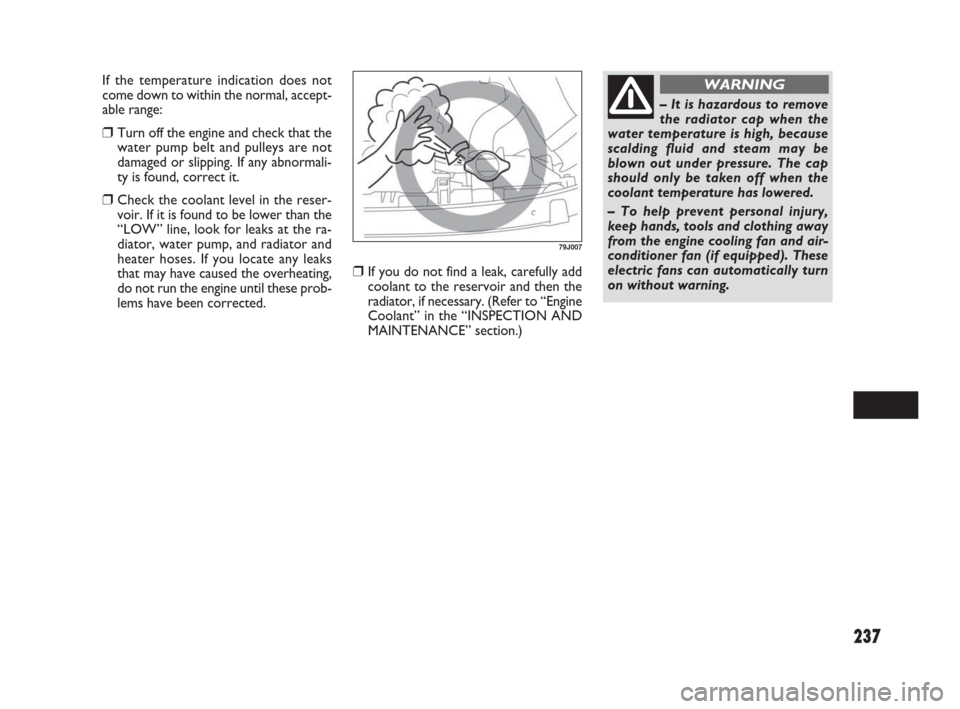
– It is hazardous to remove
the radiator cap when the
water temperature is high, because
scalding fluid and steam may be
blown out under pressure. The cap
should only be taken off when the
coolant temperature has lowered.
– To help prevent personal injury,
keep hands, tools and clothing away
from the engine cooling fan and air-
conditioner fan (if equipped). These
electric fans can automatically turn
on without warning.
WARNING
231-238 SEDICI LUM FL GB 1E 19-06-2009 11:06 Pagina 237