2009 FIAT PANDA lock
[x] Cancel search: lockPage 67 of 226
Never exceed the maximum allowed load
in the boot (see “Technical Specifica-
tions”). Make sure that the objects are well
arranged in the boot so that they will not be pro-
jected forwards following sudden braking.
WARNING
Never travel with the tailgate open: ex-
haust gases may get into the passenger’s
compartment.
WARNING
If you travel in areas with few filling sta-
tions and you want to transport fuel in
a spare tank, comply with the regulations in force
and use only an approved, suitably secured tank.
Even in this way the risk of fire increases in case
of accident.
WARNING
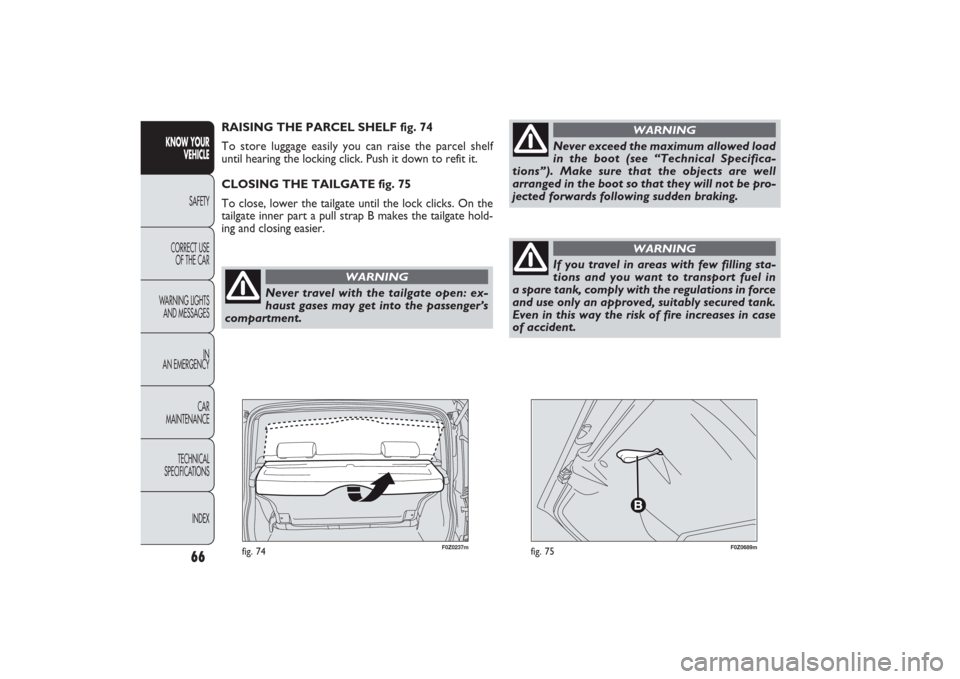
RAISING THE PARCEL SHELF fig. 74
To store luggage easily you can raise the parcel shelf
until hearing the locking click. Push it down to refit it.
CLOSING THE TAILGATE fig. 75
To close, lower the tailgate until the lock clicks. On the
tailgate inner part a pull strap B makes the tailgate hold-
ing and closing easier.
fig. 75
F0Z0689m
fig. 74
F0Z0237m
66
KNOW YOUR
VEHICLE
SAFETY
CORRECT USE
OF THE CAR
WARNING LIGHTS
AND MESSAGES
IN
AN EMERGENCY
CAR
MAINTENANCE
TECHNICAL
SPECIFICATIONS
INDEX
065-090 PANDA EN 7-10-2009 13:45 Pagina 66
Page 68 of 226

Open the tailgate with care when carrying
objects on the roof rack to prevent injuries.
WARNING
A heavy load that has not been secured
may cause serious injuries in case of
accident.
WARNING
EXTENDING THE BOOT
(versions with fixed rear seat) fig. 76
To extend the boot, proceed as follows:
1) The parcel shelf removed can be placed transversally
behind the backrests. To remove, release the two catch-
es A (one each side) from their locations and pull the par-
cel shelf outwards.
2) Operate the levers on the backrests outer side and tilt
the backrest forwards shifting aside the seat belt.
For three-point central seat belts see paragraph “Use of
the central seat belt” in chapter “Safety devices”.
To bring back the seat in its standard position: lift the back-
rest and push it backwards until you hear the locking click
and make sure the seat belts are at the front of the back-
rest.
Upon demand the car can be fitted with split rear seat.The boot extension possibilities offered by the split seat
are many and can be chosen according to the number of
passengers and the amount of luggage to be carried:
❒
total extension with right and left side of the seat tilt-
ed as described above;
❒
partial extension with left or right side of the seat tilt-
ed and place only for one person on the rear seat.
IMPORTANT If in a rather heavy load is being carried in
the boot and you are travelling at night, check and adjust
the main beam headlights aiming (see “Headlights” in this
section).fig. 76
F0Z0131m
67KNOW YOUR
VEHICLESAFETY
CORRECT USE
OF THE CAR
WARNING LIGHTS
AND MESSAGES
IN
AN EMERGENCY
CAR
MAINTENANCE
TECHNICAL
SPECIFICATIONS
INDEX
065-090 PANDA EN 7-10-2009 13:45 Pagina 67
Page 69 of 226

Once you have released the adjustment
lever, always check that the seat is locked
on the guides by trying to move it back and forth.
Failure to lock the seat in place could result in the
seat moving suddenly and the driver losing control
of the car.
WARNING
Restoring the seat position
To bring back the seat to its standard position: lift the seat
back and push it backwards until it locks and make sure
the seat belts are at the front of the seat back. EXTENDING THE BOOT
(versions with sliding rear seat) fig. 77 and 78
Partial extension
Use the lever A (in the passenger’s compartment) or
the central tab D in the boot to move the seat forward.
Total extension
Remove the parcel shelf as previously described (see ver-
sions with fixed rear seat).
Use the lever A or the central tab D in the boot to move
the seat to the required position (e.g. fully forward for to-
tal boot extension).
Lift lever B or C or pull side tabs E or F in the boot to
release the seat backrest section to tilt; act on both if you
want to tilt the whole backrest.
fig. 78
F0Z0258m
fig. 77
F0Z0257m
68
KNOW YOUR
VEHICLE
SAFETY
CORRECT USE
OF THE CAR
WARNING LIGHTS
AND MESSAGES
IN
AN EMERGENCY
CAR
MAINTENANCE
TECHNICAL
SPECIFICATIONS
INDEX
065-090 PANDA EN 7-10-2009 13:45 Pagina 68
Page 71 of 226

70
F0Z0075m
fig. 81
To close - fig. 81
Hold the bonnet up with one hand and with the other
remove rod B from its recess D; then, fit it back into its
catch C.
Lower the bonnet to approximately 20 centimetres above
the engine compartment and let it come down. Make sure
the bonnet is properly locked and not just secured in safe-
ty position. In this case, do not press the bonnet down, rather
lift it again and repeat the procedure.
For safety reasons, the bonnet must al-
ways be properly closed while the car is
travelling. Make sure that the bonnet is properly
closed and that the lock is engaged. Should you
notice that the bonnet is not properly secured
while travelling, stop the car immediately and lose
the bonnet safely.
WARNING
Pay attention to scarves, ties and other
loose fitting garments. If they accidental-
ly touch moving parts, they may easily get caught
up with serious risks for those who wear them.
WARNING
KNOW YOUR
VEHICLE
SAFETY
CORRECT USE
OF THE CAR
WARNING LIGHTS
AND MESSAGES
IN
AN EMERGENCY
CAR
MAINTENANCE
TECHNICAL
SPECIFICATIONS
INDEX
065-090 PANDA EN 7-10-2009 13:45 Pagina 70
Page 75 of 226

When the ABS cuts in and you feel the
brake pedal pulsating, do not raise foot,
but keep it pressed; in doing so you will stop in the
shortest amount of space possible depending on
the current road conditions.
WARNING
If the ABS system cuts in, it means that the
grip between the tyre and the road surface
is close to its limit: you must slow down to match
the speed to the road grip available.
WARNING
The ABS make the best use of the avail-
able grip but cannot increase it. You
should always drive carefully on slippery surfaces
and avoid any unnecessary risks.
WARNING
ABS SYSTEM (for versions/markets, where provided)
This system, which is an integral part of the braking sys-
tem, prevents one or more wheels from locking and slip-
ping in all road surface conditions, irrespective of the
intensity of the braking action, ensuring that the vehicle can
be controlled even during emergency braking.
The EBD system (Electronic Braking Force Distribution)
completes the system allowing the brake force to be dis-
tributed between the front and rear wheels.
IMPORTANT To get the maximum efficiency of the brak-
ing system, a bedding-in period of about 500 km is need-
ed: during this period it is better to avoid sharp, repeat-
ed and prolonged braking.
SYSTEM INTERVENTION
The driver can feel the ABS system has come into action
because the brake pedal pulsates slightly and the system gets
noisier: it means that the car speed should be altered to suit
the type of road surface.
74
KNOW YOUR
VEHICLE
SAFETY
CORRECT USE
OF THE CAR
WARNING LIGHTS
AND MESSAGES
IN
AN EMERGENCY
CAR
MAINTENANCE
TECHNICAL
SPECIFICATIONS
INDEX
065-090 PANDA EN 7-10-2009 13:45 Pagina 74
Page 76 of 226

If only the
x
warning light on the instru-
ment panel lights up – together with
a message in the reconfigurable multifunction dis-
play (for versions/markets, where provided) – stop
the car immediately and contact the nearest
Fiat Dealership. Leakage of hydraulic fluid from
the braking system will compromise the operation
of the braking system, whether it is of the con-
ventional type or with ABS.WARNING
FAILURE WARNING
ABS failure fig. 86
It is indicated by the
>
warning light on the instrument
panel - together with the dedicated message in the re-
configurable multifunction display (for versions/markets,
where provided) - coming on (see “Warning lights
and messages” chapter).
In this case, the braking system will still be effective, al-
though without the extra capacity offered by the ABS sys-
tem. Drive carefully to the nearest Fiat Dealership to have
the system checked.
EBD failure fig. 87
It is indicated by the
>
and
x
warning lights on the in-
strument panel - together with the dedicated message
in the multifunction display (for versions/markets, where
provided) - coming on (see “Warning lights and messages”
chapter).In this case, the rear wheels may suddenly lock and the ve-
hicle may swerve when braking sharply. Drive carefully
to the nearest Fiat Dealership to have the system checked.
fig. 87
F0Z0159m
fig. 86
F0Z0158m
75KNOW YOUR
VEHICLESAFETY
CORRECT USE
OF THE CAR
WARNING LIGHTS
AND MESSAGES
IN
AN EMERGENCY
CAR
MAINTENANCE
TECHNICAL
SPECIFICATIONS
INDEX
065-090 PANDA EN 7-10-2009 13:45 Pagina 75
Page 82 of 226

F0Z0163m
fig. 92
It is absolutely forbidden to carry out
whatever after-market operation involv-
ing steering system or steering column modifica-
tions (e.g.: installation of anti-theft device) that
could badly affect performance and safety, cause
the lapse of warranty and also result in non-com-
pliance of the car with type approval require-
ments.
WARNING
Before starting any servicing operation,
stop the engine and remove the key from
the ignition switch to operate the steering lock,
particularly when the wheels do not touch the
ground. If this is not possible (i.e. if the key must
be kept in the MAR position or the engine must
be kept running), remove the electric power steer-
ing system main fuse.
WARNING
In this case, stop the car immediately, switch off the en-
gine for about 20 seconds and then restart the engine.
If the warning light
g
is still on, along with the message
on the reconfigurable multifunction display (for versions/
markets, where provided), contact a Fiat Dealership.
IMPORTANT The steering may become stiffer following
parking manoeuvres including a great deal of steering.
This is normal and caused by the system preventing the
electric control motor overheating. No repairs are need-
ed. The power steering system will start working properly
again the next time the car is used.
81KNOW YOUR
VEHICLESAFETY
CORRECT USE
OF THE CAR
WARNING LIGHTS
AND MESSAGES
IN
AN EMERGENCY
CAR
MAINTENANCE
TECHNICAL
SPECIFICATIONS
INDEX
065-090 PANDA EN 7-10-2009 13:45 Pagina 81
Page 92 of 226

91KNOW YOUR
VEHICLESAFETYCORRECT USE
OF THE CAR
WARNING LIGHTS
AND MESSAGES
IN AN EMERGENCY
CAR
MAINTENANCE
TECHNICAL
SPECIFICATIONS
INDEX
SAFETY
F0Z0053m
fig. 98
The reel may lock when the car is parked on a steep slope:
this is perfectly normal. Furthermore, the reel mechanism
locks the belt if it is pulled and in the event of sudden brak-
ing, collisions and on high speed bends.
The rear side seats have inertia reel seat belts with three
anchor points. Upon demand (optional for 5-seat approved
cars) the central seat belt can be supplied with three an-
chor points reel belt or static two-point lap belt (for ver-
sions/markets where provided).
IMPORTANT Remember that in the event of a violent col-
lision, back seat passengers not wearing seat belts also
represent a serious danger for the front seat passengers.
SAFETY BELTSUSING THE SEAT BELTS fig. 98
The belt should be worn keeping the chest straight and
rested against the backrest.
To fasten the seat belts, hold the tongue A and insert it in-
to the buckle B, until hearing the locking click. On removal,
if it jams, let it rewind for a short stretch, then pull it out
again without jerking.
To unfasten seat belts, press button C. Guide the belt while
it is rewinding to prevent it from twisting. Through the
reel, the belt automatically adapts to the body of the pas-
senger wearing it, allowing freedom of movement.
Never press button C when travelling.
WARNING
S.B.R. SYSTEMThe car is equipped with an S.B.R. system (Seat Belt Re-
minder) made up of a buzzer which, together with the seat
belt warning light
<
on the instrument panel switching
on, warns the driver that the seat belt is not fastened.
091-110 PANDA EN 7-10-2009 13:46 Pagina 91