Page 151 of 226
150KNOW
YOUR VEHICLE
SAFETY
CORRECT USE
OF THE CAR
WARNING LIGHTS
AND MESSAGES
IN
AN EMERGENCYCAR
MAINTENANCE
TECHNICAL
SPECIFICATIONS
INDEX
F0Z0118m
fig. 140
TYPES OF BULBS fig. 140
Various types of bulbs are fitted to your car:
A Glass bulbs: they are pressure-fit. Pull to remove.
B Bayonet-type bulbs: to remove this type of bulb from
its holder, press the bulb and turn it counter-clockwise.
C Tubular bulbs: release them from their contacts to re-
move.
D Halogen bulbs: to remove the bulb, release the clip
holding the bulb in place.
E Halogen bulbs: to remove the bulb, release the clip
holding the bulb in place.
135-168 PANDA EN 7-10-2009 14:07 Pagina 150
Page 156 of 226
155KNOW
YOUR VEHICLE
SAFETY
CORRECT USE
OF THE CAR
WARNING LIGHTS
AND MESSAGESIN
AN EMERGENCYCAR
MAINTENANCE
TECHNICAL
SPECIFICATIONS
INDEX
F0Z0229m
fig. 151
TOP
OFF
ON
F0Z0228m
fig. 150
F0Z0097m
fig. 153
F0Z0096m
fig. 152
❒
loosen the four screws B-fig. 153 from their housings
and remove the bulb-holder C;
❒
remove the bulbs, pushing them slightly and rotating
counter-clockwise;
❒
refit by reversing the above mentioned operations. REAR LIGHT UNIT
To change the bulb proceed as follows:
❒
loosen the three screws A-fig. 152 from their seats, pull
gently outwards until releasing the whole headlight from
the three clips (press-fit), then release the connector;
135-168 PANDA EN 7-10-2009 14:07 Pagina 155
Page 160 of 226
159KNOW
YOUR VEHICLE
SAFETY
CORRECT USE
OF THE CAR
WARNING LIGHTS
AND MESSAGESIN
AN EMERGENCYCAR
MAINTENANCE
TECHNICAL
SPECIFICATIONS
INDEX
F0Z0102m
fig. 163
F0Z0103m
fig. 164
BOOT LIGHT
(for versions/markets, where provided)
To change the bulbs, proceed as follows:❒
open the tailgate;
❒
using the screwdriver provided, extract the ceiling light
A-fig. 163 working in the point shown;
❒
open the bulb cover B-fig. 164 and replace the pressure-
fit bulb C;
❒
close again the bulb cover B on the lens;
❒
refit correctly the light pressing one side and then the
other until the locking click is heard.
135-168 PANDA EN 7-10-2009 14:07 Pagina 159
Page 164 of 226
163KNOW
YOUR VEHICLE
SAFETY
CORRECT USE
OF THE CAR
WARNING LIGHTS
AND MESSAGESIN
AN EMERGENCYCAR
MAINTENANCE
TECHNICAL
SPECIFICATIONS
INDEX
5
7,5
7,5
10
7,5
15
15
7,5
7,5
7,5
7,5
5
5
15
–
–
7,5
7,5
7,5
20
10
10
10
10
F31
F35
F35
F37
F41
F45
F46
F49
F49
F49
F50
F51
F51
F54
FA
FB
F12
F13
F13
F38
F39
F39
F39
F39
FUSE SUMMARY TABLEPassenger’s compartment fuse-box - fig. 167 FUSE AMPEREReversing lights+15 radioCentral dashboard+15 stop lightsDoor mirror defroster Heated seats (pre-arrangement)Electric sun roofAutomatic climate control systemTyre pressureSensor for water presence in the diesel fuel filter +15 air bag control unit+15 Body-computer control unit+15 instrument panelSubwooferFreeFreeRight dipped beam headlightLeft dipped beam headlightHeadlight aiming adjustment+ 30 door locking deviceEOBD diagnosis socketRadioAutomatic climate control systemTyre pressure
135-168 PANDA EN 7-10-2009 14:07 Pagina 163
Page 169 of 226
168KNOW
YOUR VEHICLE
SAFETY
CORRECT USE
OF THE CAR
WARNING LIGHTS
AND MESSAGES
IN
AN EMERGENCYCAR
MAINTENANCE
TECHNICAL
SPECIFICATIONS
INDEX
Before towing, turn the ignition key to
MAR and then to STOP without removing
it. The steering column will automatically lock
when the key is removed and the wheels cannot
be steered.
WARNING
When towing, remember that without the
help of the servo-brake and electric pow-
er steering, a greater effort is required on the ped-
al and steering wheel. Do not use flexible cables
when towing and avoid jerky movements. While
towing, make sure not to damage parts in contact
with the car. When towing the car, comply with
the regulations of the Highway Code about tow-
ing, both concerning the towing device and the
driving behaviour on the road.
WARNING
During towing, never start the engine.
WARNING
135-168 PANDA EN 7-10-2009 14:07 Pagina 168
Page 171 of 226

●●●● ● ●●●●
●●●● ● ●●●●
●●●● ● ●●●●
●●●● ● ●●●●
●●●● ● ●●●●
●●●
●●●● ● ●●●●
●●●● ● ●●●●
●
●● ●●
●● ●●
●● ●●
●●20 40 60 80 100 120 140 160 180
SCHEDULED SERVICING PROGRAMMEThese coupons have to be carried out every 20,000 km
Thousands of km
Check tyre condition/wear and, if necessary, adjust
pressure
Check lighting system operation (headlights, direction indicators,
hazard warning lights, passenger’s compartment lights, boot lights, instrument panel warning lights, etc.)Check windscreen wiper/washer operation, adjust nozzlesCheck windscreen/rear window blade position/wearCheck front disc brake pad conditions and wearCheck rear drum brake linings conditions and wear
Condition visual check: bodywork exterior, underbody
protection, pipes and hoses (exhaust – fuel supply system
– braking system), rubber elements (boots – sleeves – bushes – etc...)
Check cleanliness of bonnet and boot locks, as well as cleanliness and lubrication of linkages
Check tension and conditions of various accessory drive belts (except for engines with automatic tensioners)Visually inspect conditions of the accessory drive beltsCheck and adjust tappet clearance (petrol versions)Check and adjust handbrake lever stroke Check anti-evaporation system (petrol versions)
INDEX TECHNICAL
SPECIFICATIONSCAR
MAINTENANCEIN
AN EMERGENCY WARNING LIGHTS
AND MESSAGESCORRECT USE
OF THE CARSAFETYKNOW
YOUR VEHICLE
170
169-190 PANDA EN 7-10-2009 14:14 Pagina 170
Page 173 of 226

YEARLY INSPECTION SCHEDULEFor cars with an annual mileage of below 20,000 km (for
example about 15,000 km) the following yearly inspec-
tion schedule is advised:❒
check conditions/wear of tyres and adjust pressure if
necessary (including spare wheel);
❒
check lighting system operation (headlights, direction
indicators, hazard warning lights, boot light, passenger’s
compartment, instrument panel warning lights, etc...);
❒
check wiper/washer system operation, adjust nozzles;
❒
check windscreen/rear window blade position/wear;
❒
check front disc brake pad conditions and wear;
❒
check cleanliness of bonnet and boot locks and lever
cleanliness and lubrication;
❒
sight inspect the conditions of: engine, gearbox, trans-
mission, pipes and hoses (exhaust – fuel supply – brak-
ing system) rubber parts (boots – sleeves – bushes etc.),
fuel and brake system hoses;
❒
check battery charge;
❒
visually check the various drive belt conditions;
❒
check and top-up liquids if required (engine coolant,
brakes, windscreen washer, battery, etc.);
❒
change engine oil;
❒
change engine oil filter;
❒
change pollen filter (for versions/markets where pro-
vided).
ADDITIONAL INTERVENTIONSEvery 1,000 km or before long journeys, check and, if nec-
essary, top-up the following:❒
engine coolant fluid level;
❒
brake fluid level;
❒
battery fluid level;
❒
windscreen washer fluid level;
❒
tyre pressure and conditions.
Every 3,000 km check the following and top-up, if required:
❒
engine oil level.
You are recommended to use FL Selenia products de-
signed and produced specifically for Fiat cars (see table
“Capacities” in chapter “Technical specifications”).
IMPORTANT – Engine oil
Should prevailing use of the car be under one of the fol-
lowing specially heavy conditions:
❒
trailer or caravan towing;
❒
dusty roads;
❒
short distances (less than 7–8 km) and with external
temperatures below zero;
INDEX TECHNICAL
SPECIFICATIONSCAR
MAINTENANCEIN
AN EMERGENCY WARNING LIGHTS
AND MESSAGESCORRECT USE
OF THE CARSAFETYKNOW
YOUR VEHICLE
172
169-190 PANDA EN 7-10-2009 14:14 Pagina 172
Page 187 of 226
186KNOW
YOUR VEHICLE
SAFETY
CORRECT USE
OF THE CAR
WARNING LIGHTS
AND MESSAGES
IN
AN EMERGENCYCAR
MAINTENANCE
TECHNICAL
SPECIFICATIONS
INDEX
F0Z0218m
fig. 186
F0G0077m
fig. 187
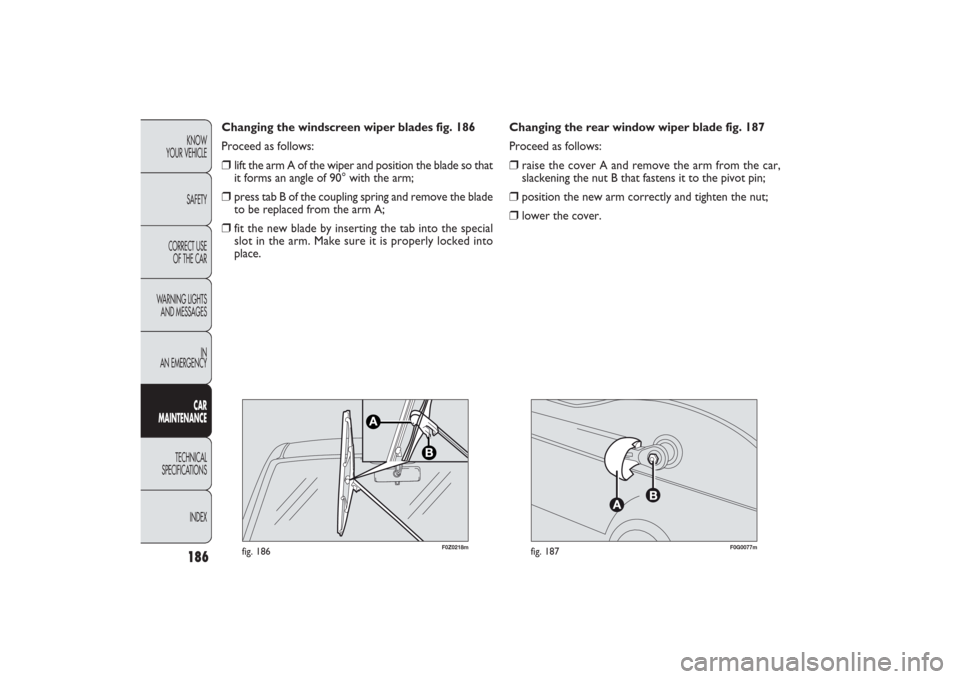
Changing the rear window wiper blade fig. 187
Proceed as follows:❒
raise the cover A and remove the arm from the car,
slackening the nut B that fastens it to the pivot pin;
❒
position the new arm correctly and tighten the nut;
❒
lower the cover. Changing the windscreen wiper blades fig. 186
Proceed as follows:
❒
lift the arm A of the wiper and position the blade so that
it forms an angle of 90° with the arm;
❒
press tab B of the coupling spring and remove the blade
to be replaced from the arm A;
❒
fit the new blade by inserting the tab into the special
slot in the arm. Make sure it is properly locked into
place.
169-190 PANDA EN 7-10-2009 14:15 Pagina 186