2009 FIAT PANDA ESP
[x] Cancel search: ESPPage 111 of 226

110
KNOW YOUR
VEHICLE
SAFETY
CORRECT USE
OF THE CAR
WARNING LIGHTS
AND MESSAGES
IN AN EMERGENCY
CAR
MAINTENANCE
TECHNICAL
SPECIFICATIONS
INDEX
The front air bag is triggered in case of
stronger shocks with respect to that of pre-
tensioners. For collisions in the range between the
two thresholds, it is normal for only the preten-
sioners to be activated.
WARNING
Do not hook rigid objects to the coat
hooks and to the support handles.
WARNING
The air bag does not replace seat belts but
increases their efficiency. Furthermore,
since front air bags are not deployed in low speed
collisions, side collisions, rear-end shunts or roll-
overs, the passengers are only protected by the
seat belts which must be fastened at all times.
WARNING
If the car has been stolen or in case of at-
tempt to steal it, if it has been subjected
to vandals or floods, have the air bag system
checked by Fiat Dealership.
WARNING
Do not wash the seats with water or pres-
surized vapour (hand washing or auto-
matic seat washing stations).
WARNING
Turning the ignition key to MAR, the warn-
ing light
F
(airbag on passenger’s side en-
abled) goes on and flashes for a few seconds, thus
reminding the passenger that the airbag on his/her
side will deploy in the event of a collision, then it
switches off.
WARNING
091-110 PANDA EN 7-10-2009 13:46 Pagina 110
Page 112 of 226

111KNOW
YOUR VEHICLE
SAFETY
WARNING LIGHTS
AND MESSAGES
IN
AN EMERGENCY
CAR
MAINTENANCE
TECHNICAL
SPECIFICATIONS
INDEX
CORRECT USE OF THE CAR
STARTING PROCEDURE FOR PETROL
VERSIONS
Proceed as follows:❒
engage the handbrake;
❒
place the gearshifting lever in neutral;
❒
press the clutch pedal all the way down without touch-
ing the accelerator;
❒
turn the ignition key to
AVV
and let it go as soon as
the engine starts.
If the engine does not start at the first attempt, return
the ignition key to
STOP
before repeating starting.
STARTING THE ENGINEThe car is fitted with an electronic engine lock device:
if the engine fails to start, see the paragraph “The Fiat
CODE system” in section “Know your vehicle”.
The engine may be noisier during the first few seconds of
operation, especially after a long period of inactivity. This
characteristic feature of the hydraulic tappet system does
not compromise functionality or reliability: the system de-
vised for your car was designed to limit maintenance
interventions.
It is dangerous to let the engine run in en-
closed spaces. The engine consumes oxy-
gen and engine exhaust contains carbon dioxide,
carbon monoxide and other toxic gasses.
WARNING
CORRECT USE
OF THE CAR
We recommend that during the initial pe-
riod you do not drive to full car perfor-
mance (e.g.: excessive acceleration, long
journeys at top speed, sharp braking, etc.).When the engine is switched off never leave
the key into the ignition switch to prevent
useless current absorption from draining the
battery.
Remember that the servo-brake and pow-
er steering are not operational until the
engine has been started, therefore much effort
than usual is required on the brake pedal
and teering wheel.
WARNING
111-122 PANDA EN 7-10-2009 15:01 Pagina 111
Page 114 of 226

113KNOW
YOUR VEHICLE
SAFETYCORRECT USE
OF THE CARWARNING LIGHTS
AND MESSAGES
IN
AN EMERGENCY
CAR
MAINTENANCE
TECHNICAL
SPECIFICATIONS
INDEX
F0Z0037m
fig. 116
PARKING THE VEHICLEProceed as follows:❒
stop the engine and engage the handbrake;
❒
engage a gear (on a slope, engage first gear if the vehi-
cle is parked uphill or reverse if it is parked downhill)
and leave the wheels steered.
Block the wheels with a wedge or a stone if the car is
parked on a steep slope.
Do not leave the key in the ignition switch at MAR to pre-
vent draining the battery. Always remove the key when
leaving the car. Never leave children unattended in the car.
Always remove the ignition key when leaving the car
and take it out with you.
HANDBRAKE fig. 116
The handbrake lever is located between the two front
seats. Pull the handbrake lever upwards until the car can-
not be moved. STOPPING THE ENGINE
Turn the ignition key to STOP while the engine is idling.
IMPORTANT After a taxing drive, you should allow the
engine to “catch its breath” before turning it off by let-
ting it idle to allow the temperature in the engine com-
partment to fall.
Never bump start the engine by pushing,
towing or coasting downhill. This could
cause a flow of fuel into the catalytic con-
verter and damage it beyond repair.A quick burst on the accelerator before
turning off the engine serves absolutely no
practical purpose, it wastes fuel and is dam-
aging especially to turbocharged engines.
EMERGENCY START-UP
If the instrument panel warning light
Y
stays on with fixed
light, the emergency start-up can be performed by using
the CODE card code (see chapter “In an emergency”).
111-122 PANDA EN 7-10-2009 15:01 Pagina 113
Page 116 of 226

115KNOW
YOUR VEHICLE
SAFETYCORRECT USE
OF THE CARWARNING LIGHTS
AND MESSAGES
IN
AN EMERGENCY
CAR
MAINTENANCE
TECHNICAL
SPECIFICATIONS
INDEX
CONTAINING RUNNING COSTSSome useful tips are given below for fuel saving and re-
ducing harmful emissions of CO
2and other pollutants
(nitrogen oxides, unburnt hydrocarbons, Particulate
Matter (PM) etc.).
GENERAL CONSIDERATIONS
Car maintenance
Have checks and adjustments carried out in accordance
with the “Scheduled servicing plan.”
Tyres
Check the pressure of the tyres routinely at an interval
of no more than 4 weeks: if the pressure is too low, con-
sumption levels increase as resistance to rolling is higher.
Unnecessary loads
Do not travel with an overloaded boot. The weight of
the car (especially when driving in town) and its trim great-
ly affects consumption and stability.
Accessories installed on longitudinal bars
Remove accessories like: roof racks, ski racks, luggage con-
tainer, etc. from the roof as soon as they are no longer
used. These accessories lower air penetration and ad-
versely affect consumption levels. When needing to
carry particularly voluminous objects, preferably use
a trailer.
To change gears properly you must push
the clutch pedal fully down. For this rea-
son, there must be no obstacles on the floor un-
der the pedals: ensure that rubber mats (if any)
are lying flat and do not interfere with the pedals.
WARNING
Do not drive with your hand resting on the
shifting lever, because this pressure, even
if light, over time can wear out the gearbox
internal components.
111-122 PANDA EN 7-10-2009 15:01 Pagina 115
Page 133 of 226

132
KNOW YOUR
VEHICLE
SAFETY
CORRECT USE
OF THE CAR
WARNING LIGHTS
AND MESSAGES
IN
AN EMERGENCY
CAR
MAINTENANCE
TECHNICAL
SPECIFICATIONS
INDEX
ESP SYSTEM FAILURE (amber)
Turning the ignition key to MAR the warning light
turns on, but it should go off after a few seconds.
If the warning light does not go off or stays on together
with the LED on the button ASR OFF when travelling, con-
tact a Fiat Dealership.
On some versions the display shows the dedicated message.
NOTE The warning light flashing when driving indicates
that the ESP system is active.
á
GENERIC FAILURE INDICATION
(amber)
The warning light turns on in the following cir-
cumstances.
Engine oil pressure sensor failure
The warning light turns on when failure is detected in en-
gine oil pressure sensor. Contact a Fiat Dealership to have
the failure fixed as soon as possible.
Water in diesel fuel filter
See what described for warning light
c.
Inertia fuel cut-off switch tripped
The warning light comes on when the inertia fuel cut-off
switch is triggered. The display shows the dedicated
message.
è
EXTERNAL LIGHT FAILURE (amber)
The warning light will come on (some versions
only) when a failure to one of the following lights
is detected:
– side lights;
– brake lights (third brake light excluded);
– rear fog lights;
– direction indicators;
– number plate lights.
The failure referring to these lights could be: one or more
blown bulbs, a blown protection fuse or an electric con-
nection cut-off.
The display shows the dedicated message.
W
REAR FOG LIGHTS (amber)
The warning light turns on when the rear fog
lights are turned on.
4
HEATED REAR WINDOW (amber)
The warning light turns on when switching the
heated rear window on.
(
123-134 PANDA EN 7-10-2009 13:49 Pagina 132
Page 136 of 226
135KNOW
YOUR VEHICLE
SAFETY
WARNING LIGHTS
AND MESSAGESIN
AN EMERGENCYCAR
MAINTENANCE
TECHNICAL
SPECIFICATIONS
INDEX
IN AN EMERGENCY
STARTING THE ENGINEEMERGENCY START-UP
If the Fiat CODE system fails to deactivate engine immo-
bilising system the instrument panel warning lights
Y
and
U
stay on and the engine cannot be started.
To start the engine the emergency start-up can be per-
formed.
Read the whole procedure carefully before trying to car-
ry it out: if you make a mistake, you need to turn the ig-
nition key back to STOP and repeat the whole operation
from the beginning.
Proceed as follows:
❒
read the five-digit electronic code from the CODE card;
❒
turn the ignition key to MAR;
❒
press and hold down the accelerator pedal: the warn-
ing light
U
turns on for about 8 seconds, and then goes
off;
❒
release the accelerator pedal and count the flashes of
the warning light
U
;
❒
count the number of flashes that corresponds to the
first digit of the code on the CODE card, then press the
accelerator pedal and hold it there until the warning
light
U
comes on (for 4 seconds) and then goes off. Re-
lease the accelerator pedal;
CORRECT USE
OF THE CAR
❒
the warning light
U
will start flashing again: after it has
flashed the number of times corresponding to the
second digit on the CODE card, fully depress the ac-
celerator pedal and hold it there;
❒
do the same for the remaining digits on the CODE card;
❒
once the last digit has been entered, hold the acceler-
ator pedal pressed. The warning light
U
will light up for
four seconds and then go out. Release the accelerator
pedal;
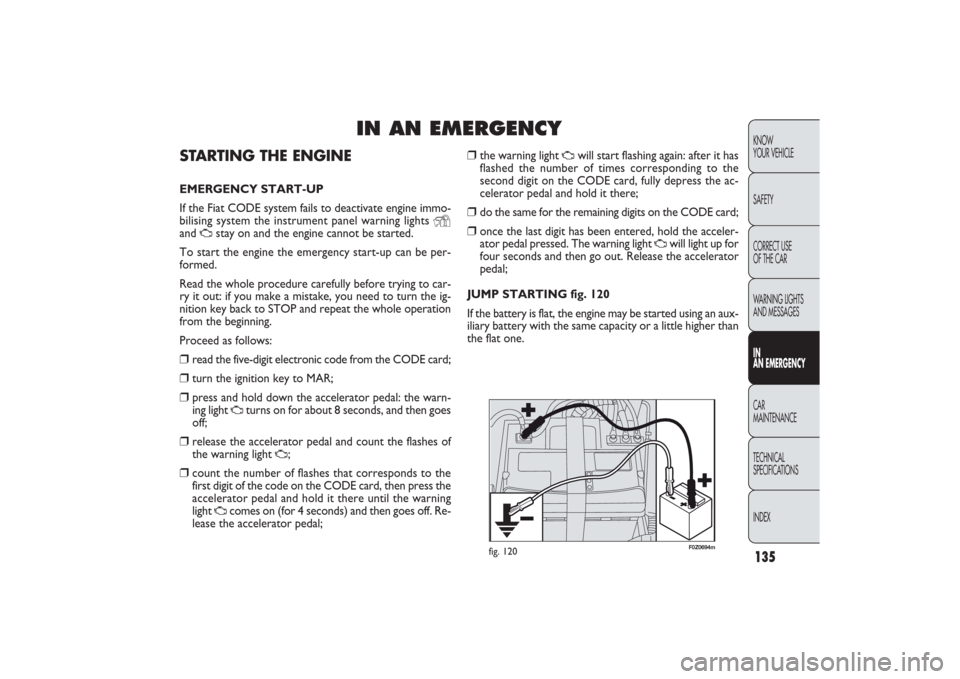
JUMP STARTING fig. 120
If the battery is flat, the engine may be started using an aux-
iliary battery with the same capacity or a little higher than
the flat one.
F0Z0694m
fig. 120
135-168 PANDA EN 7-10-2009 14:06 Pagina 135
Page 138 of 226

137KNOW
YOUR VEHICLE
SAFETY
CORRECT USE
OF THE CAR
WARNING LIGHTS
AND MESSAGESIN
AN EMERGENCYCAR
MAINTENANCE
TECHNICAL
SPECIFICATIONS
INDEX
REPLACING A WHEELGENERAL INSTRUCTIONS
The car can be delivered (upon request/where provided)
with standard spare wheel or space-saver wheel; see
changing instructions on the following paragraphs. Wheel
changing and correct use of the jack and spare wheel call
for some precautions as listed below.
The space-saver wheel (where provided) is
specific to your car, do not use it on other
models, nor use the spare wheel of other models
on your car. The space-saver wheel must only be
used in case of emergency. It shall only be used for
the distance necessary to reach a service point and
the car speed shall not exceed 80 km/h. The spare
wheel has an orange sticker that summarises the
main cautions for use and limitations. The sticker
should never be removed or covered. Never apply
a wheel cup on a space-saver wheel. The sticker
gives the following information in four languages:
Caution! For temporary use only! 80 km/h max.!
Replace by standard wheel as soon as possible. Do
not cover this label in use. If you change the type
of wheel (alloy rims instead of steel rims) you will
have to change the entire set of fastening bolts with
another set of suitably sized bolts.
WARNING
Alert other drivers that the car is station-
ary in compliance with local regulations:
hazard warning lights, warning triangle, etc. Any
passengers on board should leave the car, espe-
cially if it is heavily laden. Passengers should stay
away from on-coming traffic while the wheel is
being changed. If parked on a slope or rough sur-
face, chock the wheels with wedges or other suit-
able devices.
WARNING
The driving features of the car may change
when a space-saver wheel is fitted. Avoid
sudden acceleration and braking, sudden steering
and fast cornering. The total life of a space-saver
wheel is approximately 3000 km, after which it
must be replaced by another wheel of the same
type. Never attempt to fit a conventional tyre on
a rim designed for use as a space-saver wheel.
Have the punctured wheel repaired and replaced
as soon as possible. Two or more space-saver
wheels should never be used together. Do not
grease the threads of bolts before installing them:
they might slip out.
WARNING
135-168 PANDA EN 7-10-2009 14:06 Pagina 137
Page 172 of 226

●●●
●●● ●● ●● ●●
●●
●
●●●●
●●●●
●●
●●● ●● ●● ●●
(●)(
●)(
●)(
●)(
●)(
●)(
●)(
●)(
●)
●●●
●●● ●● ●● ●●
●●●●
●●●
20 40 60 80 100 120 140 160 180
Thousands of km
Replace air filter cartridge
(every 30,000 km for 1.3 Multijet engine)
Top-up fluids (engine coolant, brakes, windscreen washer, battery, etc...)Check timing belt conditions (1.3 Multijet engine excluded)
Replace toothed timing drive belt (*) (1.3 Multijet engine excluded)Change spark plugs (petrol versions)
Check engine management system operation (through the diagnosis socket)Check gearbox fluid levelChange engine oil and oil filter (petrol versions)Change engine oil and oil filter (Multijet versions with DPF) (**)
Change engine oil and oil filter (Multijet versions with DPF) (**)Change brake fluid (or every two years)Replace pollen filter (or once a year)Check exhaust emissions/smokiness (1.3 Multijet engine)Replace fuel filter cartridge (Green-filter) (1.3 Multijet engine)
(*) Or every 4 years for heavy usage (cold climates, town driving with long idling stops)
Or every 5 years, irrespective of the covered mileage
(**) Engine oil and filter shall be changed when the corresponding warning light turns on (see chapter “Warning lights and Mes-
sages”), or in any case every 2 years.
If the car is used mainly for town driving, the engine oil and filter should be changed every 12 months.
INDEX TECHNICAL
SPECIFICATIONSCAR
MAINTENANCEIN
AN EMERGENCY WARNING LIGHTS
AND MESSAGES CORRECT USE
OF THE CAR SAFETY KNOW
YOUR VEHICLE171
169-190 PANDA EN 7-10-2009 14:14 Pagina 171