2009 FIAT PANDA ESP
[x] Cancel search: ESPPage 47 of 226

μ
air flow towards the front seat feet area. Due to the
natural tendency of heat to spread upwards, this type
of distribution warms the passenger compartment
up as quickly as possible, providing an immediate
feeling of warmth.
w+μ
distribution between feet area vents (warmest air)
and dashboard vents (coolest air).
¥+μ
distribution between feet area vents and wind-
screen/side front window vents. This type of distri-
bution achieves an adequate warming of the pas-
senger compartment and prevents the windows
from misting up.
The set air distribution is shown by the LEDs on the
selected buttons.
To restore the automatic air distribution control, press
the AUTO button.
During automatic operation, under particular climate con-
ditions, the system can send air to the windscreen although
the relevant LED does not turn on.
Button
-
- L
Fast front window demisting/defrosting
Pressing the button
-
the system activates all the functions
required for fast demisting/defrosting, that is:
❒
compressor switching-on (if the weather conditions are
suitable);
❒
air recirculation switching-off;
❒
maximum air temperature setting (HI); IMPORTANT If the heating fluid is not sufficiently hot, max-
imum fan speed will not be activated immediately to pre-
vent air not warm enough from entering the passenger
compartment.
LO function
This function can be switched on to cool the passenger
compartment as quickly as possible; with this function
switched on the compressor will be engaged whereas air
distribution and fan speed are controlled by the system.
To turn this function off, set the required temperature.
IMPORTANT With the function switched on, however, all
the manual settings can be made.
Buttons
ÕÔ
– F
Fan speed adjustment
Pressing the buttons
Õ
or
Ôrespectively, the fan speed
shown on the display bars increases or decreases.
The fan can be cut off only if the compressor has been
switched off (B button).
To restore automatic fan speed control, press the
AUTO
button.
Buttons
¥wμ
– G H I
Air distribution manual selection
Pressing the buttons, one of the five possible air flow
distribution patterns can be selected:
¥
air flow to the windscreen and front side window
vents to demist or defrost them.
w
air flow to the central and side dashboard vents to ven-
tilate the chest and the face during the hot season.
46
KNOW YOUR
VEHICLE
SAFETY
CORRECT USE
OF THE CAR
WARNING LIGHTS
AND MESSAGES
IN
AN EMERGENCY
CAR
MAINTENANCE
TECHNICAL
SPECIFICATIONS
INDEX
031-064 PANDA EN 7-10-2009 13:43 Pagina 46
Page 63 of 226

F0Z0062m
fig. 68
F0Z0063m
fig. 69
CHILD LOCK fig. 69
To prevent opening the rear doors from the inside.
This device can only be engaged with the rear doors open:❒
position 1 – device off (door can be opened from
the passenger’s compartment);
❒
position 2 – device on (door cannot be opened from
the passenger’s compartment).
The device remains on even if the doors are unlocked
electrically.
IMPORTANT Always use this device when transporting
children.
IMPORTANT After engaging the child lock on both rear
doors, check for proper engagement by trying to open
a rear door with the internal handle. LOCKING/UNLOCKING FROM THE INSIDE
fig. 68
To unlock
Pull the control lever A.
With central door locking system, operating the lever A on
the driver’s side will unlock all the doors. Lever A on the
other doors will only open the corresponding door.
To unlock
Push the control lever A toward the door. Operating
the lever A on driver’s side will lock all doors. On the oth-
er doors, the lever will only lock the concerned door.
With mechanical lock, without centralised system, to lock
a door you need to operate the corresponding door lever;
only for rear doors locking can be engaged also with
the door open.
62
KNOW YOUR
VEHICLE
SAFETY
CORRECT USE
OF THE CAR
WARNING LIGHTS
AND MESSAGES
IN
AN EMERGENCY
CAR
MAINTENANCE
TECHNICAL
SPECIFICATIONS
INDEX
031-064 PANDA EN 7-10-2009 13:43 Pagina 62
Page 72 of 226

71
F0Z00203m
fig. 82
ROOF RACK/SKI RACKSETTING THE FASTENERS fig. 82
The roof rack fasteners A are shown in the figure.
To secure the roof rack, remove the plugs B (two each
side).
An especially designed roof rack/ski rack is available from
Lineaccessori Fiat.
On some versions, roof rack bars can be provided as
an optional.
KNOW YOUR
VEHICLESAFETY
CORRECT USE
OF THE CAR
WARNING LIGHTS
AND MESSAGES
IN
AN EMERGENCY
CAR
MAINTENANCE
TECHNICAL
SPECIFICATIONS
INDEX
After travelling a few kilometres, check that
the attachment fastening screws are tight.
WARNING
Never exceed the max. allowed load ca-
pacity (see chapter “Technical specifica-
tions”).
065-090 PANDA EN 7-10-2009 13:45 Pagina 71
Page 75 of 226

When the ABS cuts in and you feel the
brake pedal pulsating, do not raise foot,
but keep it pressed; in doing so you will stop in the
shortest amount of space possible depending on
the current road conditions.
WARNING
If the ABS system cuts in, it means that the
grip between the tyre and the road surface
is close to its limit: you must slow down to match
the speed to the road grip available.
WARNING
The ABS make the best use of the avail-
able grip but cannot increase it. You
should always drive carefully on slippery surfaces
and avoid any unnecessary risks.
WARNING
ABS SYSTEM (for versions/markets, where provided)
This system, which is an integral part of the braking sys-
tem, prevents one or more wheels from locking and slip-
ping in all road surface conditions, irrespective of the
intensity of the braking action, ensuring that the vehicle can
be controlled even during emergency braking.
The EBD system (Electronic Braking Force Distribution)
completes the system allowing the brake force to be dis-
tributed between the front and rear wheels.
IMPORTANT To get the maximum efficiency of the brak-
ing system, a bedding-in period of about 500 km is need-
ed: during this period it is better to avoid sharp, repeat-
ed and prolonged braking.
SYSTEM INTERVENTION
The driver can feel the ABS system has come into action
because the brake pedal pulsates slightly and the system gets
noisier: it means that the car speed should be altered to suit
the type of road surface.
74
KNOW YOUR
VEHICLE
SAFETY
CORRECT USE
OF THE CAR
WARNING LIGHTS
AND MESSAGES
IN
AN EMERGENCY
CAR
MAINTENANCE
TECHNICAL
SPECIFICATIONS
INDEX
065-090 PANDA EN 7-10-2009 13:45 Pagina 74
Page 77 of 226

Do not take unnecessary risks, even if your
vehicle is fitted with an ESP system. Your
driving style must always be suited to the road
conditions, visibility and traffic. The driver is ulti-
mately responsible for road safety.
WARNING
Failure indications
In the event of a failure, the ESP system will be automati-
cally switched off and warning light
á
will appear on
the instrument panel along with a message on the recon-
figurable multifunction display (where provided). The LED
on the button ASR OFF will light up (see “Warning lights
and messages”) In this case, contact a Fiat Dealership.
HILL HOLDER SYSTEM
(for versions/markets, where provided)
This system is integral part of the ESP system and it is pro-
vided to facilitate starting on slopes. It is automatically ac-
tivated in the following conditions:
❒
uphill: car at a standstill on a road with a gradient high-
er than 2%, engine running, clutch and brake pedal
pressed, gearbox in neutral or engaged gear other than
reverse.
ESP SYSTEM
(Electronic Stability Program) (for versions/markets where provided)
GENERAL INFORMATION
This is an electronic system controlling car stability in
the event of tyre grip loss, helping to maintain direction-
al control.
The ESP system is therefore particularly useful when grip
conditions of road surfaces change.
Besides the ESP, the car is provided with ASR (traction
control with interventions on brakes and engine), HILL
HOLDER (device for start on gradient without using
the brakes), MSR (control of engine braking torque when
shifting gear down) and HBA (automatic increase of brak-
ing pressure in case of emergency braking).
SYSTEM INTERVENTION
It is signalled by the blinking of the warning light
á
on the
instrument panel, to inform the driver that the car is in
critical stability and grip conditions.
System engagement
The ESP system comes on automatically when the vehi-
cle is started and cannot be turned off.
76
KNOW YOUR
VEHICLE
SAFETY
CORRECT USE
OF THE CAR
WARNING LIGHTS
AND MESSAGES
IN
AN EMERGENCY
CAR
MAINTENANCE
TECHNICAL
SPECIFICATIONS
INDEX
065-090 PANDA EN 7-10-2009 13:45 Pagina 76
Page 78 of 226

If the space-saver wheel is used, the ESP
system keeps operating. Always remind
that the space-saver wheel, being smaller than
the original wheel provides less grip.
WARNING
For the correct operation of the ESP and
ASR systems, the tyres must absolutely be
the same make and type on all wheels, in perfect
conditions and, above all, of the type, make
and size specified.
WARNING
ASR SYSTEM (Antislip Regulation)
This is integral part of the ESP system and controls the car,
intervening automatically automatically every time one or
both driving wheels slip.
Depending on the slipping conditions, two different con-
trol systems are activated:❒
if the slipping involves both drive wheels, the ASR func-
tion intervenes by reducing the power transmitted by the
engine;
❒
if the slipping involves only one driving wheel, the ASR
system cuts in automatically braking the wheel that is
slipping.
❒
downhill: car at a standstill on a road with a gradient
higher than 2%, engine running, clutch and brake pedal
pressed and reverse gear engaged.
At pickup, the ESP system control unit will keep braking
pressure on the wheels until reaching the required torque
for starting or, in any case, for a maximum of 2 seconds
in order to move easily the right foot from the brake ped-
al to the accelerator pedal.
When two seconds have elapsed, without starting, the sys-
tem is automatically deactivated, gradually releasing the
braking pressure. During this release stage, the typical me-
chanical brake release noise can be heard, indicating that
the car is about to move.
Failure indications
A possible system failure is indicated by the *warning
light on the instrument panel – together with the dedicated
message in the reconfigurable multifunction display
(for versions/markets, where provided) – coming on
(see “Warning lights and messages” chapter).
IMPORTANT The Hill Holder system is not a parking
brake; therefore, never leave the car without having
engaged the handbrake, turned the engine off and engaged
first gear.
77KNOW YOUR
VEHICLESAFETY
CORRECT USE
OF THE CAR
WARNING LIGHTS
AND MESSAGES
IN
AN EMERGENCY
CAR
MAINTENANCE
TECHNICAL
SPECIFICATIONS
INDEX
065-090 PANDA EN 7-10-2009 13:45 Pagina 77
Page 79 of 226
F0Z0267m
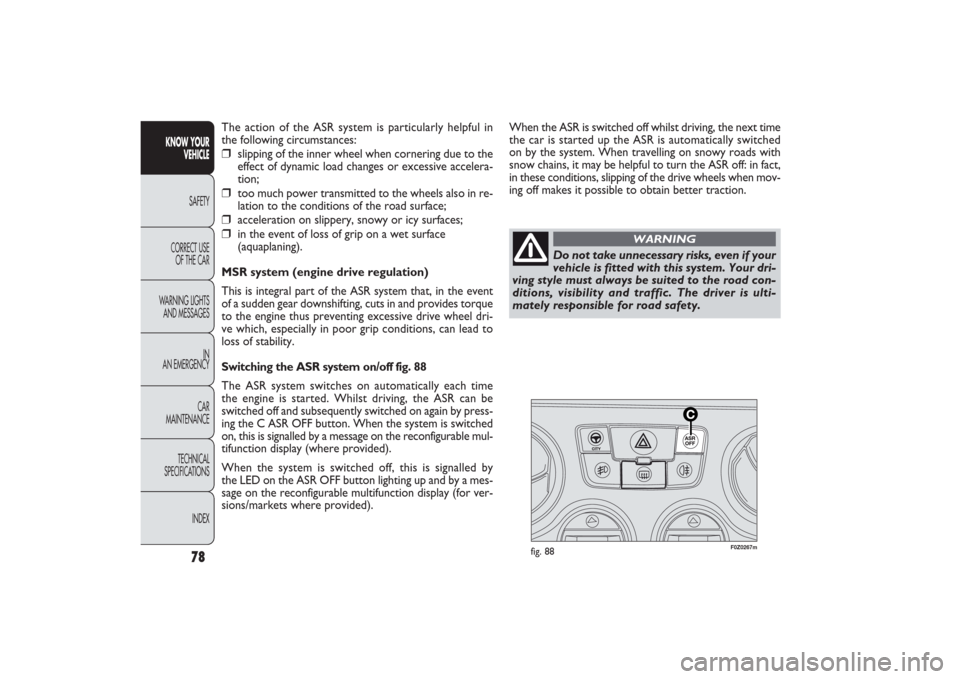
fig. 88
When the ASR is switched off whilst driving, the next time
the car is started up the ASR is automatically switched
on by the system. When travelling on snowy roads with
snow chains, it may be helpful to turn the ASR off: in fact,
in these conditions, slipping of the drive wheels when mov-
ing off makes it possible to obtain better traction. The action of the ASR system is particularly helpful in
the following circumstances:
❒
slipping of the inner wheel when cornering due to the
effect of dynamic load changes or excessive accelera-
tion;
❒
too much power transmitted to the wheels also in re-
lation to the conditions of the road surface;
❒
acceleration on slippery, snowy or icy surfaces;
❒
in the event of loss of grip on a wet surface
(aquaplaning).
MSR system (engine drive regulation)
This is integral part of the ASR system that, in the event
of a sudden gear downshifting, cuts in and provides torque
to the engine thus preventing excessive drive wheel dri-
ve which, especially in poor grip conditions, can lead to
loss of stability.
Switching the ASR system on/off fig. 88
The ASR system switches on automatically each time
the engine is started. Whilst driving, the ASR can be
switched off and subsequently switched on again by press-
ing the C ASR OFF button. When the system is switched
on, this is signalled by a message on the reconfigurable mul-
tifunction display (where provided).
When the system is switched off, this is signalled by
the LED on the ASR OFF button lighting up and by a mes-
sage on the reconfigurable multifunction display (for ver-
sions/markets where provided).
Do not take unnecessary risks, even if your
vehicle is fitted with this system. Your dri-
ving style must always be suited to the road con-
ditions, visibility and traffic. The driver is ulti-
mately responsible for road safety.
WARNING
78
KNOW YOUR
VEHICLE
SAFETY
CORRECT USE
OF THE CAR
WARNING LIGHTS
AND MESSAGES
IN
AN EMERGENCY
CAR
MAINTENANCE
TECHNICAL
SPECIFICATIONS
INDEX
065-090 PANDA EN 7-10-2009 13:45 Pagina 78
Page 84 of 226

GENERAL WARNINGS❒
When parking, take the utmost care to obstacles that
may be set above or under the sensors.
❒
Objects set close to the car rear, under certain cir-
cumstances are not detected and could therefore cause
damage to the car or be damaged.
❒
Indications sent by the sensors can be altered by dirt,
snow or ice deposited on the sensors or by ultrasound
systems (e.g.: truck pneumatic brakes or pneumatic
hammers) set nearby the car.
For proper operation, sensors must always
be clean from mud, dirt, snow or ice.
Be careful not to scratch or damage the
sensors while cleaning them. Avoid using dry, rough
or hard cloths. The sensors should be washed us-
ing clean water with the addition of car shampoo
if necessary. When using special washing equipment
such as high pressure jets or steam cleaning, clean
the sensors very quickly keeping the jet more than
10 cm away.
Parking manoeuvres however are always
under the driver’s responsibility. While ma-
noeuvring, the driver shall always make sure that
no-one is standing in the area, especially children
or animals. The parking sensor is designed to as-
sist drivers, who shall never reduce attention dur-
ing potentially dangerous manoeuvres even if per-
formed at low speed.
WARNING
83KNOW YOUR
VEHICLESAFETY
CORRECT USE
OF THE CAR
WARNING LIGHTS
AND MESSAGES
IN
AN EMERGENCY
CAR
MAINTENANCE
TECHNICAL
SPECIFICATIONS
INDEX
065-090 PANDA EN 7-10-2009 13:45 Pagina 83