Page 165 of 532
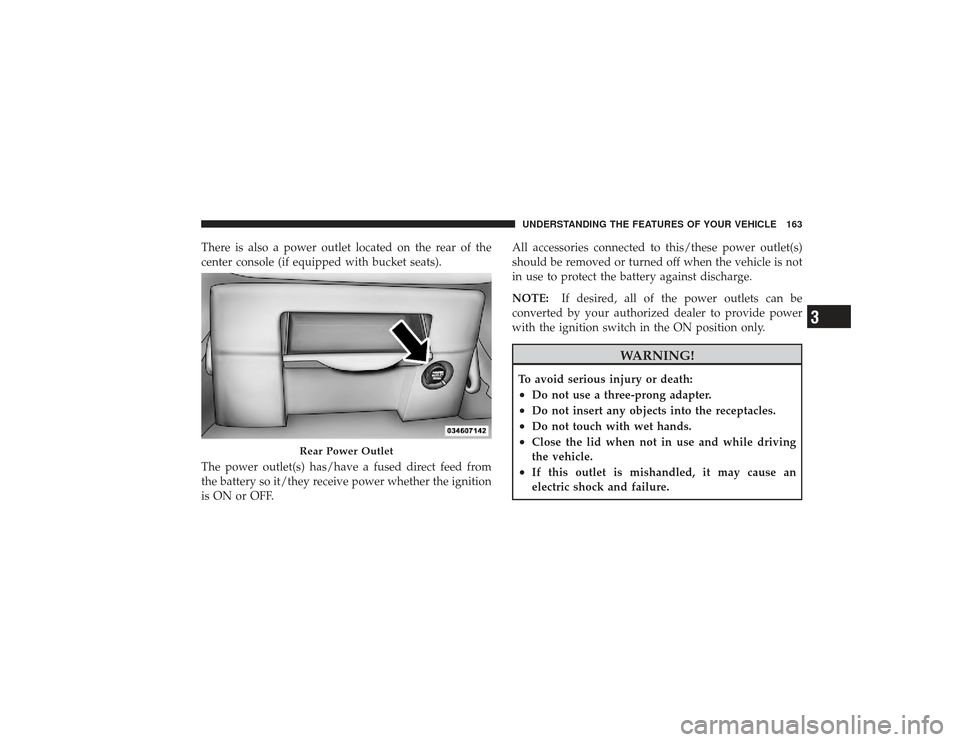
There is also a power outlet located on the rear of the
center console (if equipped with bucket seats).
The power outlet(s) has/have a fused direct feed from
the battery so it/they receive power whether the ignition
is ON or OFF.All accessories connected to this/these power outlet(s)
should be removed or turned off when the vehicle is not
in use to protect the battery against discharge.
NOTE:
If desired, all of the power outlets can be
converted by your authorized dealer to provide power
with the ignition switch in the ON position only.
WARNING!
To avoid serious injury or death:•
Do not use a three-prong adapter.
•
Do not insert any objects into the receptacles.
•
Do not touch with wet hands.
•
Close the lid when not in use and while driving
the vehicle.
•
If this outlet is mishandled, it may cause an
electric shock and failure.
Rear Power Outlet
UNDERSTANDING THE FEATURES OF YOUR VEHICLE 163
3
Page 170 of 532
WARNING!
•
This armrest is not a seat. Anyone seated on the
armrest could be seriously injured during vehicle
operation, or an accident. Only use the center
seating position when the armrest is fully upright.
•
In an accident, the latch may open if the total
weight of the items stored exceeds about 10 lbs
(4.5 kg). These items could be thrown about en-
dangering occupants of the vehicle. Items stored
should not exceed a total of 10 lbs (4.5 kg).
CAUTION!
•
Many accessories that can be plugged in draw
power from the vehicle’s battery, even when not in
use (i.e., cellular phones, etc.). Eventually, if
plugged in long enough, the vehicle’s battery will
discharge sufficiently to degrade battery life
and/or prevent engine starting.
•
Accessories that draw higher power (i.e., coolers,
vacuum cleaners, lights, etc.), will degrade the
battery even more quickly. Only use these inter-
mittently and with greater caution.
•
After the use of high power draw accessories, or
long periods of the vehicle not being started (with
accessories still plugged in), the vehicle must be
driven a sufficient length of time to allow the
generator to recharge the vehicle’s battery.
168 UNDERSTANDING THE FEATURES OF YOUR VEHICLE
Page 172 of 532
WARNING!
•
This armrest is not a seat. Anyone seated on the
armrest could be seriously injured during vehicle
operation, or an accident. Only use the center
seating position when the armrest is fully upright.
•
In an accident, the latch may open if the total
weight of the items stored exceeds about 10 lbs
(4.5 kg). These items could be thrown about en-
dangering occupants of the vehicle. Items stored
should not exceed a total of 10 lbs (4.5 kg).
CAUTION!
•
Many accessories that can be plugged in draw
power from the vehicle’s battery, even when not in
use (i.e., cellular phones, etc.). Eventually, if
plugged in long enough, the vehicle’s battery will
discharge sufficiently to degrade battery life
and/or prevent engine starting.
•
Accessories that draw higher power (i.e., coolers,
vacuum cleaners, lights, etc.), will degrade the
battery even more quickly. Only use these inter-
mittently and with greater caution.
•
After the use of high power draw accessories, or
long periods of the vehicle not being started (with
accessories still plugged in), the vehicle must be
driven a sufficient length of time to allow the
generator to recharge the vehicle’s battery.
170 UNDERSTANDING THE FEATURES OF YOUR VEHICLE
Page 176 of 532
Sliding Rear Window — If EquippedA locking device in the center of the window helps to
prevent entry from the rear of the vehicle. Squeeze the
lock to release the window.FOLD FLAT LOAD FLOOR — IF EQUIPPEDQuad Cab�models with a 60/40 rear seat may be
equipped with a folding load floor.
WARNING!
Do not operate the vehicle with loose items stored on
the load floor. While driving or in an accident you
may experience abrupt stopping, rapid acceleration,
or sharp turns. Loose objects stored on the load floor
may move around with force and strike occupants,
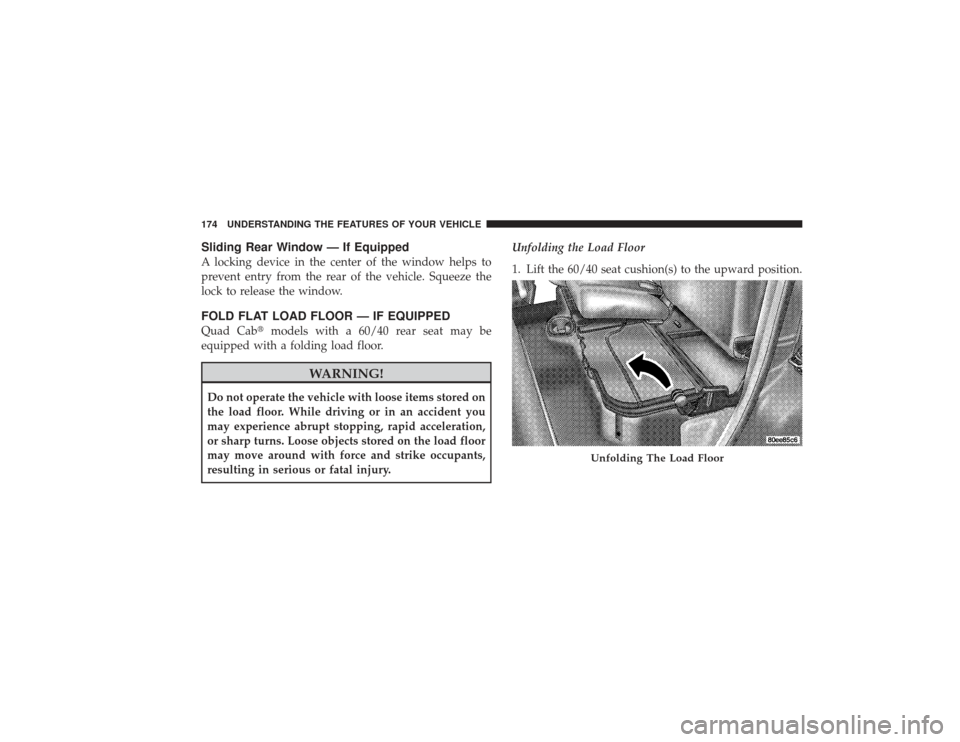
resulting in serious or fatal injury. Unfolding the Load Floor
1. Lift the 60/40 seat cushion(s) to the upward position.
Unfolding The Load Floor
174 UNDERSTANDING THE FEATURES OF YOUR VEHICLE
Page 177 of 532
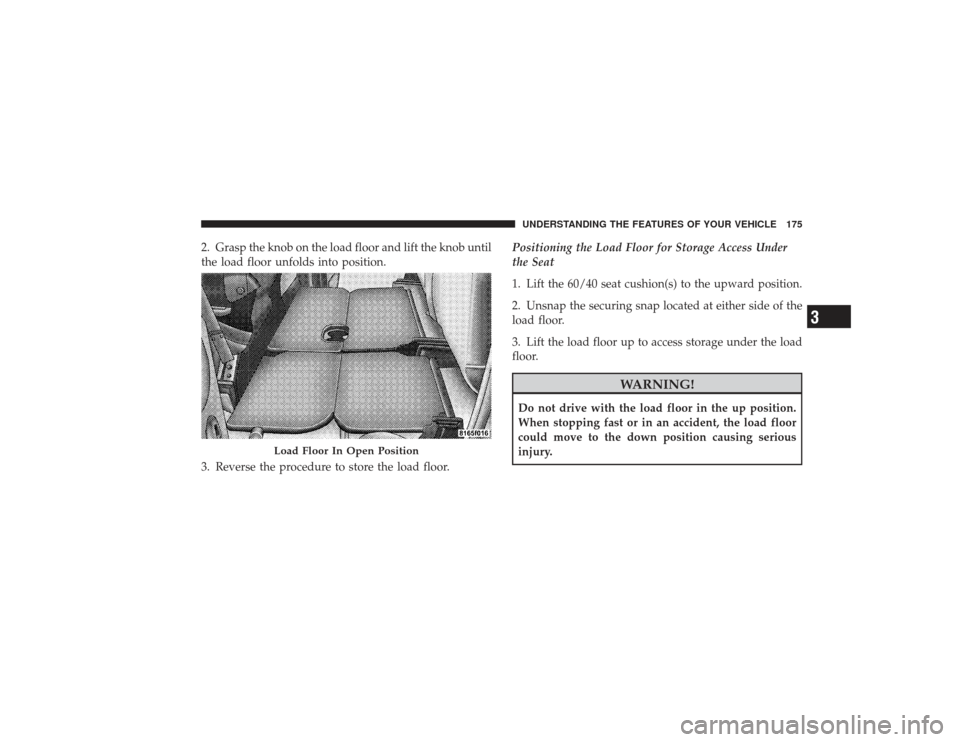
2. Grasp the knob on the load floor and lift the knob until
the load floor unfolds into position.
3. Reverse the procedure to store the load floor.Positioning the Load Floor for Storage Access Under
the Seat
1. Lift the 60/40 seat cushion(s) to the upward position.
2. Unsnap the securing snap located at either side of the
load floor.
3. Lift the load floor up to access storage under the load
floor.
WARNING!
Do not drive with the load floor in the up position.
When stopping fast or in an accident, the load floor
could move to the down position causing serious
injury.
Load Floor In Open Position
UNDERSTANDING THE FEATURES OF YOUR VEHICLE 175
3
Page 179 of 532
NOTE:If you are installing a toolbox to the front of the
pickup box, you must use Mopar �toolbox brackets
available from your authorized dealer.
You can carry wide building materials (sheets of ply-
wood, etc.) by building a raised load floor. Place lumber
across the box in the indentations provided above the
wheel housings and in the bulkhead dividers to form the
floor.
WARNING!
•
The pickup box is intended for load carrying
purposes only, not for passengers, who should sit
in seats and use seat belts.
(Continued)
WARNING! (Continued)
•
Care should always be exercised when operating a
vehicle with unrestrained cargo. Vehicle speeds
may need to be reduced. Severe turns or rough
roads may cause shifting or bouncing of the cargo
that may result in vehicle damage. If wide build-
ing materials are to be frequently carried, the
installation of a support is recommended. This
will restrain the cargo and transfer the load to the
pickup box floor.
•
If you wish to carry more than 600 lbs (272 kg) of
material suspended above the wheelhouse, sup-
ports must be installed to transfer the weight of
the load to the pickup box floor or vehicle damage
may result. The use of proper supports will permit
loading up to the rated payload.
•
Unrestrained cargo may be thrown forward in an
accident causing serious or fatal injury.UNDERSTANDING THE FEATURES OF YOUR VEHICLE 177
3
Page 181 of 532
3. Raise the right side of the tailgate until the right side
pivot clears the hanger bracket.
4. Slide the entire tailgate to the right to free the left side
pivot.
5. Remove the tailgate from the vehicle.NOTE:
•
Do not carry the tailgate loose in the truck pickup box.
•
Dual rear wheel pickup models require properly
spaced rear clearance lights. If such a vehicle is oper-
ated without a tailgate, suitable lights must be
installed.
WARNING!
To avoid inhaling carbon monoxide, which is deadly,
the exhaust system on vehicles equipped with “Cap
or Slide-In Campers” should extend beyond the
overhanging camper compartment and be free of
leaks.
Tailgate Support Strap Attachment
UNDERSTANDING THE FEATURES OF YOUR VEHICLE 179
3
Page 191 of 532

continuous chime will sound to alert you to turn the
signals off. If either indicator flashes at a rapid rate, check
for a defective outside light bulb.
4. Tachometer
The Tachometer indicates engine speed in revolutions per
minute.
CAUTION!
Do not operate the engine with the tachometer
pointer at high RPM for extended periods. Engine
damage may occur.
5. Airbag Warning Light This light turns on and remains on for seven
seconds as a bulb check when the ignition
switch is first turned ON. If the light is not on during starting, stays on, or turns on while driving, have
the system inspected by an authorized dealer as soon as
possible.
6. High Beam Indicator
This indicator shows that headlights are on high
beam.
7. Seat Belt Reminder Light When the ignition switch is first turned ON, this
light will turn on for five to eight seconds as a bulb
check. During the bulb check, if the driver’s seat
belt is unbuckled, a chime will sound. After the bulb
check or when driving, if the driver’s seat belt remains
unbuckled, the Seat Belt Reminder Light will illuminate
and the chime will sound. Refer to “Occupant Restraints”
in Section 2 for more information.
8. Speedometer
The Speedometer shows the vehicle speed in miles per
hour and/or kilometers per hour (mph/kph).
UNDERSTANDING YOUR INSTRUMENT PANEL 189
4