Page 353 of 449
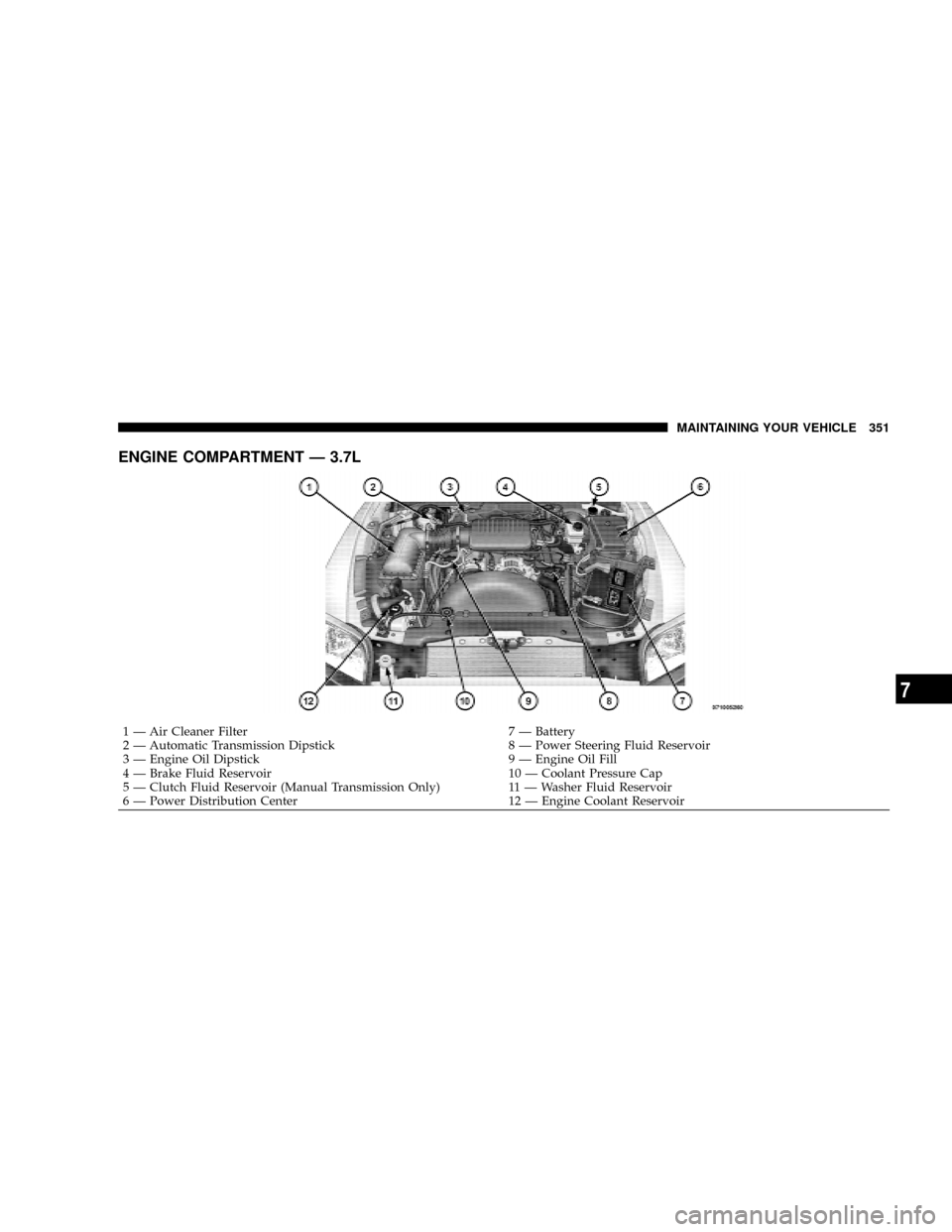
ENGINE COMPARTMENT Ð 3.7L
1 Ð Air Cleaner Filter 7 Ð Battery
2 Ð Automatic Transmission Dipstick 8 Ð Power Steering Fluid Reservoir
3 Ð Engine Oil Dipstick 9 Ð Engine Oil Fill
4 Ð Brake Fluid Reservoir 10 Ð Coolant Pressure Cap
5 Ð Clutch Fluid Reservoir (Manual Transmission Only) 11 Ð Washer Fluid Reservoir
6 Ð Power Distribution Center 12 Ð Engine Coolant ReservoirMAINTAINING YOUR VEHICLE 351
7
Page 354 of 449
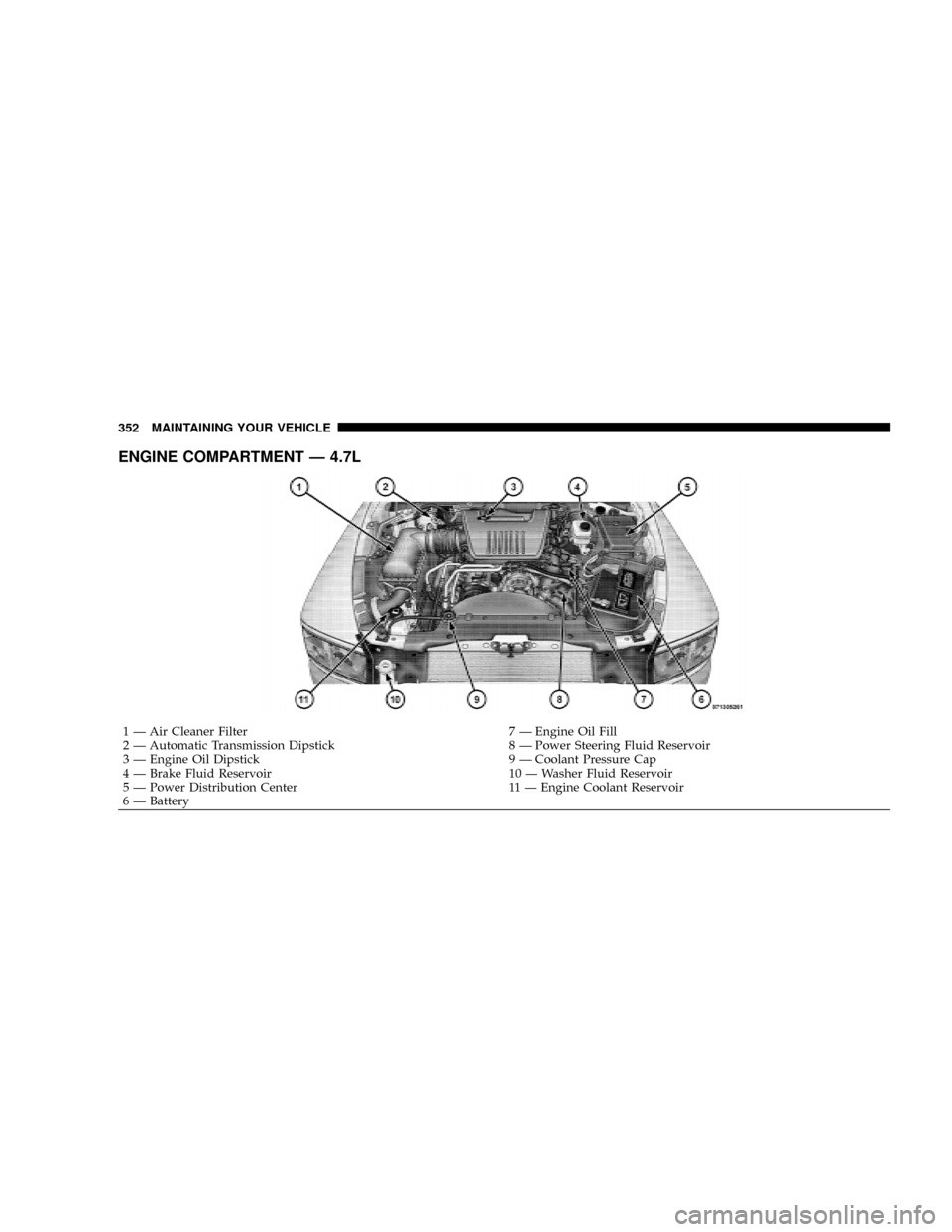
ENGINE COMPARTMENT Ð 4.7L
1 Ð Air Cleaner Filter 7 Ð Engine Oil Fill
2 Ð Automatic Transmission Dipstick 8 Ð Power Steering Fluid Reservoir
3 Ð Engine Oil Dipstick 9 Ð Coolant Pressure Cap
4 Ð Brake Fluid Reservoir 10 Ð Washer Fluid Reservoir
5 Ð Power Distribution Center 11 Ð Engine Coolant Reservoir
6 Ð Battery 352 MAINTAINING YOUR VEHICLE
Page 355 of 449
ONBOARD DIAGNOSTIC SYSTEM Ð OBD II
Your vehicle is equipped with a sophisticated onboard
diagnostic system called OBD II. This system monitors
the performance of the emissions, engine, and automatic
transmission control systems. When these systems are
operating properly, your vehicle will provide excellent
performance and fuel economy, as well as engine emis-
sions well within current government regulations.
If any of these systems require service, the OBD II system
will turn on the Malfunction Indicator Light (MIL). It will
also store diagnostic codes and other information to
assist your service technician in making repairs. Al-
though your vehicle will usually be drivable and not
need towing, see your authorized dealer for service as
soon as possible.CAUTION!
²Prolonged driving with the MIL on could cause
further damage to the emission control system. It
could also affect fuel economy and driveability.
The vehicle must be serviced before any emissions
tests can be performed.
²If the MIL is flashing while the engine is running,
severe catalytic converter damage and power loss
will soon occur. Immediate service is required.
Loose Fuel Filler Cap Message
After fuel is added, the vehicle diagnostic system can
determine if the fuel filler cap is possibly loose, improp-
erly installed, or damaged. A loose fuel filler cap message
will be displayed in the instrument cluster. Tighten the
gas cap until a9clicking9sound is heard. This is an
indication that the gas cap is properly tightened. Press
the odometer RESET button to turn the message off. If the
MAINTAINING YOUR VEHICLE 353
7
Page 374 of 449
Use only brake fluid that has been in a tightly closed
container to avoid contamination from foreign matter or
moisture.
CAUTION!
Do not allow a petroleum-base fluid to contaminate
the brake fluid. Seal damage may result.
Clutch Hydraulic System
The clutch hydraulic system is a sealed maintenance-free
system. In the event of leakage or other malfunction, the
system must be replaced.
Manual Transmission
Fluid Level Check
This fluid should be checked whenever other underhood
services are performed. The fluid level is checked by
removing the fill plug. If the level of the lubricant is more
than 1/4 in (6.35 mm) below the bottom of the filler holewhile the vehicle is level, enough lubricant should be
added to bring the level to the bottom of the filler hole.
This fluid does not require periodic changing. However,
if it becomes necessary to add or replace the fluid in these
transmissions, refer to ªFluids, Lubricants, and Genuine
Partsº in this section for the correct fluid type.
Automatic Transmission
NOTE:If equipped with a dipstick, use the following
procedure. If your vehicle has a capped dipstick, it is
sealed and should not be tampered with. Your authorized
dealer has the proper tools to ensure that the fluid level
is set properly.
Fluid Level Check
Check the fluid level while the transmission is at normal
operating temperature 180É F (82É C). This occurs after at
least 15 miles (24 km) of driving. At normal operating
temperature the fluid cannot be held comfortably be-
tween the fingertips.
372 MAINTAINING YOUR VEHICLE
Page 375 of 449
To check the automatic transmission fluid level properly,
the following procedure must be used:
1. Operate the engine at idle speed and normal operating
temperature.
2. The vehicle must be on level ground.
3. Fully apply the parking brake and press the brake
pedal.
4. Place the gear selector momentarily in each gear
position, ending with the lever in PARK.
5. Remove the dipstick, wipe it clean and reinsert it until
seated.
6. Remove the dipstick again and note the fluid level on
both sides. The fluid level should be between the ªHOTº
(upper) reference holes on the dipstick at normal operat-
ing temperature. Verify that solid coating of oil is seen on
both sides of the dipstick. If the fluid is low, add asrequired into the dipstick tube.Do not overfill.After
adding any quantity of oil through the oil fill tube, wait
a minimum of two minutes for the oil to fully drain into
the transmission before rechecking the fluid level.
NOTE:If it is necessary to check the transmissionbelow
the operating temperature, the fluid level should be
between the two ªCOLDº (lower) holes on the dipstick
with the fluid at approximately 70É F (21É C) (room
temperature). If the fluid level is correctly established at
room temperature, it should be between the ªHOTº
(upper) reference holes when the transmission reaches
180É F (82É C). Remember it is best to check the level at
the normal operating temperature.
MAINTAINING YOUR VEHICLE 373
7
Page 376 of 449
CAUTION!
Be aware that if the fluid temperature is below 50É F
(10É C) it may not register on the dipstick. Do not add
fluid until the temperature is elevated enough to
produce an accurate reading.
7. Check for leaks. Release parking brake.
To prevent dirt and water from entering the transmission
after checking or replenishing fluid, make certain that the
dipstick cap is properly reseated. It is normal for the
dipstick cap to spring back slightly from its fully-seated
position, as long as its seal remains engaged in the
dipstick tube.
Selection of Lubricant
It is important that the proper lubricant is used in the
transmission to assure optimum transmission perfor-
mance. Use only the manufacturer 's recommended trans-
mission fluid. Refer to ªFluids, Lubricants, and Genuine
Partsº in this section for the correct fluid type. It is
important that the transmission fluid be maintained at
the prescribed level using the recommended fluid.
Special Additives
Automatic Transmission Fluid (ATF) is an engineered
product and its performance may be impaired by supple-
mental additives. Therefore, do not add any fluid addi-
tives to the transmission. The only exception to this
policy is the use of special dyes to aid in detecting fluid
leaks. In addition, avoid using transmission sealers as
they may adversely affect seals.
374 MAINTAINING YOUR VEHICLE
Page 400 of 449
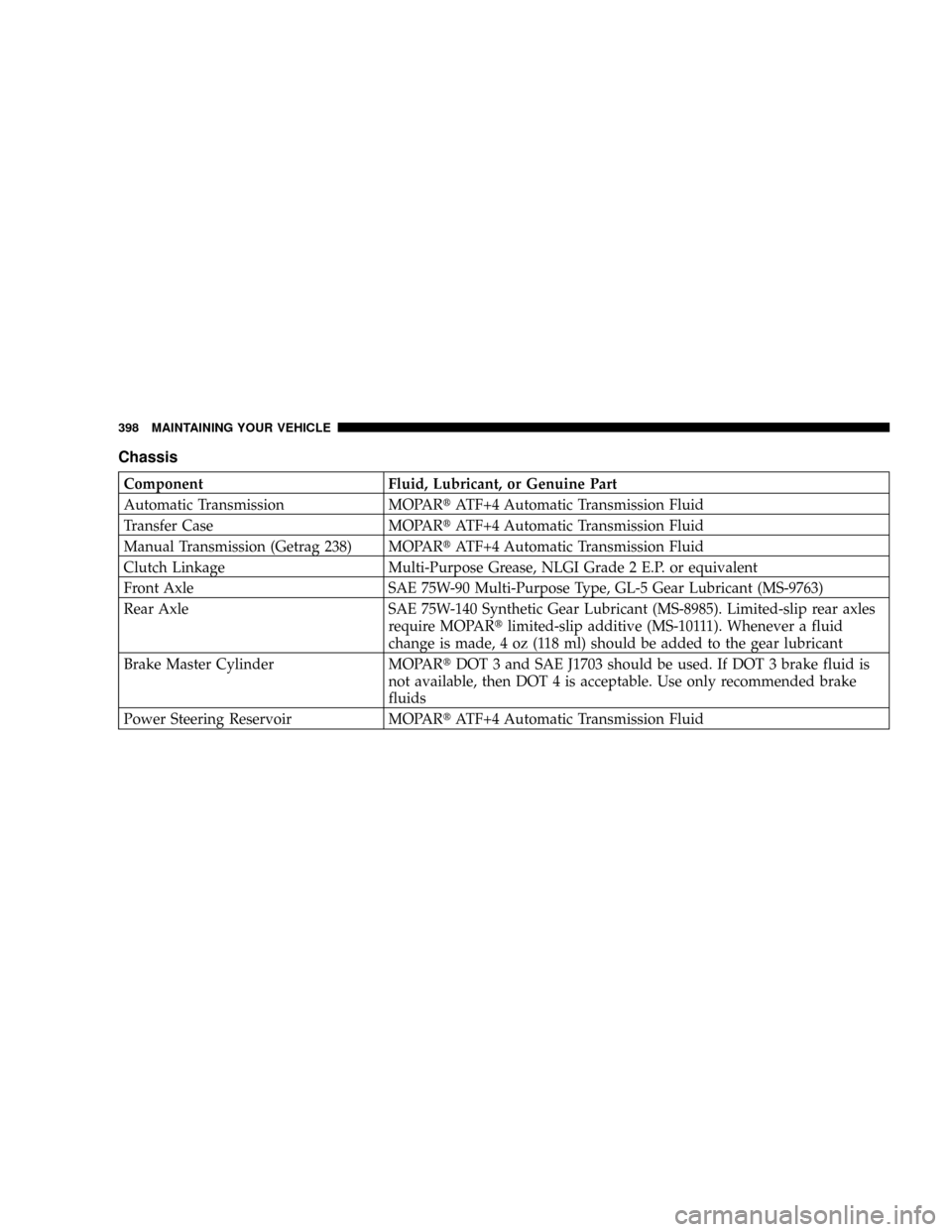
Chassis
Component Fluid, Lubricant, or Genuine Part
Automatic Transmission MOPARtATF+4 Automatic Transmission Fluid
Transfer Case MOPARtATF+4 Automatic Transmission Fluid
Manual Transmission (Getrag 238) MOPARtATF+4 Automatic Transmission Fluid
Clutch Linkage Multi-Purpose Grease, NLGI Grade 2 E.P. or equivalent
Front Axle SAE 75W-90 Multi-Purpose Type, GL-5 Gear Lubricant (MS-9763)
Rear Axle SAE 75W-140 Synthetic Gear Lubricant (MS-8985). Limited-slip rear axles
require MOPARtlimited-slip additive (MS-10111). Whenever a fluid
change is made, 4 oz (118 ml) should be added to the gear lubricant
Brake Master Cylinder MOPARtDOT 3 and SAE J1703 should be used. If DOT 3 brake fluid is
not available, then DOT 4 is acceptable. Use only recommended brake
fluids
Power Steering Reservoir MOPARtATF+4 Automatic Transmission Fluid
398 MAINTAINING YOUR VEHICLE
Page 409 of 449

60,000 Miles (100,000 km) or 60 Months Maintenance Service Schedule
oChange the engine oil and engine oil filter.
oRotate tires.
oReplace the engine air cleaner filter.
oReplace the ignition cables (3.7L engine).
oReplace the spark plugs (3.7L engines).
oReplace the top row of spark plugs (4.7L engines). **
oInspect the brake linings, replace if necessary.
oChange the manual transmission fluid if using your vehicle for any of the following: trailer towing, snow plowing, heavy loading, taxi, police,
delivery service (commercial service), off-road, desert operation or more than 50% of your driving is at sustained high speeds during hot
weather, above 90ÉF (32ÉC).
oChange the automatic transmission fluid & filter if using your vehicle for any of the following: police, taxi, fleet, or frequent trailer towing.
oChange the transfer case fluid if using your vehicle for any of the following: police, taxi, fleet, off-road, or frequent trailer towing.
Odometer Reading Date
Repair Order # Dealer Code
Signature Authorized Chrysler Dealer
MAINTENANCE SCHEDULES 407
8
M
A
I
N
T
E
N
A
N
C
E
S
C
H
E
D
U
L
E
S