Page 247 of 449
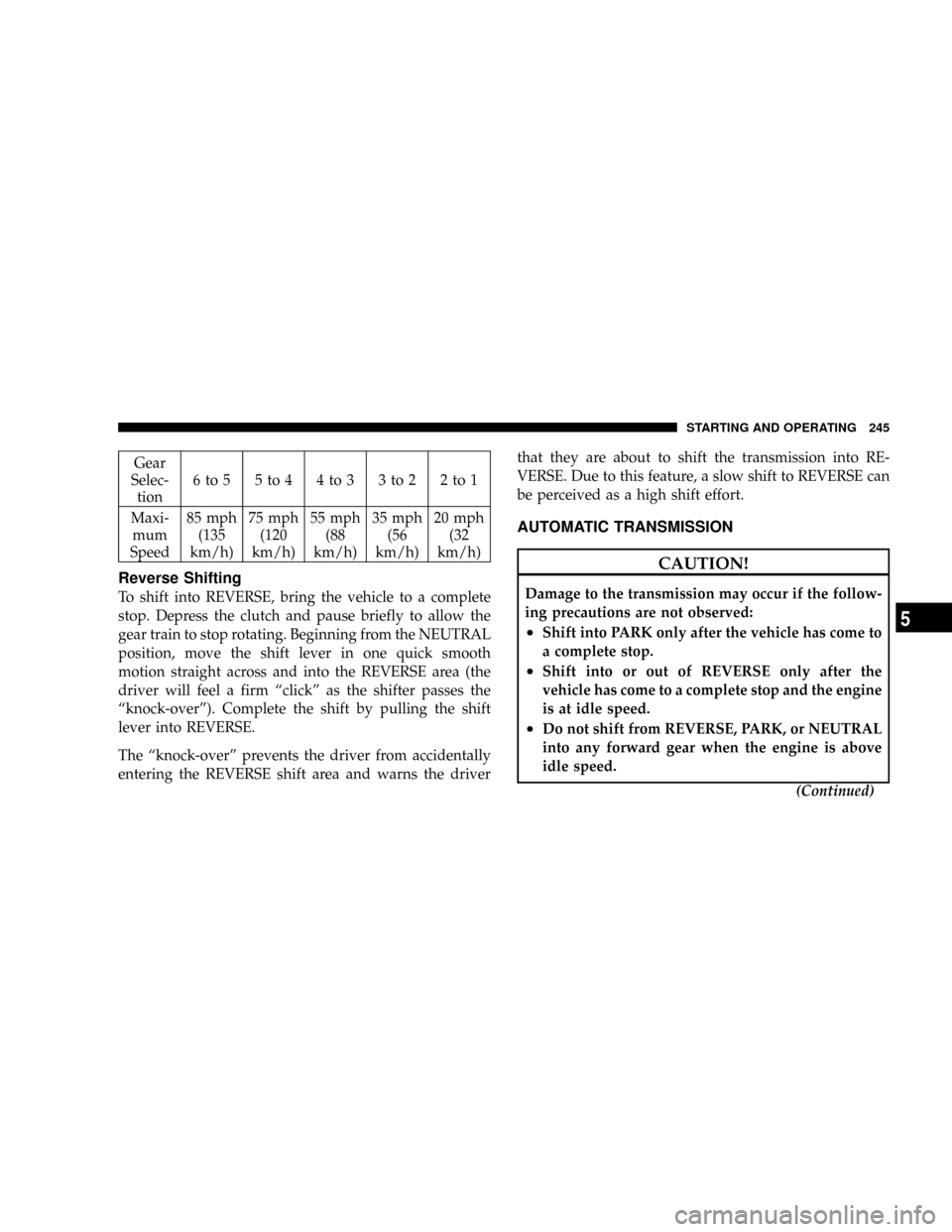
Gear
Selec-
tion6to5 5to4 4to3 3to2 2to1
Maxi-
mum
Speed85 mph
(135
km/h)75 mph
(120
km/h)55 mph
(88
km/h)35 mph
(56
km/h)20 mph
(32
km/h)
Reverse Shifting
To shift into REVERSE, bring the vehicle to a complete
stop. Depress the clutch and pause briefly to allow the
gear train to stop rotating. Beginning from the NEUTRAL
position, move the shift lever in one quick smooth
motion straight across and into the REVERSE area (the
driver will feel a firm ªclickº as the shifter passes the
ªknock-overº). Complete the shift by pulling the shift
lever into REVERSE.
The ªknock-overº prevents the driver from accidentally
entering the REVERSE shift area and warns the driverthat they are about to shift the transmission into RE-
VERSE. Due to this feature, a slow shift to REVERSE can
be perceived as a high shift effort.
AUTOMATIC TRANSMISSION
CAUTION!
Damage to the transmission may occur if the follow-
ing precautions are not observed:
²Shift into PARK only after the vehicle has come to
a complete stop.
²Shift into or out of REVERSE only after the
vehicle has come to a complete stop and the engine
is at idle speed.
²Do not shift from REVERSE, PARK, or NEUTRAL
into any forward gear when the engine is above
idle speed.
(Continued)
STARTING AND OPERATING 245
5
Page 248 of 449
CAUTION! (Continued)
²Before shifting into any gear, make sure your foot
is firmly on the brake pedal.
WARNING!
It is dangerous to move the shift lever out of PARK or
NEUTRAL if the engine speed is higher than idle
speed. If your foot is not firmly on the brake pedal,
the vehicle could accelerate quickly forward or in
reverse. You could lose control of the vehicle and hit
someone or something. Only shift into gear when the
engine is idling normally and when your right foot is
firmly on the brake pedal.
Brake/Transmission Interlock System
This system prevents you from moving the shift lever out
of PARK and into any gear unless the brake pedal is
pressed. This system is active only while the ignitionswitch is in the ON position. Always depress thebrake
pedal first,before moving the shift lever out of PARK.
Automatic Transmission
The electronic PRNDL on the instrument cluster indicates
the transmission gear selected. The shift lever is mounted
on the right side of the steering column. To drive, move
the shift lever from PARK or NEUTRAL to the desired
drive position. Pull the shift lever toward you when
shifting into REVERSE, SECOND, FIRST or PARK, or
when shifting out of PARK.
Gear Ranges
DO NOT race the engine when shifting from PARK or
NEUTRAL position into another gear range.
PARK
PARK supplements the parking brake by locking the
transmission. The engine can be started in this range.
Never use PARK while the vehicle is in motion. Apply
246 STARTING AND OPERATING
Page 250 of 449
1 (First)
For driving up very steep hills and for engine braking at
low speeds, 25 mph (40 km/h) or less, when going down
hill, use 1st gear. To prevent excessive engine speed do
not exceed 25 mph (40 km/h) in this range.
Overdrive Operation
The Overdrive automatic transmission contains an
electronically-controlled 4th and 5th (if equipped) gear
(Overdrive). The transmission will automatically shift
from Drive to Overdrive, if the following conditions are
present:
²the transmission shift lever is in Drive;
²the engine coolant has reached normal operating tem-
perature;
²vehicle speed is above approximately 30 mph
(48 km/h);
²the TOW/HAUL switch has not been activated;
²transmission has reached normal operating
temperature.
NOTE:If the vehicle is started in extremely cold tem-
peratures, the transmission may not shift into Overdrive
and will automatically select the most desirable gear for
operation at this temperature. Normal operation will
resume when the transmission fluid temperature has
risen to a suitable level. Refer to ªTorque Converter
Clutchº in this section.
248 STARTING AND OPERATING
Page 251 of 449
If the transmission temperature gets extremely hot, the
transmission will automatically select the most desirable
gear for operation at this temperature. If the transmission
temperature becomes hot enough, the ªTrans Tempº light
may illuminate and the transmission may downshift out
of Overdrive until the transmission cools down. After
cooldown, the transmission will resume normal
operation.
The transmission will downshift from Overdrive to
DRIVE if the accelerator pedal is fully depressed at
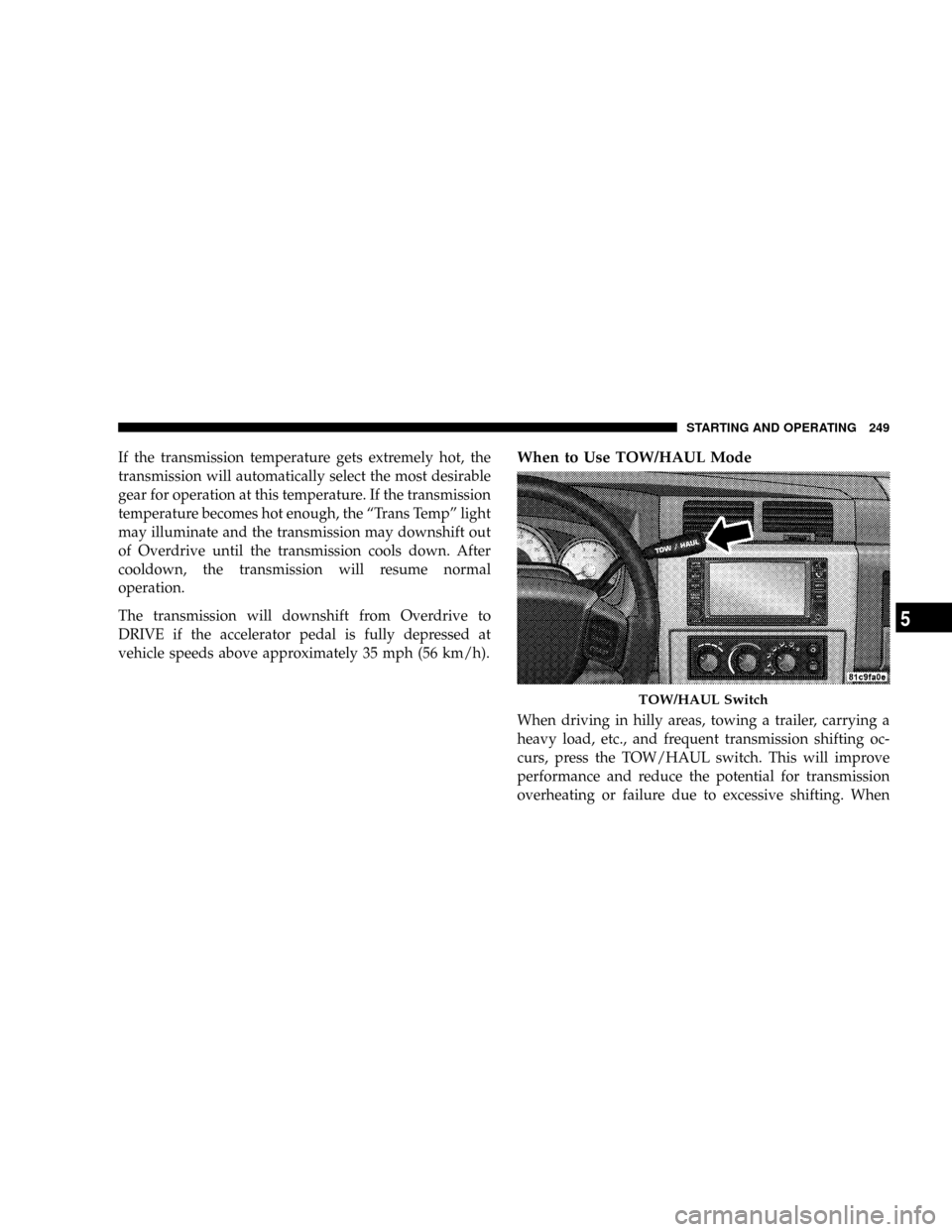
vehicle speeds above approximately 35 mph (56 km/h).When to Use TOW/HAUL Mode
When driving in hilly areas, towing a trailer, carrying a
heavy load, etc., and frequent transmission shifting oc-
curs, press the TOW/HAUL switch. This will improve
performance and reduce the potential for transmission
overheating or failure due to excessive shifting. When
TOW/HAUL Switch
STARTING AND OPERATING 249
5
Page 252 of 449
operating in TOW/HAUL mode, 5th gear (if equipped) is
disabled and 2-3 and 3-4 shift patterns are modified.
Shifts into Overdrive (4th gear) are allowed during
steady cruise (for improved fuel economy), and auto-
matic closed-throttle downshifts to 3rd gear (for im-
proved braking) will occur during steady braking.
The TOW/HAUL light will illuminate in the instrument
cluster to indicate when the switch has been activated.
Pressing the switch a second time restores normal opera-
tion. If the TOW/HAUL mode is desired, the switch must
be pressed each time the engine is started.
Torque Converter Clutch
A feature designed to improve fuel economy is included
in all automatic transmissions. A clutch, within the
torque converter, engages automatically at a calibrated
speed at light throttle. It engages at higher speeds under
heavier acceleration. This may result in a slightly differ-
ent feeling or response during normal operation in highgear. When the vehicle speed drops below a calibrated
speed, or during acceleration, the clutch automatically
and smoothly disengages. The feature is operational in
Overdrive and in Drive.
NOTE:The torque converter clutch will not engage
until the transmission fluid and engine coolant are warm
(usually after 1-3 miles [1.6 - 4.8 km] of driving). Because
the engine speed is higher when the torque converter
clutch is not engaged, it may seem as if the transmission
is not shifting into Overdrive when cold. This is normal.
Pressing the TOW/HAUL switch, when the transmission
is sufficiently warm, will demonstrate that the transmis-
sion is able to shift into, and out of, Overdrive.
NOTE:If the vehicle has not been driven in several
days, the first few seconds of operation after shifting the
transmission into gear may seem sluggish. This is due to
the fluid partially draining from the torque converter into
the transmission. This condition is normal and will not
250 STARTING AND OPERATING
Page 270 of 449
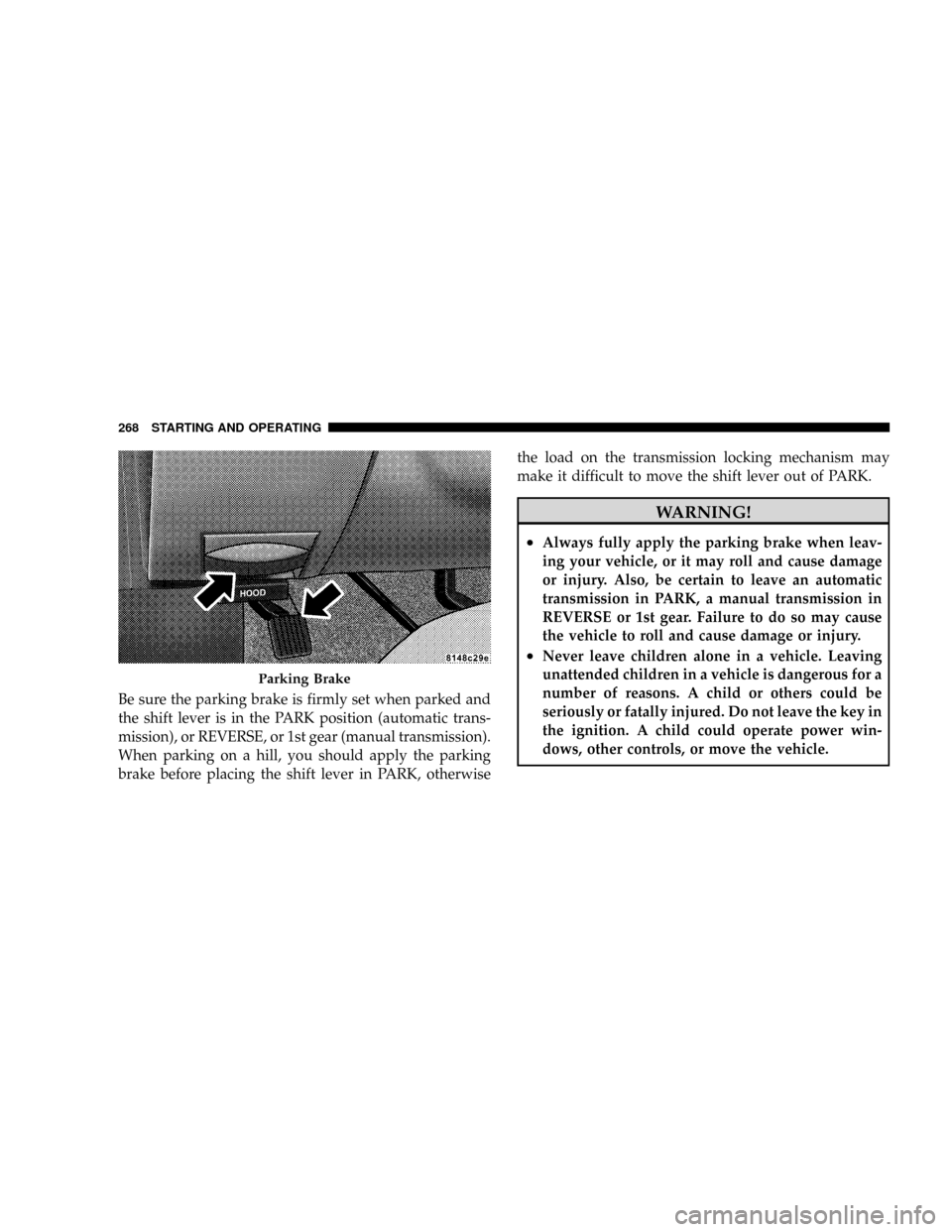
Be sure the parking brake is firmly set when parked and
the shift lever is in the PARK position (automatic trans-
mission), or REVERSE, or 1st gear (manual transmission).
When parking on a hill, you should apply the parking
brake before placing the shift lever in PARK, otherwisethe load on the transmission locking mechanism may
make it difficult to move the shift lever out of PARK.
WARNING!
²Always fully apply the parking brake when leav-
ing your vehicle, or it may roll and cause damage
or injury. Also, be certain to leave an automatic
transmission in PARK, a manual transmission in
REVERSE or 1st gear. Failure to do so may cause
the vehicle to roll and cause damage or injury.
²Never leave children alone in a vehicle. Leaving
unattended children in a vehicle is dangerous for a
number of reasons. A child or others could be
seriously or fatally injured. Do not leave the key in
the ignition. A child could operate power win-
dows, other controls, or move the vehicle.
Parking Brake
268 STARTING AND OPERATING
Page 320 of 449
WARNING! (Continued)
Make certain that the load is secured in the trailer
and will not shift during travel. When trailering
cargo that is not fully secured, dynamic load shifts
can occur that may be difficult for the driver to
control. You could lose control of your vehicle and
have an accident.
²When hauling cargo or towing a trailer, do not over-
load your vehicle or trailer. Overloading can cause a
loss of control, poor performance or damage to brakes,
axle, engine, transmission, steering, suspension, chas-
sis structure or tires.
²Safety chains must always be used between your
vehicle and trailer. Always connect the chains to the
frame or hook retainers of the vehicle hitch. Cross the
chains under the trailer tongue and allow enough
slack for turning corners.
²Vehicles with trailers should not be parked on a grade.
When parking, apply the parking brake on the tow
vehicle. Put the tow vehicle automatic transmission in
PARK. With a manual transmission, shift the transmis-
sion into REVERSE. For four-wheel drive vehicles,
make sure the transfer case is not in NEUTRAL.
Always, block or9chock9the trailer wheels.
²GCWR must not be exceeded.
²Total weight must be distributed between the tow
vehicle and the trailer so that the following four
ratings are not exceeded:
1. GVWR
2. GTW
3. GAWR
318 STARTING AND OPERATING
Page 324 of 449
Towing Tips
Before setting out on a trip, practice turning, stopping
and backing the trailer in an area away from heavy
traffic.
If using a manual transmission vehicle for trailer towing,
all starts must be in 1st gear to avoid excessive clutch
slippage.
Towing Tips Ð Automatic Transmission
The ªDº range can be selected when towing. However, if
frequent shifting occurs while in this range, the TOW/
HAUL feature should be selected.
NOTE:Using the TOW/HAUL feature while operating
the vehicle under heavy operating conditions will im-
prove performance and extend transmission life by re-
ducing excessive shifting and heat build up. This action
will also provide better engine braking.The automatic transmission fluid and filter should be
changed if you REGULARLY tow a trailer for more than
45 minutes of continuous operation. Refer to the ªMain-
tenance Scheduleº in Section 8 for proper maintenance
intervals.
NOTE:Check the automatic transmission fluid level
before towing.
Towing Tips Ð Tow/Haul (If Equipped)
To reduce potential for automatic transmission overheat-
ing, turn the TOW/HAUL feature ON when driving in
hilly areas or shift the transmission to Drive position 2 on
more severe grades.
Towing Tips Ð Electronic Speed Control (If
Equipped)
þ
Do not use in hilly terrain or with heavy loads.
322 STARTING AND OPERATING