Page 345 of 469
13. Turn on the Hazard Warning Flashers.
14. Move the shift lever into PARK (automatic transmis-
sion) or in gear (manual transmission), turn OFF the
engine and set the parking brake.
15. Disconnect the air pump hose 1 from the underside
of the sealant bottle 5 by flipping the hose valve open.
16. Connect the air pump hose valve to the tire valve and
flip the hose valve closed.
17. Leave the parking brake set and the shift lever in
PARK (automatic transmission) or NEUTRAL (manual
transmission) and start the engine.
18. Press the switch 3 on the air pump to I (ON). The air
pump should inflate the tire to at least 26 psi (1.8 bar)
within five minutes. If the tire inflates to this level,
proceed to the following step.NOTE:If a tire pressure of26 psi (1.8 bar) is not obtained within five minutes, the
tire is too badly damaged. Do not attempt to drive the
vehicle further. Call for assistance.
19. With a tire pressure of no less than 26 psi (1.8 bar)
press the AIR PUMP switch 3 to 0 (OFF) and turn off the
engine. Then, disconnect the TIREFIT system from the
tire and place it back in the vehicle.
20. Release the parking brake and drive the vehicle for
approximately 10 minutes to ensure optimum distribu-
tion of the tire sealant within the tire.
21. Turn on the Hazard Warning flashers.
22. Move the shift lever into PARK (automatic transmis-
sion) or in gear (manual transmission), turn OFF the
engine and set the parking brake.
23. Disconnect the air pump hose 1 from the underside
of the sealant bottle 5 by flipping the hose valve open.
6
WHAT TO DO IN EMERGENCIES 343
Page 346 of 469

24. Connect the air pump hose valve to the tire valve and
flip the hose valve closed.
25. Check the pressure in the tire by reading the pressure
gauge 4. If the pressure is 19 psi (1.3 bar) or greater,
proceed to the following step.NOTE:If the pressure is
less than 19 psi (1.3 bar), the tire is too badly damaged.
Do not attempt to drive the vehicle further. Call for
assistance.
26. Leave the parking brake set and the shift lever in
PARK (automatic transmission) or gear (manual trans-
mission) and start the engine.
27. Inflate the tire to the pressure indicated on the tire
pressure label on the driver-side latch pillar by pressing
the switch 3 on the air pump to I (ON) and watching the
pressure gauge. When the tire pressure is set to the
pressure indicated on the tire pressure label, press the
AIR PUMP switch 3 to 0 (OFF) and turn off the engine.28. Disconnect the TIREFIT system from the tire and
reinstall the valve cap.
29. Place the sealant kit back in the trunk of the vehicle.
Replace the sealant bottle at your nearest authorized
MOPAR�parts dealership.
30. Have the tire inspected at the earliest opportunity at
an authorized dealer or tire service center.
NOTE:
•If a pressure of at least 19 psi (1.3 bar) cannot be
maintained in the tire, the tire is too badly damaged.
Do not attempt to drive the vehicle further. Call for
assistance.
•Do not operate the electric air pump for more than
eight minutes to avoid overheating. The air pump may
be used again once it has cooled down.
•Replace the TIREFIT sealant bottle 5 once every four
years to assure optimum operation of the system.
344 WHAT TO DO IN EMERGENCIES
Page 350 of 469
2. Set the parking brake.
3. Place the shift lever into PARK (automatic transmis-
sion) or REVERSE (manual transmission).
4. Turn OFF the ignition.
5. Turn on the Hazard Warning flashers.
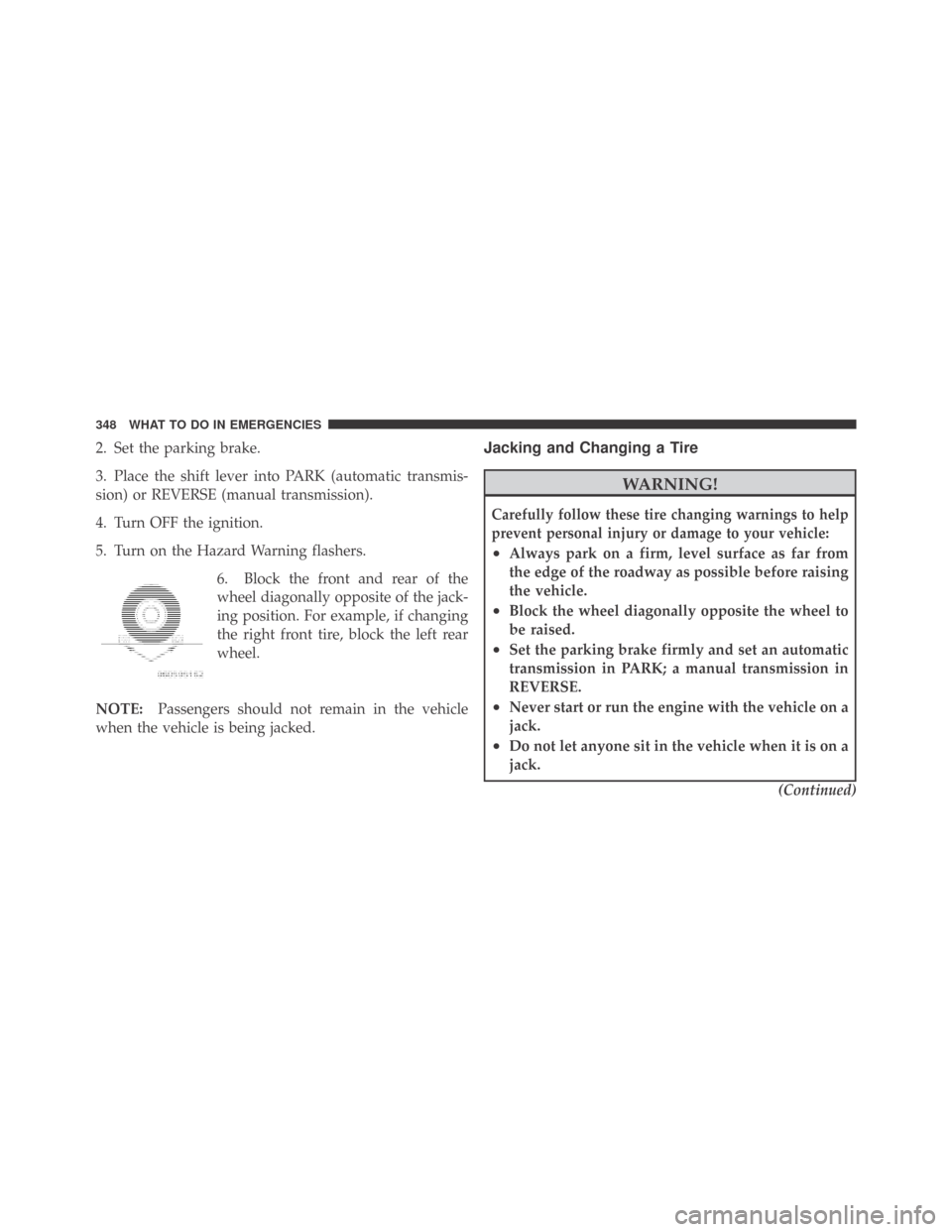
6. Block the front and rear of the
wheel diagonally opposite of the jack-
ing position. For example, if changing
the right front tire, block the left rear
wheel.
NOTE:Passengers should not remain in the vehicle
when the vehicle is being jacked.Jacking and Changing a Tire
WARNING!
Carefully follow these tire changing warnings to help
prevent personal injury or damage to your vehicle:
•Always park on a firm, level surface as far from
the edge of the roadway as possible before raising
the vehicle.
•Block the wheel diagonally opposite the wheel to
be raised.
•Set the parking brake firmly and set an automatic
transmission in PARK; a manual transmission in
REVERSE.
•Never start or run the engine with the vehicle on a
jack.
•Do not let anyone sit in the vehicle when it is on a
jack.
(Continued)
348 WHAT TO DO IN EMERGENCIES
Page 358 of 469
JUMP-STARTING
WARNING!
•Take care to avoid the radiator cooling fan when-
ever the hood is raised. It can start anytime the
ignition switch is ON. You can be hurt by the fan.
•Do not attempt to push or tow your vehicle to get
it started. Vehicles equipped with an automatic
transmission cannot be started this way. Unburned
fuel could enter the catalytic converter and once
the engine has started, ignite and damage the
converter and vehicle. If the vehicle has a dis-
charged battery, booster cables may be used to
obtain a start from another vehicle. This type of
start can be dangerous if done improperly, so
follow this procedure carefully.
(Continued)
WARNING! (Continued)
•Battery fluid is a corrosive acid solution; do not
allow battery fluid to contact eyes, skin, or cloth-
ing. Don’t lean over battery when attaching
clamps or allow the clamps to touch each other. If
acid splashes in eyes or on skin, flush contami-
nated area immediately with large quantities of
water.
•A battery generates hydrogen gas, which is flam-
mable and explosive. Keep flame or spark away
from the vent holes.
•Do not use a booster battery or any other booster
source with an output that exceeds 12-Volts.
•The battery in this vehicle has a vent hose that
should not be disconnected and should only be
replaced with a battery of the same type (vented).
356 WHAT TO DO IN EMERGENCIES
Page 359 of 469
NOTE:The battery is stored under an access cover in
the trunk. Remote battery terminals are located in the
engine compartment for jump-starting.
1. Wear eye protection and remove any metal jewelry
such as watchbands or bracelets that might make an
inadvertent electrical contact.
2. When boost is provided by a battery in another
vehicle, park that vehicle within booster cable reach, but
do not allow the vehicles to touch one another.
WARNING!
Do not permit vehicles to touch each other as this
could establish a ground connection and personal
injury could result.3. Set the parking brake, place the automatic transmis-
sion in PARK (manual transmission in NEUTRAL), and
turn the ignition switch to the LOCK position on both
vehicles.
4. Turn off the heater, radio, and all unnecessary electri-
cal loads.
5. Connect one end of the jumper cable to the remote
jump-start positive battery post(+)in the engine com-
partment. Connect the other end of the same cable to the
positive terminal of the booster battery. Refer to the
following illustration for jump-starting connections.
6
WHAT TO DO IN EMERGENCIES 357
Page 361 of 469
WARNING!
•You should not try to start your vehicle by pushing
or towing.
•Do not connect the cable to the negative post of the
discharged battery. The resulting electrical spark
could cause the battery to explode.
•During cold weather when temperatures are be-
low the freezing point, electrolyte in a discharged
battery may freeze. Do not attempt jump-starting
because the battery could rupture or explode. The
battery temperature must be brought above the
freezing point before attempting jump-start.
FREEING A STUCK VEHICLE
If your vehicle becomes stuck in mud, sand, or snow, it
can often be moved by a rocking motion. Turn your
steering wheel right and left to clear the area around thefront wheels. Then shift back and forth between RE-
VERSE and DRIVE. Using minimal accelerator pedal
pressure to maintain the rocking motion, without spin-
ning the wheels, is most effective.
NOTE:Turn off the Electronic Stability Program (ESP)
before rocking the vehicle. Refer to “Electronic Stability
Program,” or “Traction Control” in Section 5.
CAUTION!
•When “rocking” a stuck vehicle by moving be-
tween “1st” and REVERSE, do not spin the wheels
faster than 15 mph (24 km/h), or drivetrain damage
may result.
•Racing the engine or spinning the wheels too fast
may lead to transmission overheating and failure.
It can also damage the tires. Do not spin the
wheels above 35 mph (55 km/h).
6
WHAT TO DO IN EMERGENCIES 359
Page 363 of 469
If the transmission is not operative or if the vehicle is to
be towed more than 15 miles (24 km), the vehicle must be
transported using a flatbed truck.
CAUTION!
•Do not attempt to tow this vehicle from the front
with sling-type towing equipment. Damage to the
front fascia will result.
•If the transmission is not operative or if the
vehicle is to be towed more than 15 miles (24 km),
then the only approved method of towing is with
a flatbed truck. Otherwise, damage to the trans-
mission may result.
•Do not tow the vehicle from the rear. Damage to
the rear sheet metal and fascia will occur.
•Do not push or tow this vehicle with another
vehicle as damage to the bumper fascia and trans-
mission may result.If you must use the accessories (wipers, defrosters, etc.)
while being towed, the key must be in the ON position,
not the ACC position. Make certain the transmission
remains in NEUTRAL.
Towing This Vehicle Behind Another Vehicle With
A Tow Dolly
The manufacturerdoes not recommendthat you tow this
vehicle on a tow dolly. Vehicle damage may occur.
6
WHAT TO DO IN EMERGENCIES 361
Page 366 of 469
▫Exhaust System..................... 381
▫Cooling System..................... 384
▫Brake System....................... 389
▫Clutch Hydraulic System — Manual
Transmission (If Equipped)............. 392
▫Manual Transmission — If Equipped...... 392
▫Automatic Transmission — If Equipped.... 393
▫Rear Axle.......................... 394
▫Appearance Care And Protection From
Corrosion.......................... 395
�Fuses.............................. 400
▫Integrated Power Module (IPM).......... 400
▫Rear Power Distribution Center.......... 403
�Vehicle Storage....................... 407�Replacement Light Bulbs................ 408
�Bulb Replacement..................... 409
▫Low Beam Headlamp, High Beam
Headlamp, Park/Turn Lamp — Models With
Halogen Headlamps — If Equipped....... 409
▫Low Beam Headlamp, High Beam
Headlamp, And Park/Turn Lamp — Models
With High Intensity Discharge (HID)
Headlamps — If Equipped............. 409
▫Front/Rear Side Marker Lamp........... 409
▫Tail/Turn And Stop Lamp.............. 410
▫Center Tail/Backup Lamp.............. 412
▫Center High-Mounted Stop Lamp
(CHMSL).......................... 413
▫License Lamp....................... 413
364 MAINTAINING YOUR VEHICLE