Page 339 of 469
WHAT TO DO IN EMERGENCIES
CONTENTS
�Hazard Warning Flasher................ 338
�If Your Engine Overheats................ 338
�TIREFIT Tire Repair — If Equipped........ 339
�Jacking And Tire Changing............... 345
▫Jack Location/Spare Tire Stowage........ 345
▫Preparations For Jacking............... 347
▫Jacking And Changing a Tire............ 348
▫Compact Spare Tire................... 352
▫Wheel Cover Or Center Cap Installation
(If Equipped)....................... 353�Jump-Starting........................ 356
�FreeingAStuckVehicle ................. 359
�Towing A Disabled Vehicle............... 360
▫Without The Ignition Key.............. 360
▫Towing This Vehicle Behind Another Vehicle
(Flat Towing With All Four Wheels On The
Ground)........................... 360
▫Towing This Vehicle Behind Another Vehicle
WithATowDolly .................... 361
6
337
Page 362 of 469
WARNING!
Fast spinning tires can be dangerous. Forces gener-
ated by excessive wheel speeds may cause tire dam-
age or failure. A tire could explode and injure some-
one. Do not spin your vehicle’s wheels faster than
35 mph (55 km/h) when you are stuck, and don’t let
anyone near a spinning wheel, no matter what the
speed.
TOWING A DISABLED VEHICLE
Without The Ignition Key
Special care must be taken when the vehicle is towed
with the ignition in the LOCK position. The only ap-
proved method of towing without the ignition key is
with a flatbed truck. Proper towing equipment is neces-
sary to prevent damage to the vehicle.
Towing This Vehicle Behind Another Vehicle (Flat
Towing With All Four Wheels On The Ground)
Flat towing of vehicles is permitted within the following
limitations:
With The Ignition Key
Your vehicle may be towed under the following condi-
tions:
•The shift lever must be in NEUTRAL
•The distance to be traveled must not exceed 15 miles
(24 km)
•The towing speed must not exceed 30 mph (48 km/h)
CAUTION!
Exceeding these towing limits may cause a transmis-
sion failure.
360 WHAT TO DO IN EMERGENCIES
Page 363 of 469
If the transmission is not operative or if the vehicle is to
be towed more than 15 miles (24 km), the vehicle must be
transported using a flatbed truck.
CAUTION!
•Do not attempt to tow this vehicle from the front
with sling-type towing equipment. Damage to the
front fascia will result.
•If the transmission is not operative or if the
vehicle is to be towed more than 15 miles (24 km),
then the only approved method of towing is with
a flatbed truck. Otherwise, damage to the trans-
mission may result.
•Do not tow the vehicle from the rear. Damage to
the rear sheet metal and fascia will occur.
•Do not push or tow this vehicle with another
vehicle as damage to the bumper fascia and trans-
mission may result.If you must use the accessories (wipers, defrosters, etc.)
while being towed, the key must be in the ON position,
not the ACC position. Make certain the transmission
remains in NEUTRAL.
Towing This Vehicle Behind Another Vehicle With
A Tow Dolly
The manufacturerdoes not recommendthat you tow this
vehicle on a tow dolly. Vehicle damage may occur.
6
WHAT TO DO IN EMERGENCIES 361
Page 371 of 469

Trip Odometer button to turn off the message. If the
problem continues, the message will appear the next time
the vehicle is started.
A loose, improperly installed, or damaged fuel filler cap
may also turn on the MIL.
EMISSIONS INSPECTION AND MAINTENANCE
PROGRAMS
In some localities, it may be a legal requirement to pass
an inspection of this vehicle’s emissions control system.
Failure to pass could prevent vehicle registration.
For states that require an Inspection and Mainte-
nance (I/M), this check verifies the Malfunction
Indicator Light (MIL) is functioning and is not on
when the engine is running, and that the OBD II system
is ready for testing.
Normally, the OBD II system will be ready. The OBD II
system maynotbe ready if the vehicle was recentlyserviced, recently had a dead battery, or a battery replace-
ment. If the OBD II system should be determined not
ready for the I/M test, the vehicle may fail the test.
This vehicle has a simple ignition key-actuated test,
which you can use prior to going to the test station. To
check if this vehicle’s OBD II system is ready, you must
do the following:
1. Insert the ignition key into the ignition switch.
2. Turn the ignition to the ON position, but do not crank
or start the engine.
3. If you crank or start the engine, you will have to start
this test over.
4. As soon as you turn the ignition key to the ON
position, you will see the MIL symbol come on as part of
a normal bulb check.
7
MAINTAINING YOUR VEHICLE 369
Page 372 of 469

5. Approximately 15 seconds later, one of two things will
happen:
a. The MIL will flash for about 10 seconds and then
return to being fully illuminated until you turn OFF
the ignition key or start the engine. This means that the
vehicle’s OBD II system isnot readyand you should
notproceed to the I/M station.
b. The MIL will not flash at all and will remain fully
illuminated until you turn OFF the ignition key or start
the engine. This means that the vehicle’s OBD II
system isready,and you can proceed to the I/M
station.
If the OBD II system isnot ready,you should see an
authorized dealer or repair facility. If this vehicle was
recently serviced or had a battery failure or replacement,
you may need to do nothing more than drive the vehicleas you normally would in order for the OBD II system to
update. A recheck with the above test routine may then
indicate that the system is now ready.
Regardless of whether the vehicle’s OBD II system is
ready or not ready, if the MIL is illuminated during
normal vehicle operation, you should have the vehicle
serviced before going to the I/M station. The I/M station
can fail the vehicle because the MIL is on with the engine
running.
REPLACEMENT PARTS
Use of genuine MOPAR�parts for normal/scheduled
maintenance and repairs is highly recommended to en-
sure the designed performance. Damage or failures
caused by the use of non-MOPAR�parts for maintenance
and repairs will not be covered by the manufacturer’s
warranty.
370 MAINTAINING YOUR VEHICLE
Page 411 of 469
BULB REPLACEMENT
Low Beam Headlamp, High Beam Headlamp,
Park/Turn Lamp — Models with Halogen
Headlamps — If Equipped
See your authorized dealer for bulb replacement.
Low Beam Headlamp, High Beam Headlamp, and
Park/Turn Lamp — Models with High Intensity
Discharge (HID) Headlamps — If Equipped
HID Headlamps
The headlamps are a type of high voltage discharge tube.
High voltage can remain in the circuit even with the
headlamp switch off and the key removed.Because of
this, you should not attempt to service a headlamp bulb
yourself. If a headlamp bulb fails, take your vehicle to
an authorized dealer for service.
WARNING!
A transient high tension occurs at the bulb sockets of
HID headlamps when the headlamp switch is turned
ON. It may cause serious electrical shock or electro-
cution if not serviced properly. See your authorized
dealer for service.
NOTE:On vehicles equipped with HID headlamps,
when the headlamps are turned on, there is a blue hue to
the lamps. This diminishes and becomes more white after
approximately 10 seconds, as the system charges.
Front/Rear Side Marker Lamp
1. Remove the front/rear side marker. Use a fiber stick or
similar tool to gently pry the lamp on the outboard side
to disengage the clip.
7
MAINTAINING YOUR VEHICLE 409
Page 447 of 469
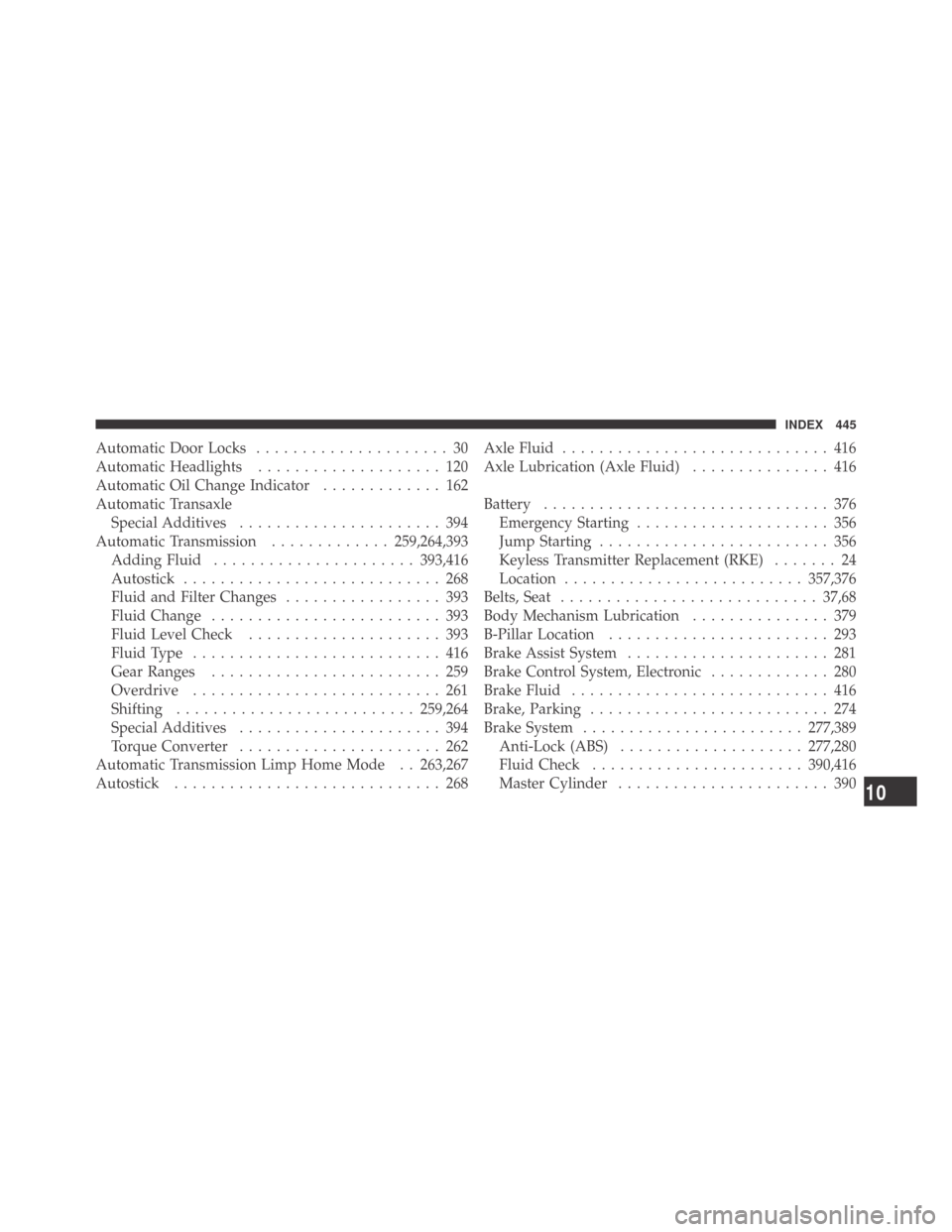
Automatic Door Locks..................... 30
Automatic Headlights.................... 120
Automatic Oil Change Indicator............. 162
Automatic Transaxle
Special Additives...................... 394
Automatic Transmission.............259,264,393
Adding Fluid......................393,416
Autostick............................ 268
Fluid and Filter Changes................. 393
Fluid Change......................... 393
Fluid Level Check..................... 393
FluidType ........................... 416
Gear Ranges......................... 259
Overdrive........................... 261
Shifting ..........................259,264
Special Additives...................... 394
Torque Converter...................... 262
Automatic Transmission Limp Home Mode . . 263,267
Autostick............................. 268AxleFluid ............................. 416
Axle Lubrication (Axle Fluid)............... 416
Battery............................... 376
Emergency Starting..................... 356
Jump Starting......................... 356
Keyless Transmitter Replacement (RKE)....... 24
Location..........................357,376
Belts, Seat............................ 37,68
Body Mechanism Lubrication............... 379
B-Pillar Location........................ 293
Brake Assist System...................... 281
Brake Control System, Electronic............. 280
Brake Fluid............................ 416
Brake, Parking.......................... 274
Brake System........................277,389
Anti-Lock (ABS)....................277,280
Fluid Check.......................390,416
Master Cylinder....................... 390
10
INDEX 445
Page 454 of 469
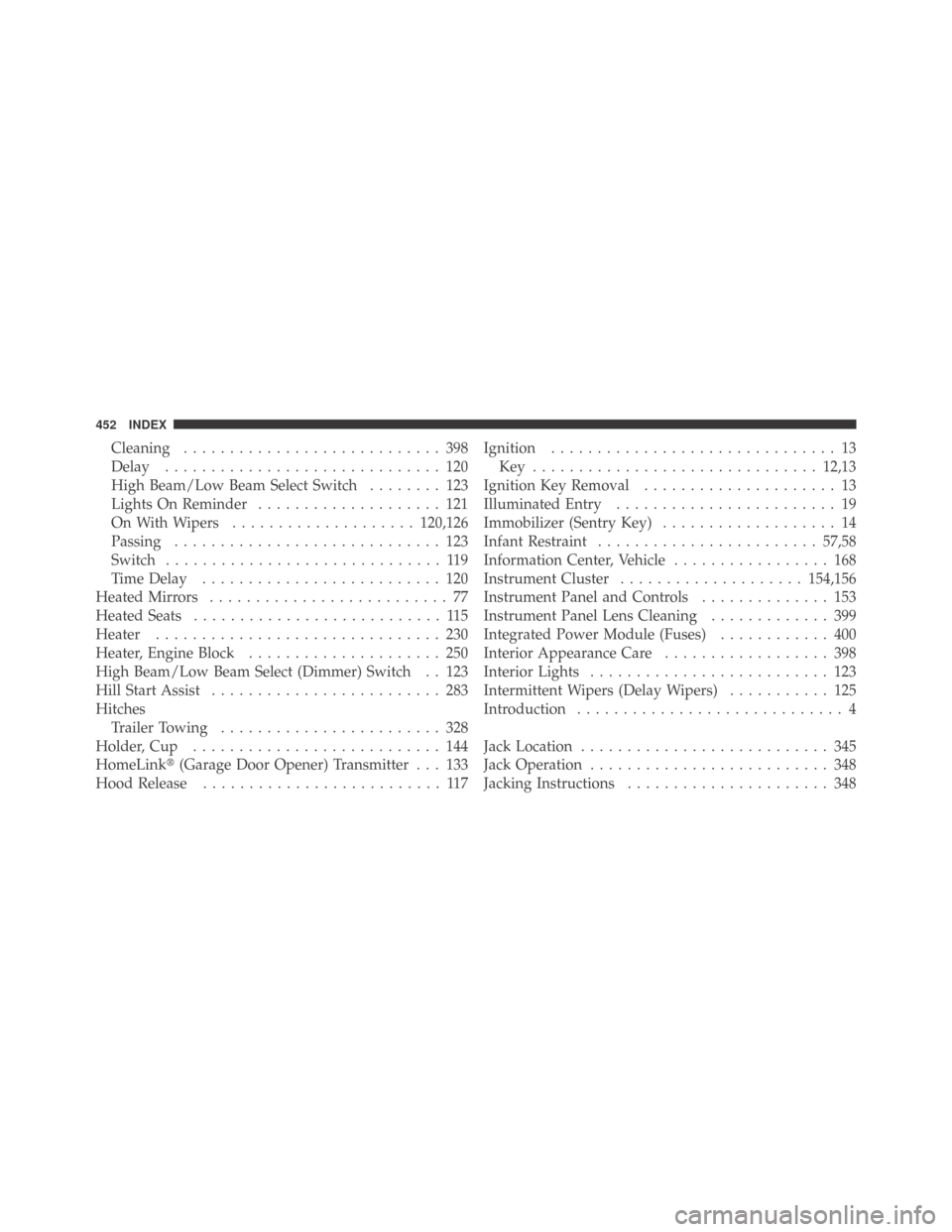
Cleaning............................ 398
Delay .............................. 120
High Beam/Low Beam Select Switch........ 123
Lights On Reminder.................... 121
On With Wipers....................120,126
Passing............................. 123
Switch .............................. 119
TimeDelay .......................... 120
Heated Mirrors.......................... 77
Heated Seats........................... 115
Heater............................... 230
Heater, Engine Block..................... 250
High Beam/Low Beam Select (Dimmer) Switch . . 123
Hill Start Assist......................... 283
Hitches
TrailerTowing ........................ 328
Holder,Cup ........................... 144
HomeLink�(Garage Door Opener) Transmitter . . . 133
Hood Release.......................... 117Ignition............................... 13
Key ............................... 12,13
Ignition Key Removal..................... 13
Illuminated Entry........................ 19
Immobilizer (Sentry Key)................... 14
Infant Restraint........................ 57,58
Information Center, Vehicle................. 168
Instrument Cluster....................154,156
Instrument Panel and Controls.............. 153
Instrument Panel Lens Cleaning............. 399
Integrated Power Module (Fuses)............ 400
Interior Appearance Care.................. 398
InteriorLights .......................... 123
Intermittent Wipers (Delay Wipers)........... 125
Introduction............................. 4
Jack Location........................... 345
Jack Operation.......................... 348
Jacking Instructions...................... 348
452 INDEX