Page 347 of 469
•If TIREFIT is liquid, clean water and a damp cloth will
remove the material from the vehicle or tire and wheel
components. Once TIREFIT sealing material has dried,
it can easily be peeled off and properly discarded.
•Do not exceed 55 mph (90 km/h) until the tire has
been inspected.
JACKING AND TIRE CHANGING
WARNING!
•Do not attempt to change a tire on the side of the
vehicle close to moving traffic. Pull far enough off
the road to avoid the danger of being hit when
operating the jack or changing the wheel.
(Continued)
WARNING! (Continued)
•Getting under a jacked-up vehicle is dangerous.
The vehicle could slip off the jack and fall on you.
You could be crushed. Never get any part of your
body under a vehicle that is on a jack. Never start
or run the engine while the vehicle is on a jack. If
you need to get under a raised vehicle, take it to a
service center where it can be raised on a lift.
•The jack is designed to use as a tool for changing
tires only. The jack should not be used to lift the
vehicle for service purposes. The vehicle should
be jacked on a firm level surface only. Avoid ice or
slippery areas.
Jack Location/Spare Tire Stowage
The jack and spare tire are both stowed under an access
cover in the trunk. Follow these steps to access the jack
and spare tire.
6
WHAT TO DO IN EMERGENCIES 345
Page 351 of 469
WARNING! (Continued)
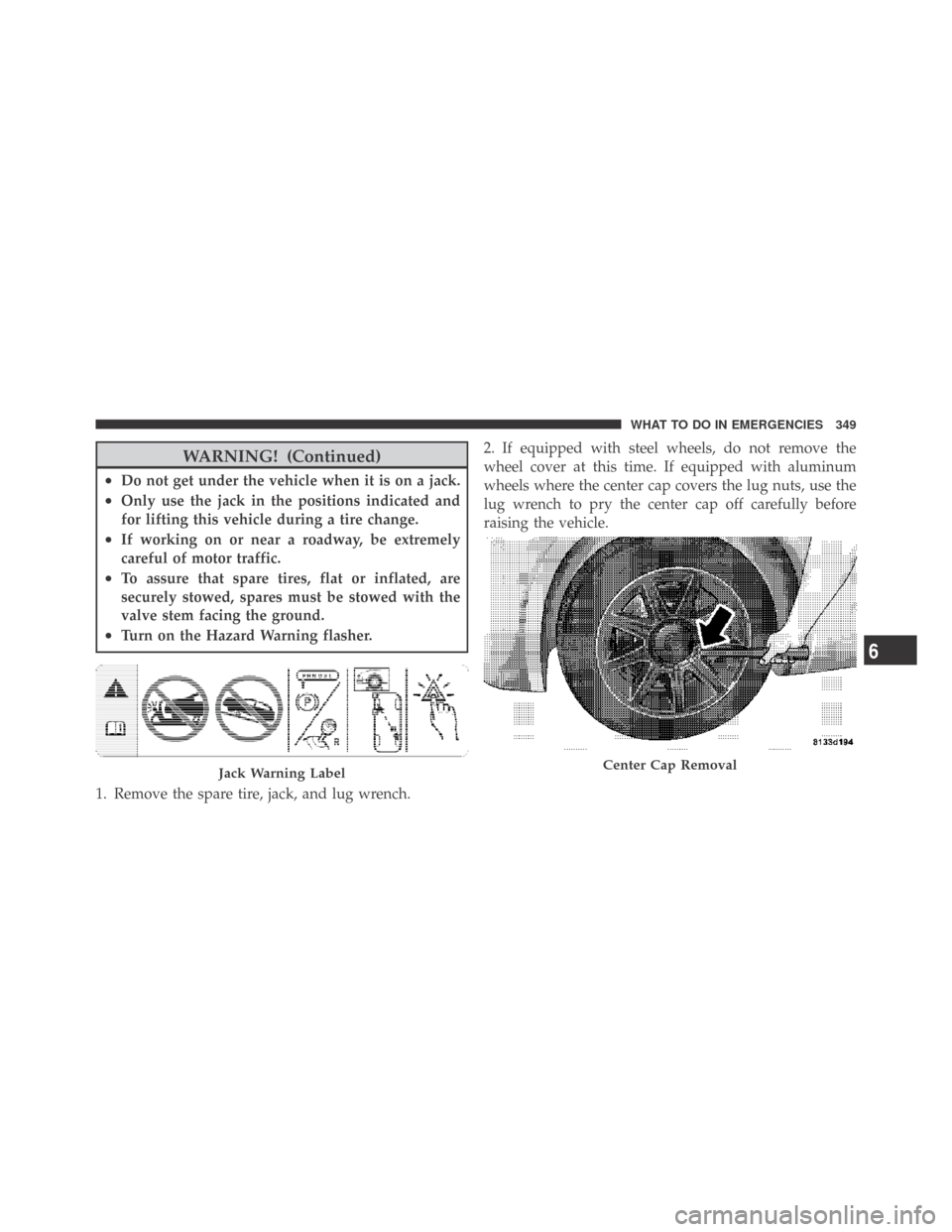
•Do not get under the vehicle when it is on a jack.
•Only use the jack in the positions indicated and
for lifting this vehicle during a tire change.
•If working on or near a roadway, be extremely
careful of motor traffic.
•To assure that spare tires, flat or inflated, are
securely stowed, spares must be stowed with the
valve stem facing the ground.
•Turn on the Hazard Warning flasher.
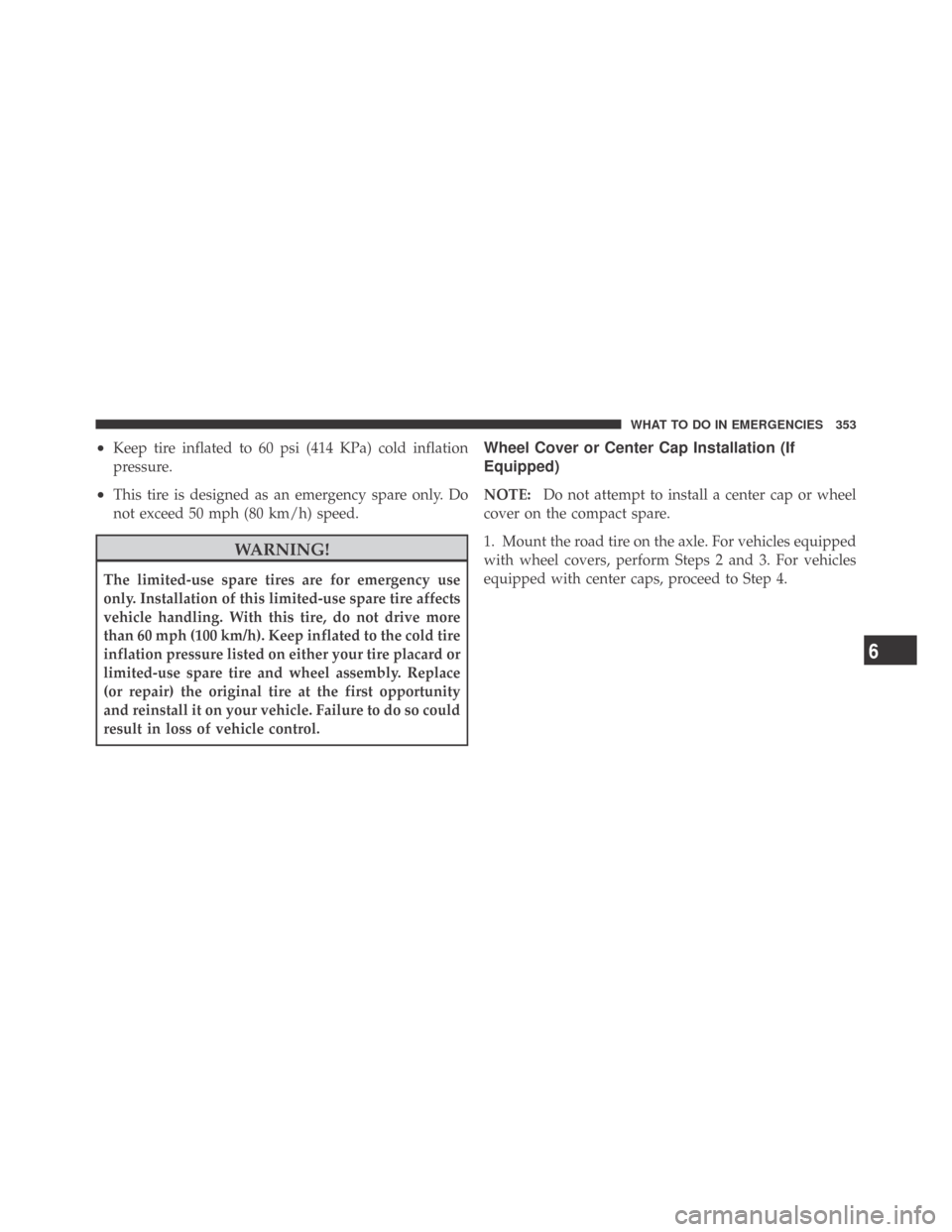
1. Remove the spare tire, jack, and lug wrench.2. If equipped with steel wheels, do not remove the
wheel cover at this time. If equipped with aluminum
wheels where the center cap covers the lug nuts, use the
lug wrench to pry the center cap off carefully before
raising the vehicle.
Jack Warning LabelCenter Cap Removal
6
WHAT TO DO IN EMERGENCIES 349
Page 354 of 469

8. Install the lug nuts with the cone shaped end of the
nut toward the wheel. Lightly tighten the lug nuts. To
avoid the risk of forcing the vehicle off the jack, do not
tighten the lug nuts fully until the vehicle is lowered to
the ground.
9. Lower the vehicle to the ground by turning the jack
handle counterclockwise.
10. Finish tightening the lug nuts. Push down on the
wrench while tightening for increased leverage. Alternate
lug nuts until each nut has been tightened twice. The
correct tightness of each lug nut is 100 ft/lb. (135 N·m). If
in doubt about the correct tightness, have them checked
with a torque wrench by your authorized dealer or at a
service station.11. Stow the jack, tools and flat tire. Make sure the base
of the jack faces the rear of the vehicle before tightening
down the fastener.
WARNING!
A loose tire or jack thrown forward in a collision or
hard stop could endanger the occupants of the ve-
hicle. Always stow the jack parts and the spare tire in
the places provided.
Compact Spare Tire
The compact spare tire is for temporary emergency use
with radial tires. It is engineered to be used on your style
vehicle only. Since this tire has limited tread life, the
original tire should be repaired (or replaced) and rein-
stalled at the first opportunity.
352 WHAT TO DO IN EMERGENCIES
Page 355 of 469
•Keep tire inflated to 60 psi (414 KPa) cold inflation
pressure.
•This tire is designed as an emergency spare only. Do
not exceed 50 mph (80 km/h) speed.
WARNING!
The limited-use spare tires are for emergency use
only. Installation of this limited-use spare tire affects
vehicle handling. With this tire, do not drive more
than 60 mph (100 km/h). Keep inflated to the cold tire
inflation pressure listed on either your tire placard or
limited-use spare tire and wheel assembly. Replace
(or repair) the original tire at the first opportunity
and reinstall it on your vehicle. Failure to do so could
result in loss of vehicle control.
Wheel Cover or Center Cap Installation (If
Equipped)
NOTE:Do not attempt to install a center cap or wheel
cover on the compact spare.
1. Mount the road tire on the axle. For vehicles equipped
with wheel covers, perform Steps 2 and 3. For vehicles
equipped with center caps, proceed to Step 4.
6
WHAT TO DO IN EMERGENCIES 353
Page 361 of 469
WARNING!
•You should not try to start your vehicle by pushing
or towing.
•Do not connect the cable to the negative post of the
discharged battery. The resulting electrical spark
could cause the battery to explode.
•During cold weather when temperatures are be-
low the freezing point, electrolyte in a discharged
battery may freeze. Do not attempt jump-starting
because the battery could rupture or explode. The
battery temperature must be brought above the
freezing point before attempting jump-start.
FREEING A STUCK VEHICLE
If your vehicle becomes stuck in mud, sand, or snow, it
can often be moved by a rocking motion. Turn your
steering wheel right and left to clear the area around thefront wheels. Then shift back and forth between RE-
VERSE and DRIVE. Using minimal accelerator pedal
pressure to maintain the rocking motion, without spin-
ning the wheels, is most effective.
NOTE:Turn off the Electronic Stability Program (ESP)
before rocking the vehicle. Refer to “Electronic Stability
Program,” or “Traction Control” in Section 5.
CAUTION!
•When “rocking” a stuck vehicle by moving be-
tween “1st” and REVERSE, do not spin the wheels
faster than 15 mph (24 km/h), or drivetrain damage
may result.
•Racing the engine or spinning the wheels too fast
may lead to transmission overheating and failure.
It can also damage the tires. Do not spin the
wheels above 35 mph (55 km/h).
6
WHAT TO DO IN EMERGENCIES 359
Page 362 of 469
WARNING!
Fast spinning tires can be dangerous. Forces gener-
ated by excessive wheel speeds may cause tire dam-
age or failure. A tire could explode and injure some-
one. Do not spin your vehicle’s wheels faster than
35 mph (55 km/h) when you are stuck, and don’t let
anyone near a spinning wheel, no matter what the
speed.
TOWING A DISABLED VEHICLE
Without The Ignition Key
Special care must be taken when the vehicle is towed
with the ignition in the LOCK position. The only ap-
proved method of towing without the ignition key is
with a flatbed truck. Proper towing equipment is neces-
sary to prevent damage to the vehicle.
Towing This Vehicle Behind Another Vehicle (Flat
Towing With All Four Wheels On The Ground)
Flat towing of vehicles is permitted within the following
limitations:
With The Ignition Key
Your vehicle may be towed under the following condi-
tions:
•The shift lever must be in NEUTRAL
•The distance to be traveled must not exceed 15 miles
(24 km)
•The towing speed must not exceed 30 mph (48 km/h)
CAUTION!
Exceeding these towing limits may cause a transmis-
sion failure.
360 WHAT TO DO IN EMERGENCIES
Page 423 of 469
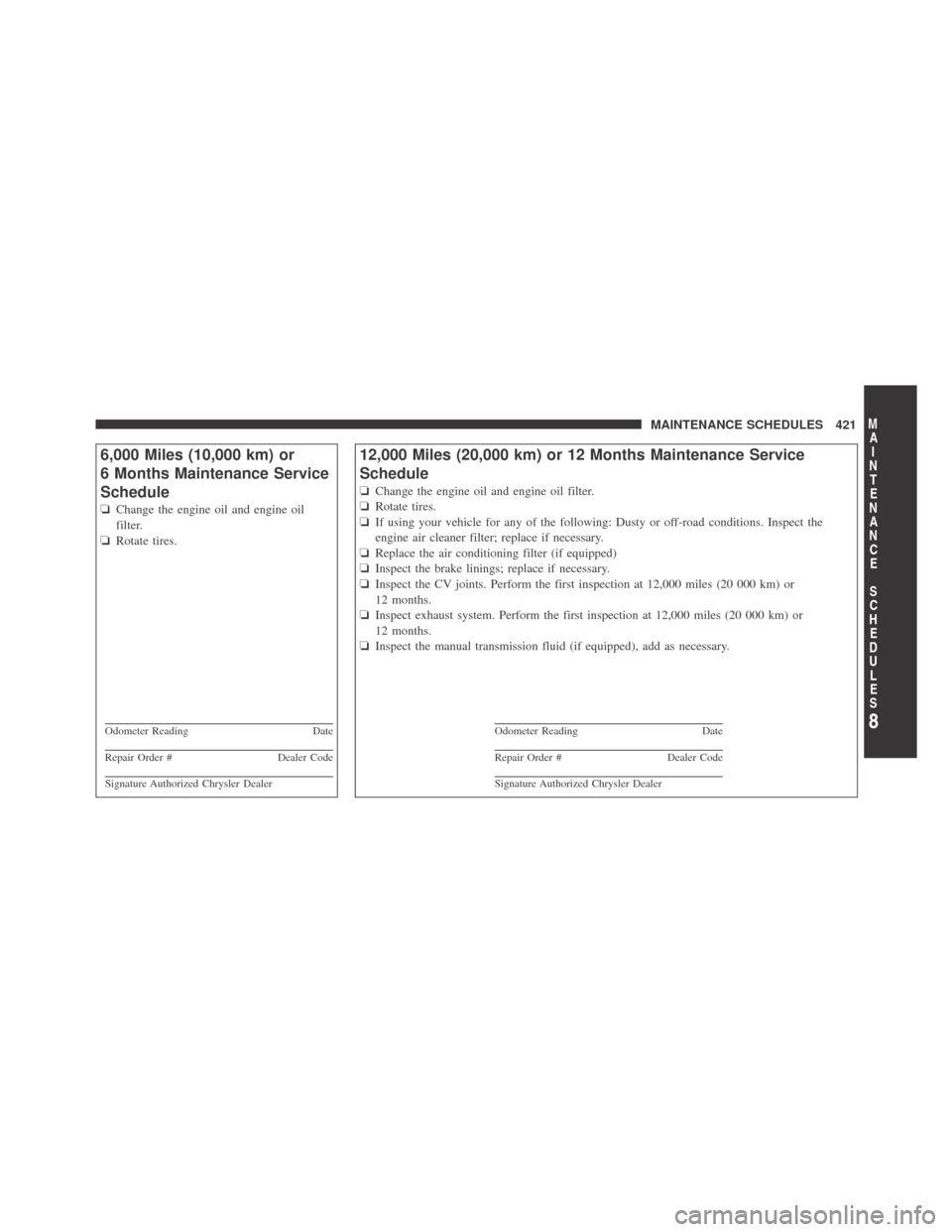
6,000 Miles (10,000 km) or
6 Months Maintenance Service
Schedule
❏Change the engine oil and engine oil
filter.
❏Rotate tires.
Odometer Reading Date
Repair Order # Dealer Code
Signature Authorized Chrysler Dealer
12,000 Miles (20,000 km) or 12 Months Maintenance Service
Schedule
❏Change the engine oil and engine oil filter.
❏Rotate tires.
❏If using your vehicle for any of the following: Dusty or off-road conditions. Inspect the
engine air cleaner filter; replace if necessary.
❏Replace the air conditioning filter (if equipped)
❏Inspect the brake linings; replace if necessary.
❏Inspect the CV joints. Perform the first inspection at 12,000 miles (20 000 km) or
12 months.
❏Inspect exhaust system. Perform the first inspection at 12,000 miles (20 000 km) or
12 months.
❏Inspect the manual transmission fluid (if equipped), add as necessary.
Odometer Reading Date
Repair Order # Dealer Code
Signature Authorized Chrysler Dealer
8
M
A
I
N
T
E
N
A
N
C
E
S
C
H
E
D
U
L
E
SMAINTENANCE SCHEDULES 421
Page 424 of 469
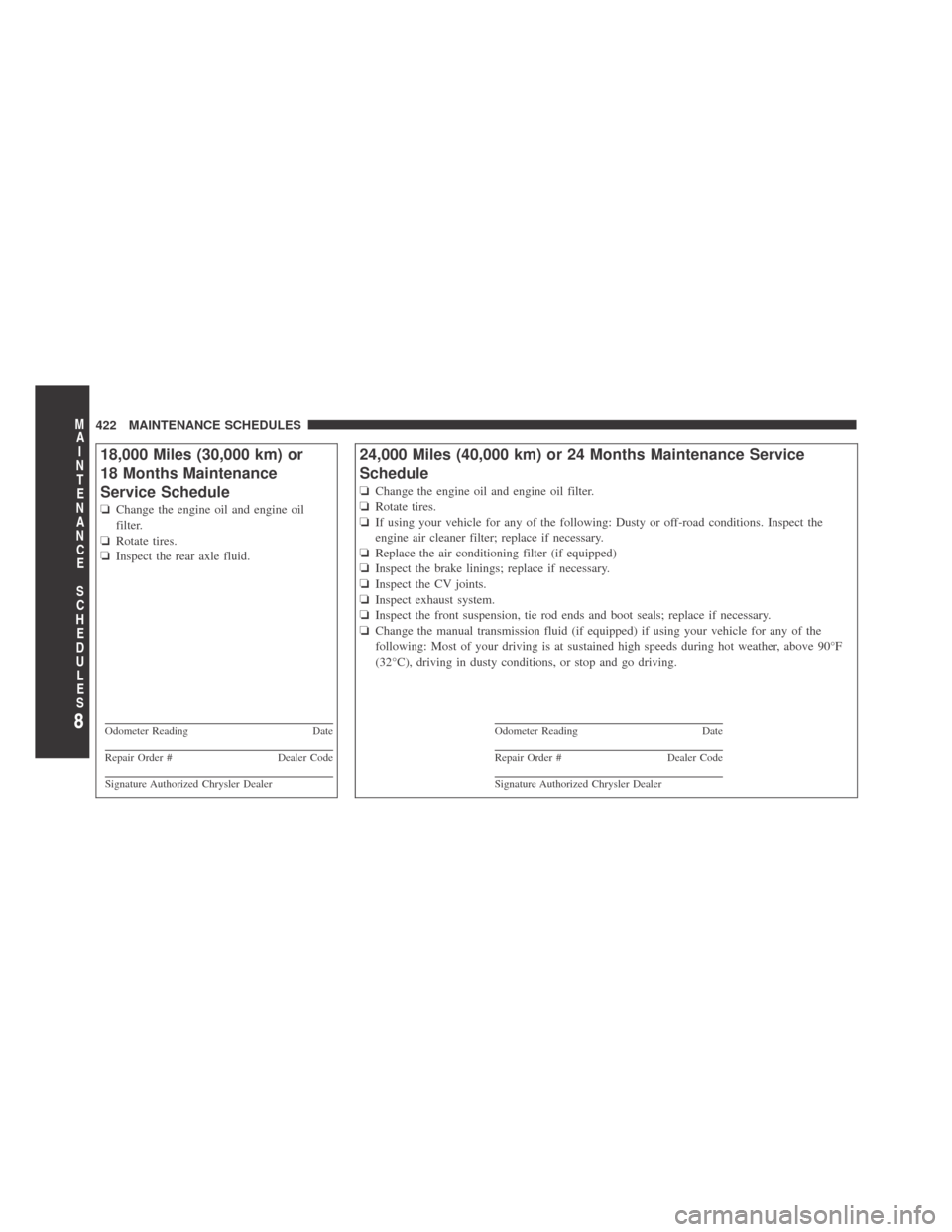
18,000 Miles (30,000 km) or
18 Months Maintenance
Service Schedule
❏Change the engine oil and engine oil
filter.
❏Rotate tires.
❏Inspect the rear axle fluid.
Odometer Reading Date
Repair Order # Dealer Code
Signature Authorized Chrysler Dealer
24,000 Miles (40,000 km) or 24 Months Maintenance Service
Schedule
❏Change the engine oil and engine oil filter.
❏Rotate tires.
❏If using your vehicle for any of the following: Dusty or off-road conditions. Inspect the
engine air cleaner filter; replace if necessary.
❏Replace the air conditioning filter (if equipped)
❏Inspect the brake linings; replace if necessary.
❏Inspect the CV joints.
❏Inspect exhaust system.
❏Inspect the front suspension, tie rod ends and boot seals; replace if necessary.
❏Change the manual transmission fluid (if equipped) if using your vehicle for any of the
following: Most of your driving is at sustained high speeds during hot weather, above 90°F
(32°C), driving in dusty conditions, or stop and go driving.
Odometer Reading Date
Repair Order # Dealer Code
Signature Authorized Chrysler Dealer
8
M
A
I
N
T
E
N
A
N
C
E
S
C
H
E
D
U
L
E
S422 MAINTENANCE SCHEDULES