Page 55 of 469

throat irritation, move to fresh air. If the irritation
continues, see your doctor. If these particles settle on
your clothing, follow the garment manufacturer’s in-
structions for cleaning.
•It is not advisable to drive your vehicle after the
airbags have been deployed. If you are involved in
another collision, the airbags will not be in place to
protect you.
WARNING!
Deployed airbags cannot protect you in another col-
lision. Have the airbags replaced by an authorized
dealer as soon as possible.
Enhanced Accident Response System
In the event of an impact that causes airbag deployment,
with the vehicle stopped, the vehicle communication
network intact, and the power intact, the Enhanced
Accident Response System performs the following func-
tions:
•Cuts off fuel to the engine.
•Flashes hazard lights.
•Turns on the interior lights, which remain on as long as
the battery has power or until the ignition key is
removed.
•Unlocks the doors automatically.
NOTE:The interior lights can only be deactivated if the
key is removed from the ignition switch or the vehicle is
driven.
2
THINGS TO KNOW BEFORE STARTING YOUR VEHICLE 53
Page 56 of 469
Maintaining Your Airbag System
WARNING!
•Modifications to any part of the airbag system
could cause it to fail when you need it. You could
be injured because the airbags are not there to
protect you. Do not modify the components or
wiring, including adding any kind of badges or
stickers to the steering wheel hub trim cover or the
upper passenger side of the instrument panel. Do
not modify the front bumper, vehicle body struc-
ture, or frame.
•You need proper knee impact protection in a
collision. Do not mount or locate any aftermarket
equipment on or behind the knee impact bolster.
•It is dangerous to try to repair any part of the
airbag system yourself. Be sure to tell anyone who
works on your vehicle that it has airbags.
Airbag Warning Light
You will want to have the airbags ready to
inflate for your protection in an impact. While
the airbag system is designed to be mainte-
nance free, if any of the following occurs, have
an authorized dealer service the system promptly:
•The Airbag Warning Light does not come on or flickers
during the six to eight seconds when the ignition
switch is first turned ON.
•The light remains on or flickers after the six to eight
second interval.
•The light flickers or comes on and remains on while
driving.
54 THINGS TO KNOW BEFORE STARTING YOUR VEHICLE
Page 58 of 469
upon request. General data that does not identify par-
ticular vehicles or crashes may be released for incorpo-
ration in aggregate crash databases, such as those main-
tained by the U.S. government and various states. Data of
a potentially sensitive nature, such as would identify a
particular driver, vehicle, or crash, will be treated confi-
dentially. Confidential data will not be disclosed by
Chrysler LLC to any third party except when:
1. Used for research purposes, such as to match data
with a particular crash record in an aggregate database,
provided confidentiality of personal data is thereafter
preserved,
2. Used in defense of litigation involving a Chrysler LLC
product,
3. Requested by police under a legal warrant, or
4. Otherwise required by law.
Data Parameters that May Be Recorded:•Diagnostic trouble code(s) and warning light status for
electronically-controlled safety systems, including the
airbag system
•Airbag disable light status (if equipped)
•�Ti m e�of airbag deployment (in terms of ignition
cycles and vehicle mileage)
•Airbag deployment level (if applicable)
•Impact velocity and angle
•Seat belt status
•Brake status (service and parking brakes)
•Accelerator status (including vehicle speed)
•Engine control status (including engine speed)
•Transmission gear selection
•Cruise control status
56 THINGS TO KNOW BEFORE STARTING YOUR VEHICLE
Page 70 of 469

If you are required to drive with the trunk/liftgate open,
make sure that all windows are closed and the climate
control BLOWER switch is set at high speed. DO NOT
use the recirculation mode.
The best protection against carbon monoxide entry into
the vehicle body is a properly maintained engine exhaust
system.
Whenever a change is noticed in the sound of the exhaust
system, when exhaust fumes can be detected inside the
vehicle, or when the underside or rear of the vehicle is
damaged, have a competent mechanic inspect the com-
plete exhaust system and adjacent body areas for broken,
damaged, deteriorated, or mispositioned parts. Open
seams or loose connections could permit exhaust fumes
to seep into the passenger compartment. In addition,
inspect the exhaust system each time the vehicle is raised
for lubrication or oil change. Replace as required.Safety Checks You Should Make Inside the
Vehicle
Seat Belts
Inspect the belt system periodically, checking for cuts,
frays, and loose parts. Damaged parts must be replaced
immediately. Do not disassemble or modify the system.
Front seat belt assemblies must be replaced after a
collision. Rear seat belt assemblies must be replaced after
a collision if they have been damaged (i.e., bent retractor,
torn webbing, etc.). If there is any question regarding belt
or retractor condition, replace the belt.
Airbag Warning Light
The light should come on and remain on for six to eight
seconds as a bulb check when the ignition switch is first
turned ON. If the light is not lit during starting, see your
authorized dealer. If the light stays on, flickers, or comes
on while driving, have the system checked by an autho-
rized dealer.
68 THINGS TO KNOW BEFORE STARTING YOUR VEHICLE
Page 71 of 469

Defroster
Check operation by selecting the defrost mode and place
the blower control on high speed. You should be able to
feel the air directed against the windshield. See your
authorized dealer for service if your defroster is
inoperable.
Periodic Safety Checks You Should Make Outside
the Vehicle
Tires
Examine tires for excessive tread wear and uneven wear
patterns. Check for stones, nails, glass, or other objects
lodged in the tread. Inspect the tread and sidewall for
cuts and cracks. Check the wheel nuts for tightness.
Check the tires (including spare) for proper pressure.
Lights
Have someone observe the operation of exterior lights
while you work the controls. Check turn signal and high
beam indicator lights on the instrument panel.
Door Latches
Check for positive closing, latching, and locking.
Fluid Leaks
Check area under vehicle after overnight parking for fuel,
engine coolant, oil, or other fluid leaks. Also, if gasoline
fumes are detected or if fuel, power steering fluid, or
brake fluid leaks are suspected, the cause should be
located and corrected immediately.
2
THINGS TO KNOW BEFORE STARTING YOUR VEHICLE 69
Page 74 of 469
�Voice Recognition (VR) System —
If Equipped.......................... 106
▫Voice Recognition (VR) System Operation . . . 106
▫Commands........................ 108
▫VoiceTraining .......................111
�Seats...............................111
▫Easy Entry Seats......................111
▫Power Seats........................ 112
▫Manual Front Seatback Recline........... 113
▫Lumbar Support..................... 114
▫Head Restraints..................... 114
▫Heated Seats....................... 115
▫Folding Rear Seat.................... 116�To Open And Close The Hood............ 117
�Lights ............................. 119
▫Headlight Switch.................... 119
▫Automatic Headlights — If Equipped...... 120
▫Headlights On With Wipers (Available With
Auto Headlights Only)................ 120
▫Headlight Time Delay................. 120
▫Daytime Running Lights — If Equipped.... 121
▫Lights-On Reminder.................. 121
▫Fog Lights — If Equipped.............. 121
▫Multifunction Lever.................. 122
▫Overhead Console Map/Reading Lights.... 123
▫InteriorLights ...................... 123
72 UNDERSTANDING THE FEATURES OF YOUR VEHICLE
Page 75 of 469
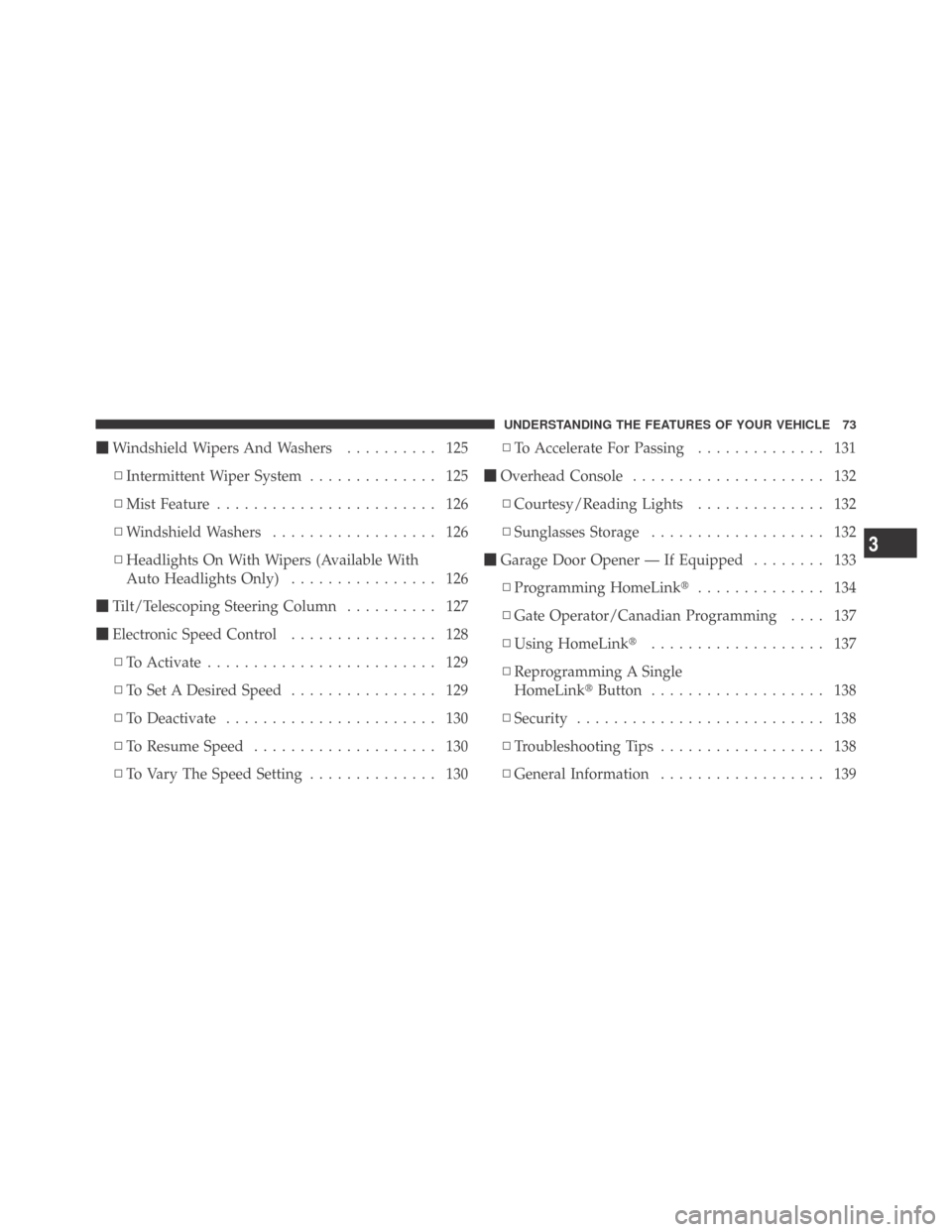
�Windshield Wipers And Washers.......... 125
▫Intermittent Wiper System.............. 125
▫Mist Feature........................ 126
▫Windshield Washers.................. 126
▫Headlights On With Wipers (Available With
Auto Headlights Only)................ 126
�Tilt/Telescoping Steering Column.......... 127
�Electronic Speed Control................ 128
▫To Activate......................... 129
▫To Set A Desired Speed................ 129
▫To Deactivate....................... 130
▫To Resume Speed.................... 130
▫To Vary The Speed Setting.............. 130▫To Accelerate For Passing.............. 131
�Overhead Console..................... 132
▫Courtesy/Reading Lights.............. 132
▫Sunglasses Storage................... 132
�Garage Door Opener — If Equipped........ 133
▫Programming HomeLink�.............. 134
▫Gate Operator/Canadian Programming.... 137
▫Using HomeLink�................... 137
▫Reprogramming A Single
HomeLink�Button................... 138
▫Security........................... 138
▫Troubleshooting Tips.................. 138
▫General Information.................. 139
3
UNDERSTANDING THE FEATURES OF YOUR VEHICLE 73
Page 77 of 469
MIRRORS
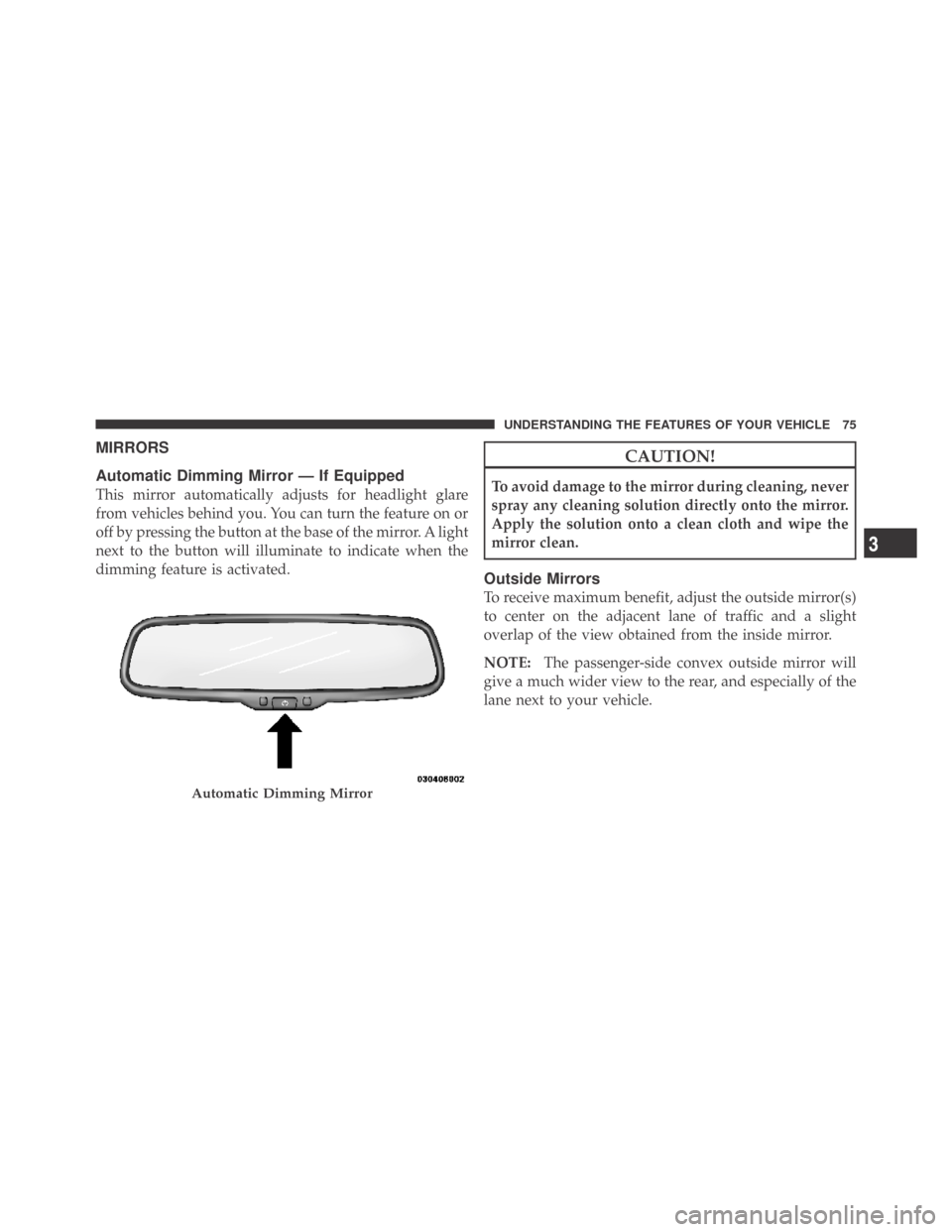
Automatic Dimming Mirror — If Equipped
This mirror automatically adjusts for headlight glare
from vehicles behind you. You can turn the feature on or
off by pressing the button at the base of the mirror. A light
next to the button will illuminate to indicate when the
dimming feature is activated.
CAUTION!
To avoid damage to the mirror during cleaning, never
spray any cleaning solution directly onto the mirror.
Apply the solution onto a clean cloth and wipe the
mirror clean.
Outside Mirrors
To receive maximum benefit, adjust the outside mirror(s)
to center on the adjacent lane of traffic and a slight
overlap of the view obtained from the inside mirror.
NOTE:The passenger-side convex outside mirror will
give a much wider view to the rear, and especially of the
lane next to your vehicle.
Automatic Dimming Mirror
3
UNDERSTANDING THE FEATURES OF YOUR VEHICLE 75