Page 97 of 534

Periodic Safety Checks You Should Make Outside
the Vehicle
Tires
Examine tires for excessive tread wear or uneven wear
patterns. Check for stones, nails, glass, or other objects
lodged in the tread. Inspect tread and sidewall for cuts or
cracks. Check wheel nuts for tightness. Check the tires
(including spare) for proper pressure.
Lights
Have someone observe the operation of exterior lights
while you work the controls. Check turn signal and high
beam indicator lights on the instrument panel.
Fluid Leaks
Check area under vehicle after overnight parking for fuel,
engine coolant, oil or other fluid leaks. Also, if gasoline
fumes are detected or fuel, power steering fluid, trans-
mission fluid or brake fluid leaks are suspected, the cause
should be located and corrected immediately.
Exhaust Gas
WARNING!
Exhaust gases can injure or kill. They contain carbon
monoxide (CO) which is colorless and odorless.
Breathing it can make you unconscious and can
eventually poison you. To avoid breathing (CO),
follow these safety tips:
Do not run the engine in a closed garage or in confined
areas any longer than needed to move your vehicle in or
out of the area.
If it is necessary to sit in a parked vehicle with the engine
running, adjust your heating or cooling controls to force
outside air into the vehicle. Set the blower at high speed.
THINGS TO KNOW BEFORE STARTING YOUR VEHICLE 95
2
ProCarManuals.com
Page 323 of 534
STARTING AND OPERATING
CONTENTS
�Starting Procedures.................... 324
▫Automatic Transaxle.................. 324
�Engine Block Heater — If Equipped......... 327
�Automatic Transaxle.................... 327
▫Brake/Transaxle Interlock System......... 328
▫Four-Speed Or Six-Speed Automatic
Transaxle.......................... 329
▫Reset Mode - Electronic Transaxle......... 334
�Driving On Slippery Surfaces............. 334▫Acceleration........................ 334
▫Traction........................... 335
�Driving Through Water.................. 335
▫Flowing/Rising Water................. 336
▫Shallow Standing Water................ 336
�Power Steering........................ 338
▫Power Steering Fluid Check............. 338
�Parking Brake........................ 339
5
ProCarManuals.com
Page 340 of 534
POWER STEERING
The standard power steering system will give you good
vehicle response and increased ease of maneuverability
in tight spaces. The system will provide mechanical
steering capability if power assist is lost.
If for some reason the power assist is interrupted, it will
still be possible to steer your vehicle. Under these condi-
tions, you will observe a substantial increase in steering
effort, especially at very low vehicle speeds and during
parking maneuvers.
NOTE:Increased noise levels at the end of the steering
wheel travel are considered normal and do not indicate
that there is a problem with the power steering system.
Upon initial start-up in cold weather, the power steering
pump may make noise for a short amount of time. This is
due to the cold, thick fluid in the steering system. This
noise should be considered normal, and it does not in any
way damage the steering system.WARNING!
Continued operation with reduced power steering
assist could pose a safety risk to yourself and others.
Service should be obtained as soon as possible.
CAUTION!
Prolonged operation of the steering system at the end
of the steering wheel travel will increase the steering
fluid temperature and it should be avoided when
possible. Damage to the power steering pump may
occur.
Power Steering Fluid Check
Checking the power steering fluid level at a defined
service interval is not required. The fluid should only be
checked if a leak is suspected, abnormal noises are
338 STARTING AND OPERATING
ProCarManuals.com
Page 341 of 534

apparent, and/or the system is not functioning as antici-
pated. Coordinate inspection efforts through an autho-
rized dealer.
WARNING!
Fluid level should be checked on a level surface and
with the engine off to prevent injury from moving
parts and to ensure accurate fluid level reading. Do
not overfill. Use only manufacturers recommended
power steering fluid.
If necessary, add fluid to restore to the proper indicated
level. With a clean cloth, wipe any spilled fluid from all
surfaces. For correct fluid type, refer to ”Power Steering
Reservoir” under “Fluids, Lubricants, and Genuine
Parts” in this section.
PARKING BRAKE
When the parking brake is applied with the ignition
switch ON, the brake light in the instrument cluster will
turn on.
NOTE:This light only shows that the parking brake is
applied. It does not show the degree of brake application.
Before leaving the vehicle, make sure that the parking
brake is fully applied and place the gear selector lever in
the PARK position. To release the parking brake, depress
the emergency break pedal a second time and let your
foot up as you feel the brake disengage.
STARTING AND OPERATING 339
5
ProCarManuals.com
Page 435 of 534
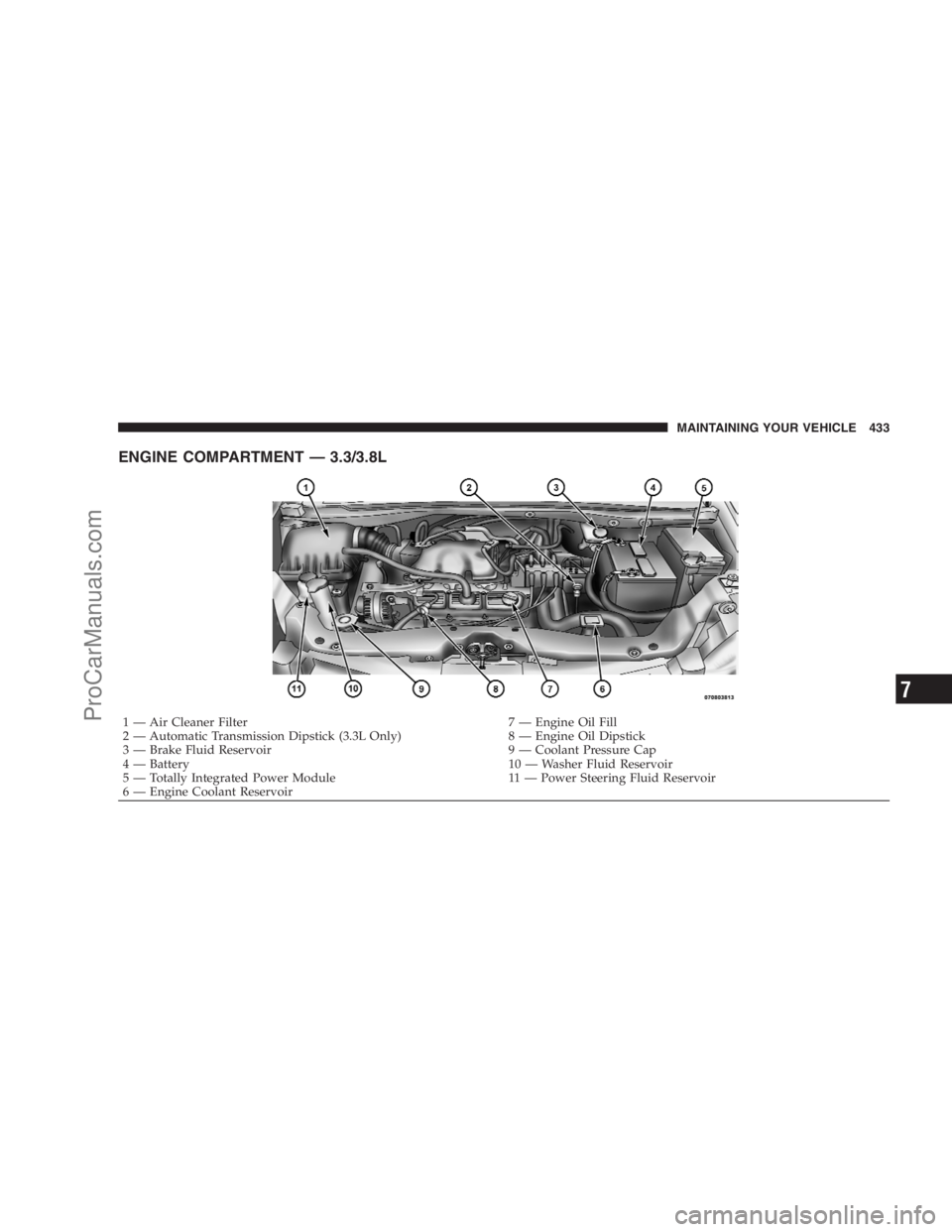
ENGINE COMPARTMENT — 3.3/3.8L
1 — Air Cleaner Filter 7 — Engine Oil Fill
2 — Automatic Transmission Dipstick (3.3L Only) 8 — Engine Oil Dipstick
3 — Brake Fluid Reservoir 9 — Coolant Pressure Cap
4 — Battery 10 — Washer Fluid Reservoir
5 — Totally Integrated Power Module 11 — Power Steering Fluid Reservoir
6 — Engine Coolant ReservoirMAINTAINING YOUR VEHICLE 433
7
ProCarManuals.com
Page 436 of 534
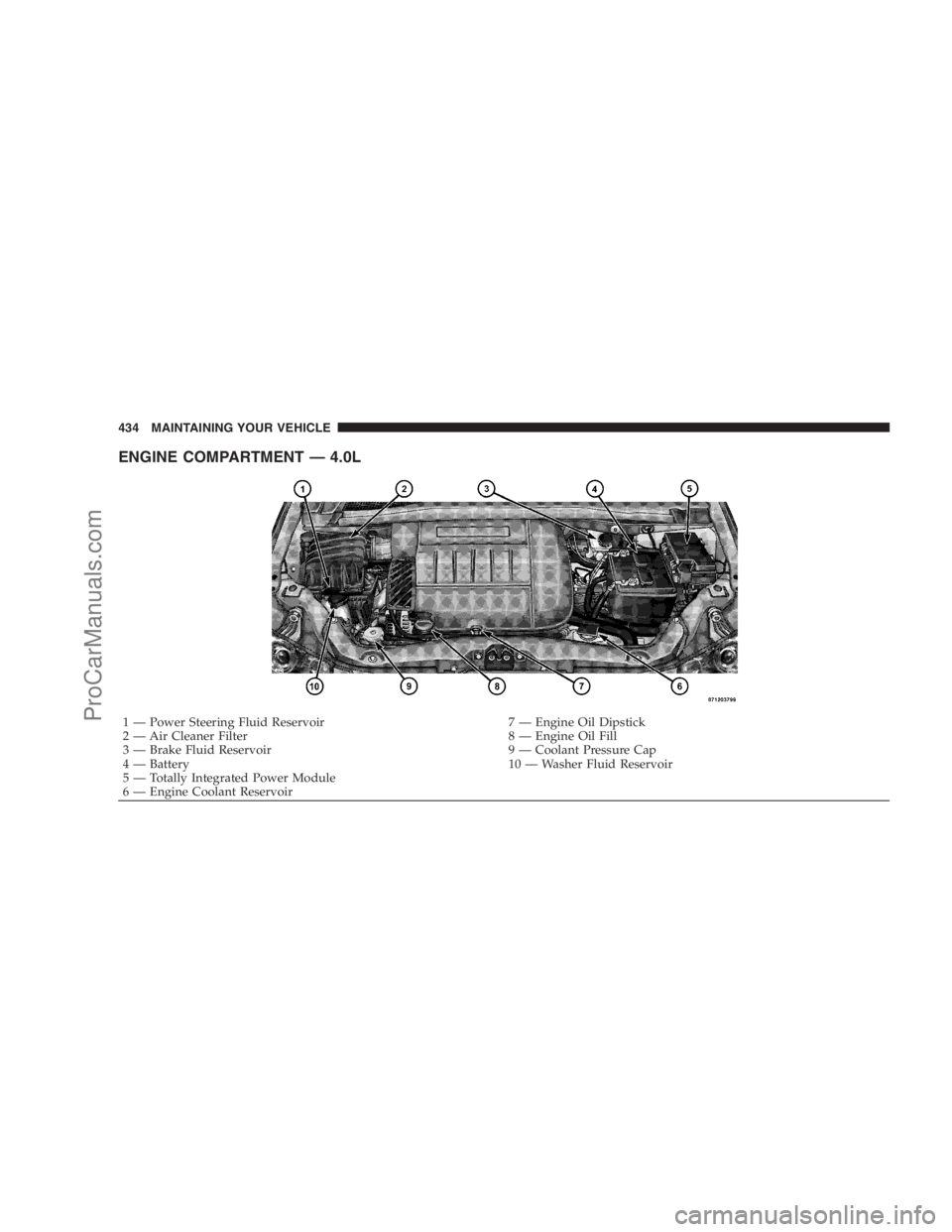
ENGINE COMPARTMENT — 4.0L
1 — Power Steering Fluid Reservoir 7 — Engine Oil Dipstick
2 — Air Cleaner Filter 8 — Engine Oil Fill
3 — Brake Fluid Reservoir 9 — Coolant Pressure Cap
4 — Battery 10 — Washer Fluid Reservoir
5 — Totally Integrated Power Module
6 — Engine Coolant Reservoir 434 MAINTAINING YOUR VEHICLE
ProCarManuals.com
Page 483 of 534
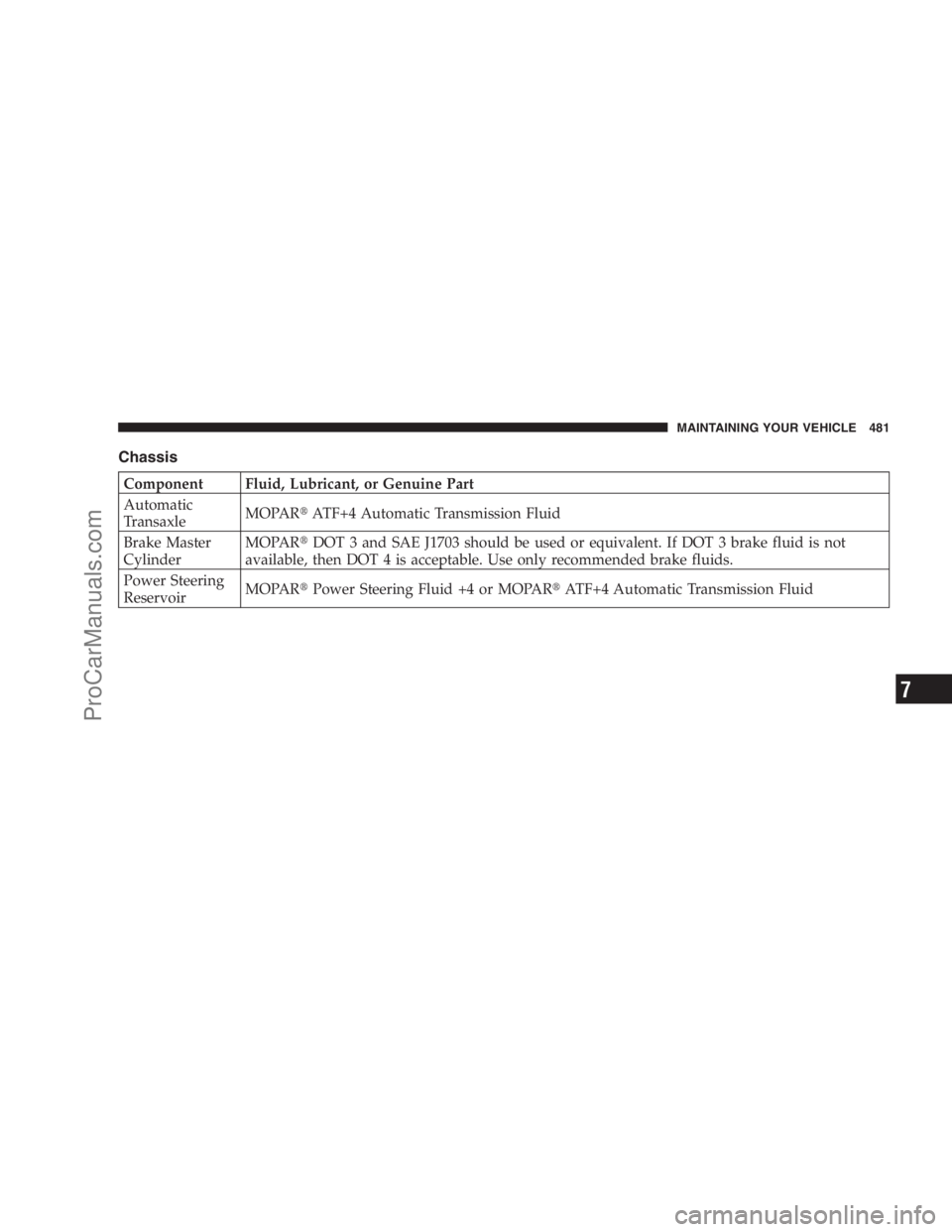
Chassis
Component Fluid, Lubricant, or Genuine Part
Automatic
TransaxleMOPAR�ATF+4 Automatic Transmission Fluid
Brake Master
CylinderMOPAR�DOT 3 and SAE J1703 should be used or equivalent. If DOT 3 brake fluid is not
available, then DOT 4 is acceptable. Use only recommended brake fluids.
Power Steering
ReservoirMOPAR�Power Steering Fluid +4 or MOPAR�ATF+4 Automatic Transmission Fluid
MAINTAINING YOUR VEHICLE 481
7
ProCarManuals.com
Page 488 of 534
•Check the fluid levels of the coolant reservoir, the
brake master cylinder, the power steering and the
transaxle and add as needed.
•Check all lights and other electrical items for correct
operation.
At Each Oil Change
•Change the engine oil filter.
•Inspect the brake hoses and lines.
CAUTION!
Failure to perform the required maintenance items
may result in damage to the vehicle.
Required Maintenance Intervals
Refer to the Maintenance Schedules on the following
pages for the required maintenance intervals.
486 MAINTENANCE SCHEDULES
8
M
A
I
N
T
E
N
A
N
C
E
S
C
H
E
D
U
L
E
S
ProCarManuals.com