2009 DODGE CARAVAN warning light
[x] Cancel search: warning lightPage 379 of 534

will not be present, and a pressure value will be dis-
played instead of dashes. A system fault can occur by any
of the following scenarios:
1. Jamming due to electronic devices or driving next to
facilities emitting the same radio frequencies as the TPMS
sensors.
2. Installing some form of aftermarket window tinting
that affects radio wave signals.
3. Accumulation of excessive snow and/or ice around
the wheels or wheel housings.
4. Using tire chains on the vehicle.
5. Using wheels/tires not equipped with TPMS sensors.
NOTE:
1. The compact spare tire (if equipped) does not have a
TPMS. Therefore, the TPMS will not monitor the pressure
in the compact spare tire.2. If you install the compact spare tire in place of a road
tire that has a pressure below the low-pressure warning
limit, upon the next ignition key cycle, the TPMS Telltale
Warning Light will remain on, a chime will sound, and
the EVIC will still display a flashing pressure value in the
graphic display.
3. After driving the vehicle for up to 10 minutes above
15 mph (25 km/h), the TPMS Telltale Warning Light will
flash on and off for 75 seconds and then remain on solid.
In addition, the EVIC will display a CHECK TPM SYS-
TEM message for three seconds and then display dashes
(- -) in place of the pressure value.
4. For each subsequent ignition key cycle, a chime will
sound, the TPMS Telltale Warning Light will flash on and
off for 75 seconds and then remain on solid, and the EVIC
will display a CHECK TPM SYSTEM message for three
seconds and then display dashes (- -) in place of the
pressure value.
STARTING AND OPERATING 377
5
ProCarManuals.com
Page 380 of 534

5.Once you repair or replace the original road tire, and
reinstall it on the vehicle in place of the compact spare, the
TPMS will update automatically. In addition, the TPMS
Telltale Warning Light will turn off and the graphic in the
EVIC will display a new pressure value instead of dashes
(- -), as long no tire pressure is below the low pressure
warning limit in any of the four active road tires.
NOTE:The vehicle may need to be driven for up to
10 minutes above 15 mph (25 km/h) in order for the
TPMS to receive this information.
General Information
This device complies with Part 15 of the FCC rules and
RSS 210 of Industry Canada. Operation is subject to the
following conditions:
•This device may not cause harmful interference.
•This device must accept any interference received, includ-
ing interference that may cause undesired operation.
The tire pressure sensors are regulated under one of the
following licenses:
United States.....................KR5S120123
Canada........................2671-S120123
FUEL REQUIREMENTS
3.3L/3.8L Gasoline Engine
These engines are designed to meet all
emissions regulations and provide excel-
lent fuel economy and performance when
using high-quality unleaded “regular”
gasoline having an octane rating of 87. The
use of premium gasoline is not recom-
mended. Under normal conditions, the use of premium
gasoline will not provide a benefit over high-quality
regular gasolines, and in some circumstances may result
in poorer performance.
378 STARTING AND OPERATING
ProCarManuals.com
Page 384 of 534
Fuel System Cautions
CAUTION!
Follow these guidelines to maintain your vehicle’s
performance:
•The use of leaded gas is prohibited by Federal law.
Using leaded gasoline can impair engine performance
and damage the emission control system.
•An out-of-tune engine, or certain fuel or ignition
malfunctions, can cause the catalytic converter to
overheat. If you notice a pungent burning odor or
some light smoke, your engine may be out of tune or
malfunctioning and may require immediate service.
Contact your authorized dealer for service assistance.
•The use of fuel additives which are now being sold as
octane enhancers is not recommended. Most of these
products contain high concentrations of methanol.Fuel system damage or vehicle performance problems
resulting from the use of such fuels or additives is not
the responsibility of the manufacturer.
NOTE:Intentional tampering with emissions control
systems can result in civil penalties being assessed
against you.
Carbon Monoxide Warnings
WARNING!
Carbon monoxide (CO) in exhaust gases is deadly.
•To prevent carbon monoxide poisoning DO NOT
inhale exhaust gases. They contain carbon monox-
ide, a colorless and odorless gas which can kill.
(Continued)
382 STARTING AND OPERATING
ProCarManuals.com
Page 390 of 534
WARNING!
•Never have any smoking materials lit in or near
the vehicle when the gas cap is removed or the
tank filled.
•Never add fuel when the engine is running. This is
in violation of most state and federal fire regula-
tions and will cause the malfunction indicator
light to turn on.
NOTE:
•Tighten the fuel filler cap until you hear a “clicking”
sound. This is an indication that the fuel filler cap is
properly tightened.
•If the gas cap is not tightened properly, the Malfunc-
tion Indicator Light may come on. Be sure the gas cap
is tightened every time the vehicle is refueled.
WARNING!
A fire may result if gasoline is pumped into a
portable container that is inside of a vehicle. You
could be burned. Always place gas containers on the
ground while filling.
Loose Fuel Filler Cap Message
If thegASCAPmessage is displayed in the instrument
cluster, this signifies a leak or change in the evaporative
system is detected. Sometimes this is the result of a
loosely fitting (or possibly damaged) filler cap. Tighten
the fuel filler cap properly and press the odometer reset
button to turn thegASCAPmessage off.
Make sure that the fuel filler cap is tightened each time
the vehicle is refueled.
388 STARTING AND OPERATING
ProCarManuals.com
Page 405 of 534

•Trailer brakes are recommended for trailers over
1,000 lbs (454 kg) and required for trailers in excess of
2,000 lbs (907 kg).
CAUTION!
If the trailer weighs more than 1,000 lbs (454 kg)
loaded, it should have its own brakes and they
should be of adequate capacity. Failure to do this
could lead to accelerated brake lining wear, higher
brake pedal effort, and longer stopping distances.
WARNING!
•Do not connect trailer brakes to your vehicle’s
hydraulic brake lines. It can overload your brake
system and cause it to fail. You might not have
brakes when you need them and could have an
accident.
(Continued)
WARNING! (Continued)
•Towing any trailer will increase your stopping
distance. When towing you should allow for addi-
tional space between your vehicle and the vehicle
in front of you. Failure to do so could result in an
accident.
Towing Requirements — Trailer Lights and Wiring
Whenever you pull a trailer, regardless of the trailer size,
stop lights and turn signals on the trailer are required for
motoring safety.
The Trailer Tow Package may include a four-pin or a
seven-pin wiring harness. Use a factory approved trailer
harness and connector.
NOTE:Do not cut or splice wiring into the vehicles
wiring harness.
STARTING AND OPERATING 403
5
ProCarManuals.com
Page 422 of 534
CAUTION!
Do not attempt to raise the vehicle by jacking on
locations other than those indicated in Step 5.
6. Place the wrench on the jack screw and turn to the
right until the jack head is properly engaged in the
described location.Do not raise the vehicle until you are
sure the jack is securely engaged.
7. Raise the vehicle by turning the jack screw to the right,
using the swivel wrench. Raise the vehicle only until the
tire just clears the surface and enough clearance is
obtained to install the spare tire. Minimum tire lift
provides maximum stability.
WARNING!
Raising the vehicle higher than necessary can make
the vehicle less stable. It could slip off the jack and
hurt someone near it. Raise the vehicle only enough
to remove the tire.
8. Remove the wheel lug nuts, for vehicles with wheel
covers, remove the cover from the wheel by hand. Do not
pry the wheel cover off. Then pull the wheel off the hub.
9. Install the compact spare tire. Lightly tighten the lug
nuts. To avoid the risk of forcing the vehicle off the jack,
do not tighten the lug nuts fully until the vehicle has been
lowered.
NOTE:
•Do not install the wheel cover on the compact spare.
•Do not use a hammer or force to install the wheel
covers.
420 WHAT TO DO IN EMERGENCIES
ProCarManuals.com
Page 458 of 534
•Keep the front of the radiator clean. If your vehicle is
equipped with air conditioning, also keep the front of
the condenser clean also.
•Do not change the thermostat for Summer or Winter
operation. If replacement is ever necessary, install
ONLY the correct type thermostat. Other designs may
result in unsatisfactory coolant performance, poor gas
mileage, and increased emissions.
Brakes
In order to assure brake system performance, all brake
system components should be inspected periodically.
Refer to the “Maintenance Schedule” in Section 8 for the
proper maintenance intervals.
WARNING!
Riding the brakes can lead to brake failure and
possibly an accident. Driving with your foot resting
or riding on the brake pedal can result in abnormally
high brake temperatures, excessive lining wear, and
possible brake damage. You wouldn’t have your full
braking capacity in an emergency.
Master Cylinder — Brake Fluid Level Check
The fluid level in the master cylinder should be checked
when performing underhood services, or immediately if
the brake system warning light indicates system failure.
Clean the top of the master cylinder area before removing
the cap. Add fluid to bring the level up to the top of the
“FULL” mark on the side of the master cylinder reservoir.
Overfilling of fluid is not recommended because it may
cause leaking in the system.
456 MAINTAINING YOUR VEHICLE
ProCarManuals.com
Page 514 of 534
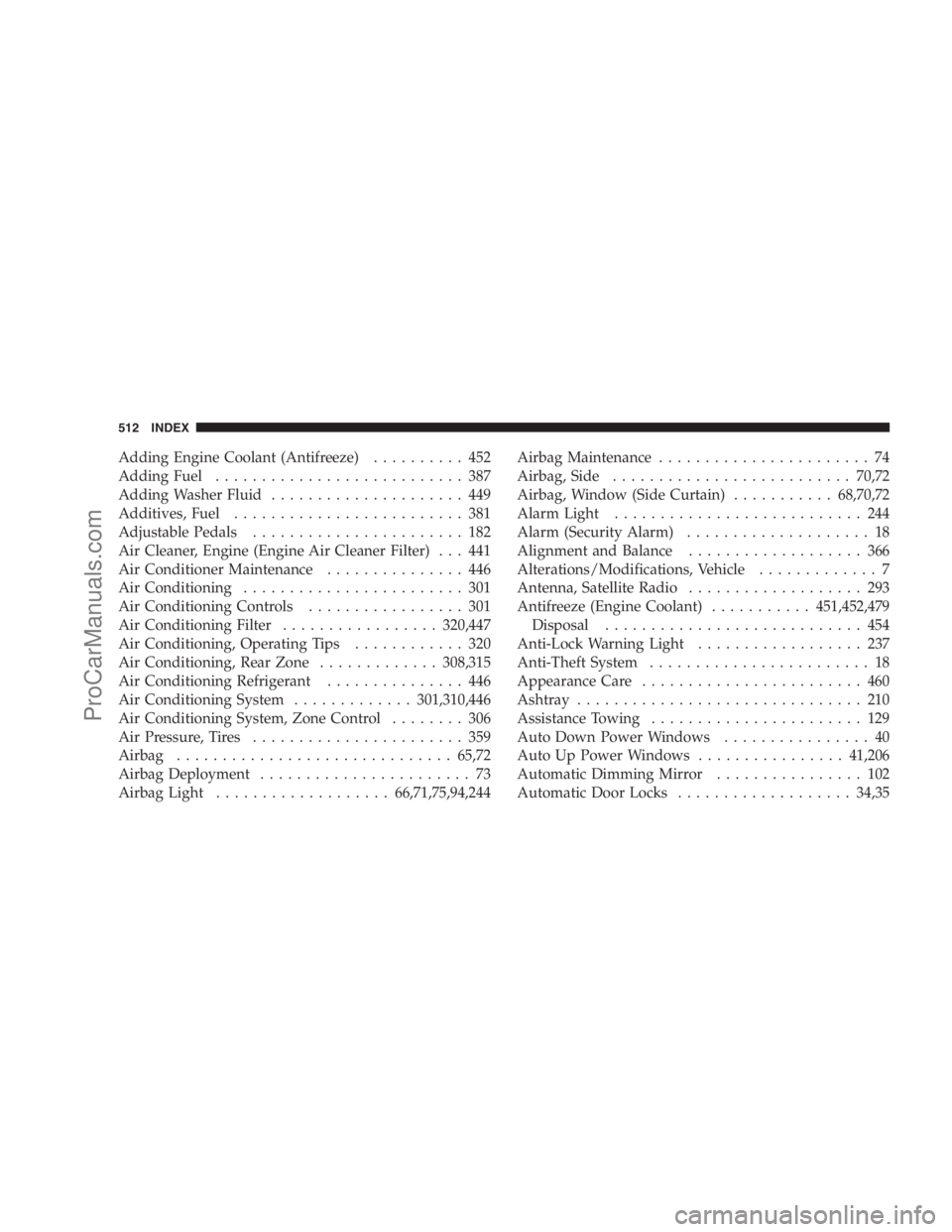
Adding Engine Coolant (Antifreeze).......... 452
Adding Fuel........................... 387
Adding Washer Fluid..................... 449
Additives, Fuel......................... 381
Adjustable Pedals....................... 182
Air Cleaner, Engine (Engine Air Cleaner Filter) . . . 441
Air Conditioner Maintenance............... 446
Air Conditioning........................ 301
Air Conditioning Controls................. 301
Air Conditioning Filter.................320,447
Air Conditioning, Operating Tips............ 320
Air Conditioning, Rear Zone.............308,315
Air Conditioning Refrigerant............... 446
Air Conditioning System.............301,310,446
Air Conditioning System, Zone Control........ 306
Air Pressure, Tires....................... 359
Airbag..............................65,72
Airbag Deployment....................... 73
Airbag Light...................66,71,75,94,244Airbag Maintenance....................... 74
Airbag, Side..........................70,72
Airbag, Window (Side Curtain)...........68,70,72
Alarm Light........................... 244
Alarm (Security Alarm).................... 18
Alignment and Balance................... 366
Alterations/Modifications, Vehicle............. 7
Antenna, Satellite Radio................... 293
Antifreeze (Engine Coolant)...........451,452,479
Disposal............................ 454
Anti-Lock Warning Light.................. 237
Anti-Theft System........................ 18
Appearance Care........................ 460
Ashtray............................... 210
Assistance Towing....................... 129
Auto Down Power Windows................ 40
Auto Up Power Windows................41,206
Automatic Dimming Mirror................ 102
Automatic Door Locks...................34,35
512 INDEX
ProCarManuals.com