Page 383 of 534
To fix a Non-FFV vehicle inadvertently fueled once with
E-85 perform the following:
•drain the fuel tank (see your authorized dealer)
•change the engine oil and oil filter
•disconnect and reconnect the battery to reset the
engine controller memory
More extensive repairs will be required for prolonged
exposure to E-85 fuel.
MMT In Gasoline
MMT is a manganese containing metallic additive that is
blended into some gasoline to increase octane. Gasoline
blended with MMT provides no performance advantage
beyond gasoline of the same octane number without
MMT. Gasoline blended with MMT reduces spark plug
life and reduces emission system performance in some
vehicles. The manufacturer recommends that gasoline
without MMT be used in your vehicle. The MMT contentof gasoline may not be indicated on the gasoline pump,
therefore, you should ask your gasoline retailer whether
the gasoline contains MMT.
It is even more important to look for gasolines without
MMT in Canada, because MMT can be used at levels
higher than those allowed in the United States.
MMT is prohibited in Federal and California reformu-
lated gasolines.
Materials Added to Fuel
All gasoline sold in the United States is required to
contain effective detergent additives. Use of additional
detergents or other additives are not needed under
normal conditions and would result in additional cost.
Therefore you should not have to add anything to the
fuel.
STARTING AND OPERATING 381
5
ProCarManuals.com
Page 407 of 534
Towing Tips
Before setting out on a trip, practice turning, stopping
and backing the trailer in an area away from heavy
traffic.
Towing Tips — Automatic Transaxle
The DRIVE gear can be selected when towing. However,
if frequent shifting occurs while in DRIVE, move the gear
selector lever into third gear (with four-speed transaxle)
or fifth gear (with six-speed transaxle).
NOTE:Moving the gear selector lever into third gear
(with four-speed transaxle) or fifth gear (with six-speed
transaxle) while operating the vehicle under heavy oper-
ating conditions will improve performance and extend
transaxle life by reducing excessive shifting and heat
build up. This action will also provide better engine
braking.
Seven-Pin Connector
1 — Battery 5 — Ground
2 — Backup Lamps 6 — Left Stop/Turn
3 — Right Stop/Turn 7 — Running Lamps
4 — Electric BrakesSTARTING AND OPERATING 405
5
ProCarManuals.com
Page 412 of 534
HAZARD WARNING FLASHER
The Hazard Warning Flasher switch is located in the
center of the instrument panel above the radio.
Press the switch to turn on the Hazard
Warning Flashers. When the Hazard
Warning Flasher switch is activated,
all directional turn signals will flash
on and off to warn oncoming traffic of
an emergency. Press the switch a sec-
ond time to turn off flashers.
This is an emergency warning system and should not be
used when the vehicle is in motion. Use it when your
vehicle is disabled and is creating a safety hazard for
other motorists.
When you must leave the vehicle to seek assistance, the
Hazard Warning Flashers will continue to operate even
though the ignition switch is OFF.NOTE:With extended use, the Hazard Warning Flash-
ers may wear down your battery.
IF YOUR ENGINE OVERHEATS
In any of the following situations, you can reduce the
potential for overheating by taking the appropriate ac-
tion.
•On the highways — Slow down.
•In city traffic — While stopped, shift the transmission
shift lever into NEUTRAL, but do not increase engine
idle speed.
NOTE:There are steps that you can take to slow down
an impending overheat condition. If your air conditioner
is on, turn it off. The air conditioning system adds heat to
the engine cooling system and turning off the A/C
removes this heat. You can also turn the temperature
control to maximum heat, the mode control to floor, and
410 WHAT TO DO IN EMERGENCIES
ProCarManuals.com
Page 426 of 534
CAUTION!
For vehicles equipped with Stow ’n Go seating, the
winch mechanism is designed specifically to stow a
compact spare tire only. Do not attempt to use the
winch to stow the full size flat tire, or any other
full-size tire. Vehicle damage may result.
JUMP-STARTING PROCEDURE
WARNING!
•Do not attempt to push or tow the vehicle to get it
started. Vehicles equipped with an automatic
transmission cannot be started this way. Unburned
fuel could enter the catalytic converter and once
the engine has started, ignite and damage the
converter and vehicle.
(Continued)
WARNING! (Continued)
•If the vehicle has a discharged battery, booster
cables may be used to obtain a start from another
vehicle. This type of start can be dangerous if done
improperly, so follow this procedure carefully.
•Battery fluid is a corrosive acid solution; do not
allow battery fluid to contact eyes, skin or cloth-
ing. Do not lean over a battery when attaching
clamps, or allow the clamps to touch each other. If
acid splashes in eyes or on skin, flush the contami-
nated area immediately with large quantities of
water.
•A battery generates hydrogen gas, which is flam-
mable and explosive. Keep all flames and sparks
away from the vent holes. Do not use a booster
battery or any other booster source with an output
that exceeds 12-Volts.
(Continued)
424 WHAT TO DO IN EMERGENCIES
ProCarManuals.com
Page 427 of 534

WARNING! (Continued)
•Take special care to avoid the radiator cooling fan
whenever the hood is raised. The cooling fan is
electrically operated and can start anytime the
ignition switch is ON. You can be hurt by the fan.
•During cold weather when temperatures are be-
low the freezing point, electrolyte in a discharged
battery may freeze. Do not attempt jump-starting
because the battery could rupture or explode. The
battery temperature must be brought up above the
freezing point before attempting a jump-start.
When jump-starting, proceed as follows:
1. Wear eye protection and remove any metal jewelry,
such as watch bands or bracelets, that might make an
inadvertent electrical contact.2. When a boost is provided by a battery in another
vehicle, park that vehicle within booster cable reach and
do not let the vehicles touch. Set the parking brake, place
the automatic transmission shift lever into PARK and
turn the ignition switch to the OFF position for both
vehicles.
3. Turn OFF the heater, radio and all unnecessary elec-
trical loads.
4. Connect one end of a jumper cable to the positive
terminal of the discharged battery. Connect the other end
of the same cable to the positive terminal of the booster
battery.
WARNING!
Do not permit vehicles to touch each other, as this
could establish a ground connection and personal
injury could result.
WHAT TO DO IN EMERGENCIES 425
6
ProCarManuals.com
Page 428 of 534
5. Connect the other cable, first to the negative terminal
of the booster battery, and then to the engine of the
vehicle with the discharged battery. Make sure there is a
good contact on the engine.
WARNING!
Do not connect the cable to the negative post of the
discharge battery. The resulting electrical spark could
cause the battery to explode.
6. Start the engine in the vehicle that has the booster
battery. Let the engine idle a few minutes, then start the
engine in the vehicle with the discharged battery.7. When removing the jumper cables, reverse the above
sequence exactly. Be careful of the moving belts and fan.
WARNING!
Any procedure other than the jump-starting process
listed could result in:
•Personal injury caused by electrolyte squirting out
the battery vent;
•Personal injury or property damage due to battery
explosion;
•Damage to charging system of booster vehicle or
of immobilized vehicle.
426 WHAT TO DO IN EMERGENCIES
ProCarManuals.com
Page 433 of 534
MAINTAINING YOUR VEHICLE
CONTENTS
�Engine Compartment — 3.3/3.8L.......... 433
�Engine Compartment — 4.0L............. 434
�Onboard Diagnostic System — OBD II....... 435
▫Loose Fuel Filler Cap Message — Gascap . . . 435
�Emissions Inspection And Maintenance
Programs............................ 436
�Replacement Parts..................... 437
�Dealer Service........................ 438
�Maintenance Procedures................. 438▫Engine Oil......................... 438
▫Engine Oil Filter..................... 441
▫Engine Air Cleaner Filter............... 441
▫Exhaust System...................... 442
▫Maintenance-Free Battery............... 444
▫Air Conditioner Maintenance............ 446
▫Steering Shaft Seal.................... 448
▫Drive Shaft Universal Joints............. 448
▫Body Lubrication..................... 448
7
ProCarManuals.com
Page 435 of 534
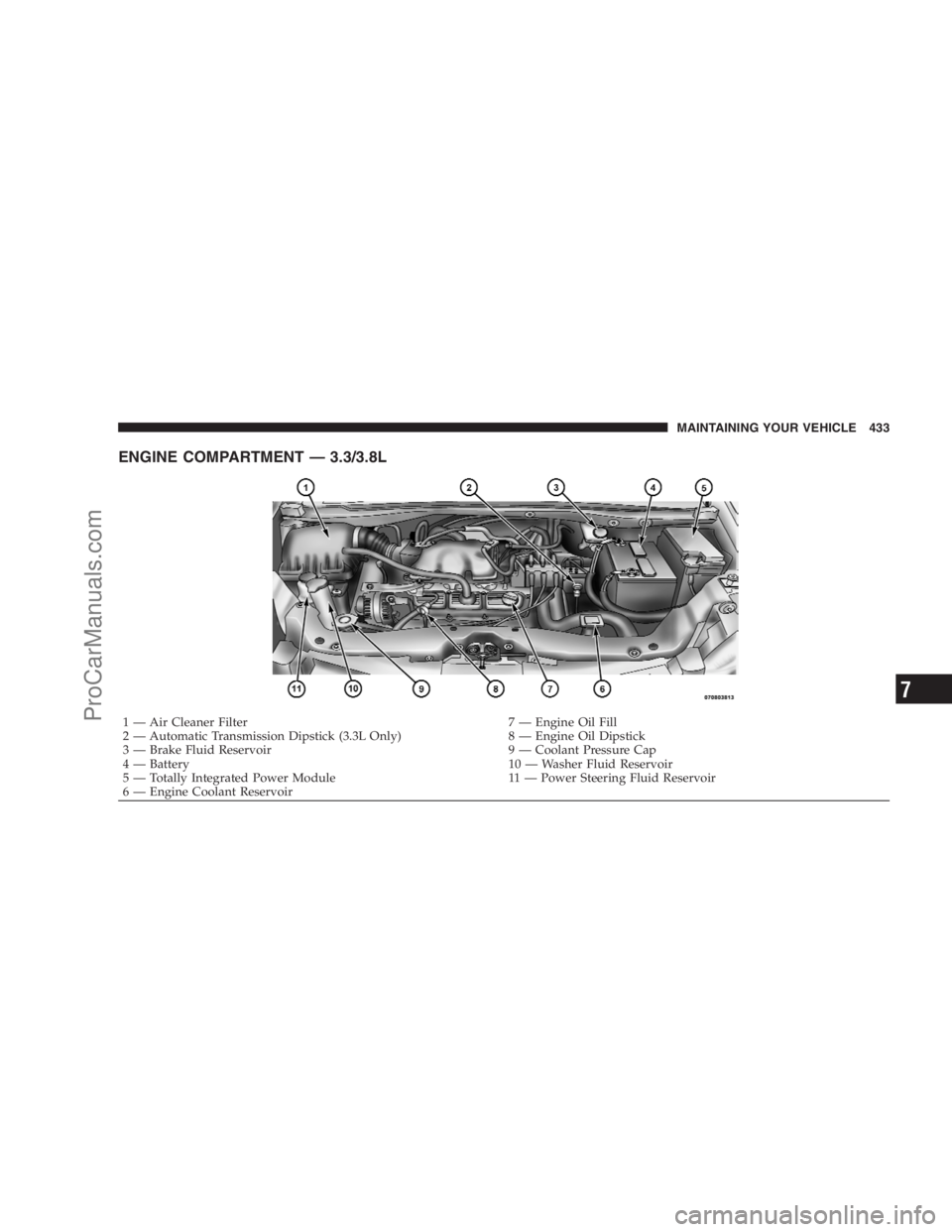
ENGINE COMPARTMENT — 3.3/3.8L
1 — Air Cleaner Filter 7 — Engine Oil Fill
2 — Automatic Transmission Dipstick (3.3L Only) 8 — Engine Oil Dipstick
3 — Brake Fluid Reservoir 9 — Coolant Pressure Cap
4 — Battery 10 — Washer Fluid Reservoir
5 — Totally Integrated Power Module 11 — Power Steering Fluid Reservoir
6 — Engine Coolant ReservoirMAINTAINING YOUR VEHICLE 433
7
ProCarManuals.com