Page 413 of 534
the fan control to high. This allows the heater core to act
as a supplement to the radiator and aids in removing heat
from the engine cooling system.
CAUTION!
Driving with a hot cooling system could damage
your vehicle. If temperature gauge reads “H”, pull
over and stop the vehicle. Idle the vehicle with the air
conditioner turned off until the pointer drops back
into the normal range. If the pointer remains on the
“H”, turn the engine off immediately, and call for
service.
WARNING!
A hot engine cooling system is dangerous. You or
others could be badly burned by steam or boiling
coolant. You may want to call a service center if your
vehicle overheats. If you decide to look under the
hood yourself, see Section 7, Maintenance, of this
manual. Follow the warnings under the Cooling
System Pressure Cap paragraph.
WHAT TO DO IN EMERGENCIES 411
6
ProCarManuals.com
Page 433 of 534
MAINTAINING YOUR VEHICLE
CONTENTS
�Engine Compartment — 3.3/3.8L.......... 433
�Engine Compartment — 4.0L............. 434
�Onboard Diagnostic System — OBD II....... 435
▫Loose Fuel Filler Cap Message — Gascap . . . 435
�Emissions Inspection And Maintenance
Programs............................ 436
�Replacement Parts..................... 437
�Dealer Service........................ 438
�Maintenance Procedures................. 438▫Engine Oil......................... 438
▫Engine Oil Filter..................... 441
▫Engine Air Cleaner Filter............... 441
▫Exhaust System...................... 442
▫Maintenance-Free Battery............... 444
▫Air Conditioner Maintenance............ 446
▫Steering Shaft Seal.................... 448
▫Drive Shaft Universal Joints............. 448
▫Body Lubrication..................... 448
7
ProCarManuals.com
Page 435 of 534
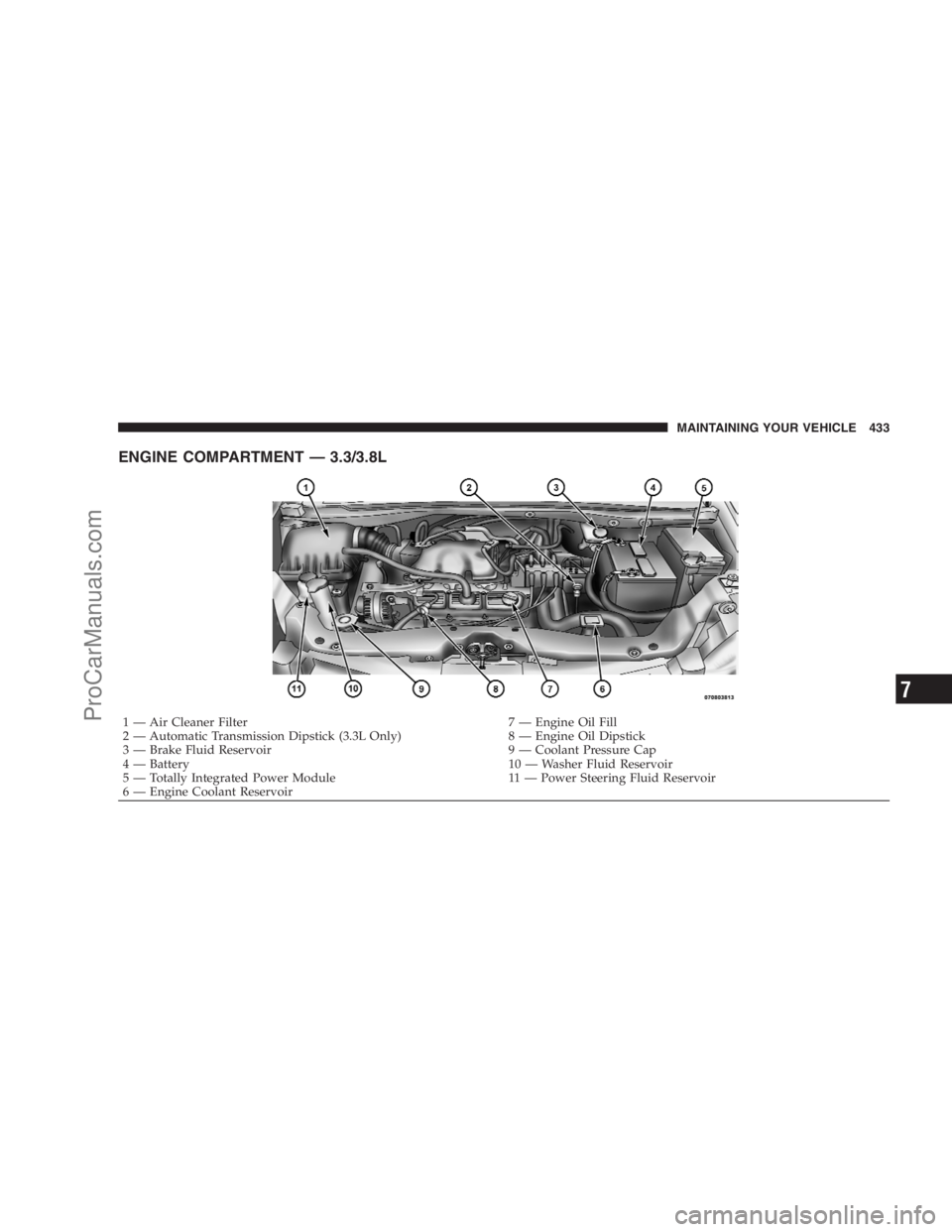
ENGINE COMPARTMENT — 3.3/3.8L
1 — Air Cleaner Filter 7 — Engine Oil Fill
2 — Automatic Transmission Dipstick (3.3L Only) 8 — Engine Oil Dipstick
3 — Brake Fluid Reservoir 9 — Coolant Pressure Cap
4 — Battery 10 — Washer Fluid Reservoir
5 — Totally Integrated Power Module 11 — Power Steering Fluid Reservoir
6 — Engine Coolant ReservoirMAINTAINING YOUR VEHICLE 433
7
ProCarManuals.com
Page 436 of 534
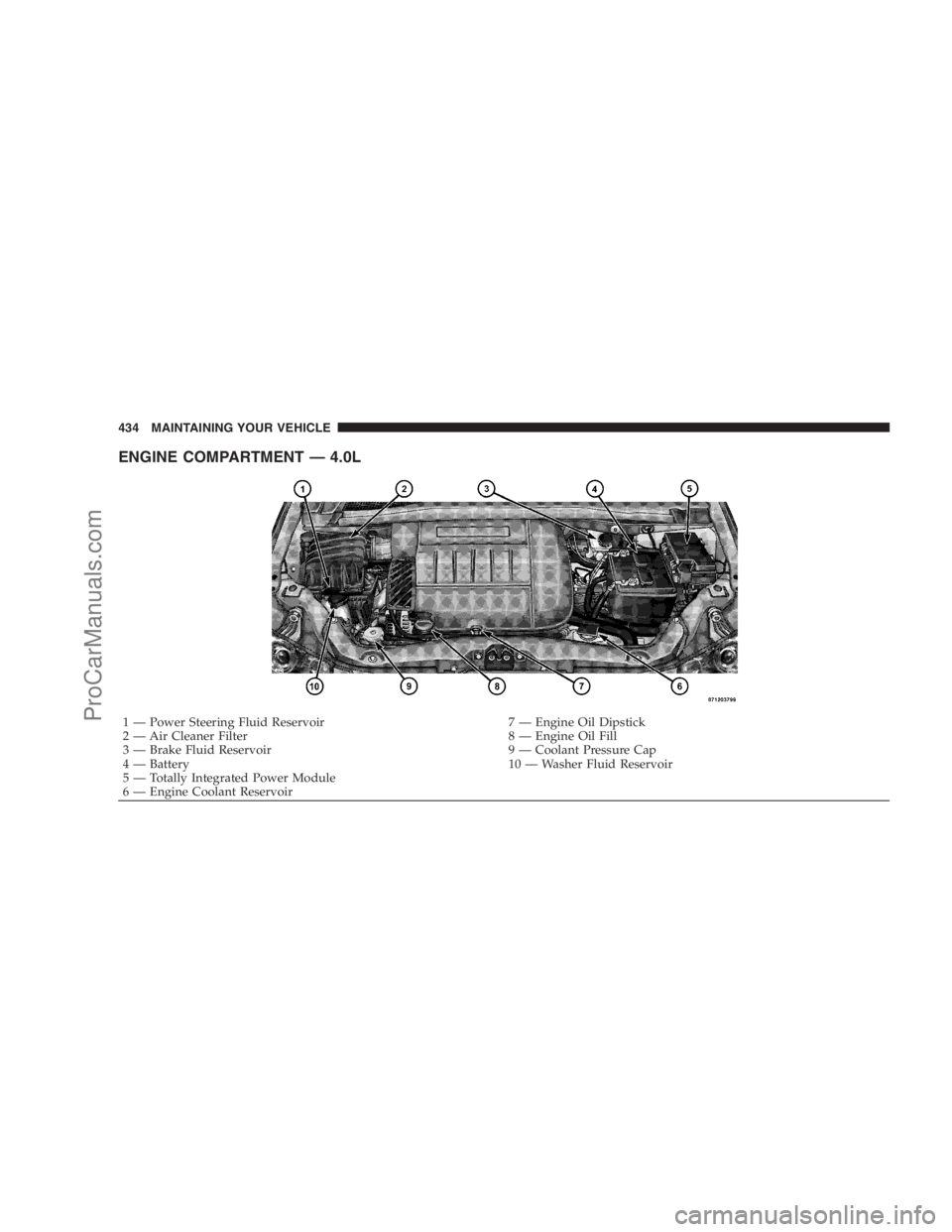
ENGINE COMPARTMENT — 4.0L
1 — Power Steering Fluid Reservoir 7 — Engine Oil Dipstick
2 — Air Cleaner Filter 8 — Engine Oil Fill
3 — Brake Fluid Reservoir 9 — Coolant Pressure Cap
4 — Battery 10 — Washer Fluid Reservoir
5 — Totally Integrated Power Module
6 — Engine Coolant Reservoir 434 MAINTAINING YOUR VEHICLE
ProCarManuals.com
Page 440 of 534
DEALER SERVICE
Your authorized dealer has the qualified service person-
nel, special tools, and equipment to perform all service
operations in an expert manner. Service Manuals are
available which include detailed service information for
your vehicle. Refer to these manuals before attempting
any procedure yourself.
NOTE:Intentional tampering with emissions control
systems can result in civil penalties being assessed
against you.
WARNING!
You can be badly injured working on or around a
motor vehicle. Only do service work for which you
have the knowledge and the proper equipment. If
you have any doubt about your ability to perform a
service job, take your vehicle to a competent me-
chanic.
MAINTENANCE PROCEDURES
The pages that follow contain therequiredmaintenance
services determined by the engineers who designed your
vehicle.
Besides the maintenance items for which there are fixed
maintenance intervals, there are other items that should
operate satisfactorily without periodic maintenance.
However, if a malfunction of these items does occur, it
could adversely affect the engine or vehicle performance.
These items should be inspected if a malfunction is
observed or suspected.
Engine Oil
Checking Oil Level
To assure proper engine lubrication, the engine oil must
be maintained at the correct level. Check the oil level at
regular intervals, such as every fuel stop.
438 MAINTAINING YOUR VEHICLE
ProCarManuals.com
Page 441 of 534

The best time to check the engine oil level is about five
minutes after a fully warmed engine is shut OFF or
before starting the engine after it has sat overnight.
Checking the oil while the vehicle is on level ground will
improve the accuracy of the oil level readings. Maintain
the oil level between the MIN and MAX markings on the
dipstick. Adding one quart of oil when the reading is at
the MIN mark will result in a MAX reading on these
engines.
CAUTION!
Overfilling or underfilling will cause oil aeration, or
loss of oil pressure. This could damage your engine.
Change Engine Oil
The oil change indicator system will remind you that it is
time to take your vehicle in for scheduled maintenance.
Refer to “Maintenance Schedule” in Section 8 of this
manual for information on this system.
NOTE: Under no circumstances should oil change
intervals exceed 6,000 miles (10 000 km) or six months,
whichever occurs first.
Engine Oil Selection
For best performance and maximum protection under all
types of operating conditions, the manufacturer only
recommends engine oils that are API certified and meet
the requirements of Chrysler Material Standard MS-6395.
MAINTAINING YOUR VEHICLE 439
7
ProCarManuals.com
Page 442 of 534
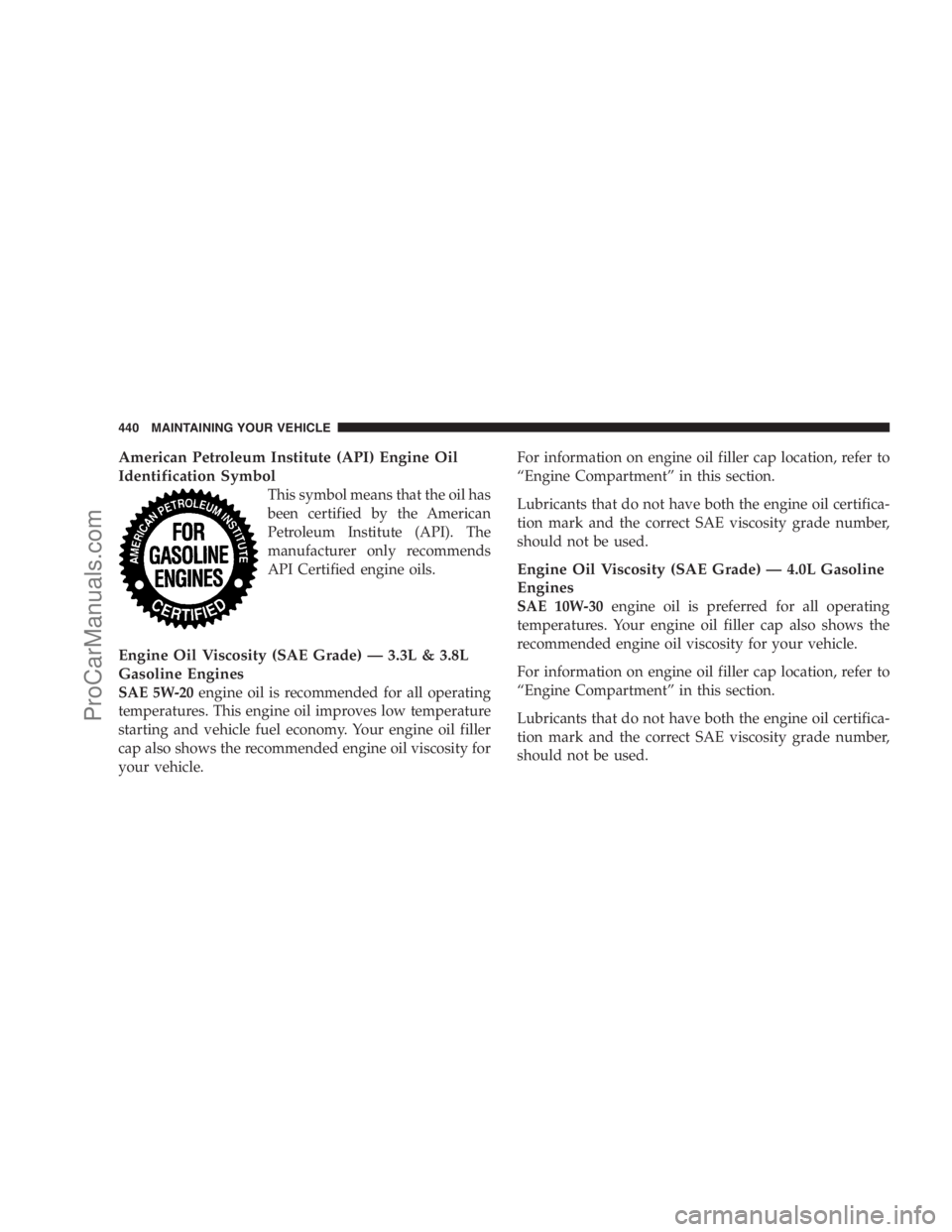
American Petroleum Institute (API) Engine Oil
Identification Symbol
This symbol means that the oil has
been certified by the American
Petroleum Institute (API). The
manufacturer only recommends
API Certified engine oils.
Engine Oil Viscosity (SAE Grade) — 3.3L & 3.8L
Gasoline Engines
SAE 5W-20engine oil is recommended for all operating
temperatures. This engine oil improves low temperature
starting and vehicle fuel economy. Your engine oil filler
cap also shows the recommended engine oil viscosity for
your vehicle.For information on engine oil filler cap location, refer to
“Engine Compartment” in this section.
Lubricants that do not have both the engine oil certifica-
tion mark and the correct SAE viscosity grade number,
should not be used.
Engine Oil Viscosity (SAE Grade) — 4.0L Gasoline
Engines
SAE 10W-30engine oil is preferred for all operating
temperatures. Your engine oil filler cap also shows the
recommended engine oil viscosity for your vehicle.
For information on engine oil filler cap location, refer to
“Engine Compartment” in this section.
Lubricants that do not have both the engine oil certifica-
tion mark and the correct SAE viscosity grade number,
should not be used.
440 MAINTAINING YOUR VEHICLE
ProCarManuals.com
Page 443 of 534
Synthetic Engine Oils
You may use synthetic engine oils provided the recom-
mended oil quality requirements are met, and the recom-
mended maintenance intervals for oil and filter changes
are followed.
Materials Added to Engine Oil
The manufacturer strongly recommends against the ad-
dition of any additives (other than leak detection dyes) to
the engine oil. Engine oil is an engineered product and its
performance may be impaired by supplemental
additives.
Disposing of Used Engine Oil and Oil Filters
Care should be taken in disposing of used engine oil and
oil filters from your vehicle. Used oil and oil filters,
indiscriminately discarded, can present a problem to the
environment. Contact your authorized dealer, servicestation, or governmental agency for advice on how and
where used oil and oil filters can be safely discarded in
your area.
Engine Oil Filter
The engine oil filter should be replaced at every engine
oil change.
Engine Oil Filter Selection
The manufacturer’s engines have a full-flow type oil
filter. Use a filter of this type for replacement. The quality
of replacement filters varies considerably. Only high
quality filters should be used to assure most efficient
service. MOPAR�engine oil filters are a high quality oil
filter and are recommended.
Engine Air Cleaner Filter
Refer to the “Maintenance Schedule” in Section 8 for the
proper maintenance intervals.
MAINTAINING YOUR VEHICLE 441
7
ProCarManuals.com