Page 374 of 475
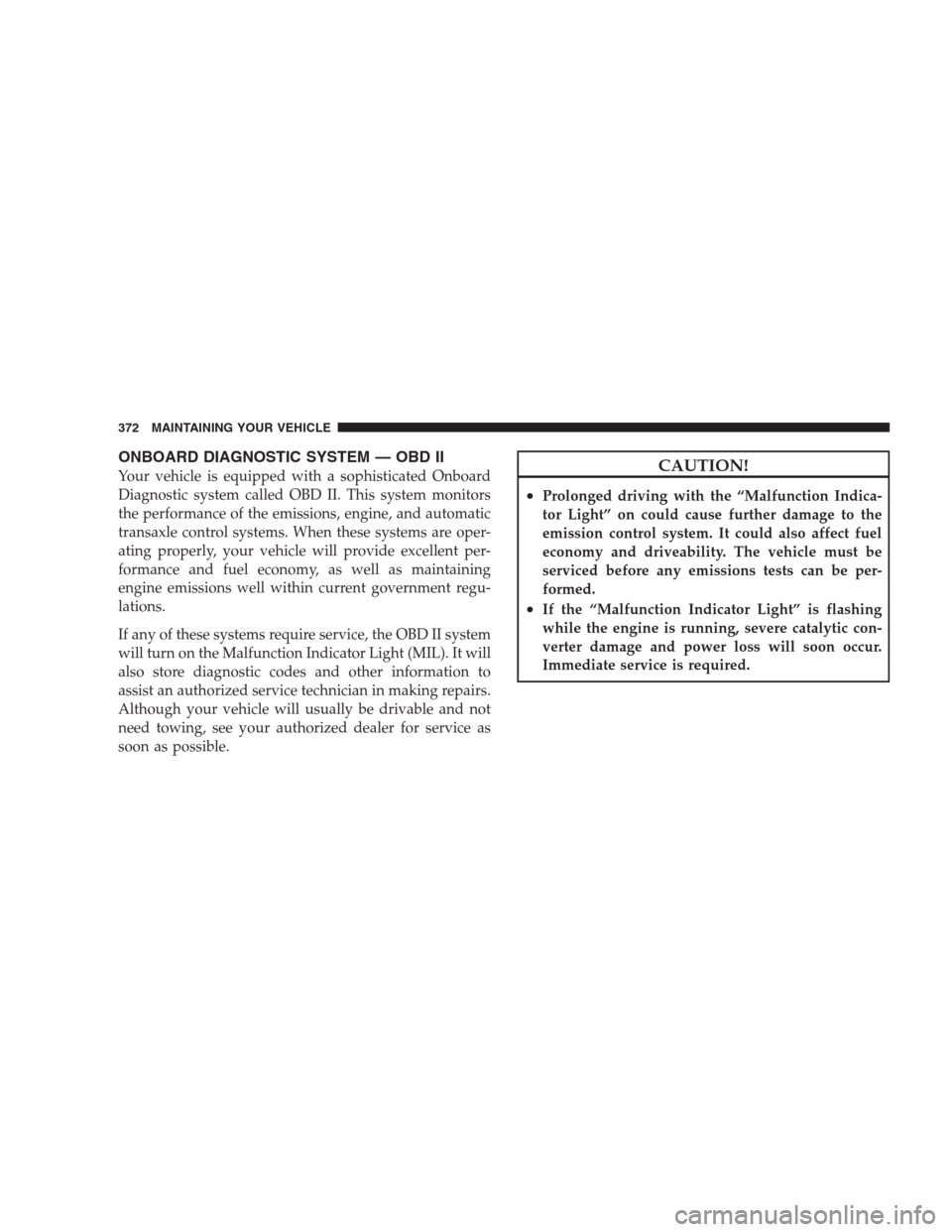
ONBOARD DIAGNOSTIC SYSTEM — OBD II
Your vehicle is equipped with a sophisticated Onboard
Diagnostic system called OBD II. This system monitors
the performance of the emissions, engine, and automatic
transaxle control systems. When these systems are oper-
ating properly, your vehicle will provide excellent per-
formance and fuel economy, as well as maintaining
engine emissions well within current government regu-
lations.
If any of these systems require service, the OBD II system
will turn on the Malfunction Indicator Light (MIL). It will
also store diagnostic codes and other information to
assist an authorized service technician in making repairs.
Although your vehicle will usually be drivable and not
need towing, see your authorized dealer for service as
soon as possible.CAUTION!
•Prolonged driving with the “Malfunction Indica-
tor Light” on could cause further damage to the
emission control system. It could also affect fuel
economy and driveability. The vehicle must be
serviced before any emissions tests can be per-
formed.
•If the “Malfunction Indicator Light” is flashing
while the engine is running, severe catalytic con-
verter damage and power loss will soon occur.
Immediate service is required.
372 MAINTAINING YOUR VEHICLE
Page 375 of 475

Loose Fuel Filler Cap Message
After fuel is added, the vehicle diagnostic system can
determine if the fuel filler cap is possibly loose or
improperly installed. A “GASCAP” message will be
displayed in the instrument cluster. Tighten the gas cap
until a�clicking�sound is heard. This is an indication that
the gas cap is properly tightened. Press the trip odometer
“Reset” button to turn off the message. If the problem
persists, the message will appear the next time the
vehicle is started. This might indicate a damaged cap. If
the problem is detected twice in a row, the system will
turn on the “Malfunction Indicator Light (MIL).” Resolv-
ing the problem will turn the MIL light off.
EMISSIONS INSPECTION AND MAINTENANCE
PROGRAMS
In some localities, it may be a legal requirement to pass
an inspection of your vehicle’s emissions control system.
Failure to pass could prevent vehicle registration.
For states that require an Inspection and Mainte-
nance (I/M), this check verifies the Malfunction
Indicator Light (MIL) is functioning and is not on
when the engine is running, and that the OBD II system
is ready for testing.
Normally, the OBD II system will be ready. The OBD II
system maynotbe ready if your vehicle was recently
serviced, recently had a dead battery or a battery replace-
ment. If the OBD II system should be determined not
ready for the I/M test, your vehicle may fail the test.
MAINTAINING YOUR VEHICLE 373
7
Page 378 of 475
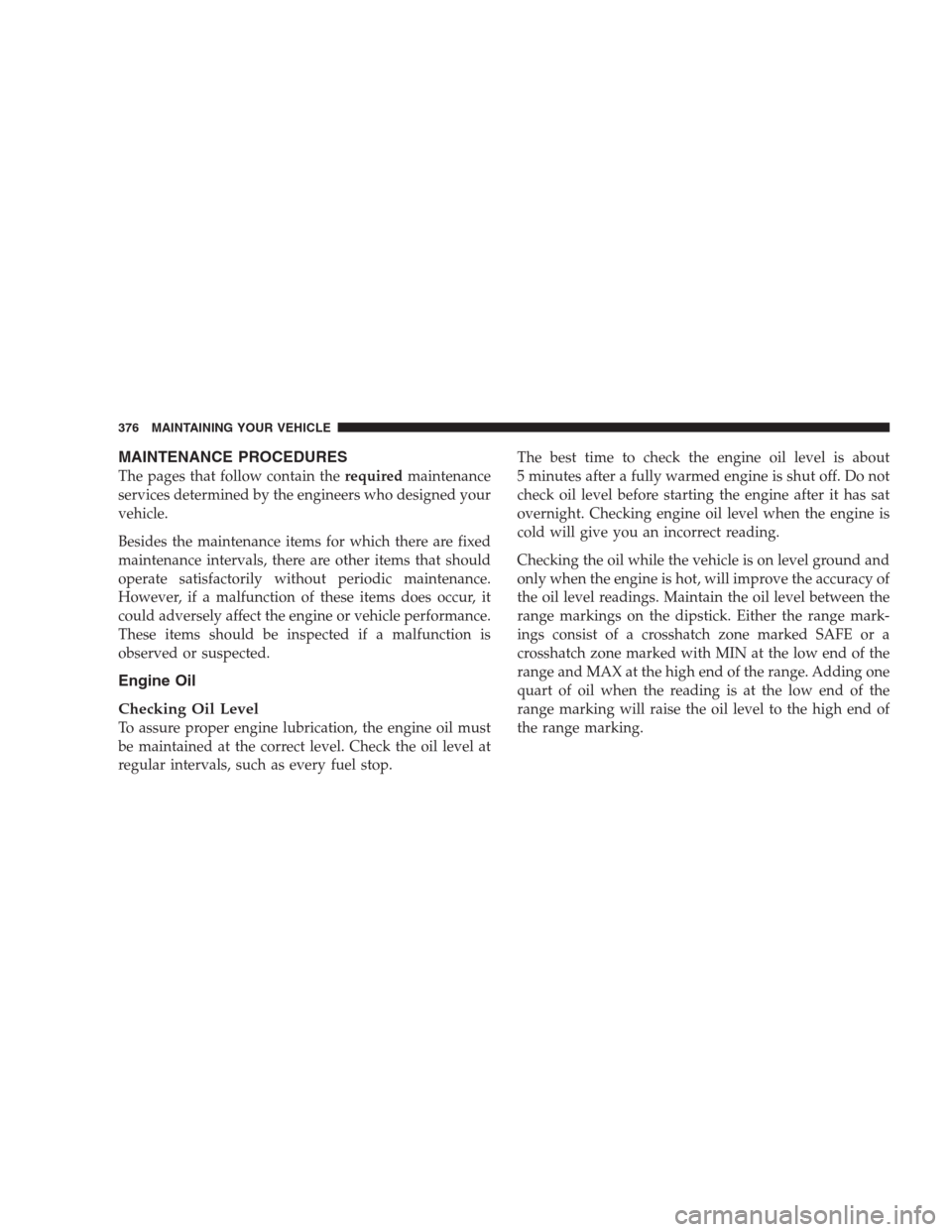
MAINTENANCE PROCEDURES
The pages that follow contain therequiredmaintenance
services determined by the engineers who designed your
vehicle.
Besides the maintenance items for which there are fixed
maintenance intervals, there are other items that should
operate satisfactorily without periodic maintenance.
However, if a malfunction of these items does occur, it
could adversely affect the engine or vehicle performance.
These items should be inspected if a malfunction is
observed or suspected.
Engine Oil
Checking Oil Level
To assure proper engine lubrication, the engine oil must
be maintained at the correct level. Check the oil level at
regular intervals, such as every fuel stop.The best time to check the engine oil level is about
5 minutes after a fully warmed engine is shut off. Do not
check oil level before starting the engine after it has sat
overnight. Checking engine oil level when the engine is
cold will give you an incorrect reading.
Checking the oil while the vehicle is on level ground and
only when the engine is hot, will improve the accuracy of
the oil level readings. Maintain the oil level between the
range markings on the dipstick. Either the range mark-
ings consist of a crosshatch zone marked SAFE or a
crosshatch zone marked with MIN at the low end of the
range and MAX at the high end of the range. Adding one
quart of oil when the reading is at the low end of the
range marking will raise the oil level to the high end of
the range marking.
376 MAINTAINING YOUR VEHICLE
Page 380 of 475
Engine Oil Viscosity (SAE Grade) — 2.4L and 2.7L
Engines
SAE 5W-20 engine oil is recommended for all operating
temperatures. This engine oil improves low temperature
starting and vehicle fuel economy. Your engine oil filler
cap also shows the recommended engine oil viscosity for
your vehicle.
The engine oil filler cap also shows the recommended
engine oil viscosity for your engine. For information on
engine oil filler cap location, refer to “Engine Compart-
ment” in this section.
Lubricants which do not have both the engine oil certi-
fication mark and the correct SAE viscosity grade num-
ber should not be used.
Engine Oil Viscosity (SAE Grade) — 3.5L Engine
SAE 10W-30 engine oil is preferred for all operating
temperatures. The engine oil filler cap also shows the
recommended engine oil viscosity for your vehicle.Lubricants which do not have both the engine oil certi-
fication mark and the correct SAE viscosity grade num-
ber should not be used.
The engine oil filler cap also shows the recommended
engine oil viscosity for your engine. For information on
engine oil filler cap location, refer to “Engine Compart-
ment” in this section.
Lubricants which do not have both the engine oil certi-
fication mark and the correct SAE viscosity grade num-
ber should not be used.
Synthetic Engine Oils
You may use synthetic engine oils provided the recom-
mended oil quality requirements are met, and the recom-
mended maintenance intervals for oil and filter changes
are followed.
378 MAINTAINING YOUR VEHICLE
Page 388 of 475
WARNING!
Commercially available windshield washer solvents
are flammable. They could ignite and burn you. Care
must be exercised when filling or working around
the washer solution.
Exhaust System
The best protection against carbon monoxide entry into
the vehicle body is a properly maintained engine exhaust
system.
If you notice a change in the sound of the exhaust system
or if exhaust fumes can be detected inside the vehicle or
when the underside or rear of the vehicle is damaged,
have a competent technician inspect the complete ex-
haust system and adjacent body areas for broken, dam-
aged, deteriorated, or mispositioned parts. Open seams
or loose connections could permit exhaust fumes to seep
into the passenger compartment. In addition, inspect theexhaust system each time the vehicle is raised for an oil
change or lubrication. Replace as required.
WARNING!
Exhaust gases can injure or kill. They contain carbon
monoxide (CO) which is colorless and odorless.
Breathing it can make you unconscious and can
eventually poison you. To avoid breathing CO, refer
to Exhaust Gas in the Safety Tips section of this
manual.
The catalytic converter requires the use of unleaded fuel
only. Leaded gasoline will destroy the effectiveness of the
catalyst as an emission control device.
386 MAINTAINING YOUR VEHICLE
Page 422 of 475
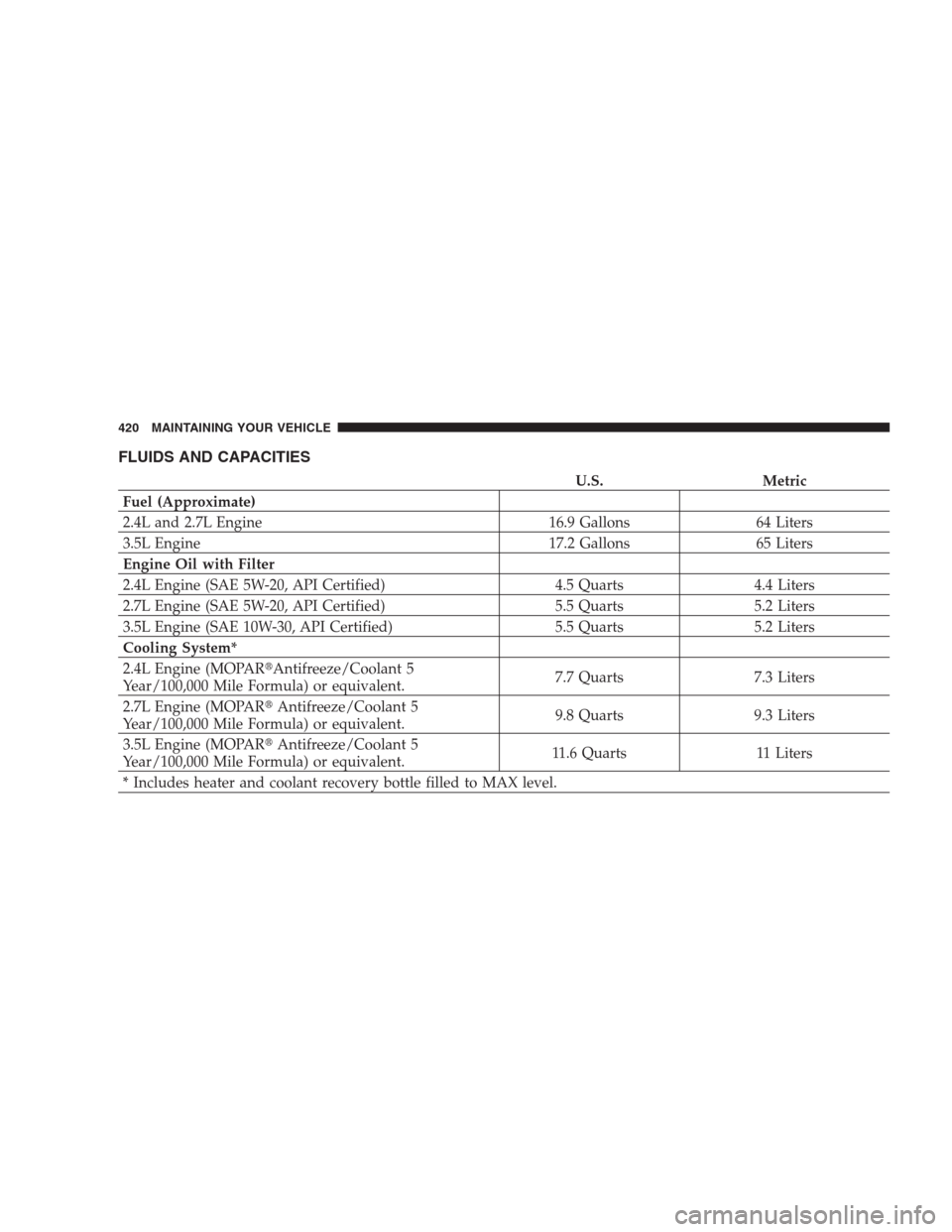
FLUIDS AND CAPACITIES
U.S. Metric
Fuel (Approximate)
2.4L and 2.7L Engine 16.9 Gallons 64 Liters
3.5L Engine 17.2 Gallons 65 Liters
Engine Oil with Filter
2.4L Engine (SAE 5W-20, API Certified) 4.5 Quarts 4.4 Liters
2.7L Engine (SAE 5W-20, API Certified) 5.5 Quarts 5.2 Liters
3.5L Engine (SAE 10W-30, API Certified) 5.5 Quarts 5.2 Liters
Cooling System*
2.4L Engine (MOPAR�Antifreeze/Coolant 5
Year/100,000 Mile Formula) or equivalent.7.7 Quarts 7.3 Liters
2.7L Engine (MOPAR�Antifreeze/Coolant 5
Year/100,000 Mile Formula) or equivalent.9.8 Quarts 9.3 Liters
3.5L Engine (MOPAR�Antifreeze/Coolant 5
Year/100,000 Mile Formula) or equivalent.11.6 Quarts 11 Liters
* Includes heater and coolant recovery bottle filled to MAX level.
420 MAINTAINING YOUR VEHICLE
Page 423 of 475
FLUIDS, LUBRICANTS, AND GENUINE PARTS
Engine
Component Fluid, Lubricant, or Genuine Part
Engine CoolantMOPAR�Antifreeze/Coolant 5 Year/100,000 Mile Formula HOAT (Hybrid
Organic Additive Technology) or equivalent
Engine Oil (2.4L and 2.7L Engine)Use API Certified engine oil. SAE 5W-20 is recommended. Refer to the en-
gine oil fill cap for the correct SAE grade meeting Chrysler Material Stan-
dard MS-6395.
Engine Oil (3.5L Engine)Use API Certified engine oil. SAE 10W-30 is recommended. Refer to the
engine oil viscosity chart for the correct SAE grade meeting Chrysler Mate-
rial Standard MS-6395.
Oil Filter (2.4L Engine ) MOPAR�Oil Filter (P/N 04884900AB) or equivalent
Oil Filter (2.7L and 3.5L Engine) MOPAR�Oil Filter (P/N 04884899AB) or equivalent
Spark Plugs (2.4L Engine) ZFR5F-11 (Gap 0.043 in [1.11 mm])
Spark Plugs (2.7L Engine) TE10PMC5 (Gap 0.050 in [1.27 mm])
Spark Plugs (3.5L Engine) ZFR5LP-13G (Gap 0.050 in [1.27 mm])
Fuel Selection (2.4L and 2.7L Engine) 87 Octane
MAINTAINING YOUR VEHICLE 421
7
Page 424 of 475
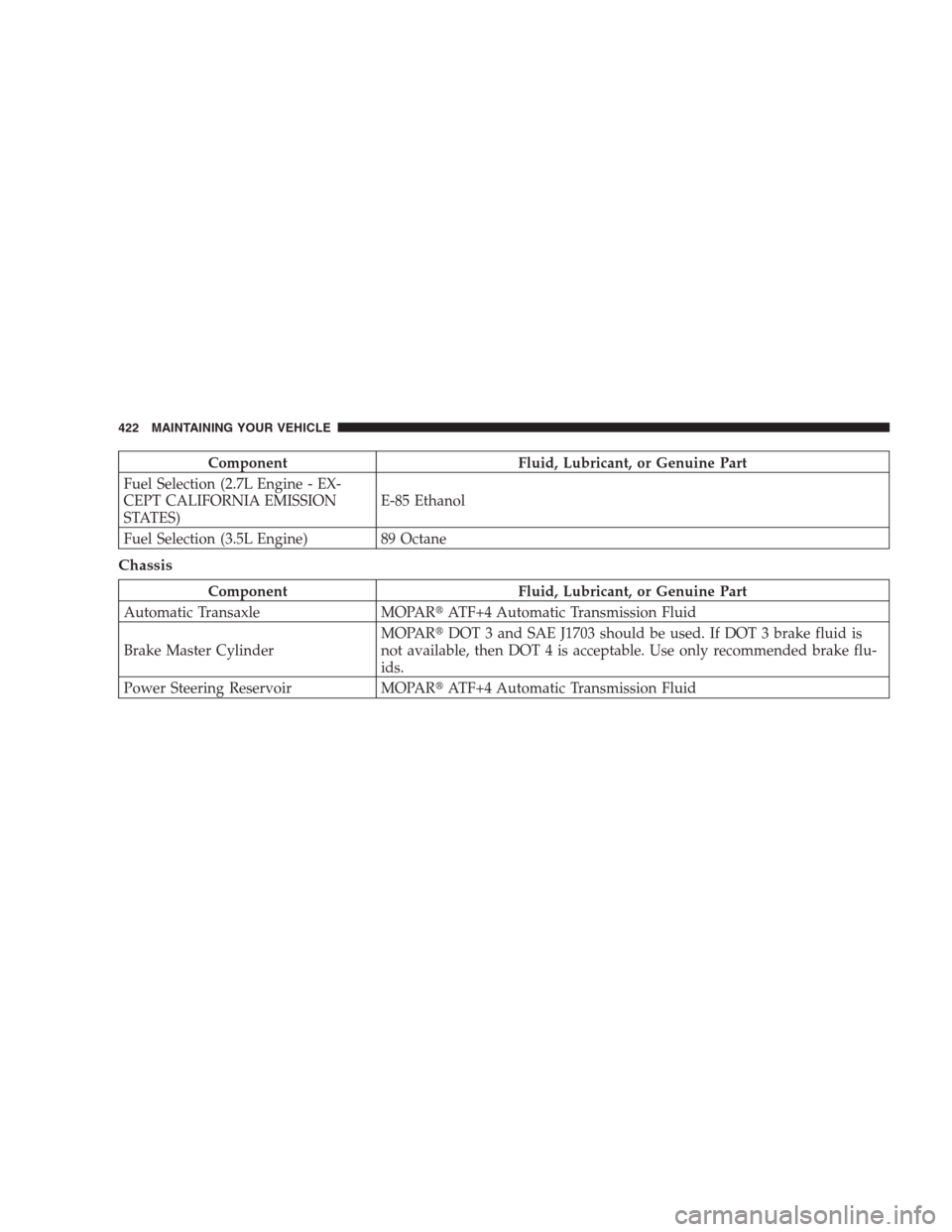
Component Fluid, Lubricant, or Genuine Part
Fuel Selection (2.7L Engine - EX-
CEPT CALIFORNIA EMISSION
STATES)E-85 Ethanol
Fuel Selection (3.5L Engine) 89 Octane
Chassis
Component Fluid, Lubricant, or Genuine Part
Automatic Transaxle MOPAR�ATF+4 Automatic Transmission Fluid
Brake Master CylinderMOPAR�DOT 3 and SAE J1703 should be used. If DOT 3 brake fluid is
not available, then DOT 4 is acceptable. Use only recommended brake flu-
ids.
Power Steering Reservoir MOPAR�ATF+4 Automatic Transmission Fluid
422 MAINTAINING YOUR VEHICLE