Page 350 of 475

Automatic Transaxle
The DRIVE range can be selected when towing. How-
ever, if frequent shifting occurs while in this range, third
gear for a four-speed automatic and the fifth gear for a
six-speed AutoStick�should be selected.
NOTE:Using third or fifth instead of DRIVE while
operating the vehicle under heavy operating conditions,
will improve performance and extend transaxle life by
reducing excessive shifting and heat build-up. This ac-
tion will also provide better engine braking.
If youREGULARLY TOWa trailer for more than 45 min-
utes of continuous operation, then change the automatic
transaxle fluid and filter according to the interval speci-
fied for “police, taxi, fleet, or frequent trailer towing” in
the “Maintenance Schedule” in this manual.NOTE:Check the four-speed automatic transaxle fluid
level before towing. AutoStick�six—speed transmission
is sealed and the fluid level cannot be checked. See your
authorized dealership service center for assistance.
Electronic Speed Control — (If Equipped)
•
Do not use in hilly terrain or with heavy loads.
•When using the speed control, if you experience speed
drops greater than 10 mph (16 km/h), disengage until
you can get back to cruising speed.
•Use speed control in flat terrain and with light loads to
maximize fuel efficiency.
348 STARTING AND OPERATING
Page 355 of 475
the fan control to High. This allows the heater core to act
as a supplement to the radiator and aids in removing heat
from the engine cooling system.
CAUTION!
Driving with a hot cooling system could damage
your vehicle. If the pointer rises to the H (red) mark,
the instrument cluster will sound a chime. Pull over
and stop the vehicle with the engine at idle, when
safe. Turn off the air conditioning and wait until the
pointer drops back into the normal range. If the
pointer remains on the H (red) mark for more than a
minute, turn the engine off immediately and call for
service.
WARNING!
A hot engine cooling system is dangerous. You or
others could be badly burned by steam or boiling
coolant. You may want to call a service center if your
vehicle overheats. If you decide to look under the
hood yourself, refer to Section 7, Maintenance, of this
manual. Follow the warnings under the Cooling
System Pressure Cap paragraph.
Engine Oil Overheating — 2.4L Engine Only (If
Equipped)
During sustained high-speed driving or trailer tow up
long grades on hot day, the engine oil temperature may
become too hot. If this happens, the “HOTOIL” message
flashes, the vehicle speed will be reduced to 53 mph
(85 km/h) until the engine oil temperature is reduced.
WHAT TO DO IN EMERGENCIES 353
6
Page 366 of 475

NOTE:Refer to “Maintenance Procedures” in Section 7
of this manual for information on accessing the battery
for service or replacement.
WARNING!
Any procedure other than above could result in:
•Personal injury caused by electrolyte squirting out
the battery vent;
•Personal injury or property damage due to battery
explosion;
•Damage to charging system of booster vehicle or
of immobilized vehicle.
FREEING A STUCK VEHICLE
If your vehicle becomes stuck in mud, sand, or snow, it
can often be moved by a rocking motion. Turn your
steering wheel right and left to clear the area around the
front wheels. Then shift back and forth between RE-
VERSE and FIRST gear. Usually the least accelerator
pedal pressure to maintain the rocking motion without
spinning the wheels is most effective.
NOTE:
If your vehicle is equipped with Traction Con-
trol, turn the system to Partial OFF before
attempting to “rock” the vehicle. Refer to “Par-
tial Off Mode” under “Electronic Stability Pro-
gram (ESP)” in Section 5 of this manual.
364 WHAT TO DO IN EMERGENCIES
Page 369 of 475
MAINTAINING YOUR VEHICLE
CONTENTS
�Engine Compartment — 2.4L............. 369
�Engine Compartment — 2.7L............. 370
�Engine Compartment — 3.5L............. 371
�Onboard Diagnostic System — OBD II...... 372
▫Loose Fuel Filler Cap Message........... 373
�Emissions Inspection And Maintenance
Programs............................ 373
�Replacement Parts..................... 375
�Dealer Service........................ 375�Maintenance Procedures................. 376
▫Engine Oil......................... 376
▫Engine Oil Filter..................... 379
▫Engine Air Cleaner Filter............... 380
▫Maintenance-Free Battery.............. 380
▫Air Conditioner Maintenance............ 382
▫A/C Air Filter — If Equipped........... 383
▫Body Lubrication.................... 384
▫Adding Washer Fluid................. 385
7
Page 375 of 475

Loose Fuel Filler Cap Message
After fuel is added, the vehicle diagnostic system can
determine if the fuel filler cap is possibly loose or
improperly installed. A “GASCAP” message will be
displayed in the instrument cluster. Tighten the gas cap
until a�clicking�sound is heard. This is an indication that
the gas cap is properly tightened. Press the trip odometer
“Reset” button to turn off the message. If the problem
persists, the message will appear the next time the
vehicle is started. This might indicate a damaged cap. If
the problem is detected twice in a row, the system will
turn on the “Malfunction Indicator Light (MIL).” Resolv-
ing the problem will turn the MIL light off.
EMISSIONS INSPECTION AND MAINTENANCE
PROGRAMS
In some localities, it may be a legal requirement to pass
an inspection of your vehicle’s emissions control system.
Failure to pass could prevent vehicle registration.
For states that require an Inspection and Mainte-
nance (I/M), this check verifies the Malfunction
Indicator Light (MIL) is functioning and is not on
when the engine is running, and that the OBD II system
is ready for testing.
Normally, the OBD II system will be ready. The OBD II
system maynotbe ready if your vehicle was recently
serviced, recently had a dead battery or a battery replace-
ment. If the OBD II system should be determined not
ready for the I/M test, your vehicle may fail the test.
MAINTAINING YOUR VEHICLE 373
7
Page 377 of 475
Regardless of whether your vehicle’s OBD II system is
ready or not, if the MIL is illuminated during normal
vehicle operation you should have your vehicle serviced
before going to the I/M station. The I/M station can fail
your vehicle because the MIL is on with the engine
running.
REPLACEMENT PARTS
Use of genuine MOPAR�parts for normal/scheduled
maintenance and repairs is highly recommended to en-
sure the designed performance. Damage or failures
caused by the use of non-MOPAR�parts for maintenance
and repairs will not be covered by the manufacturer’s
warranty.
DEALER SERVICE
Your authorized dealer has the qualified service person-
nel, special tools, and equipment to perform all service
operations in an expert manner. Service Manuals are
available which include detailed service information for
your vehicle. Refer to these manuals before attempting
any procedure yourself.
NOTE:Intentional tampering with emissions control
systems can result in civil penalties being assessed
against you.
WARNING!
You can be badly injured working on or around a
motor vehicle. Only do service work for which you
have the knowledge and the proper equipment. If
you have any doubt about your ability to perform a
service job, take your vehicle to a competent me-
chanic.
MAINTAINING YOUR VEHICLE 375
7
Page 378 of 475
MAINTENANCE PROCEDURES
The pages that follow contain therequiredmaintenance
services determined by the engineers who designed your
vehicle.
Besides the maintenance items for which there are fixed
maintenance intervals, there are other items that should
operate satisfactorily without periodic maintenance.
However, if a malfunction of these items does occur, it
could adversely affect the engine or vehicle performance.
These items should be inspected if a malfunction is
observed or suspected.
Engine Oil
Checking Oil Level
To assure proper engine lubrication, the engine oil must
be maintained at the correct level. Check the oil level at
regular intervals, such as every fuel stop.The best time to check the engine oil level is about
5 minutes after a fully warmed engine is shut off. Do not
check oil level before starting the engine after it has sat
overnight. Checking engine oil level when the engine is
cold will give you an incorrect reading.
Checking the oil while the vehicle is on level ground and
only when the engine is hot, will improve the accuracy of
the oil level readings. Maintain the oil level between the
range markings on the dipstick. Either the range mark-
ings consist of a crosshatch zone marked SAFE or a
crosshatch zone marked with MIN at the low end of the
range and MAX at the high end of the range. Adding one
quart of oil when the reading is at the low end of the
range marking will raise the oil level to the high end of
the range marking.
376 MAINTAINING YOUR VEHICLE
Page 379 of 475
CAUTION!
Do not overfill the engine. Overfilling the engine
will cause oil aeration, which can lead to loss of oil
pressure and an increase in oil temperature. This
could damage your engine.
Change Engine Oil
The oil change indicator system will remind you that it is
time to take your vehicle in for scheduled maintenance.
Refer to “Maintenance Schedule” in Section 8 of this
manual for information on this system.
NOTE: Under no circumstances should oil change
intervals exceed 6,000 miles (10 000 km) or 6 months,
whichever occurs first.
Engine Oil Selection
For best performance and maximum protection under all
types of operating conditions, the manufacturer recom-
mends engine oils that are API Certified and meet the
requirements of Chrysler Material Standard MS-6395.
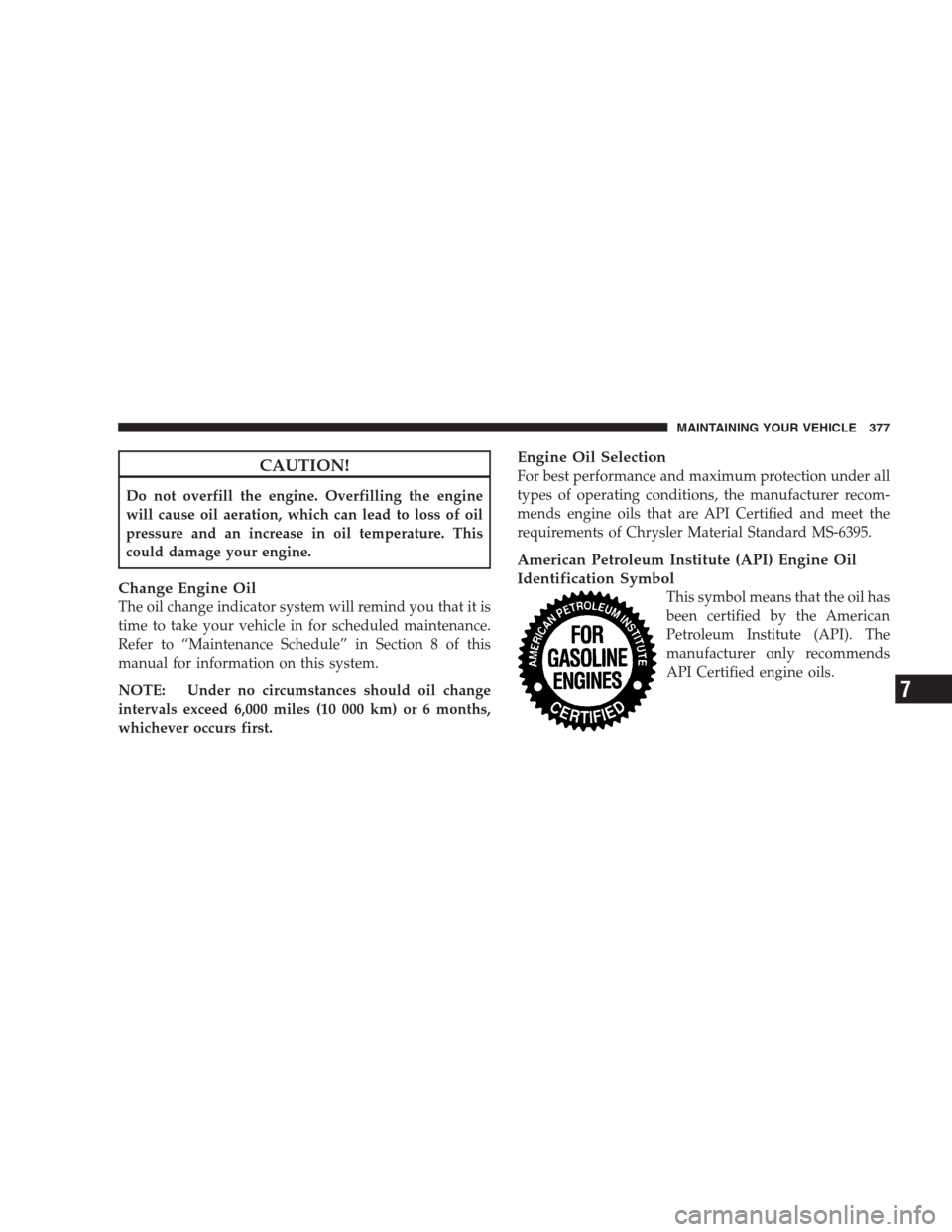
American Petroleum Institute (API) Engine Oil
Identification Symbol
This symbol means that the oil has
been certified by the American
Petroleum Institute (API). The
manufacturer only recommends
API Certified engine oils.
MAINTAINING YOUR VEHICLE 377
7