Page 261 of 475
•Air Conditioner Control
Press this button to turn on the air conditioning
during manual operation only. When the air con-
ditioning is turned on, cool dehumidified air will
flow through the outlets selected with the Mode control
dial. Press this button a second time to turn OFF the air
conditioning. An LED in the button illuminates when
manual compressor operation is selected.
•Recirculation Control
The system will automatically control recircu-
lation. However, pressing the Recirculation
Control button will temporarily put the system
in recirculation mode (ten minutes). This can
be used when outside conditions such as smoke, odors,
dust, or high humidity are present. Activating recircula-
tion will cause the LED in the control button to illumi-
nate. After ten minutes, the system will return to normal
AUTO mode function and the LED will turn off.NOTE:
•When the ignition switch is turned to the LOCK
position, the recirculation feature will be cancelled.
•In cold weather, use of the Recirculation mode may lead
to excessive window fogging. The Recirculation mode is
not allowed in the floor, defrost, or defrost/floor mode in
order to improve window clearing. Recirculation will be
disabled automatically if these modes are selected.
•Extended use of recirculation may cause the windows
to fog. If the interior of the windows begins to fog,
press the Recirculation button to return to outside air.
Some temp/humidity conditions will cause captured
interior air to condense on windows and hamper
visibility. For this reason, the system will not allow
Recirculation to be selected while in floor, defrost, or
defrost/floor mode. Attempting to use the recircula-
tion while in these modes will cause the LED in the
control button to blink and then turn off.
UNDERSTANDING YOUR INSTRUMENT PANEL 259
4
Page 265 of 475
STARTING AND OPERATING
CONTENTS
�Starting Procedures.................... 267
▫Normal Starting..................... 267
▫Tip Start Feature..................... 268
▫Extremely Cold Weather (Below�20°F Or
�29°C)............................ 268
▫If Engine Fails To Start................ 268
▫After Starting....................... 269
�Engine Block Heater — If Equipped........ 270
�Automatic Transaxle................... 270▫Brake/Transaxle Interlock System......... 272
▫Automatic Transaxle Ignition Interlock
System............................ 273
▫4 Speed/6 Speed Automatic Transaxle..... 273
�AutoStick�— If Equipped............... 277
▫Operation......................... 277
▫General Information.................. 278
�Driving On Slippery Surfaces............. 279
▫Acceleration........................ 279
5
Page 269 of 475

STARTING PROCEDURES
Before starting your vehicle, adjust your seat, adjust both
inside and outside mirrors, and fasten your seat belt.
Make sure all occupants have securely fastened their seat
belts.
WARNING!
•Never leave children alone in a vehicle. Leaving
children in a vehicle unattended is dangerous for a
number of reasons. A child or others could be
seriously or fatally injured. Do not leave the key in
the ignition. A child could operate power win-
dows, other controls, or move the vehicle.
•Do not leave animals or children inside parked
vehicles in hot weather; interior heat buildup may
cause serious injury or death.
(Continued)
WARNING! (Continued)
•Be sure to turn off the engine and remove the key
from the ignition switch if you want to rest or
sleep in your car. Accidents can be caused by
inadvertently moving the gear selection lever or
by pressing the accelerator pedal. This may cause
excessive heat in the exhaust system, resulting in
overheating and vehicle fire which may cause
serious or fatal injuries.
Normal Starting
The shift lever must be in the PARK or NEUTRAL
position before you can start the engine. Apply the brakes
before shifting to any driving gear.
NOTE:Normal starting of either a cold or a warm
engine does not require pumping or depressing the
accelerator pedal.
STARTING AND OPERATING 267
5
Page 270 of 475
Tip Start Feature
Do notpress the accelerator. Turn the ignition key briefly
to START position, and release it. The starter motor will
continue to run, and it will disengage automatically
when the engine is running. If the engine fails to start, the
starter will disengage automatically in 10 seconds. If this
occurs, turn the ignition switch to the LOCK position,
wait 10 to 15 seconds, then repeat the normal starting
procedure.
Extremely Cold Weather (Below�20°F or�29°C)
To ensure reliable starting at these temperatures, use of
an externally powered electric engine block heater (avail-
able from your authorized dealer) is recommended.
If Engine Fails to Start
WARNING!
•Never pour fuel or other flammable liquid into the
throttle body air inlet opening in an attempt to
start the vehicle. This could result in flash fire
causing serious personal injury.
(Continued)
268 STARTING AND OPERATING
Page 271 of 475

WARNING! (Continued)
•Do not attempt to push or tow your vehicle to get
it started. Vehicles equipped with an automatic
transmission cannot be started this way. Unburned
fuel could enter the catalytic converter and once
the engine has started, ignite and damage the
converter and vehicle. If the vehicle has a dis-
charged battery, booster cables may be used to
obtain a start from a booster battery or the battery
in another vehicle. This type of start can be dan-
gerous if done improperly. Refer to Section 6 for
proper jump-starting procedures and follow them
carefully.
If the engine fails to start after you have followed the
“Normal Starting” or “Extreme Cold Weather” proce-
dures, it may be flooded. To clear any excess fuel, push
the accelerator pedal all the way to the floor and hold it.
Then, turn the ignition switch to the START position andrelease it as soon as the starter engages. The starter motor
will disengage automatically in 10 seconds. Once this
occurs, release the accelerator pedal, turn the ignition
switch to the LOCK position, wait 10 to 15 seconds, then
repeat the normal starting procedure.
CAUTION!
To prevent damage to the starter, do not crank the
engine for more than 15 seconds at a time. Wait 10 to
15 seconds before trying again.
After Starting
The idle speed will automatically decrease as the engine
warms up.
STARTING AND OPERATING 269
5
Page 273 of 475
WARNING!
•It is dangerous to move the shift lever out of or if
the engine speed is higher than idle speed. If your
foot is not firmly on the brake pedal, the vehicle
could accelerate quickly forward or in reverse. You
could lose control of the vehicle and hit someone
or something. Only shift into gear when the en-
gine is idling normally and when your right foot is
firmly on the brake pedal.
(Continued)
WARNING! (Continued)
•Unintended movement of a vehicle could injure
those in and near the vehicle. As with all vehicles,
you should never exit a vehicle while the engine is
running. Before exiting a vehicle, you should
always shift the vehicle into PARK, remove the
key from the ignition, and apply the parking
brake. Once the key is removed from the ignition,
the shift lever is locked in the PARK position,
securing the vehicle against unwanted movement.
Furthermore, you should never leave children un-
attended inside a vehicle.
STARTING AND OPERATING 271
5
Page 274 of 475
Brake/Transaxle Interlock System
This system prevents you from moving the shift lever out
of PARK and into any gear unless the brake pedal is
pressed. This system is active only while the ignition
switch is in the ON position.Always press the brake
pedal first, before moving the shift lever out of PARK.
NOTE:If a malfunction occurs, the transaxle will not
shift out of PARK. Battery power is required to release the
Brake/Transaxle Interlock system. However, an override
system allows you to shift out of PARK in case of loss of
power. To activate the override system:
•Firmly apply the parking brake.
•Insert the ignition key into the ignition key lock
cylinder and rotate it to the ON position.
•Remove the cup holder liner.
•Insert a key, screwdriver, or finger into the hole at the
front of the cup holder and push and hold the manual
override release lever forward.
•While holding the release lever forward, move the
shift lever from PARK to NEUTRAL.
•Release the manual override.
NOTE:If this occurs, even if the override is successful,
it is recommended that you visit a dealer at your earliest
possible convenience. Your dealer has diagnostic equip-
ment to determine if the problem could recur.
272 STARTING AND OPERATING
Page 275 of 475
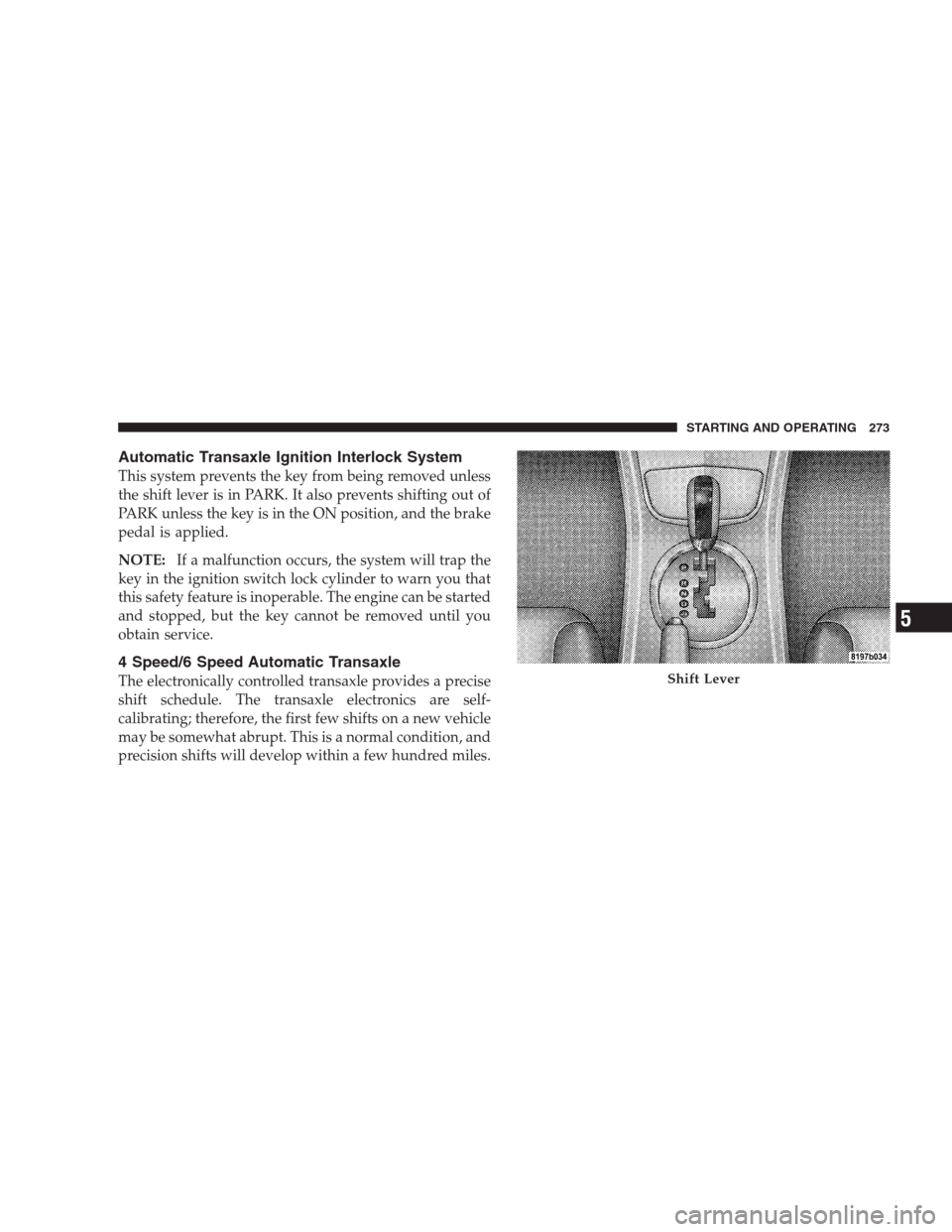
Automatic Transaxle Ignition Interlock System
This system prevents the key from being removed unless
the shift lever is in PARK. It also prevents shifting out of
PARK unless the key is in the ON position, and the brake
pedal is applied.
NOTE:If a malfunction occurs, the system will trap the
key in the ignition switch lock cylinder to warn you that
this safety feature is inoperable. The engine can be started
and stopped, but the key cannot be removed until you
obtain service.
4 Speed/6 Speed Automatic Transaxle
The electronically controlled transaxle provides a precise
shift schedule. The transaxle electronics are self-
calibrating; therefore, the first few shifts on a new vehicle
may be somewhat abrupt. This is a normal condition, and
precision shifts will develop within a few hundred miles.Shift Lever
STARTING AND OPERATING 273
5