Page 290 of 410
TOWING TIPS
Before setting out on a trip, practice turning, stopping
and backing the trailer in an area away from heavy
traffic.
Automatic Transaxle
The OVERDRIVE/DRIVE gear range can be selected
when towing. However, if frequent shifting occurs while
in this range, third gear should be selected.
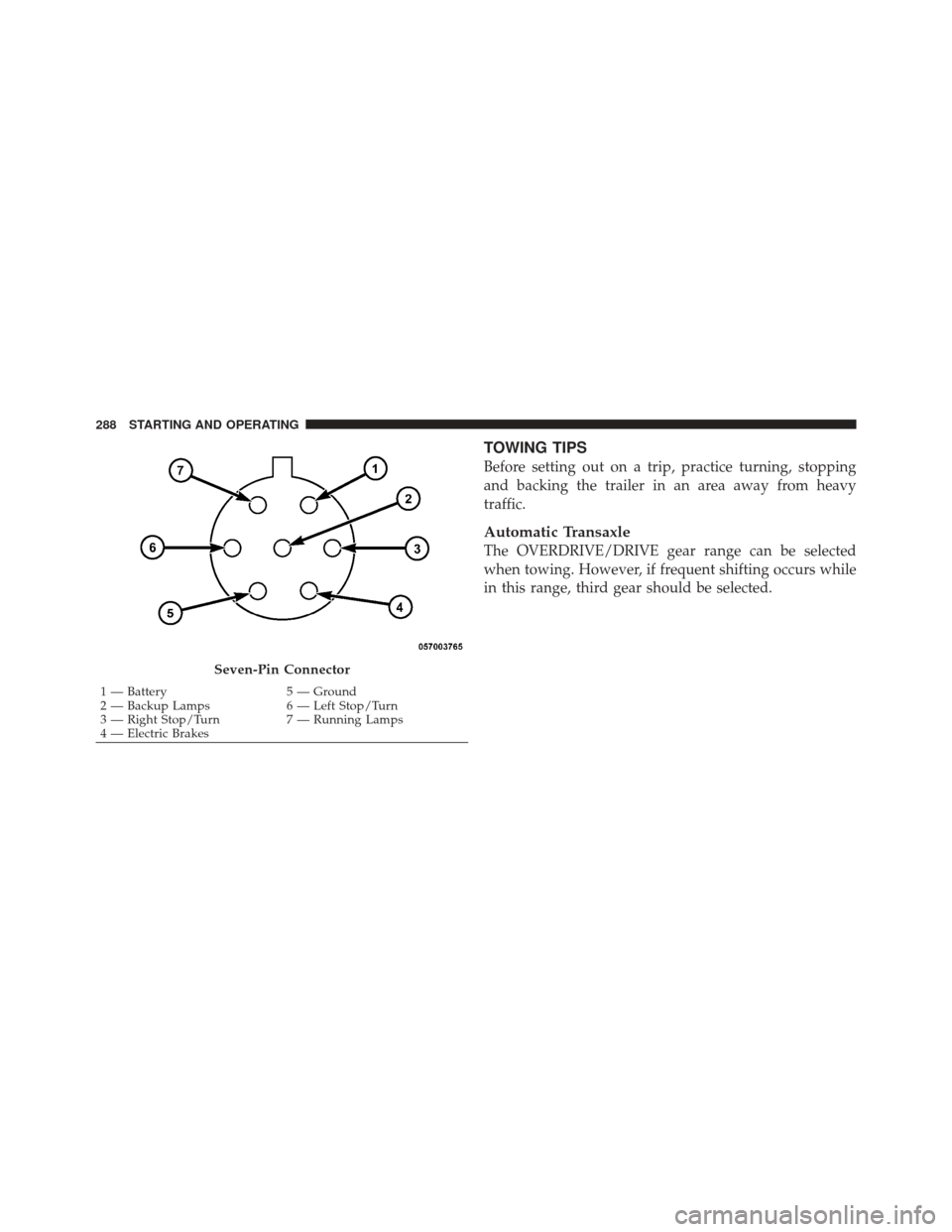
Seven-Pin Connector
1 — Battery5 — Ground
2 — Backup Lamps 6 — Left Stop/Turn
3 — Right Stop/Turn 7 — Running Lamps
4 — Electric Brakes
288 STARTING AND OPERATING
Page 298 of 410
Preparations For Jacking
1. Park the vehicle on a firm, level surface. Avoid ice or
slippery areas.
WARNING!
Do not attempt to change a tire on the side of the
vehicle close to moving traffic. Pull far enough off
the road to avoid the danger of being hit when
operating the jack or changing the wheel.
2. Set the parking brake.
3. Place the shift lever in PARK (automatic transaxle) or
REVERSE (manual transaxle).
4. Turn OFF the ignition.
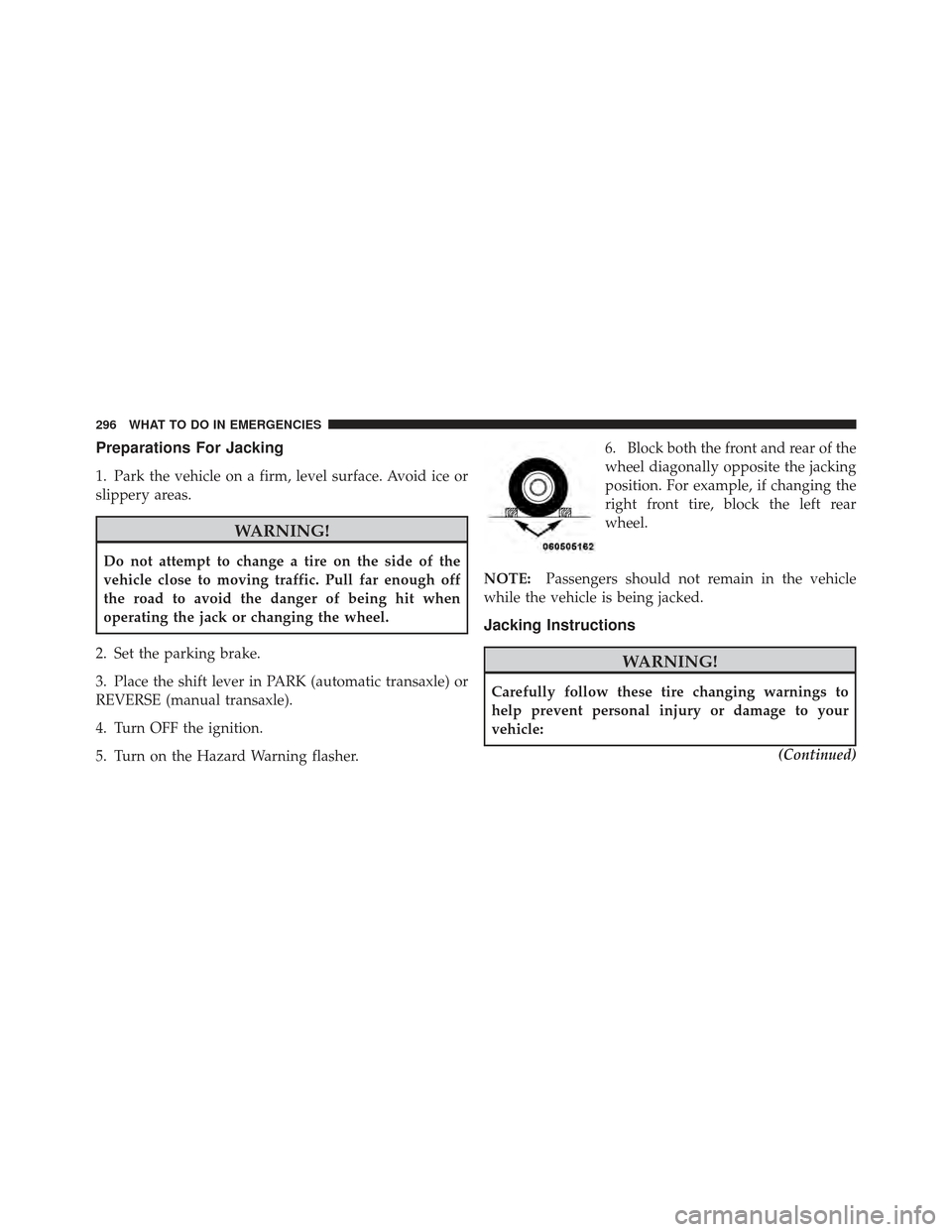
5. Turn on the Hazard Warning flasher. 6. Block both the front and rear of the
wheel diagonally opposite the jacking
position. For example, if changing the
right front tire, block the left rear
wheel.
NOTE: Passengers should not remain in the vehicle
while the vehicle is being jacked.
Jacking Instructions
WARNING!
Carefully follow these tire changing warnings to
help prevent personal injury or damage to your
vehicle:
(Continued)
296 WHAT TO DO IN EMERGENCIES
Page 299 of 410
WARNING! (Continued)
•Always park on a firm, level surface as far from
the edge of the roadway as possible before raising
the vehicle.
•Block the wheel diagonally opposite the wheel to
be raised.
•Set the parking brake firmly, and shift a automatic
transmission into PARK; a manual transmission
into REVERSE.
•Never start or run the engine with the vehicle on a
jack.
•Do not let anyone sit in the vehicle when it is on a
jack.
•Do not get under the vehicle when it is on a jack.
•Only use the jack in the positions indicated and
for lifting this vehicle during a tire change.(Continued)
WARNING! (Continued)
•If working on or near a roadway, be extremely
careful of motor traffic.
•To assure that spare tires, flat or inflated, are
securely stowed, spares must be stowed with the
valve stem facing the ground.
•Turn on the Hazard Warning flasher.
1. Remove the scissors jack and lug wrench from the
stowage bag.
Jack Warning Label
6
WHAT TO DO IN EMERGENCIES 297
Page 303 of 410
1. Wear eye protection and remove any metal jewelry
such as watch bands or bracelets that might make an
inadvertent electrical contact.
2. When boosting from a battery in another vehicle, park
that vehicle within booster cable reach but without
letting the vehicles touch. Set parking brake, place auto-
matic transaxle in PARK (manual transaxle in NEU-
TRAL) and turn ignition to OFF for both vehicles.
3. Turn off the heater, radio and all unnecessary electrical
loads.
4. Connect one end of a jumper cable to the positive
terminal of the booster battery. Connect the other end of
the jumper cable to the positive terminal of the dis-
charged battery.WARNING!
•Battery fluid is a corrosive acid solution; do not
allow battery fluid to contact eyes, skin or cloth-
ing. Don’t lean over battery when attaching
clamps or allow the clamps to touch each other. If
acid splashes in eyes or on skin, flush the contami-
nated area immediately with large quantities of
water.
•A battery generates hydrogen gas which is flam-
mable and explosive. Keep flame or spark away
from the vent holes. Do not use a booster battery
or any other booster source with an output that
exceeds 12-Volts.
5. Connect the other cable, first to the negative terminal
of the booster battery and then to the negative terminal of
the discharged battery. Make sure you have a good
contact.
6
WHAT TO DO IN EMERGENCIES 301
Page 308 of 410

▫Exhaust System ..................... 321
▫ Cooling System ..................... 323
▫ Brake System ....................... 329
▫ Automatic Transaxle .................. 331
▫ Manual Transaxle .................... 334
▫ Appearance Care And Protection From
Corrosion .......................... 334
� Fuses .............................. 340
▫ Integrated Power Module (IPM) .......... 340
� Vehicle Storage ....................... 344
� Replacement Bulbs .................... 344 �
Bulb Replacement ..................... 345
▫ Headlights ......................... 345
▫ Front Parking, Turn Signal, And Side Marker
Lights ............................ 346
▫ Front Fog Lights — If Equipped .......... 347
▫ Tail/Stop Lights And Rear
Turn Signal Lights .................... 347
▫ Backup Lights ...................... 348
▫ Center High-Mounted Stop Light (CHMSL) . . 348
� Fluids And Capacities .................. 349
� Fluids, Lubricants And Genuine Parts ....... 350
▫ Engine ............................ 350
▫ Chassis ........................... 351
306 MAINTAINING YOUR VEHICLE
Page 309 of 410
ENGINE COMPARTMENT — 2.4L
1 — Washer Fluid Reservoir7 — Battery
2 — Power Steering Fluid Reservoir 8 — Automatic Transaxle Dipstick
3 — Engine Coolant Reservoir 9 — Engine Oil Dipstick
4 — Brake Fluid Reservoir 10 — Engine Oil Fill
5 — Power Distribution Center 11 — Coolant Pressure Cap
6 — Air Cleaner Filter
7
MAINTAINING YOUR VEHICLE 307
Page 310 of 410
ENGINE COMPARTMENT — 2.4L TURBO
1 — Engine Oil Fill6 — Battery
2 — Washer Fluid Reservoir 7 — Engine Oil Dipstick
3 — Engine Coolant Reservoir 8 — Power Steering Fluid Reservoir
4 — Brake Fluid Reservoir 9 — Coolant Pressure Cap
5 — Air Cleaner Filter
308 MAINTAINING YOUR VEHICLE
Page 331 of 410

Brake System
In order to assure brake system performance, all brake
system components should be inspected periodically.
Refer to the “Maintenance Schedules” in Section 8 for the
proper maintenance intervals.
WARNING!
Riding the brakes can lead to brake failure and
possibly an accident. Driving with your foot resting
or riding on the brake pedal can result in abnormally
high brake temperatures, excessive lining wear, and
possible brake damage. You would not have your full
braking capacity in an emergency.
Master Cylinder - Brake Fluid Level Check
Check the fluid level in the master cylinder immediately
if the Brake System Warning Telltale Light indicates
system failure.Check the fluid level in the master cylinder when per-
forming underhood services.
Clean the top of the master cylinder area before removing
the cap. If necessary, add fluid to bring the fluid level up
to the requirements described on the brake fluid reser-
voir.
Overfilling of fluid is not recommended because it may
cause leaking in the system.
Fluid level can be expected to fall as the brake pads wear.
Brake fluid level should be checked when pads are
replaced. However, low fluid level may be caused by a
leak and a checkup may be needed.
NOTE:
If your vehicle is equipped with a manual
transaxle, the Brake Fluid Reservoir supplies fluid to both
the Brake System and the Clutch Release System. The
two systems are separated in the reservoir and a leak in
one system will not affect the other system. The manual
7
MAINTAINING YOUR VEHICLE 329