Page 55 of 410

seats because this can also affect occupant classification.
Also, if you fold down the seats in the second row check
to be sure they don’t touch the front passenger seat.
If the front passenger seat is damaged in any way, it
should only be serviced by an authorized dealer. If the
seat is removed (or even if the seat attachment bolts are
loosened or tightened in any way), take the vehicle to an
authorized dealer.
If there is a fault present in the OCS, the Airbag Warning
Light (a red light located in the center of the instrument
cluster directly in front of the driver) will be turned on.
This indicates that you should take the vehicle to an
authorized dealer. The Airbag Warning Light is turned on
whenever there is fault that can affect the operation of the
airbag system. If there is a fault present in the OCS, both
the PAD Indicator Light and the Airbag Warning Light
are illuminated to show that the passenger airbag is
turned off until the fault is cleared. If an object is lodgedunder the seat and interferes with operation of the weight
sensors, a fault will occur which turns on both the PAD
Indicator Light and the Airbag Warning Light. Once the
lodged object is removed, the fault will be automatically
cleared after a short period of time.
•The
Driver and Passenger Airbag/Inflator Units are
located in the center of the steering wheel and the right
side of the instrument panel. When the ORC detects a
collision requiring the airbags, it signals the inflator
units. A large quantity of nontoxic gas is generated to
inflate the front airbags. Different airbag inflation rates
may be possible based on collision severity and occu-
pant size. The steering wheel hub trim cover and the
upper right side of the instrument panel separate and
fold out of the way as the bags inflate to their full size.
The bags fully inflate in about 50 - 70 milliseconds.
This is about half of the time it takes to blink your eyes.
The bags then quickly deflate while helping to restrain
the driver and front passenger. The driver’s front
2
THINGS TO KNOW BEFORE STARTING YOUR VEHICLE 53
Page 61 of 410

WARNING! (Continued)
•Do not place or hang any items such as add-on
video players on the front seat backs. The addi-
tional weight may cause the Occupant Classifica-
tion System to be unable to correctly classify the
right front occupant. This could allow the passen-
ger frontal airbag to inflate when it is not desired.
•You need proper knee impact protection in a
collision. Do not mount or locate any aftermarket
equipment on or behind the knee blocker panel.
•It is dangerous to try to repair any part of the
airbag system yourself. Be sure to tell anyone who
works on your vehicle that it has an airbag system.
NOTE:
Perchlorate Material – special handling may ap-
ply. See www.dtsc.ca.gov/hazardouswaste/perchlorate.”
Airbag Warning Light
You will want to have the airbags ready to
inflate for your protection in a collision. While
the airbag system is designed to be mainte-
nance free, if any of the following occur, have
an authorized dealer service the system immediately:
•The Airbag Warning Light does not come on during
the six to eight seconds when the ignition switch is
first turned on.
•The light remains on after the six to eight second
interval.
•The light comes on and remains on while driving.
2
THINGS TO KNOW BEFORE STARTING YOUR VEHICLE 59
Page 63 of 410

upon request. General data that does not identify par-
ticular vehicles or crashes may be released for incorpo-
ration in aggregate crash databases, such as those main-
tained by the U.S. government and various states. Data of
a potentially sensitive nature, such as would identify a
particular driver, vehicle, or crash, will be treated confi-
dentially. Confidential data will not be disclosed by
Chrysler LLC to any third party except when:
1. Used for research purposes, such as to match data
with a particular crash record in an aggregate database,
provided confidentiality of personal data is thereafter
preserved
2. Used in defense of litigation involving a Chrysler LLC
product
3. Requested by police under a legal warrant
4. Otherwise required by lawData Parameters that May Be Recorded:
•Diagnostic trouble code(s) and warning light status for
electronically-controlled safety systems, including the
airbag system
•Airbag disable light status (if equipped)
•�Time�
of airbag deployment (in terms of ignition
cycles and vehicle mileage)
•Airbag deployment level (if applicable)
•Impact velocity and angle
•Seat belt status
•Brake status (service and parking brakes)
•Accelerator status (including vehicle speed)
•Engine control status (including engine speed)
•Transmission gear selection
2
THINGS TO KNOW BEFORE STARTING YOUR VEHICLE 61
Page 75 of 410

Airbag Warning Light
The light should come on and remain on for six to eight
seconds as a bulb check when the ignition switch is first
turned ON. If the light is not lit during starting, see your
authorized dealer. If the light stays on, flickers, or comes
on while driving, have the system checked by an autho-
rized dealer.
Defroster
Check operation by selecting the defrost mode and place
the blower control on high speed. You should be able to
feel the air directed against the windshield. See your
authorized dealer for service if your defroster is
inoperable.
Periodic Safety Checks You Should Make Outside
the Vehicle
Tires
Examine tires for excessive tread wear and uneven wear
patterns. Check for stones, nails, glass, or other objectslodged in the tread. Inspect the tread and sidewall for
cuts and cracks. Check the wheel nuts for tightness.
Check the tires (including spare) for proper pressure.
Lights
Have someone observe the operation of exterior lights
while you work the controls. Check turn signal and high
beam indicator lights on the instrument panel.
Door Latches
Check for positive closing, latching, and locking.
Fluid Leaks
Check area under vehicle after overnight parking for fuel,
engine coolant, oil, or other fluid leaks. Also, if gasoline
fumes are detected or if fuel, power steering fluid, or
brake fluid leaks are suspected, the cause should be
located and corrected immediately.
2
THINGS TO KNOW BEFORE STARTING YOUR VEHICLE 73
Page 78 of 410

▫Manual Lumbar — If Equipped .......... 112
▫ Folding Front Passenger Seat —
If Equipped ........................ 113
▫ Adjustable Head Restraints ............. 114
▫ Heated Seats — If Equipped ............ 114
▫ Folding Rear Seat .................... 116
▫ Tumbling Rear Seat ................... 118
▫ Rear Seat Removal ................... 120
� Emergency Seatback Release .............. 122
� To Open And Close The Hood ............ 123
� Lights ............................. 125
▫ Map/Reading Lights .................. 125
▫ Headlights ......................... 126 ▫
Parking And Instrument Panel Lights ...... 126
▫ Daytime Running Lights (DRL) —
If Equipped ........................ 127
▫ Lights — On Reminder ................ 127
▫ Fog Lights — If Equipped .............. 128
▫ Turn Signal Operation ................. 128
▫ High Beam/Low Beam Select Switch ...... 129
▫ Flash-To-Pass ....................... 130
� Windshield Wipers And Washers .......... 130
▫ Windshield Wiper Operation ............ 130
▫ Intermittent Wiper System .............. 131
▫ Windshield Washers .................. 132
▫ Mist Feature ........................ 132
76 UNDERSTANDING THE FEATURES OF YOUR VEHICLE
Page 81 of 410
MIRRORS
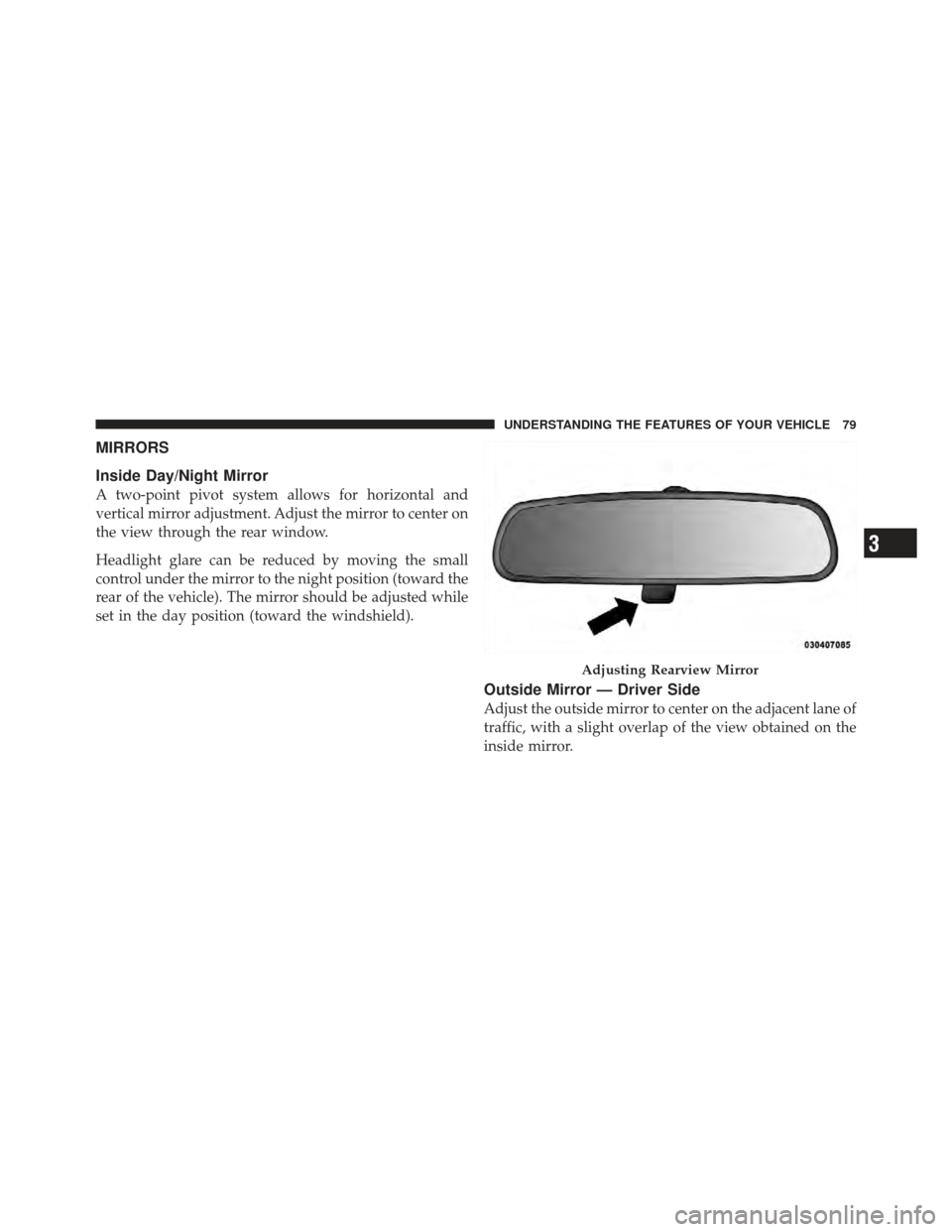
Inside Day/Night Mirror
A two-point pivot system allows for horizontal and
vertical mirror adjustment. Adjust the mirror to center on
the view through the rear window.
Headlight glare can be reduced by moving the small
control under the mirror to the night position (toward the
rear of the vehicle). The mirror should be adjusted while
set in the day position (toward the windshield).
Outside Mirror — Driver Side
Adjust the outside mirror to center on the adjacent lane of
traffic, with a slight overlap of the view obtained on the
inside mirror.
Adjusting Rearview Mirror
3
UNDERSTANDING THE FEATURES OF YOUR VEHICLE 79
Page 83 of 410
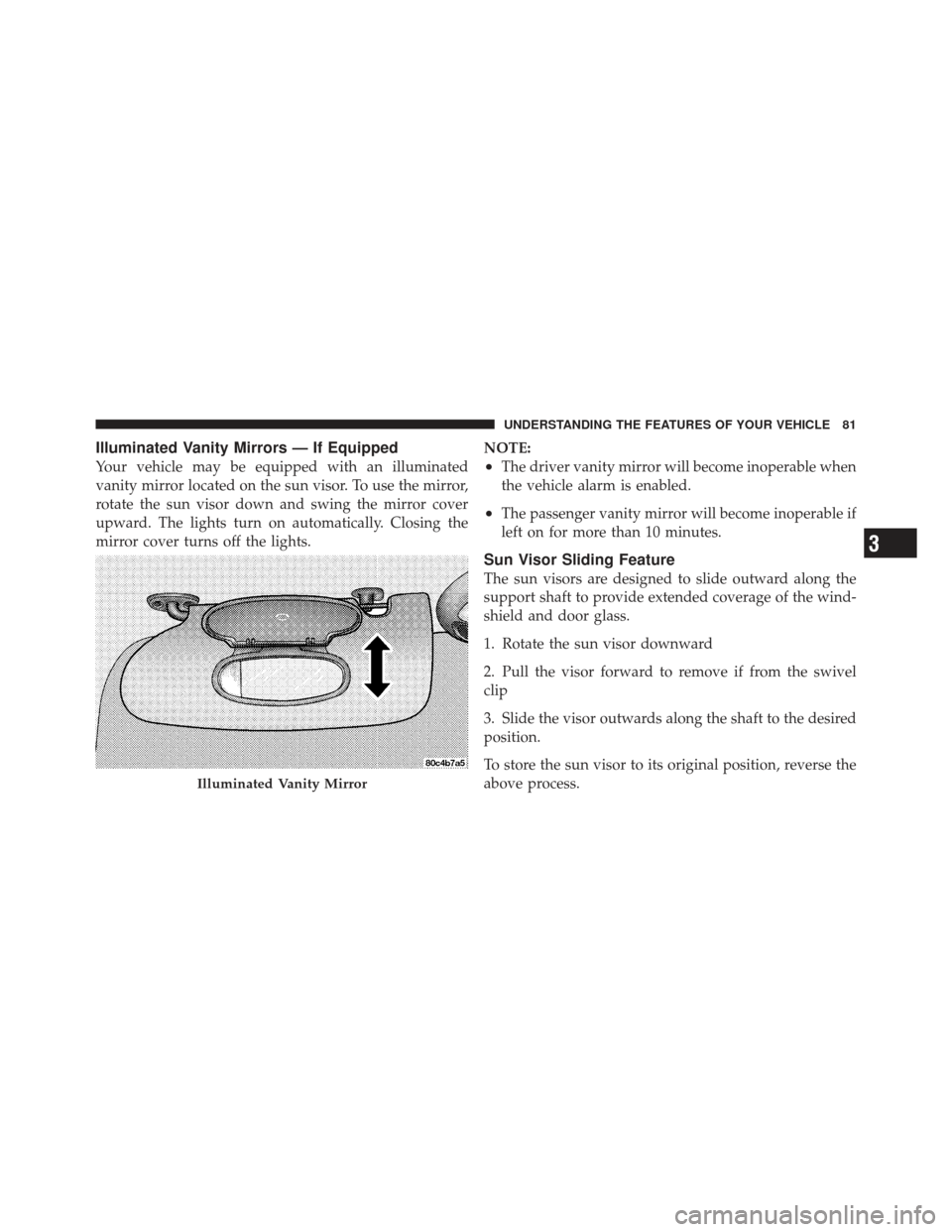
Illuminated Vanity Mirrors — If Equipped
Your vehicle may be equipped with an illuminated
vanity mirror located on the sun visor. To use the mirror,
rotate the sun visor down and swing the mirror cover
upward. The lights turn on automatically. Closing the
mirror cover turns off the lights.NOTE:•The driver vanity mirror will become inoperable when
the vehicle alarm is enabled.
•The passenger vanity mirror will become inoperable if
left on for more than 10 minutes.
Sun Visor Sliding Feature
The sun visors are designed to slide outward along the
support shaft to provide extended coverage of the wind-
shield and door glass.
1. Rotate the sun visor downward
2. Pull the visor forward to remove if from the swivel
clip
3. Slide the visor outwards along the shaft to the desired
position.
To store the sun visor to its original position, reverse the
above process.
Illuminated Vanity Mirror
3
UNDERSTANDING THE FEATURES OF YOUR VEHICLE 81
Page 98 of 410
•The uconnect�phone does slightly lower your chances
of successfully making a phone call as to that for the
cellular phone directly.
WARNING!
Your phone must be turned on and paired to the
uconnect� phone to allow use of this vehicle feature
in emergency situations, when the cellular phone has
network coverage and stays paired to the uconnect �
phone.
Towing Assistance
If you need towing assistance:
•Press the PHONE button to begin.
•After the �Ready�prompt and the following beep, say
�Towing Assistance.� NOTE:
•The towing assistance number dialed is based on the
country where the vehicle is purchased (1-800-528-
2069 for the U.S., 1-877-213-4525 for Canada, 55-14-
3454 for Mexico City and 1-800-712-3040 for outside
Mexico City in Mexico).
•If supported, this number may be programmable on
some systems. To do this, press the PHONE button
and say “Setup”, followed by “Towing Assistance”.
Paging
To learn how to page, refer to
�Working with Automated
Systems.� Paging works properly except for pagers of
certain companies, which time out a little too soon to
work properly with the uconnect� phone.
Voice Mail Calling
To learn how to access your voice mail, refer to �Working
with Automated Systems.�
96 UNDERSTANDING THE FEATURES OF YOUR VEHICLE