Page 305 of 493
STARTING AND OPERATING
CONTENTS
�Starting Procedures.................... 307
▫Automatic Transmission............... 308
▫Keyless Go (If Equipped)............... 308
▫Normal Starting..................... 309
▫Extremely Cold Weather (Below -20°F Or
-29°C)............................ 310
▫If Engine Fails To Start................ 311
▫After Starting....................... 312
�Engine Block Heater — If Equipped........ 312�Automatic Transmission................. 313
▫Automatic Transmission — General
Information........................ 313
▫Brake/Transmission Shift Interlock System . . 315
▫Brake/Transmission Interlock Manual
Override.......................... 316
▫5-Speed Automatic Transmission......... 317
�AutoStick�.......................... 321
▫AutoStick�Operation................. 321
▫AutoStick�General Information.......... 322
5
Page 306 of 493
�Driving On Slippery Surfaces............. 323
▫Acceleration........................ 323
▫Traction........................... 323
�Driving Through Water................. 324
▫Flowing/Rising Water................. 324
▫Shallow Standing Water............... 324
�Power Steering....................... 326
▫Power Steering Fluid Check............. 326
�Parking Brake........................ 327
�Brake System........................ 329
▫Anti-Lock Brake System............... 329
�Electronic Brake Control System........... 332
▫ABS (Anti-Lock Brake System)........... 332▫TCS (Traction Control System)........... 332
▫BAS (Brake Assist System).............. 333
▫ESP (Electronic Stability Program)........ 333
▫Synchronizing ESP................... 337
▫ESP/BAS Malfunction Indicator Light And
ESP/TCS Indicator Light............... 337
�Tire Safety Information................. 338
▫Tire Markings....................... 338
▫Tire Identification Number (TIN)......... 342
▫Tire Loading And Tire Pressure.......... 343
�Tires — General Information............. 347
▫Tire Pressure....................... 347
▫Tire Inflation Pressures................ 348
▫Tire Pressures For High Speed Operation . . . 349
304 STARTING AND OPERATING
Page 310 of 493
Automatic Transmission
The shift lever must be in the NEUTRAL or PARK
position before you can start the engine. Apply the brakes
before shifting into any driving gear.
CAUTION!
Damage to the transmission may occur if the follow-
ing precautions are not observed:
•Shift into PARK only after the vehicle has come to
a complete stop.
•Shift into or out of REVERSE only after the
vehicle has come to a complete stop and the engine
is at idle speed.
•Do not shift from REVERSE, PARK, or NEUTRAL
into any forward gear when the engine is above
idle speed.
•Before shifting into any gear, make sure your foot
is firmly on the brake pedal.
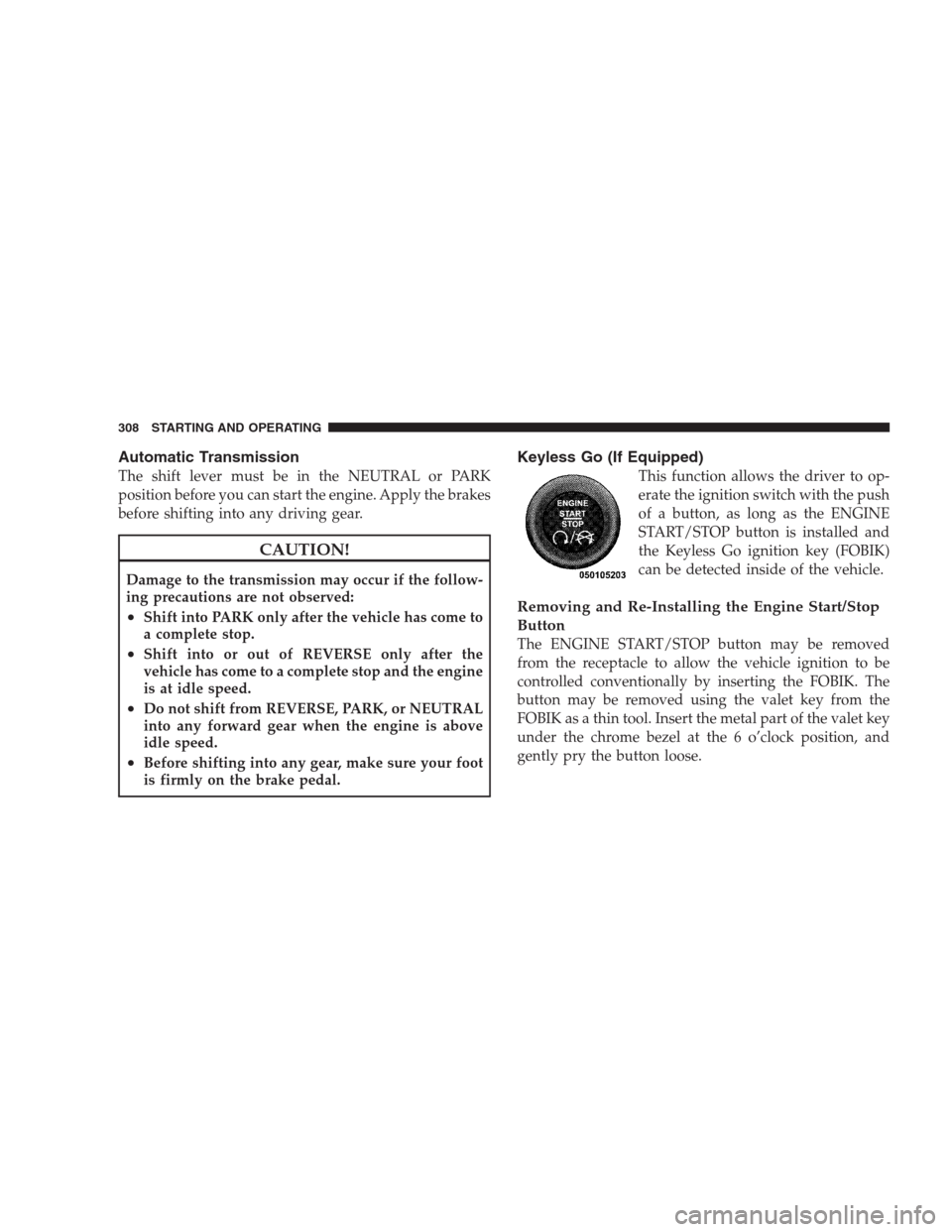
Keyless Go (If Equipped)
This function allows the driver to op-
erate the ignition switch with the push
of a button, as long as the ENGINE
START/STOP button is installed and
the Keyless Go ignition key (FOBIK)
can be detected inside of the vehicle.
Removing and Re-Installing the Engine Start/Stop
Button
The ENGINE START/STOP button may be removed
from the receptacle to allow the vehicle ignition to be
controlled conventionally by inserting the FOBIK. The
button may be removed using the valet key from the
FOBIK as a thin tool. Insert the metal part of the valet key
under the chrome bezel at the 6 o’clock position, and
gently pry the button loose.
308 STARTING AND OPERATING
Page 311 of 493
To reinstall the button, position it with its lettering
oriented horizontal and readable. Gently insert the but-
ton into the receptacle by pressing on the center of the
button. If the button slips in easily, it has been installed
correctly. Press firmly on the center of the button to seat
the button into the receptacle.
The ENGINE START/STOP button should only be re-
moved or inserted with the ignition in the OFF position.
Keyless Go Functions — With Driver ’s Foot Off
The Brake Pedal (In PARK Position)
•
Press the ENGINE START/STOP buttononce (ACC
position)to activate the radio, wipers, and windows.
•Press the ENGINE START/STOP buttontwice (ON
position)to activate the heating/air conditioning
(HVAC) controls, and the instrument cluster.
•Press the ENGINE START/STOP buttonthree times
(OFF position)to turn off the ignition switch.
Normal Starting
Using The ENGINE START/STOP Button
NOTE:Normal starting of either a cold or a warm
engine is obtained without pumping or depressing the
accelerator pedal.
To start the engine, the transmission must be in PARK or
NEUTRAL. From any ignition state, press and hold the
brake pedal while pressing the ENGINE START/STOP
button. The system takes over and attempts to start the
vehicle. If the vehicle fails to start, the starter will
disengage automatically after 10 seconds. If you wish to
stop the cranking of the engine prior to the engine
starting, press the button again.
STARTING AND OPERATING 309
5
Page 313 of 493
If Engine Fails To Start
WARNING!
•Never pour fuel or other flammable liquids into
the throttle body air inlet opening in an attempt to
start the vehicle. This could result in a flash fire
causing serious personal injury.
•Do not attempt to push or tow your vehicle to get
it started. Vehicles equipped with an automatic
transmission cannot be started this way. Unburned
fuel could enter the catalytic converter and once
the engine has started, ignite and damage the
converter and vehicle. If the vehicle has a dis-
charged battery, booster cables may be used to
obtain a start from a booster battery or the battery
in another vehicle. This type of start can be dan-
gerous if done improperly. Refer to Section 6 for
proper jump-starting procedures and follow them
carefully.Clearing A Flooded Engine - Using ENGINE
START/STOP Button
If the engine fails to start after you have followed the
“Normal Starting” or “Extreme Cold Weather�proce-
dures, it may be flooded. To clear any excess fuel, press
and hold the accelerator pedal all the way to the floor
with your right foot, and then press and release the
ENGINE START/STOP button once. The starter motor
will engage automatically, run for 10 seconds, and then
disengage. Once this occurs, release the accelerator pedal
and the brake pedal, wait 10 to 15 seconds, then repeat
the normal starting procedure.
Clearing A Flooded Engine - Using Fob With Integrated
Key
If the engine fails to start after you have followed the
“Normal Starting” or “Extreme Cold Weather” proce-
dures, it may be flooded. To clear any excess fuel, push
the accelerator pedal all the way to the floor and hold it.
Then, turn the ignition switch to the START position and
STARTING AND OPERATING 311
5
Page 315 of 493
AUTOMATIC TRANSMISSION
CAUTION!
Damage to the transmission may occur if the follow-
ing precautions are not observed:
•Shift into PARK only after the vehicle has come to
a complete stop.
•Shift into or out of REVERSE only after the
vehicle has come to a complete stop and the engine
is at idle speed.
•Do not shift from REVERSE, PARK, or NEUTRAL
into any forward gear when the engine is above
idle speed.
•Before shifting into any gear, make sure your foot
is firmly on the brake pedal.
WARNING!
It is dangerous to move the shift lever out of PARK or
NEUTRAL if the engine speed is higher than idle
speed. If your foot is not firmly on the brake pedal,
the vehicle could accelerate quickly forward or in
reverse. You could lose control of the vehicle and hit
someone or something. Only shift into gear when the
engine is idling normally and when your right foot is
firmly on the brake pedal.
Automatic Transmission — General Information
The automatic transmission selects individual gears au-
tomatically, dependent upon:
•Altitude
•Vehicle loading
•Driving style
•Shift lever position
STARTING AND OPERATING 313
5
Page 316 of 493
•Accelerator position
•Vehicle speed
The gear shifting process is continuously adapted, de-
pendent on the driving style, the driving situation, and
the road characteristics.
NOTE:
•After selecting any driving position, wait a moment to
allow the gear to engage fully before accelerating,
especially when the engine is cold.
•If there is a need to restart the engine, be sure to cycle
the key to the LOCK position before restarting. Trans-
mission engagement may be delayed up to 10 seconds
after restart if the key is not cycled to the LOCK
position first.
•The electronically-controlled transmission provides a
precise shift schedule. The transmission electronics are
self-calibrating. Therefore, the first few shifts on a new
vehicle may be somewhat abrupt or soft until after the
break-in period. This is a normal condition, and pre-
cision shifts will develop within a few shift cycles.
The shift lever is automatically locked while in the PARK
position. To move the shift lever out of the PARK
position, the brake pedal must be firmly depressed before
the shift lock will release.
Move the shift lever to the desired position only when the
engine is idling normally and the brake pedal is applied.
Do not release the brake pedal until ready to drive. The
vehicle may otherwise accelerate quickly when the shift
lever is in DRIVE or REVERSE position.
314 STARTING AND OPERATING
Page 317 of 493
WARNING!
Unintended movement of a vehicle could injure
those in and near the vehicle. As with all vehicles,
you should never exit a vehicle while the engine is
running. Before exiting a vehicle, you should always
shift the transmission into PARK, remove the key
from the ignition, and apply the parking brake. Once
the key is removed from the ignition, the transmis-
sion shift lever is locked in the PARK position,
securing the vehicle against unwanted movement.
Furthermore, you should never leave unattended
children inside a vehicle.
Over-Temperature Mode
The transmission electronics constantly monitor the
transmission oil temperature. If the transmission exceeds
normal operating temperature, the transmission will
change the way it shifts to help control the condition.
This may result in a slightly different feeling or response
during normal operation in DRIVE position. After the
transmission cools down, it will return to normal
operation.
Brake/Transmission Shift Interlock System
This vehicle is equipped with a Brake Transmission Shift
Interlock (BTSI) system that holds the shift lever in the
PARK position when the ignition switch is in the LOCK
position. To move the shift lever out of the PARK
position, the ignition switch must be turned to the ON
position, and the brake pedal must be depressed.
STARTING AND OPERATING 315
5