Page 328 of 493
POWER STEERING
The standard power steering system will give you good
vehicle response and increased ease of maneuverability
in tight spaces. The system will provide mechanical
steering capability if power assist is lost.
If for some reason the power assist is interrupted, it will
still be possible to steer your vehicle. Under these condi-
tions, you will observe a substantial increase in steering
effort, especially at very low vehicle speeds and during
parking maneuvers.
NOTE:Increased noise levels at the end of the steering
wheel travel are considered normal and do not indicate
that there is a problem with the power steering system.
Upon initial start-up in cold weather, the power steering
pump may make noise for a short amount of time. This is
due to the cold, thick fluid in the steering system. This
noise should be considered normal, and it does not in any
way damage the steering system.WARNING!
Continued operation with reduced power steering
assist could pose a safety risk to yourself and others.
Service should be obtained as soon as possible.
CAUTION!
Prolonged operation of the steering system at the end
of the steering wheel travel will increase the steering
fluid temperature and it should be avoided when
possible. Damage to the power steering pump may
occur.
Power Steering Fluid Check
Checking the power steering fluid level at a defined
service interval is not required. The fluid should only be
checked if a leak is suspected, abnormal noises are
326 STARTING AND OPERATING
Page 329 of 493
apparent, and/or the system is not functioning as antici-
pated. Coordinate inspection efforts through an autho-
rized dealer.
No chemical flushes should be used in any power
steering system; only the approved lubricant may be
used.
WARNING!
Fluid level should be checked on a level surface and
with the engine off to prevent injury from moving
parts and to ensure accurate fluid level reading. Do
not overfill. Use only manufacturer’s recommended
power steering fluid.
If necessary, add fluid to restore to the proper indicated
level. With a clean cloth, wipe any spilled fluid from all
surfaces. Refer to “Fluids, Lubricants, and Genuine
Parts” in Section 7 for the correct fluid type.
PARKING BRAKE
The parking brake should always be applied when the
driver is not in the vehicle.
WARNING!
Never use PARK position on an automatic transmis-
sion as a substitute for the parking brake. Always
apply the parking brake fully when parked to guard
against vehicle movement and possible injury or
damage.
When parking on a flat surface, place the shift lever in the
PARK position first and then apply the parking brake.
When parking on a hill, it is important to apply the
parking brake before placing the shift lever in PARK,
otherwise the load on the transmission locking mecha-
nism may make it difficult to move the shift lever out of
STARTING AND OPERATING 327
5
Page 336 of 493
power may also be reduced to assist in counteracting the
condition of oversteer or understeer and help the vehicle
maintain the desired path.
The ESP uses sensors in the vehicle to determine the path
that the driver intends to steer the vehicle and compares
it to the actual path of the vehicle. When the actual path
does not match the intended path, the ESP applies the
brake of the appropriate wheel to assist in counteracting
the condition of oversteer or understeer.
•Oversteer - when the vehicle is turning more than
appropriate for the steering wheel position.
•Understeer - when the vehicle is turning less than
appropriate for the steering wheel position.
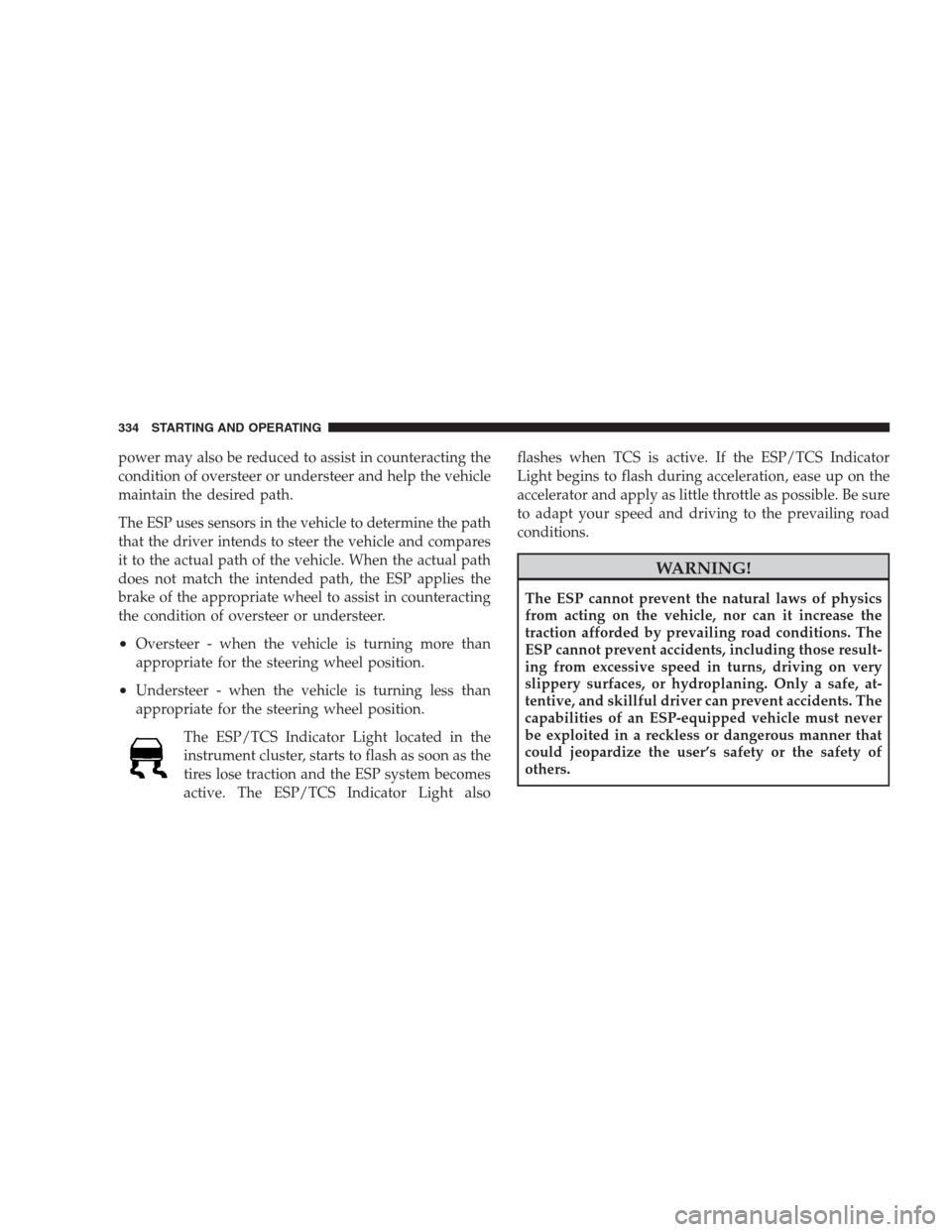
The ESP/TCS Indicator Light located in the
instrument cluster, starts to flash as soon as the
tires lose traction and the ESP system becomes
active. The ESP/TCS Indicator Light alsoflashes when TCS is active. If the ESP/TCS Indicator
Light begins to flash during acceleration, ease up on the
accelerator and apply as little throttle as possible. Be sure
to adapt your speed and driving to the prevailing road
conditions.
WARNING!
The ESP cannot prevent the natural laws of physics
from acting on the vehicle, nor can it increase the
traction afforded by prevailing road conditions. The
ESP cannot prevent accidents, including those result-
ing from excessive speed in turns, driving on very
slippery surfaces, or hydroplaning. Only a safe, at-
tentive, and skillful driver can prevent accidents. The
capabilities of an ESP-equipped vehicle must never
be exploited in a reckless or dangerous manner that
could jeopardize the user’s safety or the safety of
others.
334 STARTING AND OPERATING
Page 339 of 493
WARNING!
With the ESP switched OFF, the enhanced vehicle
stability offered by ESP is unavailable. In an emer-
gency evasive maneuver, the ESP system will not
engage to assist in maintaining stability. The “Full
Off” ESP mode is intended for off-highway or off-
road only.
Synchronizing ESP
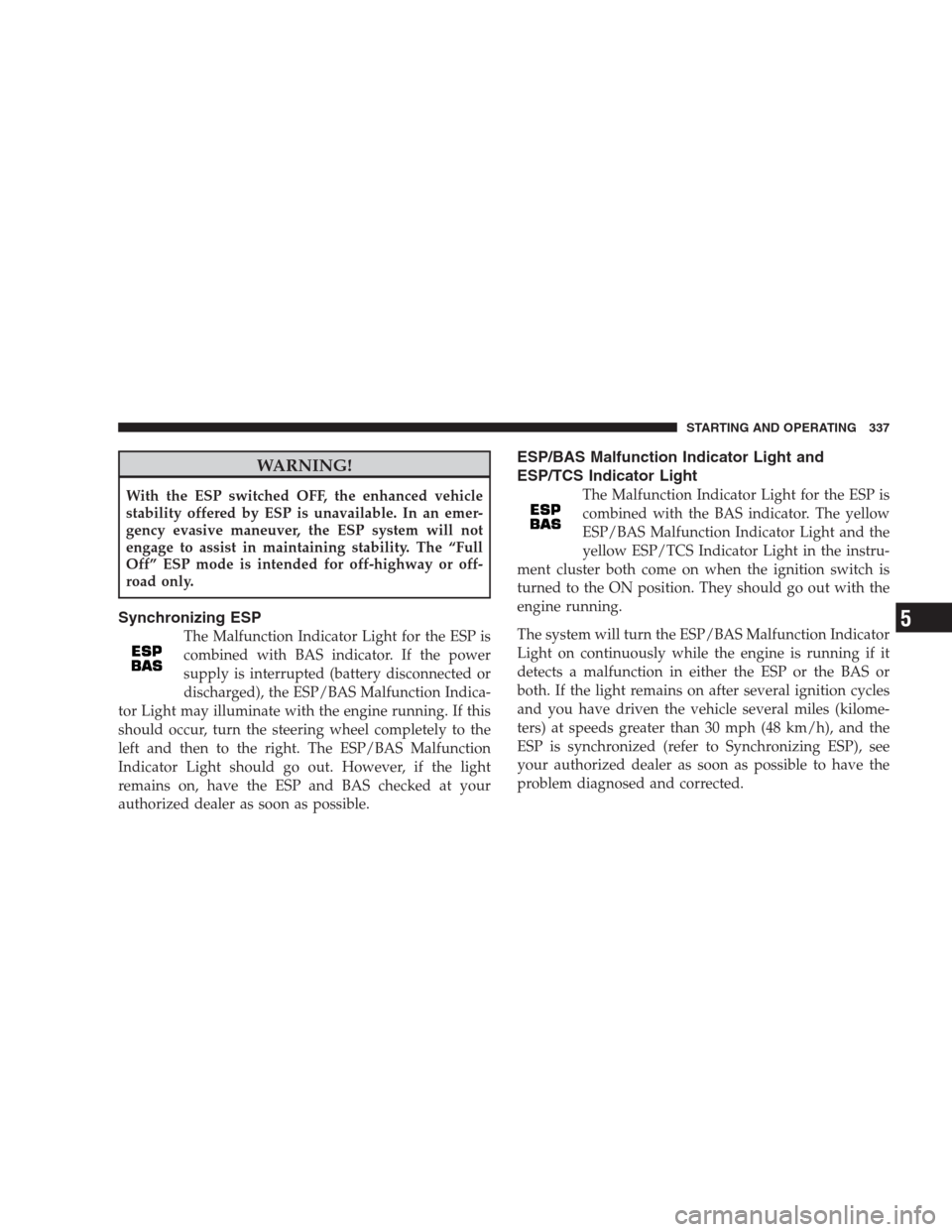
The Malfunction Indicator Light for the ESP is
combined with BAS indicator. If the power
supply is interrupted (battery disconnected or
discharged), the ESP/BAS Malfunction Indica-
tor Light may illuminate with the engine running. If this
should occur, turn the steering wheel completely to the
left and then to the right. The ESP/BAS Malfunction
Indicator Light should go out. However, if the light
remains on, have the ESP and BAS checked at your
authorized dealer as soon as possible.
ESP/BAS Malfunction Indicator Light and
ESP/TCS Indicator Light
The Malfunction Indicator Light for the ESP is
combined with the BAS indicator. The yellow
ESP/BAS Malfunction Indicator Light and the
yellow ESP/TCS Indicator Light in the instru-
ment cluster both come on when the ignition switch is
turned to the ON position. They should go out with the
engine running.
The system will turn the ESP/BAS Malfunction Indicator
Light on continuously while the engine is running if it
detects a malfunction in either the ESP or the BAS or
both. If the light remains on after several ignition cycles
and you have driven the vehicle several miles (kilome-
ters) at speeds greater than 30 mph (48 km/h), and the
ESP is synchronized (refer to Synchronizing ESP), see
your authorized dealer as soon as possible to have the
problem diagnosed and corrected.
STARTING AND OPERATING 337
5
Page 397 of 493
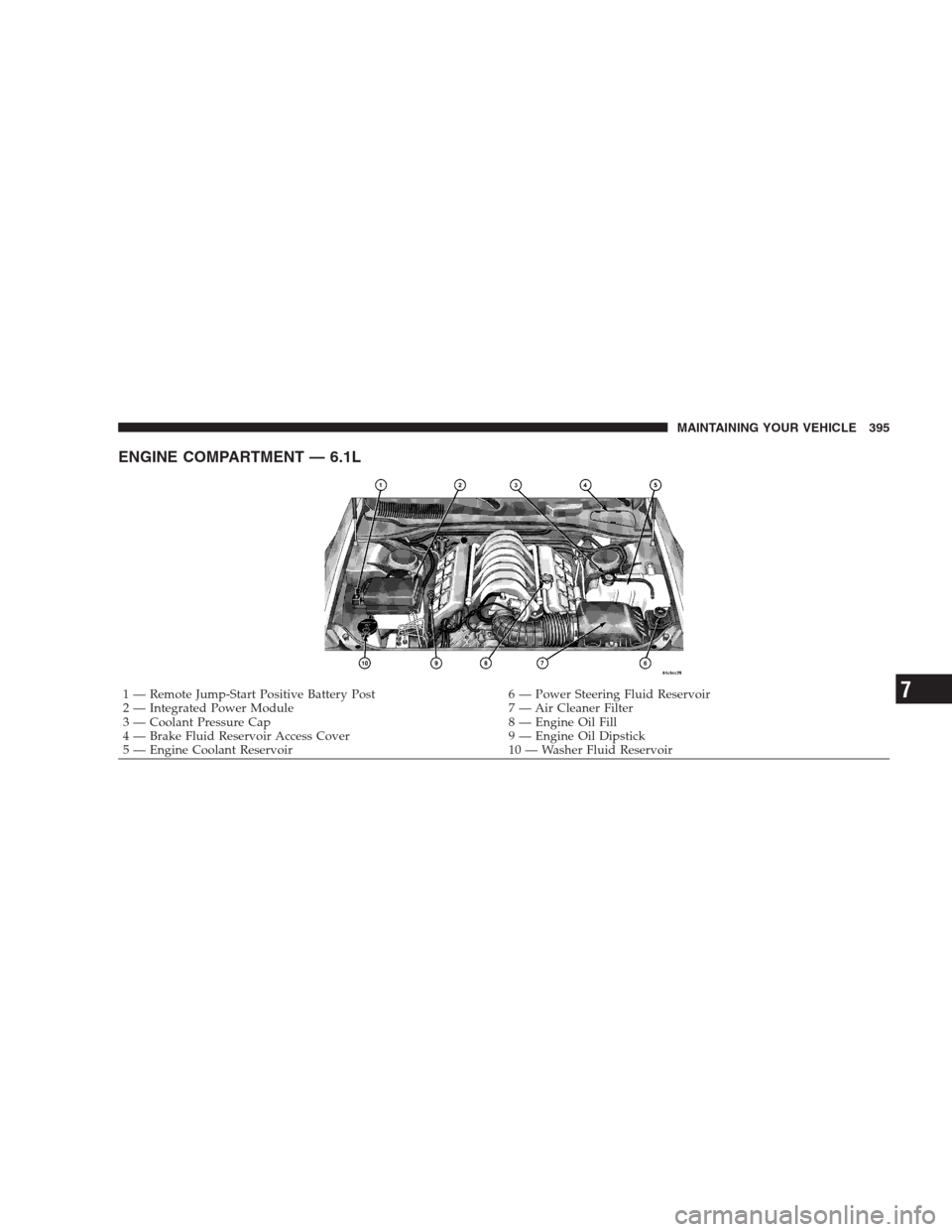
ENGINE COMPARTMENT — 6.1L
1 — Remote Jump-Start Positive Battery Post 6 — Power Steering Fluid Reservoir
2 — Integrated Power Module 7 — Air Cleaner Filter
3 — Coolant Pressure Cap 8 — Engine Oil Fill
4 — Brake Fluid Reservoir Access Cover 9 — Engine Oil Dipstick
5 — Engine Coolant Reservoir 10 — Washer Fluid ReservoirMAINTAINING YOUR VEHICLE 3957
Page 432 of 493
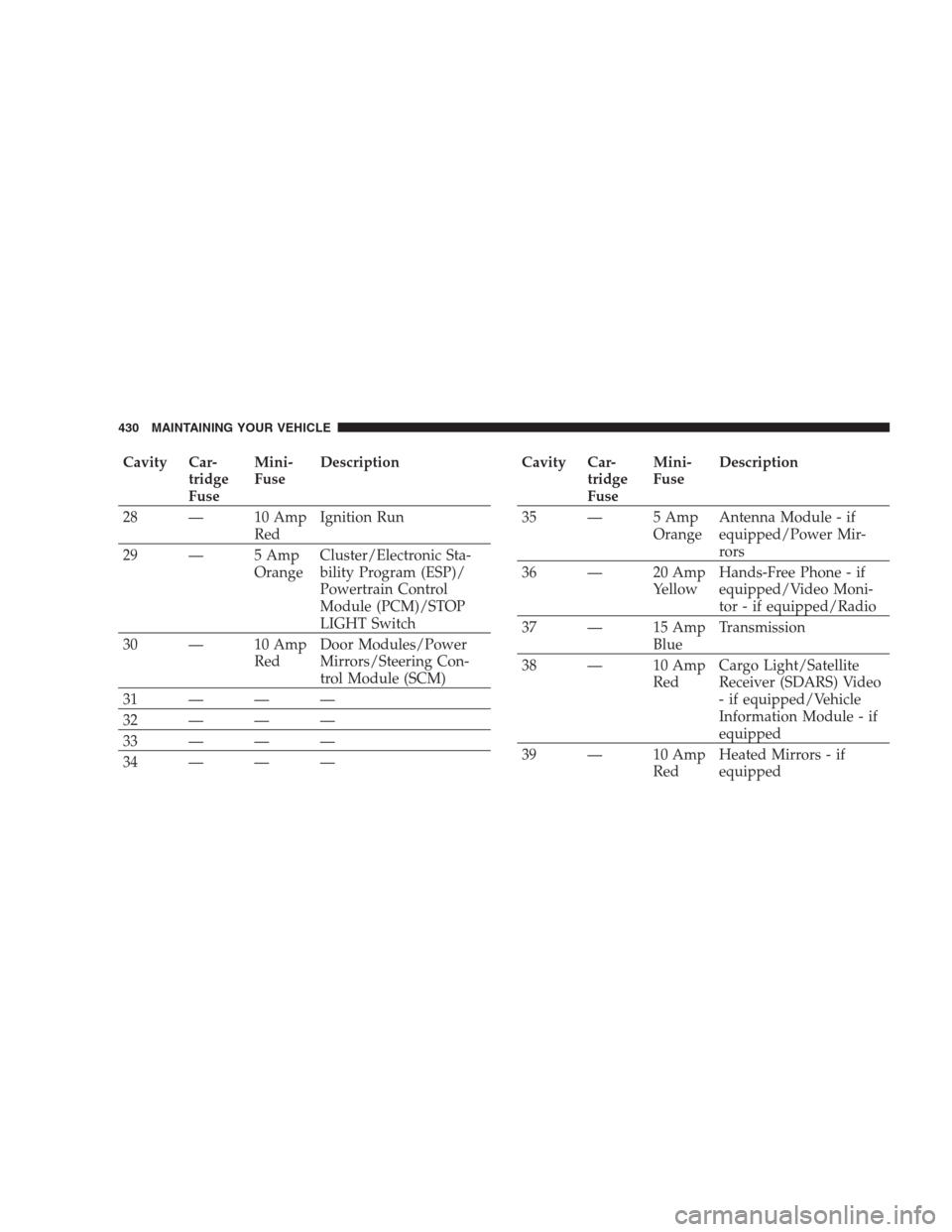
Cavity Car-
tridge
FuseMini-
FuseDescription
28 — 10 Amp
RedIgnition Run
29 — 5 Amp
OrangeCluster/Electronic Sta-
bility Program (ESP)/
Powertrain Control
Module (PCM)/STOP
LIGHT Switch
30 — 10 Amp
RedDoor Modules/Power
Mirrors/Steering Con-
trol Module (SCM)
31———
32———
33———
34———Cavity Car-
tridge
FuseMini-
FuseDescription
35 — 5 Amp
OrangeAntenna Module - if
equipped/Power Mir-
rors
36 — 20 Amp
YellowHands-Free Phone - if
equipped/Video Moni-
tor - if equipped/Radio
37 — 15 Amp
BlueTransmission
38 — 10 Amp
RedCargo Light/Satellite
Receiver (SDARS) Video
- if equipped/Vehicle
Information Module - if
equipped
39 — 10 Amp
RedHeated Mirrors - if
equipped
430 MAINTAINING YOUR VEHICLE
Page 442 of 493
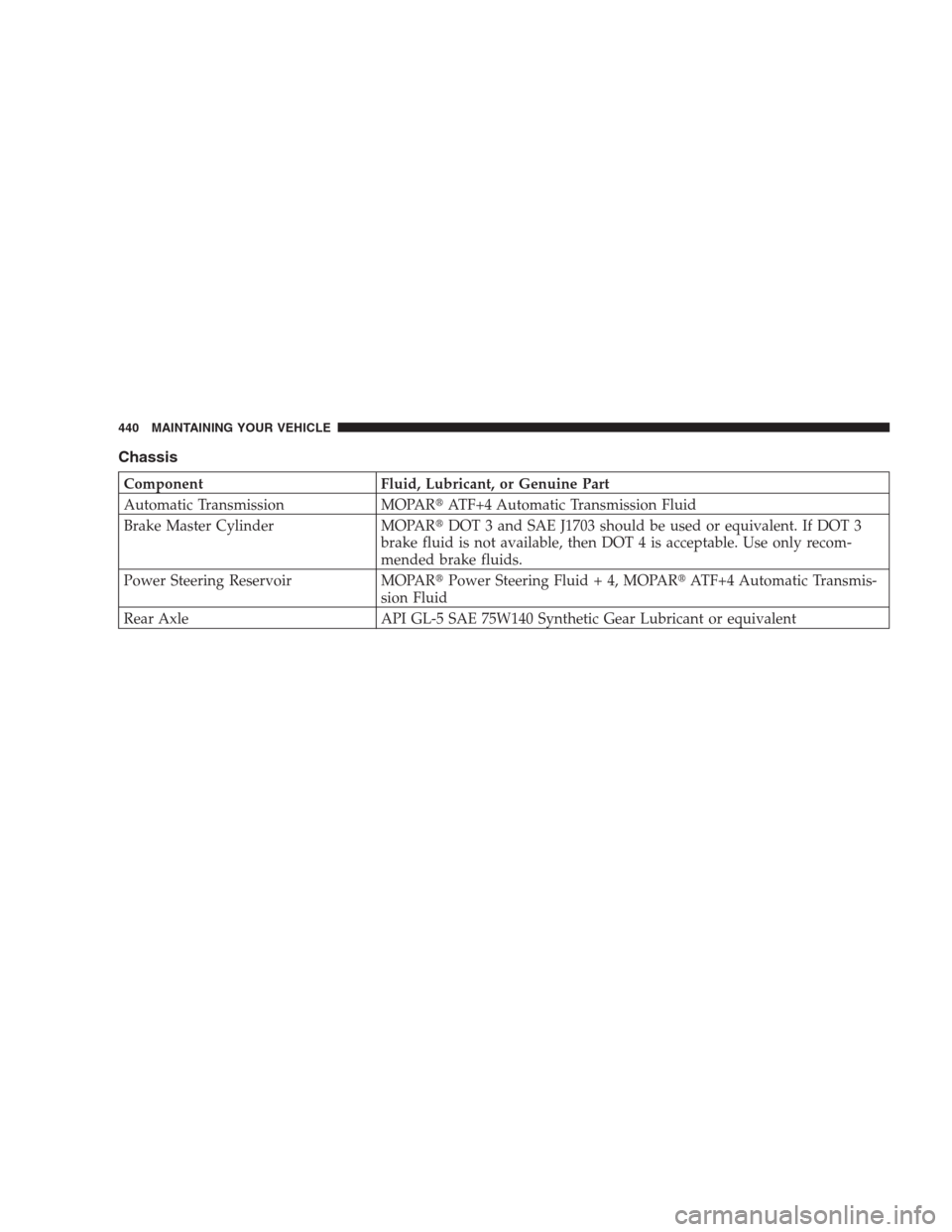
Chassis
Component Fluid, Lubricant, or Genuine Part
Automatic Transmission MOPAR�ATF+4 Automatic Transmission Fluid
Brake Master Cylinder MOPAR�DOT 3 and SAE J1703 should be used or equivalent. If DOT 3
brake fluid is not available, then DOT 4 is acceptable. Use only recom-
mended brake fluids.
Power Steering Reservoir MOPAR�Power Steering Fluid + 4, MOPAR�ATF+4 Automatic Transmis-
sion Fluid
Rear Axle API GL-5 SAE 75W140 Synthetic Gear Lubricant or equivalent
440 MAINTAINING YOUR VEHICLE
Page 446 of 493
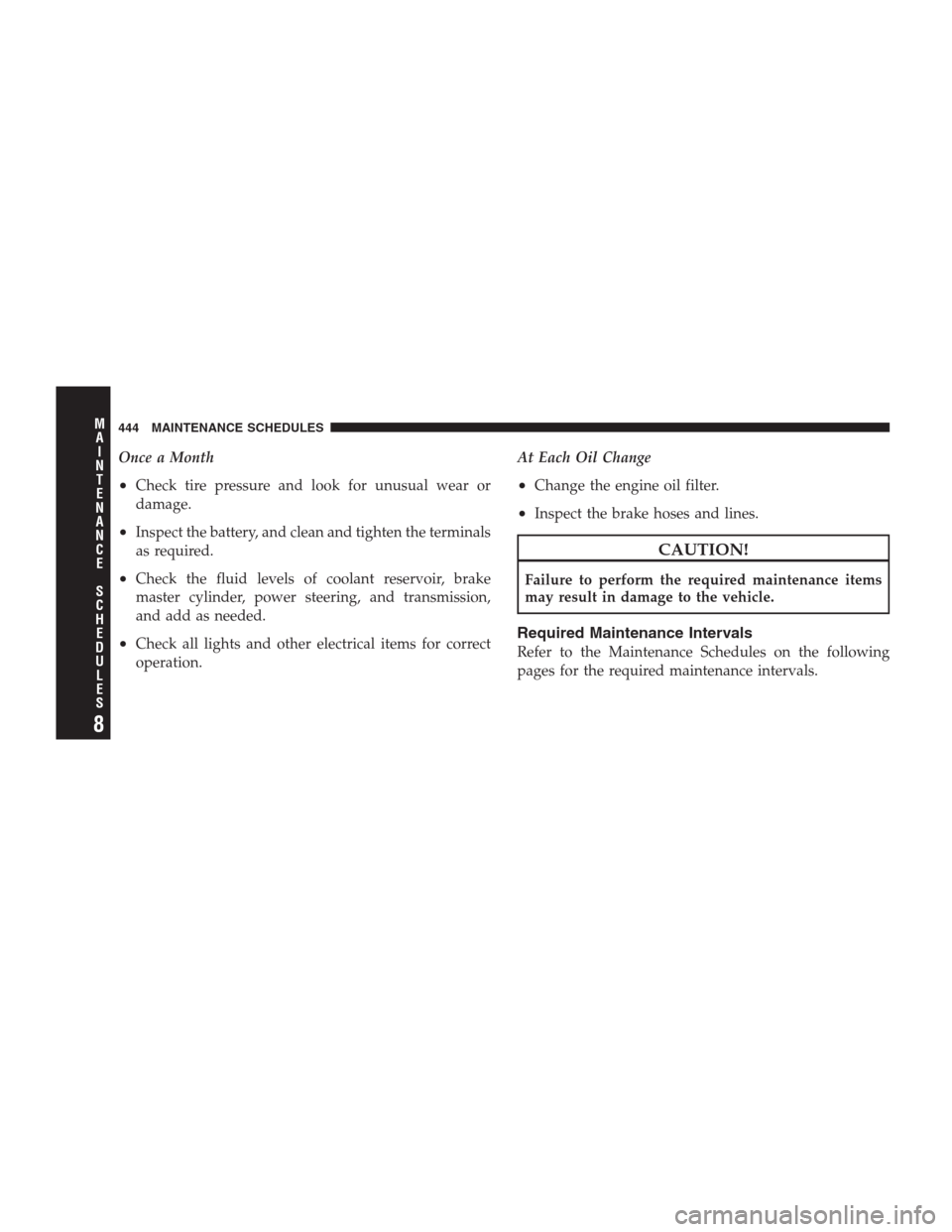
Once a Month
•Check tire pressure and look for unusual wear or
damage.
•Inspect the battery, and clean and tighten the terminals
as required.
•Check the fluid levels of coolant reservoir, brake
master cylinder, power steering, and transmission,
and add as needed.
•Check all lights and other electrical items for correct
operation.At Each Oil Change
•Change the engine oil filter.
•Inspect the brake hoses and lines.
CAUTION!
Failure to perform the required maintenance items
may result in damage to the vehicle.
Required Maintenance Intervals
Refer to the Maintenance Schedules on the following
pages for the required maintenance intervals.
444 MAINTENANCE SCHEDULES
8
M
A
I
N
T
E
N
A
N
C
E
S
C
H
E
D
U
L
E
S