Page 29 of 526
•Doors closed
•Hood closed
•Trunk closed
•Hazard switch off
•Brake switch inactive (brake pedal not pressed)
•Ignition key removed from ignition switch
•Battery at an acceptable charge level
•RKE PANIC button not pressed
To Enter Remote Start Mode
Press and release the REMOTE START button
on the RKE transmitter twice, within five sec-
onds. The parking lights will flash and the horn
will chirp twice (if programmed). Then, the
engine will start and the vehicle will remain in the
Remote Start mode for a 15-minute cycle.NOTE:
•The park lamps will turn on and remain on during
Remote Start mode.
•For security, power window and power sunroof op-
eration (if equipped) are disabled when the vehicle is
in the Remote Start mode.
•The engine can be started two consecutive times (two
15-minute cycles) with the RKE transmitter. However,
the ignition switch must be cycled to the ON position
before you can repeat the start sequence for a third
cycle.
To Exit Remote Start Mode without Driving the
Vehicle
Press and release the REMOTE START button one time,
or allow the engine to run for the entire 15-minute cycle.
THINGS TO KNOW BEFORE STARTING YOUR VEHICLE 27
2
Page 30 of 526
NOTE:To avoid unintentional shut downs, the system
will disable the one time press of the REMOTE START
button for two seconds after receiving a valid Remote
Start request.
To Exit Remote Start Mode and Drive the Vehicle
Before the end of the 15-minute cycle, press and release
the UNLOCK button on the RKE transmitter to unlock
the doors and disarm the Vehicle Security Alarm (if
equipped). Then, prior to the end of the 15-minute cycle,
insert the key into the ignition switch and turn the switch
to the ON position.
NOTE:
•The ignition switch must be in the ON position in
order to drive the vehicle.
•For vehicles equipped with the Electronic Vehicle
Information Center (EVIC), the message “Insert Key/
Turn To Run” will flash in the EVIC until you insert
the key. Once inserted, the message “Turn To Run”
will flash in the EVIC until you turn the key to run.
DOOR LOCKS
Manual Door Locks
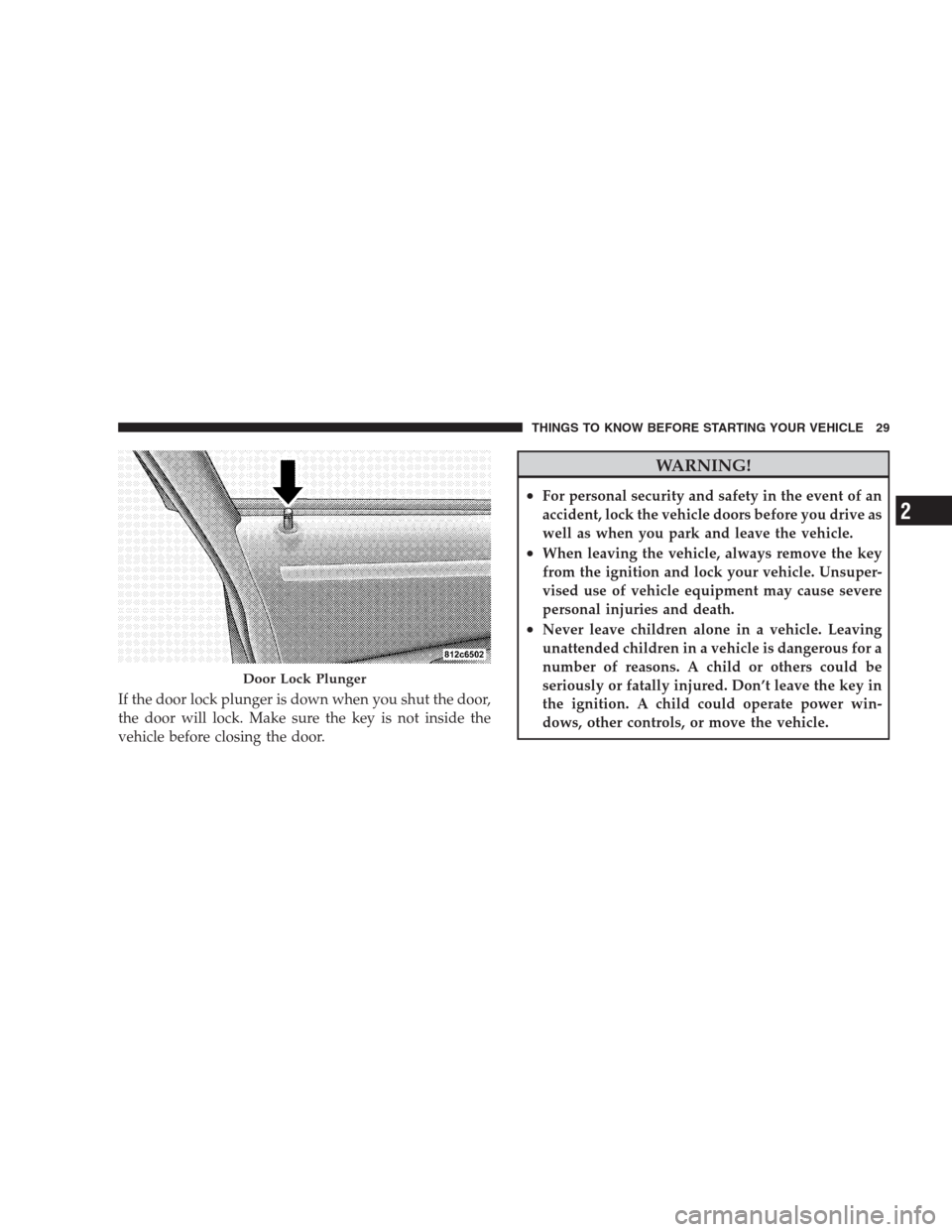
To lock each door, push the door lock plunger on each
door trim panel downward. To unlock each door, pull the
door lock plunger on each door trim panel upward.
28 THINGS TO KNOW BEFORE STARTING YOUR VEHICLE
Page 31 of 526
If the door lock plunger is down when you shut the door,
the door will lock. Make sure the key is not inside the
vehicle before closing the door.
WARNING!
•For personal security and safety in the event of an
accident, lock the vehicle doors before you drive as
well as when you park and leave the vehicle.
•When leaving the vehicle, always remove the key
from the ignition and lock your vehicle. Unsuper-
vised use of vehicle equipment may cause severe
personal injuries and death.
•Never leave children alone in a vehicle. Leaving
unattended children in a vehicle is dangerous for a
number of reasons. A child or others could be
seriously or fatally injured. Don’t leave the key in
the ignition. A child could operate power win-
dows, other controls, or move the vehicle.
Door Lock Plunger
THINGS TO KNOW BEFORE STARTING YOUR VEHICLE 29
2
Page 32 of 526
Power Door Locks
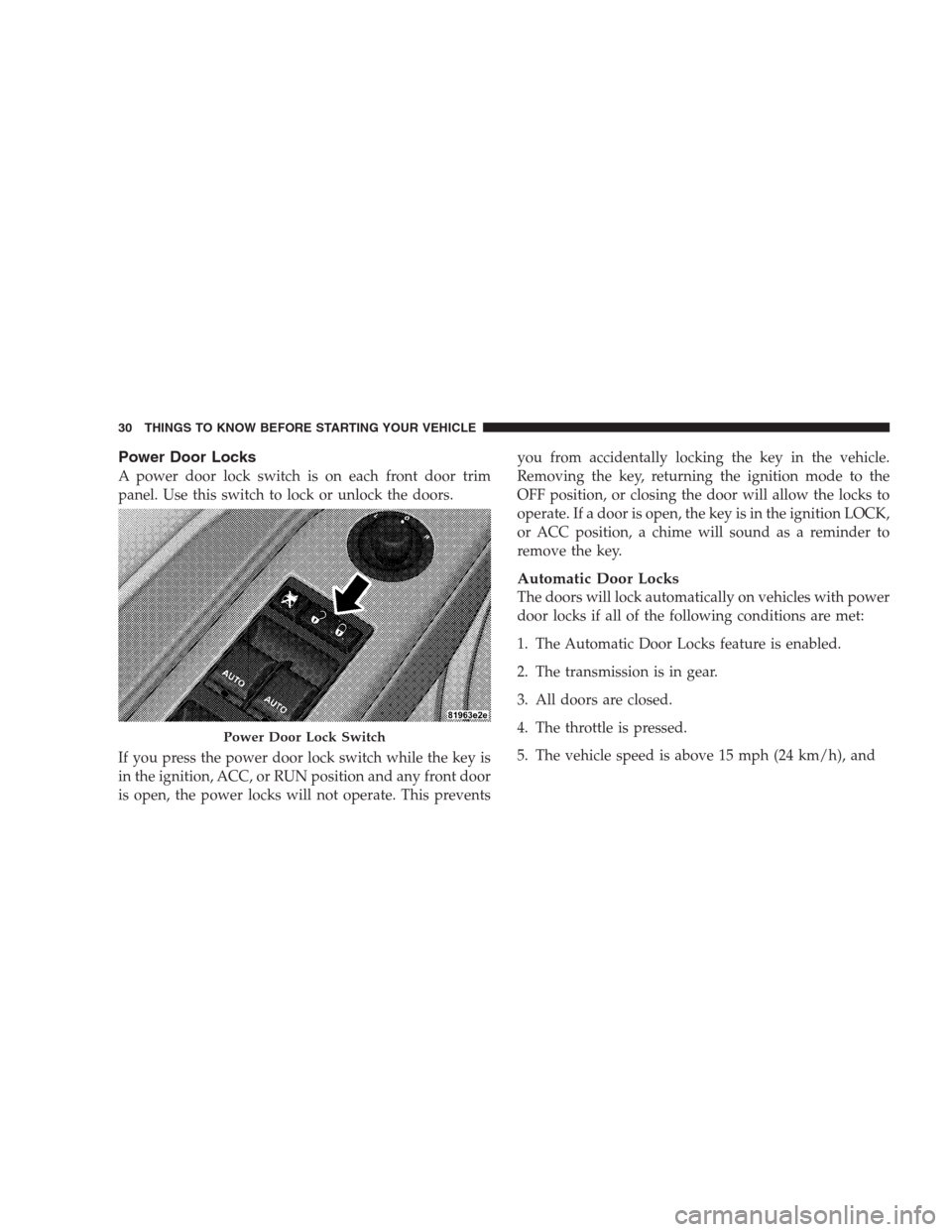
A power door lock switch is on each front door trim
panel. Use this switch to lock or unlock the doors.
If you press the power door lock switch while the key is
in the ignition, ACC, or RUN position and any front door
is open, the power locks will not operate. This preventsyou from accidentally locking the key in the vehicle.
Removing the key, returning the ignition mode to the
OFF position, or closing the door will allow the locks to
operate. If a door is open, the key is in the ignition LOCK,
or ACC position, a chime will sound as a reminder to
remove the key.
Automatic Door Locks
The doors will lock automatically on vehicles with power
door locks if all of the following conditions are met:
1. The Automatic Door Locks feature is enabled.
2. The transmission is in gear.
3. All doors are closed.
4. The throttle is pressed.
5. The vehicle speed is above 15 mph (24 km/h), and
Power Door Lock Switch
30 THINGS TO KNOW BEFORE STARTING YOUR VEHICLE
Page 33 of 526
6. The doors were not previously locked using the power
door lock switch or Remote Keyless Entry (RKE)
transmitter.
Automatic Door Locks Programming
The Automatic Door Locks feature can be enabled or
disabled as follows:
•For vehicles equipped with the Electronic Vehicle
Information Center (EVIC), refer to “Lock Doors Au-
tomatically at 15 mph (24 km/h)” under “Personal
Settings (Customer-Programmable Features)” in the
“Electronic Vehicle Information Center (EVIC),” in
Section 4 of this manual.
•For vehicles not equipped with the EVIC, perform the
following procedure:
1. Close all doors and place the key in the ignition
switch.2. Cycle the ignition switch between LOCK and ON and
then back to LOCK four times ending up in the LOCK
position (do not start engine).
3. Depress the power door LOCK switch to lock the
doors.
4. A single chime will indicate the completion of the
programming.
5. Repeat these steps if you want to return this feature to
its previous setting.
NOTE:Use the Automatic Door Locks feature in accor-
dance with local laws.Automatic Unlock Doors on Exit
The doors will unlock automatically on vehicles with
power door locks if:
1. The Automatic Unlock Doors On Exit feature is en-
abled.
THINGS TO KNOW BEFORE STARTING YOUR VEHICLE 31
2
Page 34 of 526
2. The transmission was in gear and the vehicle speed
returned to 0 mph (0 km/h).
3. The transmission is in NEUTRAL or PARK.
4. The driver door is opened.
5. The doors were not previously unlocked, and
6. The vehicle speed is 0 mph (0 km/h).
Automatic Unlock Doors on Exit Programming
The Automatic Unlock Doors On Exit feature can be
enabled or disabled as follows:
•For vehicles equipped with the EVIC, refer to “Unlock
Doors Automatically on Exit” under “Personal Set-
tings (Customer-Programmable Features)” in the
“Electronic Vehicle Information Center (EVIC),” in
Section 4 of this manual.
•For vehicles not equipped with the EVIC, perform the
following procedure:1. Close all doors and place the key in the ignition.
2. Cycle the ignition switch between LOCK and ON and
then back to LOCK four times ending up in the LOCK
position (do not start engine).
3. Depress the power door UNLOCK switch to unlock
the doors.
4. A single chime will indicate the completion of the
programming.
5. Repeat these steps if you want to return this feature to
its previous setting.
NOTE:Use the Automatic Unlock Doors On Exit feature
in accordance with local laws.
Child Protection Door Lock
To provide a safer environment for small children riding
in the rear seats, the rear doors are equipped with a Child
Protection Door Lock system.
32 THINGS TO KNOW BEFORE STARTING YOUR VEHICLE
Page 35 of 526
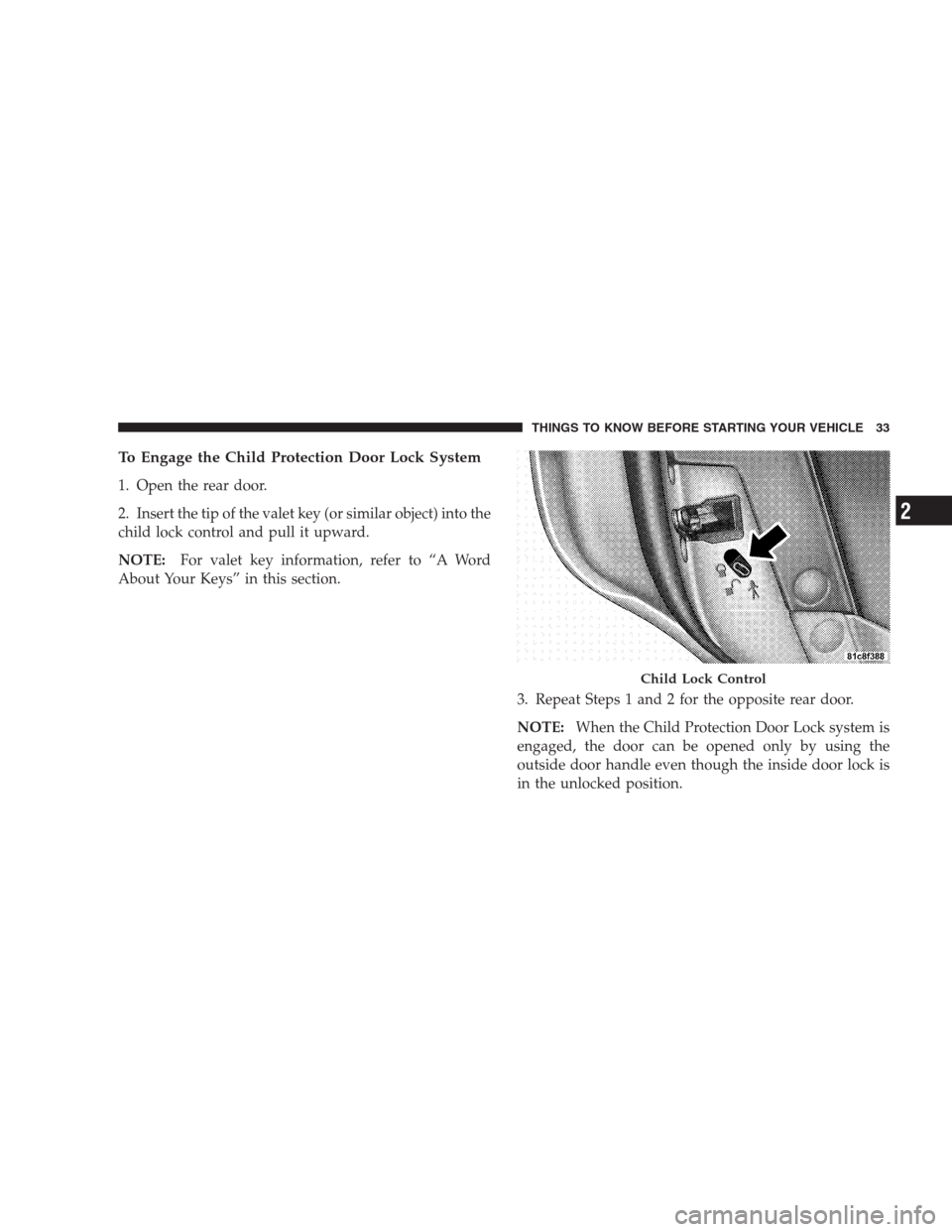
To Engage the Child Protection Door Lock System
1. Open the rear door.
2. Insert the tip of the valet key (or similar object) into the
child lock control and pull it upward.
NOTE:For valet key information, refer to “A Word
About Your Keys” in this section.
3. Repeat Steps 1 and 2 for the opposite rear door.
NOTE:When the Child Protection Door Lock system is
engaged, the door can be opened only by using the
outside door handle even though the inside door lock is
in the unlocked position.
Child Lock Control
THINGS TO KNOW BEFORE STARTING YOUR VEHICLE 33
2
Page 36 of 526
WARNING!
Avoid trapping anyone in a vehicle in a collision.
Remember that the rear doors can only be opened
from the outside when the child protection locks are
engaged. Failure to follow this warning may result in
serious injury or death.
NOTE:
•After engaging the Child Protection Door Lock sys-
tem, always test the door from the inside to make
certain it is in the desired position.
•For emergency exit with the system engaged, move
the door lock plunger to the UNLOCK position, roll
down the window and open the door with the outside
door handle.
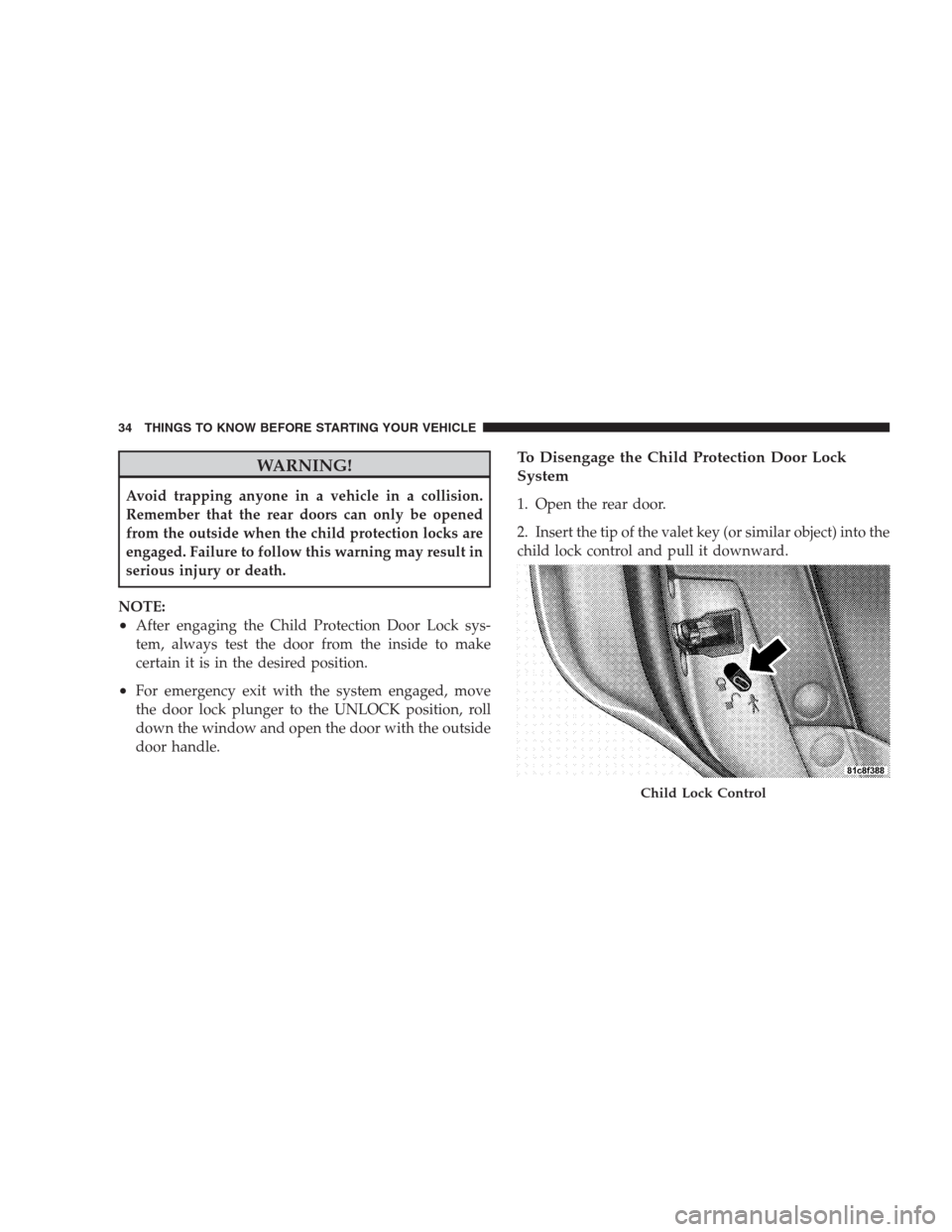
To Disengage the Child Protection Door Lock
System
1. Open the rear door.
2. Insert the tip of the valet key (or similar object) into the
child lock control and pull it downward.
Child Lock Control
34 THINGS TO KNOW BEFORE STARTING YOUR VEHICLE