2009 CHRYSLER 300 ECU
[x] Cancel search: ECUPage 25 of 526
4. Repeat these steps if you want to return this feature to
its previous setting.
NOTE:Pressing the LOCK button on the RKE transmit-
ter while you are in the vehicle will activate the security
alarm. Opening a door with the security alarm activated
will cause the alarm to sound. Press the UNLOCK button
to deactivate the security alarm.
Turn Headlights On with Remote Key Unlock
This feature activates the headlights for up to 90 seconds
when the doors are unlocked with the RKE transmitter.
The time for this feature is programmable on vehicles
equipped with the EVIC. Refer to “Turn Headlights On
with Remote Key Unlock,” under “Personal Settings
(Customer-Programmable Features)” under “Electronic
Vehicle Information Center (EVIC) – If Equipped” in
Section 4.
To Lock the Doors
Press and release the LOCK button on the RKE transmit-
ter to lock all doors. The turn signal lights will flash and
the horn will chirp to acknowledge the signal.
Sound Horn with Remote Key Lock
This feature will cause the horn to chirp when the doors
are locked with the RKE transmitter. This feature can be
turned on or turned off. To change the current setting,
proceed as follows:
•For vehicles equipped with the EVIC, refer to “Sound
Horn with Remote Key Lock,” under “Personal Set-
tings (Customer-Programmable Features)” under
“Electronic Vehicle Information Center (EVIC) – If
Equipped” in Section 4.
•For vehicles not equipped with the EVIC, perform the
following procedure:
THINGS TO KNOW BEFORE STARTING YOUR VEHICLE 23
2
Page 26 of 526
1. Press the LOCK button on a programmed RKE trans-
mitter for at least four seconds, but no longer than
10 seconds. Then, press the PANIC button while still
holding the LOCK button.
2. Release both buttons at the same time.
3. Test the feature while outside of the vehicle by press-
ing the LOCK button on the RKE transmitter with the
ignition switch in the LOCK position and the key re-
moved.
4. Repeat these steps if you want to return this feature to
its previous setting.
NOTE:Pressing the LOCK button on the RKE transmit-
ter while you are in the vehicle will activate the security
alarm. Opening a door with the security alarm activated
will cause the alarm to sound. Press the UNLOCK button
to deactivate the security alarm.To Unlatch the Trunk
Press the TRUNK button on the RKE transmitter two
times within five seconds to unlatch the trunk.
Using the Panic Alarm
To turn the Panic Alarm feature on or off, press and hold
the PANIC button on the RKE transmitter for at least one
second and release. When the Panic Alarm is on, the
headlights and park lights will flash, the horn will pulse
on and off, and the interior lights will turn on.
The Panic Alarm will stay on for three minutes unless
you turn it off by either pressing the PANIC button a
second time or drive the vehicle at a speed of 15 mph
(24 km/h) or greater.
NOTE:
•The interior lights will turn off if you turn the ignition
switch to the ACC or ON position while the Panic
Alarm is activated. However, the exterior lights and
horn will remain on.
24 THINGS TO KNOW BEFORE STARTING YOUR VEHICLE
Page 28 of 526

3. Reposition the access door panel over the battery
opening and snap into place.
General Information
This device complies with Part 15 of the FCC rules and
RSS 210 of Industry Canada. Operation is subject to the
following conditions:
•This device may not cause harmful interference.
•This device must accept any interference received,
including interference that may cause undesired
operation.
NOTE:Changes or modifications not expressly ap-
proved by the party responsible for compliance could
void the user’s authority to operate the equipment.
If your RKE transmitter fails to operate from a normal
distance, check for these two conditions:1. A weak battery in the RKE transmitter. The expected
life of the battery is a minimum of three years.
2. Closeness to a radio transmitter such as a radio station
tower, airport transmitter, and some mobile or CB radios.
REMOTE STARTING SYSTEM — IF EQUIPPED
This system uses the Remote Keyless Entry
(RKE) transmitter to start the engine conve-
niently from outside the vehicle while still
maintaining security. The system has a range of
328 ft (100 m).
NOTE:The vehicle must be equipped with an auto-
matic transmission to be equipped with Remote Start.
How to Use Remote Start
All of the following conditions must be met before the
engine will remote start:
•Shift lever in PARK
26 THINGS TO KNOW BEFORE STARTING YOUR VEHICLE
Page 29 of 526
•Doors closed
•Hood closed
•Trunk closed
•Hazard switch off
•Brake switch inactive (brake pedal not pressed)
•Ignition key removed from ignition switch
•Battery at an acceptable charge level
•RKE PANIC button not pressed
To Enter Remote Start Mode
Press and release the REMOTE START button
on the RKE transmitter twice, within five sec-
onds. The parking lights will flash and the horn
will chirp twice (if programmed). Then, the
engine will start and the vehicle will remain in the
Remote Start mode for a 15-minute cycle.NOTE:
•The park lamps will turn on and remain on during
Remote Start mode.
•For security, power window and power sunroof op-
eration (if equipped) are disabled when the vehicle is
in the Remote Start mode.
•The engine can be started two consecutive times (two
15-minute cycles) with the RKE transmitter. However,
the ignition switch must be cycled to the ON position
before you can repeat the start sequence for a third
cycle.
To Exit Remote Start Mode without Driving the
Vehicle
Press and release the REMOTE START button one time,
or allow the engine to run for the entire 15-minute cycle.
THINGS TO KNOW BEFORE STARTING YOUR VEHICLE 27
2
Page 30 of 526
NOTE:To avoid unintentional shut downs, the system
will disable the one time press of the REMOTE START
button for two seconds after receiving a valid Remote
Start request.
To Exit Remote Start Mode and Drive the Vehicle
Before the end of the 15-minute cycle, press and release
the UNLOCK button on the RKE transmitter to unlock
the doors and disarm the Vehicle Security Alarm (if
equipped). Then, prior to the end of the 15-minute cycle,
insert the key into the ignition switch and turn the switch
to the ON position.
NOTE:
•The ignition switch must be in the ON position in
order to drive the vehicle.
•For vehicles equipped with the Electronic Vehicle
Information Center (EVIC), the message “Insert Key/
Turn To Run” will flash in the EVIC until you insert
the key. Once inserted, the message “Turn To Run”
will flash in the EVIC until you turn the key to run.
DOOR LOCKS
Manual Door Locks
To lock each door, push the door lock plunger on each
door trim panel downward. To unlock each door, pull the
door lock plunger on each door trim panel upward.
28 THINGS TO KNOW BEFORE STARTING YOUR VEHICLE
Page 31 of 526
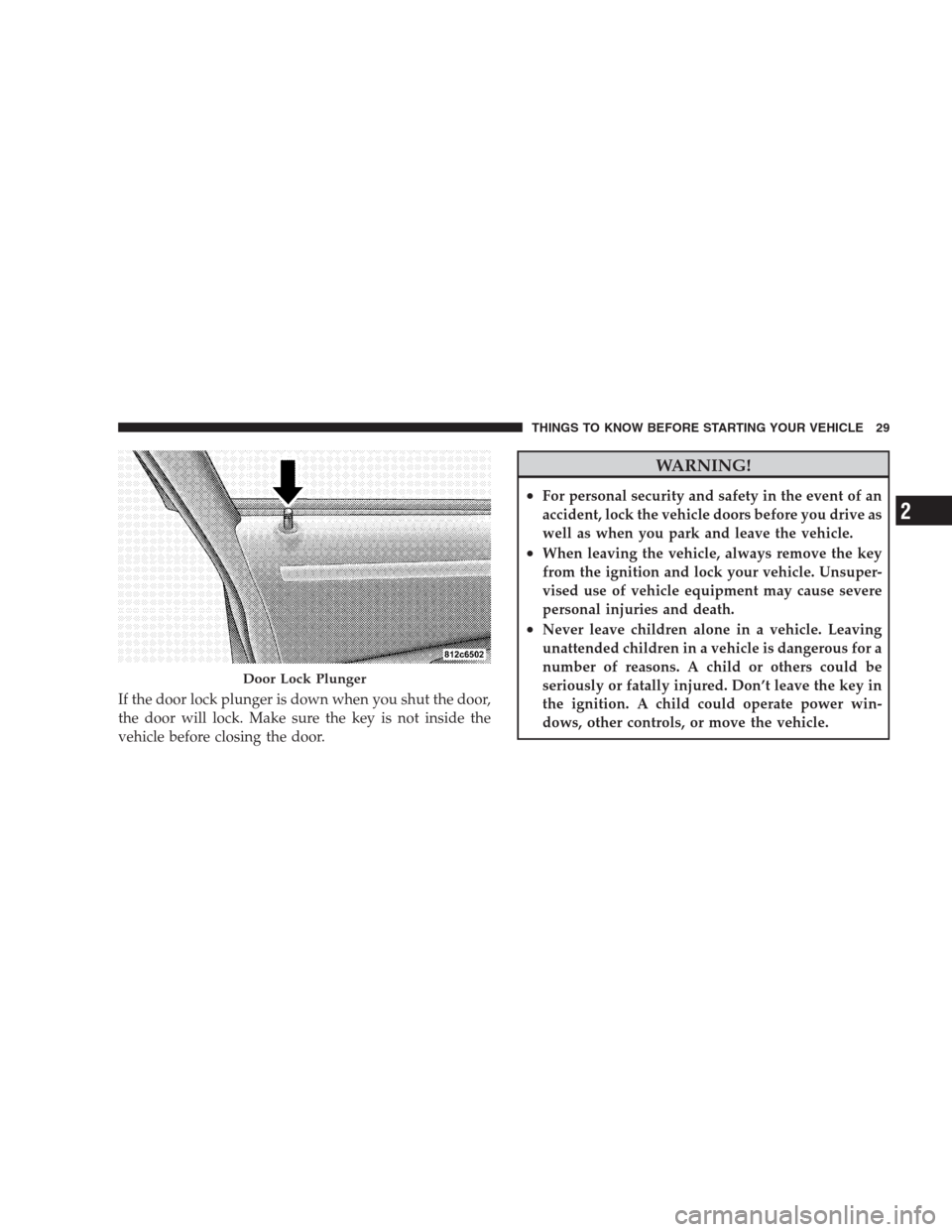
If the door lock plunger is down when you shut the door,
the door will lock. Make sure the key is not inside the
vehicle before closing the door.
WARNING!
•For personal security and safety in the event of an
accident, lock the vehicle doors before you drive as
well as when you park and leave the vehicle.
•When leaving the vehicle, always remove the key
from the ignition and lock your vehicle. Unsuper-
vised use of vehicle equipment may cause severe
personal injuries and death.
•Never leave children alone in a vehicle. Leaving
unattended children in a vehicle is dangerous for a
number of reasons. A child or others could be
seriously or fatally injured. Don’t leave the key in
the ignition. A child could operate power win-
dows, other controls, or move the vehicle.
Door Lock Plunger
THINGS TO KNOW BEFORE STARTING YOUR VEHICLE 29
2
Page 57 of 526
Along with the seat belts, front airbags work with the
instrument panel knee bolsters to provide improved
protection for the driver and front passenger. Side curtain
and seat airbags also work with seat belts to improve
occupant protection.
While the seat belts are designed to protect you in many
types of collisions, the front airbags will deploy in
moderate to severe frontal collisions. For vehicles so
equipped, the supplemental side curtain airbag and front
seat-mounted side airbag on the crash side of the vehicle
will also trigger in moderate to severe side collisions.
However, even in collisions where the airbags deploy,
you need the seat belts to keep you in the correct position
for the airbags to protect you properly.
Here are some simple steps you can take to minimize
the risk of harm from a deploying airbag.
1. Children 12 years old and younger should ride buck-
led up in the rear seat.WARNING!
Infants in rear-facing child restraints should NEVER
ride in the front seat of a vehicle with a passenger
front airbag. An airbag deployment could cause
severe injury or death to infants in that position.
2. Children who are not big enough to wear the vehicle
seat belt properly should be secured in the rear seat in
child restraints or belt-positioning booster seats. (Refer to
information on Child Restraints in this section.)
3. Older children who do not use child restraints or
belt-positioning booster seats should ride properly buck-
led up in the rear seat. Never allow children to slide the
shoulder belt behind them or under their arm.
4. If a child from 1 to 12 years old must ride in the front
passenger seat because the vehicle is crowded, move the
THINGS TO KNOW BEFORE STARTING YOUR VEHICLE 55
2
Page 68 of 526
small children ride in proper restraint systems. This is the
law, and you can be prosecuted for ignoring it.
Children 12 years and younger should ride properly
buckled up in a rear seat, if available. According to crash
statistics, children are safer when properly restrained in
the rear seats rather than in the front.
WARNING!
In a collision, an unrestrained child, even a tiny baby,
can become a missile inside the vehicle. The force
required to hold even an infant on your lap could
become so great that you could not hold the child, no
matter how strong you are. The child and others
could be badly injured. Any child riding in your
vehicle should be in a proper restraint for the child’s
size.There are different sizes and types of restraints for
children from newborn size to the child almost large
enough for an adult safety belt. Always check the child
seat Owner’s Manual to ensure you have the correct seat
for your child. Use the restraint that is correct for your
child.
Infants and Child Restraints
•
Safety experts recommend that children ride
rearward-facing in the vehicle until they are at least
one year oldandweigh at least 20 lbs (9 kg). Two types
of child restraints can be used rearward-facing, infant
carriers and convertible child seats.
•The infant carrier is only used rearward-facing in the
vehicle. It is recommended for children who weigh up
to about 20 lbs (9 kg). Convertible child seats can be
used either rearward-facing or forward-facing in the
vehicle. Convertible child seats often have a higher
weight limit in the rearward-facing direction than
66 THINGS TO KNOW BEFORE STARTING YOUR VEHICLE