2009 CHEVROLET TRAVERSE engine
[x] Cancel search: enginePage 313 of 422
Do not connect positive (+) to
negative (−) or you will get a short
that would damage the battery
and maybe other parts too. And
do not connect the negative (−)
cable to the negative (−) terminal
on the dead battery because this
can cause sparks.
6. Connect the red positive (+)
cable to the positive (+) terminal
of the dead battery.
Use a remote positive (+)
terminal if the vehicle has one.7. Do not let the other end
touch metal. Connect it to the
positive (+) terminal of the good
battery. Use a remote positive (+)
terminal if the vehicle has one.
8. Now connect the black
negative (−) cable to the
negative (−) terminal of the
good battery. Use a remote
negative (−) terminal if the
vehicle has one.
Do not let the other end touch
anything until the next step. The
other end of the negative (−)
cable does not go to the dead
battery. It goes to a heavy,
unpainted metal engine part, or to
a remote negative (−) terminal on
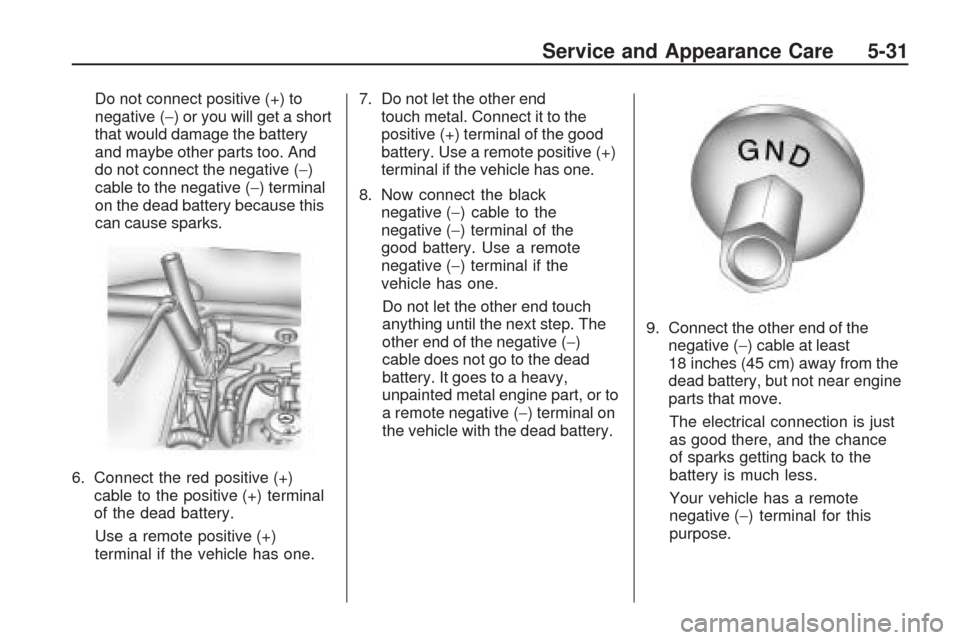
the vehicle with the dead battery.9. Connect the other end of the
negative (−) cable at least
18 inches (45 cm) away from the
dead battery, but not near engine
parts that move.
The electrical connection is just
as good there, and the chance
of sparks getting back to the
battery is much less.
Your vehicle has a remote
negative (−) terminal for this
purpose.
Service and Appearance Care 5-31
Page 314 of 422
10. Now start the vehicle with the
good battery and run the
engine for a while.
11. Try to start the vehicle that had
the dead battery. If it will not
start after a few tries, it probably
needs service.
Notice:If the jumper cables are
connected or removed in the
wrong order, electrical shorting
may occur and damage the
vehicle. The repairs would not be
covered by the vehicle warranty.
Always connect and remove the
jumper cables in the correct order,
making sure that the cables do not
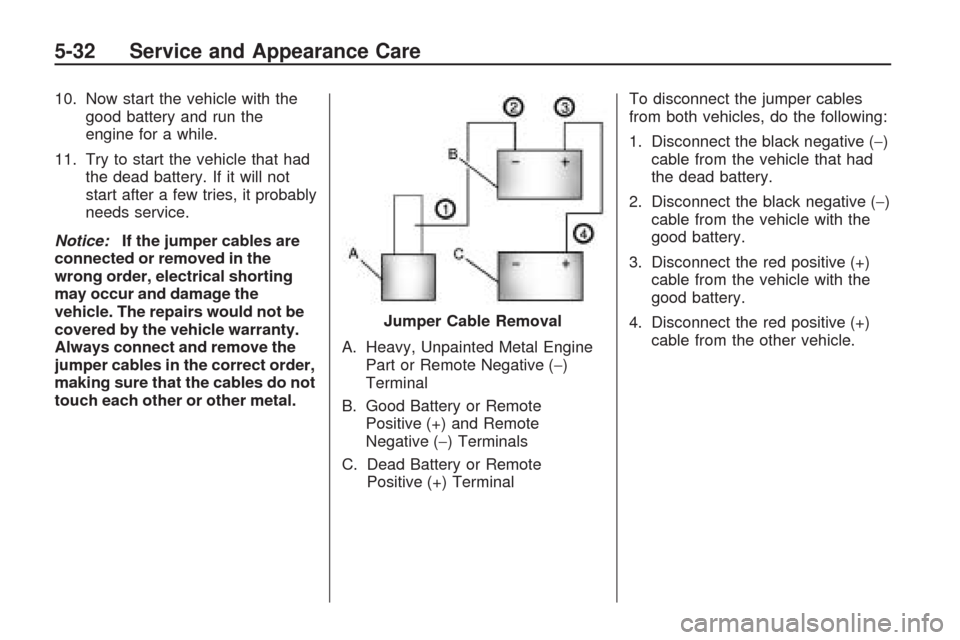
touch each other or other metal.A. Heavy, Unpainted Metal Engine
Part or Remote Negative (−)
Terminal
B. Good Battery or Remote
Positive (+) and Remote
Negative (−) Terminals
C. Dead Battery or Remote
Positive (+) TerminalTo disconnect the jumper cables
from both vehicles, do the following:
1. Disconnect the black negative (−)
cable from the vehicle that had
the dead battery.
2. Disconnect the black negative (−)
cable from the vehicle with the
good battery.
3. Disconnect the red positive (+)
cable from the vehicle with the
good battery.
4. Disconnect the red positive (+)
cable from the other vehicle. Jumper Cable Removal
5-32 Service and Appearance Care
Page 321 of 422
Tire Size
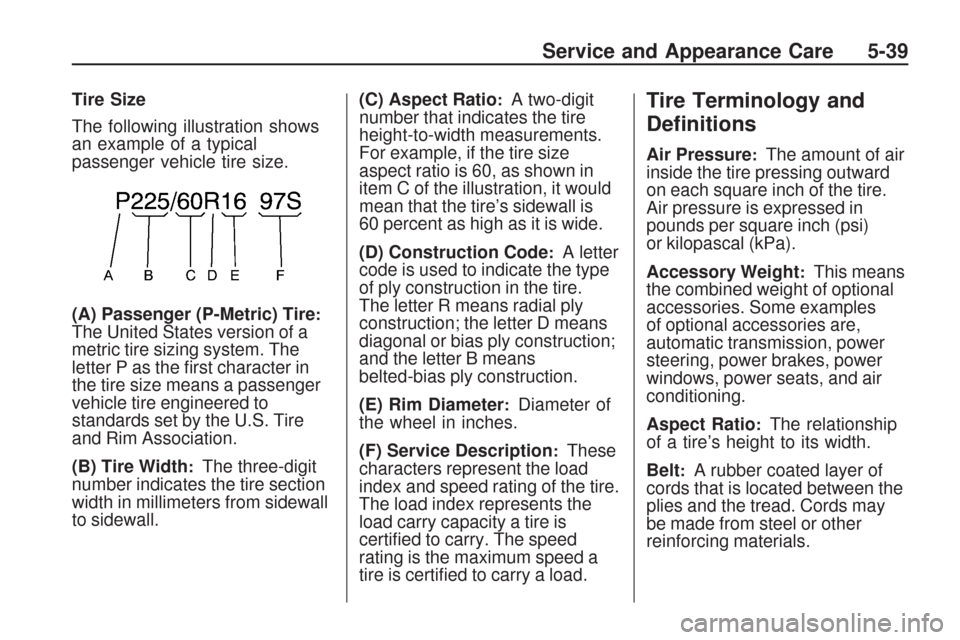
The following illustration shows
an example of a typical
passenger vehicle tire size.
(A) Passenger (P-Metric) Tire
:The United States version of a
metric tire sizing system. The
letter P as the rst character in
the tire size means a passenger
vehicle tire engineered to
standards set by the U.S. Tire
and Rim Association.
(B) Tire Width
:The three-digit
number indicates the tire section
width in millimeters from sidewall
to sidewall.(C) Aspect Ratio
:A two-digit
number that indicates the tire
height-to-width measurements.
For example, if the tire size
aspect ratio is 60, as shown in
item C of the illustration, it would
mean that the tire’s sidewall is
60 percent as high as it is wide.
(D) Construction Code
:A letter
code is used to indicate the type
of ply construction in the tire.
The letter R means radial ply
construction; the letter D means
diagonal or bias ply construction;
and the letter B means
belted-bias ply construction.
(E) Rim Diameter
:Diameter of
the wheel in inches.
(F) Service Description
:These
characters represent the load
index and speed rating of the tire.
The load index represents the
load carry capacity a tire is
certied to carry. The speed
rating is the maximum speed a
tire is certied to carry a load.
Tire Terminology and
Denitions
Air Pressure:The amount of air
inside the tire pressing outward
on each square inch of the tire.
Air pressure is expressed in
pounds per square inch (psi)
or kilopascal (kPa).
Accessory Weight
:This means
the combined weight of optional
accessories. Some examples
of optional accessories are,
automatic transmission, power
steering, power brakes, power
windows, power seats, and air
conditioning.
Aspect Ratio
:The relationship
of a tire’s height to its width.
Belt
:A rubber coated layer of
cords that is located between the
plies and the tread. Cords may
be made from steel or other
reinforcing materials.
Service and Appearance Care 5-39
Page 330 of 422

The TPMS sensor matching process
is outlined below:
1. Set the parking brake.
2. Turn the ignition switch to
ON/RUN with the engine off.
3. Press the Remote Keyless
Entry (RKE) transmitter’s LOCK
and UNLOCK buttons at the
same time for approximately
ve seconds. The horn sounds
twice to signal the receiver
is in relearn mode and TIRE
LEARNING ACTIVE message
displays on the DIC screen.
4. Start with the driver side front tire.
5. Remove the valve cap from the
valve cap stem. Activate the
TPMS sensor by increasing or
decreasing the tire’s air pressure
for ve seconds, or until a horn
chirp sounds. The horn chirp,
which may take up to 30 seconds
to sound, conrms that the sensor
identication code has been
matched to this tire and wheel
position.6. Proceed to the passenger side
front tire, and repeat the
procedure in Step 5.
7. Proceed to the passenger side
rear tire, and repeat the
procedure in Step 5.
8. Proceed to the driver side rear
tire, and repeat the procedure
in Step 5. The horn sounds
two times to indicate the sensor
identication code has been
matched to the driver side rear
tire, and the TPMS sensor
matching process is no longer
active. The TIRE LEARNING
ACTIVE message on the
DIC display screen goes off.
9. Turn the ignition switch to
LOCK/OFF.
10. Set all four tires to the
recommended air pressure level
as indicated on the Tire and
Loading Information label.
11. Put the valve caps back on the
valve stems.Tire Inspection and
Rotation
We recommend that you
regularly inspect the vehicle’s
tires, including the spare tire, if
the vehicle has one, for signs of
wear or damage. SeeWhen It Is
Time for New Tires on page 5-50
for more information.
Tires should be rotated
every 5,000 to 8,000 miles
(8 000 to 13 000 km). See
Scheduled Maintenance on
page 6-3.
The purpose of a regular tire
rotation is to achieve a uniform
wear for all tires on the vehicle.
This will ensure that the vehicle
continues to perform most like it
did when the tires were new.
5-48 Service and Appearance Care
Page 338 of 422
If a Tire Goes Flat
It is unusual for a tire to blowout
while you are driving, especially if
you maintain the tires properly. See
Tires on page 5-36. If air goes out of
a tire, It is much more likely to leak
out slowly. But if you should ever
have a blowout, here are a few tips
about what to expect and what to do:
If a front tire fails, the at tire will
create a drag that pulls the vehicle
toward that side. Take your foot off
the accelerator pedal and grip the
steering wheel rmly. Steer to
maintain lane position, and then
gently brake to a stop well out of
the traffic lane.
A rear blowout, particularly on a
curve, acts much like a skid and may
require the same correction you
would use in a skid. In any rearblowout, remove your foot from the
accelerator pedal. Get the vehicle
under control by steering the way
you want the vehicle to go. It may be
very bumpy and noisy, but you can
still steer. Gently brake to a stop, well
off the road if possible.
If a tire goes at, avoid further tire
and wheel damage by driving slowly
to a level place and stopping.
1. Turn on the hazard warning
ashers. SeeHazard Warning
Flashers on page 3-5.
2. Park the vehicle. Set the parking
brake rmly and put the shift
lever in P (Park).
3. Turn off the engine.
4. Inspect the at tire.{CAUTION
Lifting a vehicle and getting under
it to do maintenance or repairs is
dangerous without the appropriate
safety equipment and training. If a
jack is provided with the vehicle, it
is designed only for changing a
at tire. If it is used for anything
else, you or others could be badly
injured or killed if the vehicle slips
off the jack. If a jack is provided
with the vehicle, only use it for
changing a at tire.
This vehicle may come with a jack
and spare tire or a tire sealant and
compressor kit. To use the jack and
spare tire, seeChanging a Flat Tire
on page 5-65. To use the tire sealant
and compressor kit, seeTire Sealant
and Compressor Kit on page 5-57.
5-56 Service and Appearance Care
Page 339 of 422
Tire Sealant and
Compressor Kit
{CAUTION
Idling a vehicle in an enclosed
area with poor ventilation is
dangerous. Engine exhaust may
enter the vehicle. Engine exhaust
contains Carbon Monoxide (CO)
which cannot be seen or smelled.
It can cause unconsciousness
and even death. Never run the
engine in an enclosed area that
has no fresh air ventilation. For
more information, seeEngine
Exhaust on page 2-30.
{CAUTION
Over-inating a tire could cause
the tire to rupture and you or
others could be injured. Be sure to
read and follow the tire sealant and
compressor kit instructions and
inate the tire to its recommended
pressure. Do not exceed the
recommended pressure.
{CAUTION
Storing the tire sealant and
compressor kit or other equipment
in the passenger compartment
of the vehicle could cause injury.
In a sudden stop or collision, loose
equipment could strike someone.
Store the tire sealant and
compressor kit in its original
location.If this vehicle has a tire sealant and
compressor kit, there may not be a
spare tire, tire changing equipment,
and on some vehicles there may not
be a place to store a tire.
The tire sealant and compressor
can be used to temporarily seal
punctures up to
14inch (6 mm) in the
tread area of the tire. It can also be
used to inate an under inated tire.
If the tire has been separated from
the wheel, has damaged sidewalls,
or has a large puncture, the tire
is too severely damaged for the tire
sealant and compressor kit to be
effective. SeeRoadside Assistance
Program on page 7-6.
Read and follow all of the tire
sealant and compressor kit
instructions.
Service and Appearance Care 5-57
Page 347 of 422
Changing a Flat Tire
If a tire goes at, avoid further tire
and wheel damage by driving slowly
to a level place. Turn on the hazard
warning ashers. SeeHazard
Warning Flashers on page 3-5.
{CAUTION
Changing a tire can be dangerous.
The vehicle can slip off the jack
and roll over or fall on you or other
people. You and they could be
badly injured or even killed. Find
a level place to change your tire.
To help prevent the vehicle from
moving:
1. Set the parking brake rmly.
2. Put the shift lever in
P (Park).
(Continued)
CAUTION (Continued)
3. Turn off the engine and do
not restart while the vehicle
is raised.
4. Do not allow passengers to
remain in the vehicle.
To be even more certain the
vehicle will not move, you should
put blocks at the front and rear of
the tire farthest away from the
one being changed. That would
be the tire, on the other side, at
the opposite end of the vehicle.
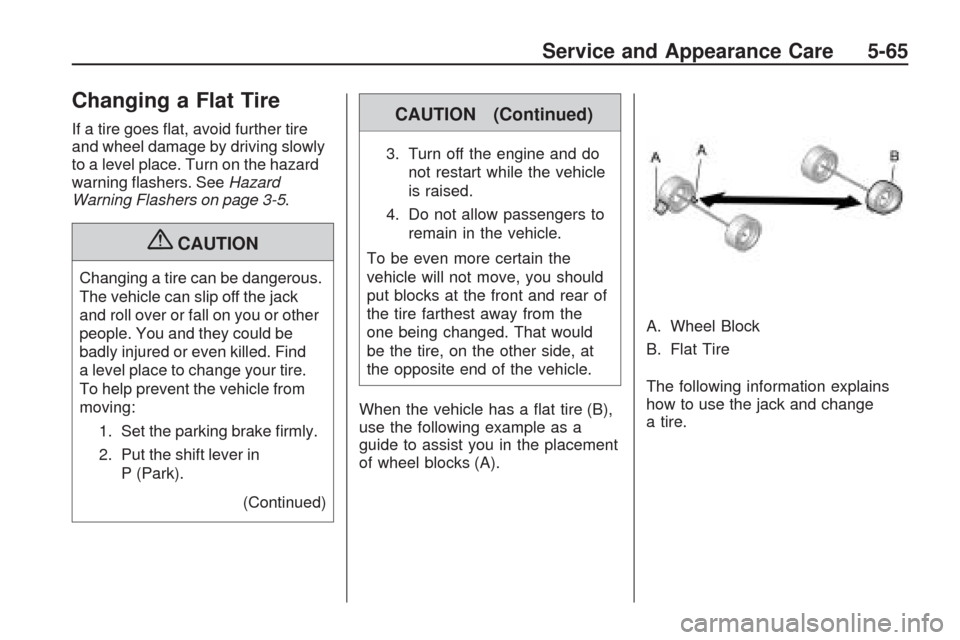
When the vehicle has a at tire (B),
use the following example as a
guide to assist you in the placement
of wheel blocks (A).A. Wheel Block
B. Flat Tire
The following information explains
how to use the jack and change
a tire.
Service and Appearance Care 5-65
Page 367 of 422
Vehicle Identication
Vehicle Identication
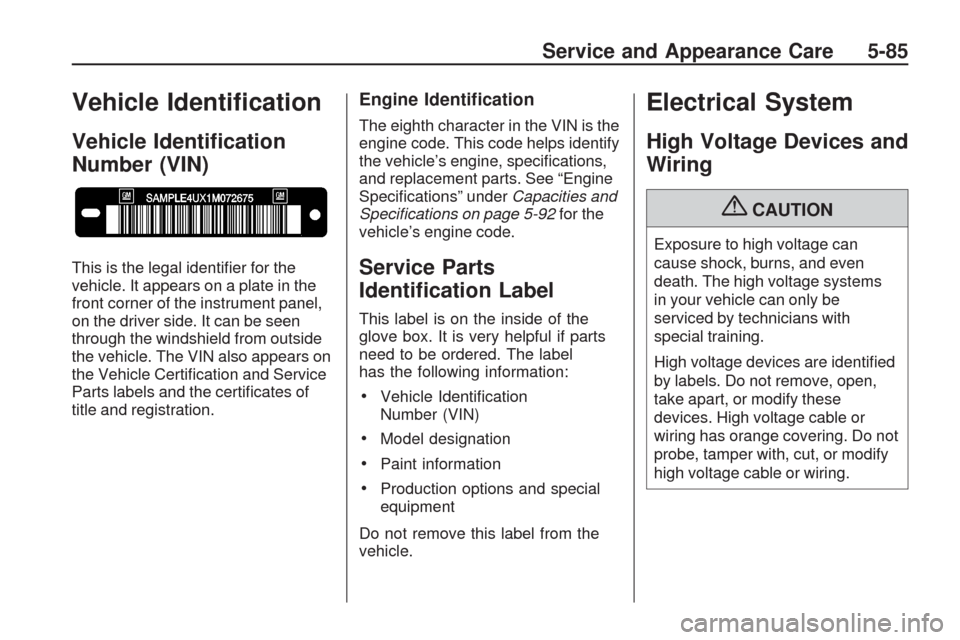
Number (VIN)
This is the legal identier for the
vehicle. It appears on a plate in the
front corner of the instrument panel,
on the driver side. It can be seen
through the windshield from outside
the vehicle. The VIN also appears on
the Vehicle Certication and Service
Parts labels and the certicates of
title and registration.
Engine Identication
The eighth character in the VIN is the
engine code. This code helps identify
the vehicle’s engine, specications,
and replacement parts. See “Engine
Specications” underCapacities and
Specifications on page 5-92for the
vehicle’s engine code.
Service Parts
Identication Label
This label is on the inside of the
glove box. It is very helpful if parts
need to be ordered. The label
has the following information:
Vehicle Identication
Number (VIN)
Model designation
Paint information
Production options and special
equipment
Do not remove this label from the
vehicle.
Electrical System
High Voltage Devices and
Wiring
{CAUTION
Exposure to high voltage can
cause shock, burns, and even
death. The high voltage systems
in your vehicle can only be
serviced by technicians with
special training.
High voltage devices are identied
by labels. Do not remove, open,
take apart, or modify these
devices. High voltage cable or
wiring has orange covering. Do not
probe, tamper with, cut, or modify
high voltage cable or wiring.
Service and Appearance Care 5-85