2009 CHEVROLET KODIAK child restraint
[x] Cancel search: child restraintPage 1 of 376

Seats and Restraint System............................. 1-1
Front Seats
............................................... 1-2
Rear Seats
..............................................1-10
Safety Belts
.............................................1-11
Child Restraints
.......................................1-28
Airbag System
.........................................1-48
Restraint System Check
............................1-59
Features and Controls..................................... 2-1
Keys
........................................................ 2-2
Doors and Locks
....................................... 2-6
Windows
.................................................. 2-8
Starting and Operating Your Vehicle
...........2-10
Mirrors
....................................................2-51
Storage Areas
.........................................2-53
Instrument Panel............................................. 3-1
Instrument Panel Overview
.......................... 3-4
Climate Controls
......................................3-20
Warning Lights, Gages, and Indicators
........3-23
Audio System(s)
.......................................3-48
Driving Your Vehicle....................................... 4-1
Your Driving, the Road, and the Vehicle
....... 4-2
Towing
...................................................4-23Service and Appearance Care.......................... 5-1
Service
..................................................... 5-3
Fuel
......................................................... 5-6
Checking Things Under the Hood
...............5-22
Rear Axle
...............................................5-67
Four-Wheel Drive
.....................................5-68
Front Axle
...............................................5-69
Noise Control System
...............................5-70
Bulb Replacement
....................................5-71
Windshield Wiper Blade Replacement
.........5-71
Other Service Items
..................................5-72
Tires
......................................................5-76
Appearance Care
.....................................5-87
Vehicle Identification
.................................5-94
Electrical System
......................................5-95
Capacities and Specifications
...................5-102
Normal Maintenance Replacement Parts
....5-108
Maintenance Schedule..................................... 6-1
Maintenance Schedule
................................ 6-2
Customer Assistance Information.................... 7-1
Customer Assistance and Information
........... 7-2
Reporting Safety Defects
............................ 7-9
Vehicle Data Recording and Privacy
...........7-11
Index................................................................ 1
2009 Chevrolet Kodiak Owner ManualM
Page 4 of 376

Vehicle Symbol Chart
Here are some additional symbols that may be found on
the vehicle and what they mean. For more information
on the symbol, refer to the index.
9:Airbag Readiness Light
#:Air Conditioning
!:Antilock Brake System (ABS)
g:Audio Steering Wheel Controls or OnStar®
$:Brake System Warning Light
":Charging System
I:Cruise Control
B:Engine Coolant Temperature
O:Exterior Lamps
#:Fog Lamps
.:Fuel Gage
+:Fuses
i:Headlamp High/Low-Beam Changer
j:LATCH System Child Restraints
*:Malfunction Indicator Lamp
::Oil Pressure
}:Power
/:Remote Vehicle Start
>:Safety Belt Reminders
7:Tire Pressure Monitor
F:Traction Control
M:Windshield Washer Fluid
iv
Page 5 of 376

Front Seats......................................................1-2
Bucket Seats.................................................1-2
Split Bench Seat (80/20 Split)..........................1-6
Air Suspension Seats......................................1-6
Rear Seats.....................................................1-10
Rear Seat Operation.....................................1-10
Safety Belts...................................................1-11
Safety Belts: They Are for Everyone................1-11
How to Wear Safety Belts Properly.................1-16
Lap-Shoulder Belt.........................................1-24
Safety Belt Use During Pregnancy..................1-26
Lap Belt......................................................1-27
Safety Belt Extender.....................................1-28
Child Restraints.............................................1-28
Older Children..............................................1-28
Infants and Young Children............................1-32
Child Restraint Systems.................................1-36
Where to Put the Restraint.............................1-38
Lower Anchors and Tethers for
Children (LATCH)......................................1-40
Securing a Child Restraint in a Rear
Outside Seat Position (Crew Cab)................1-40Securing a Child Restraint in the Center
Rear Seat Position (Crew Cab)...................1-42
Securing a Child Restraint in the Center
Front Seat Position....................................1-44
Securing a Child Restraint in the Right
Front Seat Position....................................1-44
Airbag System...............................................1-48
Where Are the Airbags?................................1-50
When Should an Airbag Inflate?.....................1-52
What Makes an Airbag Inflate?.......................1-53
How Does an Airbag Restrain?.......................1-53
What Will You See After an Airbag Inflates?........1-54
Airbag Off Switch..........................................1-55
Servicing Your Airbag-Equipped Vehicle...........1-58
Adding Equipment to Your Airbag-Equipped
Vehicle...................................................
.1-58
Restraint System Check..................................1-59
Checking the Restraint Systems......................1-59
Replacing Restraint System Parts
After a Crash............................................1-60
Section 1 Seats and Restraint System
1-1
Page 28 of 376

Lap-Shoulder Belt
All seating positions in the vehicle have a lap-shoulder
belt except for the center passenger positions (if
equipped), which have a lap belt. SeeLap Belt on
page 1-27for more information.
The following instructions explain how to wear a
lap-shoulder belt properly.
1. Adjust the seat, if the seat is adjustable, so you can
sit up straight. To see how, see “Seats” in the Index.
2. Pick up the latch plate and pull the belt across you.
Do not let it get twisted.
The lap-shoulder belt may lock if you pull the belt
across you very quickly. If this happens, let the belt
go back slightly to unlock it. Then pull the belt
across you more slowly.
If the shoulder portion of a passenger belt is pulled
out all the way, the child restraint locking feature
may be engaged. If this happens, let the belt
go back all the way and start again.3. Push the latch plate into the buckle until it clicks.
Pull up on the latch plate to make sure it is secure.
If the belt is not long enough, seeSafety Belt
Extender on page 1-28.
Position the release button on the buckle so that
the safety belt could be quickly unbuckled if
necessary.
4. If equipped with a shoulder belt height adjuster,
move it to the height that is right for you. See
“Shoulder Belt Height Adjustment” later in this
section for instructions on use and important safety
information.
1-24
Page 32 of 376
Safety Belt Extender
If the safety belt will fasten around you, you should
use it.
But if a safety belt is not long enough, your
dealer/retailer will order you an extender. When you go
in to order it, take the heaviest coat you will wear,
so the extender will be long enough for you. To help
avoid personal injury, do not let someone else use
it, and use it only for the seat it is made to fit. The
extender has been designed for adults. Never use it for
securing child seats. To wear it, attach it to the
regular safety belt. For more information, see the
instruction sheet that comes with the extender.
Child Restraints
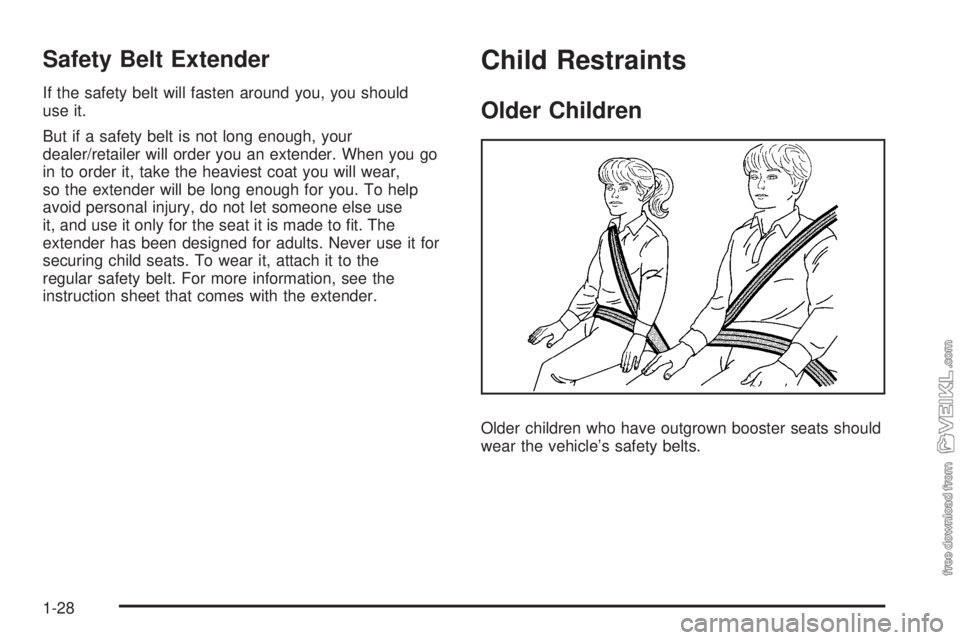
Older Children
Older children who have outgrown booster seats should
wear the vehicle’s safety belts.
1-28
Page 33 of 376

The manufacturer’s instructions that come with the
booster seat, state the weight and height limitations for
that booster. Use a booster seat with a lap-shoulder
belt until the child passes the below fit test:
•Sit all the way back on the seat. Do the knees bend
at the seat edge? If yes, continue. If no, return to
the booster seat.
•Buckle the lap-shoulder belt. Does the shoulder belt
rest on the shoulder? If yes, continue. If no, then
return to the booster seat.
•Does the lap belt fit low and snug on the hips,
touching the thighs? If yes, continue. If no, return to
the booster seat.
•Can proper safety belt fit be maintained for
length of trip? If yes, continue. If no, return to
the booster seat.
If you have the choice, a child should sit in a position
with a lap-shoulder belt and get the additional restraint a
shoulder belt can provide.
Q:What is the proper way to wear safety belts?
A:An older child should wear a lap-shoulder belt
and get the additional restraint a shoulder belt can
provide. The shoulder belt should not cross the face
or neck. The lap belt should fit snugly below the hips,
just touching the top of the thighs. This applies belt
force to the child’s pelvic bones in a crash. It should
never be worn over the abdomen, which could cause
severe or even fatal internal injuries in a crash.
According to accident statistics, children and infants are
safer when properly restrained in the rear seating
positions than in the front seating positions.
In a crash, children who are not buckled up can strike
other people who are buckled up, or can be thrown
out of the vehicle. Older children need to use safety
belts properly.
1-29
Page 36 of 376

Infants and Young Children
Everyone in a vehicle needs protection! This includes
infants and all other children. Neither the distance
traveled nor the age and size of the traveler changes the
need, for everyone, to use safety restraints. In fact, the
law in every state in the United States and in every
Canadian province says children up to some age must
be restrained while in a vehicle.{CAUTION:
Children can be seriously injured or strangled if a
shoulder belt is wrapped around their neck and
the safety belt continues to tighten. Never leave
children unattended in a vehicle and never allow
children to play with the safety belts.
Airbags plus lap-shoulder belts offer protection for adults
and older children, but not for young children and infants.
Neither the vehicle’s safety belt system nor its airbag
system is designed for them. Every time infants and
young children ride in vehicles, they should have the
protection provided by appropriate child restraints.
Children who are not restrained properly can strike other
people, or can be thrown out of the vehicle.
1-32
Page 37 of 376

{CAUTION:
Never do this.
Never hold an infant or a child while riding in a
vehicle. Due to crash forces, an infant or a child
will become so heavy it is not possible to hold it
during a crash. For example, in a crash at only
25 mph (40 km/h), a 12 lb (5.5 kg) infant will
suddenly become a 240 lb (110 kg) force on a
person’s arms. An infant should be secured in an
appropriate restraint.
1-33