2009 CHEVROLET HHR fold seats
[x] Cancel search: fold seatsPage 5 of 450
Front Seats......................................................1-2
Manual Seats................................................1-2
Seat Height Adjuster.......................................1-3
Power Seat...................................................1-3
Power Lumbar ...............................................1-4
Heated Seats.................................................1-4
Reclining Seatbacks........................................1-5
Head Restraints.............................................1-7
Passenger Folding Seatback............................1-8
Rear Seats.....................................................1-10
Split Folding Rear Seat.................................1-10
Safety Belts...................................................1-13
Safety Belts: They Are for Everyone................1-13
How to Wear Safety Belts Properly.................1-18
Lap-Shoulder Belt.........................................1-26
Safety Belt Use During Pregnancy..................1-31
Safety Belt Extender.....................................1-31
Child Restraints.............................................1-32
Older Children..............................................1-32
Infants and Young Children............................1-35
Child Restraint Systems.................................1-39
Where to Put the Restraint.............................1-42Lower Anchors and Tethers for
Children (LATCH)......................................1-43
Securing a Child Restraint in a
Rear Seat Position....................................1-51
Securing a Child Restraint in the
Right Front Seat Position............................1-54
Airbag System...............................................1-58
Where Are the Airbags?................................1-61
When Should an Airbag Inate?.....................1-63
What Makes an Airbag Inate?.......................1-64
How Does an Airbag Restrain?.......................1-64
What Will You See After an Airbag Inates?.....1-65
Passenger Sensing System
(Without Turbo/With Turbo and RPO AS5). . . .1-66
Passenger Sensing System
(With Turbo and RPO AR9 or AE4)............
.1-72
Servicing Your Airbag-Equipped Vehicle...........1-77
Adding Equipment to Your Airbag-Equipped
Vehicle....................................................1-78
Restraint System Check..................................1-79
Checking the Restraint Systems......................1-79
Replacing Restraint System Parts
After a Crash............................................1-80
Section 1 Seats and Restraint System
1-1
Page 13 of 450
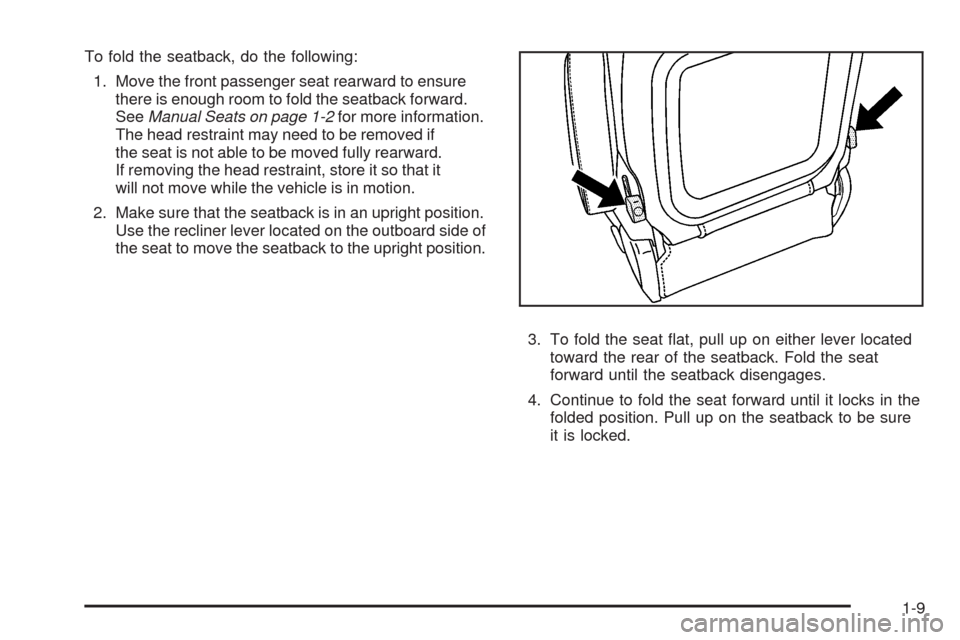
To fold the seatback, do the following:
1. Move the front passenger seat rearward to ensure
there is enough room to fold the seatback forward.
SeeManual Seats on page 1-2for more information.
The head restraint may need to be removed if
the seat is not able to be moved fully rearward.
If removing the head restraint, store it so that it
will not move while the vehicle is in motion.
2. Make sure that the seatback is in an upright position.
Use the recliner lever located on the outboard side of
the seat to move the seatback to the upright position.
3. To fold the seat at, pull up on either lever located
toward the rear of the seatback. Fold the seat
forward until the seatback disengages.
4. Continue to fold the seat forward until it locks in the
folded position. Pull up on the seatback to be sure
it is locked.
1-9
Page 14 of 450
To raise the seatback to an upright position:
1. Pull up on either lever.
2. Push the seatback up until it is in a locked position.
{CAUTION:
If either seatback is not locked, it could move
forward in a sudden stop or crash. That could
cause injury to the person sitting there. Always
push and pull on the seatbacks to be sure they
are locked.
3. Push and pull on the seatback to make sure it is
locked.
Rear Seats
Split Folding Rear Seat
The seatbacks can be folded at.
To lower the rear seatback(s):
1. Move the front seat forward and/or put the front
seatback in an upright position so it does not
interfere with folding the rear seatback forward.
2. Open the rear door while the vehicle is parked.
3. The rear head restraint may need to be removed if
it interferes with the front seat when the front seat
is moved back in place. If removed, store the
head restraint where it cannot move while the
vehicle is in motion.
Notice:Folding a rear seat with the safety belts
still fastened may cause damage to the seat or the
safety belts. Always unbuckle the safety belts
and return them to their normal stowed position
before folding a rear seat.
1-10
Page 50 of 450
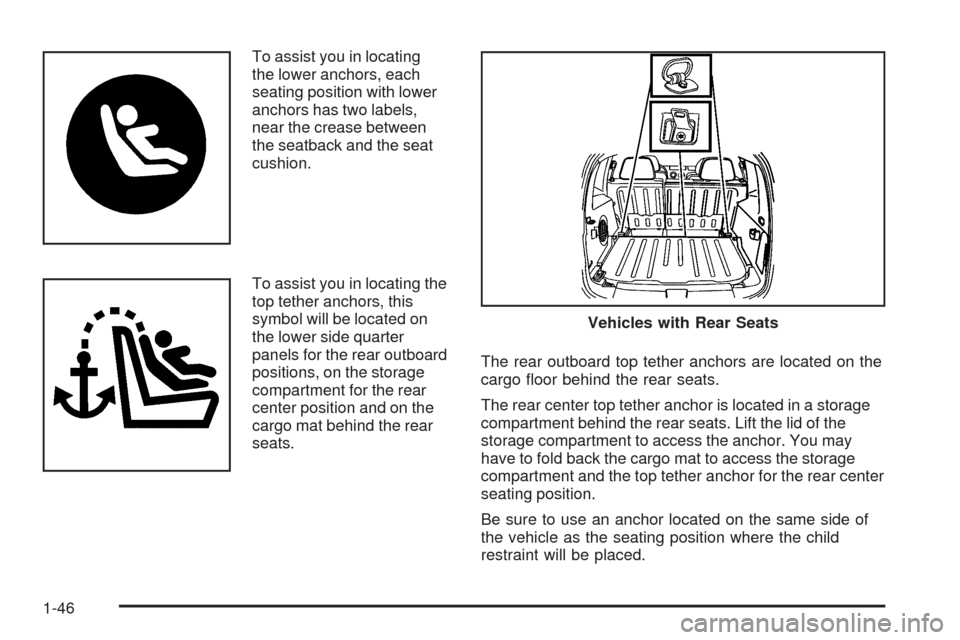
To assist you in locating
the lower anchors, each
seating position with lower
anchors has two labels,
near the crease between
the seatback and the seat
cushion.
To assist you in locating the
top tether anchors, this
symbol will be located on
the lower side quarter
panels for the rear outboard
positions, on the storage
compartment for the rear
center position and on the
cargo mat behind the rear
seats.The rear outboard top tether anchors are located on the
cargo oor behind the rear seats.
The rear center top tether anchor is located in a storage
compartment behind the rear seats. Lift the lid of the
storage compartment to access the anchor. You may
have to fold back the cargo mat to access the storage
compartment and the top tether anchor for the rear center
seating position.
Be sure to use an anchor located on the same side of
the vehicle as the seating position where the child
restraint will be placed.
Vehicles with Rear Seats
1-46
Page 53 of 450
Notice:Do not let the LATCH attachments rub
against the vehicle’s safety belts. This may damage
these parts. If necessary, move buckled safety
belts to avoid rubbing the LATCH attachments.
Do not fold the empty rear seat with a safety belt
buckled. This could damage the safety belt or
the seat. Unbuckle and return the safety belt to its
stowed position, before folding the seat.
1. Attach and tighten the lower attachments to the
lower anchors. If the child restraint does not have
lower attachments or the desired seating position
does not have lower anchors, secure the child
restraint with the top tether and the safety belts.
Refer to your child restraint manufacturer
instructions and the instructions in this manual.
1.1. Find the lower anchors for the desired
seating position.
1.2. Put the child restraint on the seat.
1.3. Attach and tighten the lower attachments on
the child restraint to the lower anchors.2. If the child restraint manufacturer recommends that
the top tether be attached, attach and tighten the
top tether to the top tether anchor, if equipped.
Refer to the child restraint instructions and
the following steps:
2.1. To secure a child restraint in the rear
center seating position, nd the storage
compartment behind the rear seats. You may
have to fold back the cargo mat to access the
storage compartment and the top tether
anchor.
Lift the lid of the storage compartment to
access the top tether anchor for the rear
center seating position.
2.2. To secure a child restraint in the rear
outboard seating positions, nd the top
tether anchor located on the cargo oor
behind the rear seats.
Be sure to use an anchor located on the
same side of the vehicle as the seating
position where the child restraint will
be placed.
1-49
Page 117 of 450
Parking Brake
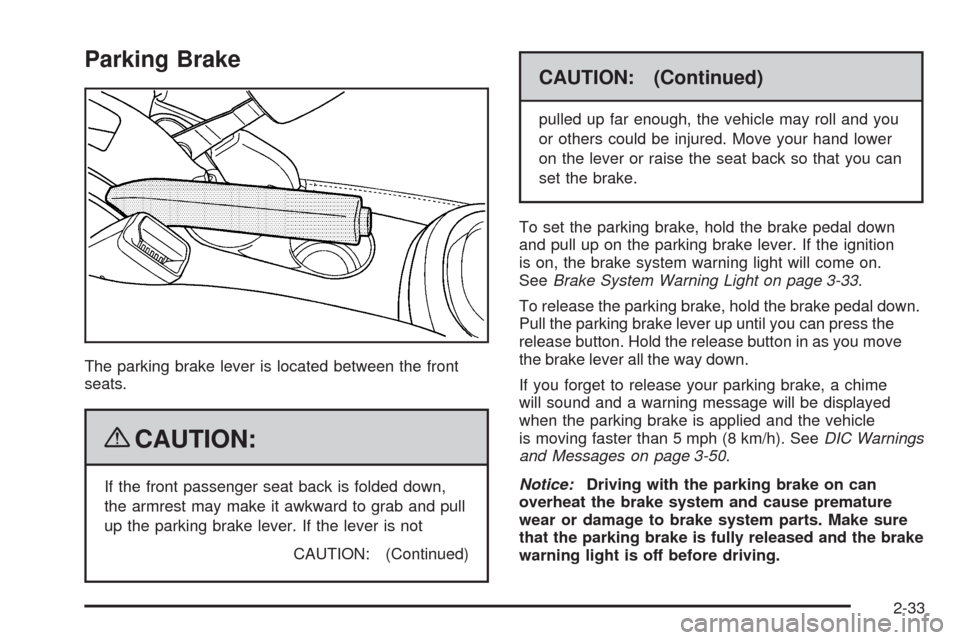
The parking brake lever is located between the front
seats.
{CAUTION:
If the front passenger seat back is folded down,
the armrest may make it awkward to grab and pull
up the parking brake lever. If the lever is not
CAUTION: (Continued)
CAUTION: (Continued)
pulled up far enough, the vehicle may roll and you
or others could be injured. Move your hand lower
on the lever or raise the seat back so that you can
set the brake.
To set the parking brake, hold the brake pedal down
and pull up on the parking brake lever. If the ignition
is on, the brake system warning light will come on.
SeeBrake System Warning Light on page 3-33.
To release the parking brake, hold the brake pedal down.
Pull the parking brake lever up until you can press the
release button. Hold the release button in as you move
the brake lever all the way down.
If you forget to release your parking brake, a chime
will sound and a warning message will be displayed
when the parking brake is applied and the vehicle
is moving faster than 5 mph (8 km/h). SeeDIC Warnings
and Messages on page 3-50.
Notice:Driving with the parking brake on can
overheat the brake system and cause premature
wear or damage to brake system parts. Make sure
that the parking brake is fully released and the brake
warning light is off before driving.
2-33
Page 267 of 450
If you put things inside your vehicle — like
suitcases, tools, packages, or anything else — they
will go as fast as the vehicle goes. If you have to
stop or turn quickly, or if there is a crash, they will
keep going.
{CAUTION:
Things you put inside your vehicle can strike
and injure people in a sudden stop or turn, or
in a crash.
Put things in the cargo area of your
vehicle. Try to spread the weight evenly.
Never stack heavier things, like
suitcases, inside the vehicle so that some
of them are above the tops of the seats.
Do not leave an unsecured child restraint
in your vehicle.
When you carry something inside the
vehicle, secure it whenever you can.
Do not leave a seat folded down unless
you need to.
Towing
Towing Your Vehicle
To avoid damage, the disabled vehicle should be towed
with all four wheels off the ground. Consult your dealer/
retailer or a professional towing service if the disabled
vehicle must be towed. SeeRoadside Assistance
Program on page 7-7.
To tow the vehicle behind another vehicle for
recreational purposes, such as behind a motorhome,
see “Recreational Vehicle Towing” following.
Recreational Vehicle Towing
Recreational vehicle towing means towing the vehicle
behind another vehicle – such as behind a motorhome.
The two most common types of recreational vehicle
towing are known as dinghy towing and dolly towing.
Dinghy towing is towing the vehicle with all four wheels
on the ground. Dolly towing is towing the vehicle with
two wheels on the ground and two wheels up on a device
known as a dolly.
4-31
Page 446 of 450
Recongurable Performance Display (RPD)........3-43
Recreational Vehicle Towing.............................4-31
Reimbursement Program, GM Mobility................. 7-7
Remote Keyless Entry (RKE) System.................. 2-4
Remote Keyless Entry (RKE) System, Operation . . . 2-4
Remote Vehicle Start........................................ 2-7
Removing the Flat Tire and Installing
the Spare Tire.....................................5-80, 5-85
Removing the Spare Tire and Tools...................5-77
Replacement Bulbs.........................................5-51
Replacement Parts, Maintenance......................6-16
Reporting Safety Defects
Canadian Government..................................7-16
General Motors...........................................7-16
United States Government............................7-16
Restraint System Check
Checking the Restraint Systems....................1-79
Replacing Restraint System Parts
After a Crash..........................................1-80
Retained Accessory Power (RAP)......................2-25
Ride Control Systems....................................... 4-7
Electronic Stability (ESC)................................ 4-7
Enhanced Traction System (ETS)...................4-13
Roadside Assistance Program............................ 7-7
Rocking Your Vehicle to Get it Out....................4-25
Roof
Sunroof......................................................2-56
Roof Rack System..........................................2-54
Running the Vehicle While Parked.....................2-38S
Safety Belt Reminders.....................................3-29
Safety Belts
Care of ....................................................5-102
Extender....................................................1-31
How to Wear Safety Belts Properly................1-18
Lap-Shoulder Belt........................................1-26
Safety Belts Are for Everyone.......................1-13
Use During Pregnancy.................................1-31
Safety Defects
Reporting to the Canadian Government................7-16
Reporting to General Motors.........................7-16
Reporting to the United States Government.....7-16
Safety Warnings and Symbols.............................. iii
Scheduled Maintenance..................................... 6-4
Additional Required Services........................... 6-7
Scheduling Appointments.................................7-11
Seatback, Folding Passenger............................. 1-8
Seats
Driver Seat Height Adjuster............................. 1-3
Heated Seats............................................... 1-4
Passenger Folding Seatback........................... 1-8
Power Lumbar .............................................. 1-4
Power Seat.................................................. 1-3
Reclining Seatbacks...................................... 1-5
Split Folding Rear Seat................................1-10
Securing a Child Restraint
Rear Seat Position......................................1-51
Right Front Seat Position..............................1-54
12