2009 CHEVROLET HHR seat adjustment
[x] Cancel search: seat adjustmentPage 30 of 450
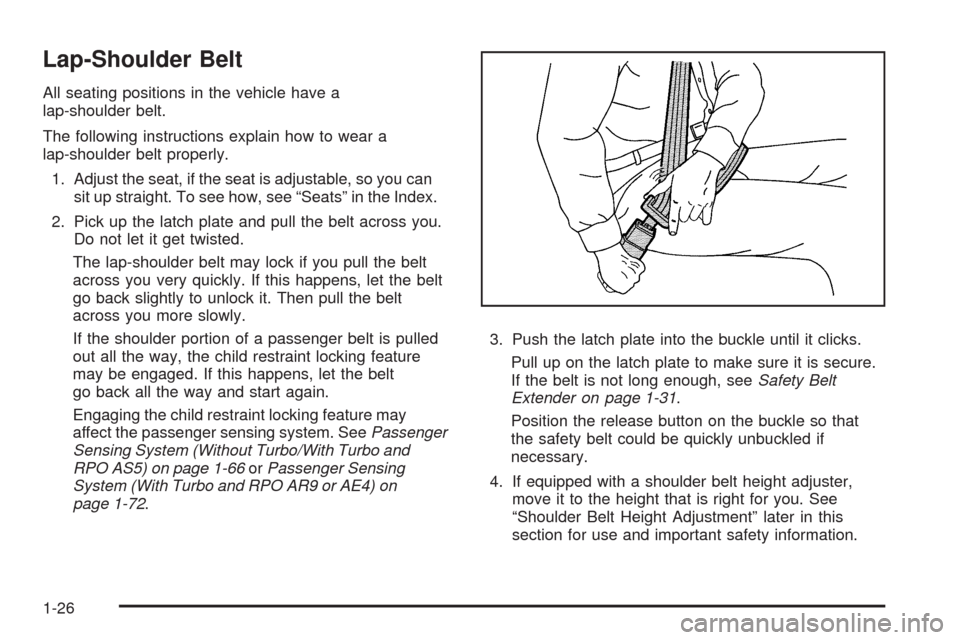
Lap-Shoulder Belt
All seating positions in the vehicle have a
lap-shoulder belt.
The following instructions explain how to wear a
lap-shoulder belt properly.
1. Adjust the seat, if the seat is adjustable, so you can
sit up straight. To see how, see “Seats” in the Index.
2. Pick up the latch plate and pull the belt across you.
Do not let it get twisted.
The lap-shoulder belt may lock if you pull the belt
across you very quickly. If this happens, let the belt
go back slightly to unlock it. Then pull the belt
across you more slowly.
If the shoulder portion of a passenger belt is pulled
out all the way, the child restraint locking feature
may be engaged. If this happens, let the belt
go back all the way and start again.
Engaging the child restraint locking feature may
affect the passenger sensing system. SeePassenger
Sensing System (Without Turbo/With Turbo and
RPO AS5) on page 1-66orPassenger Sensing
System (With Turbo and RPO AR9 or AE4) on
page 1-72.3. Push the latch plate into the buckle until it clicks.
Pull up on the latch plate to make sure it is secure.
If the belt is not long enough, seeSafety Belt
Extender on page 1-31.
Position the release button on the buckle so that
the safety belt could be quickly unbuckled if
necessary.
4. If equipped with a shoulder belt height adjuster,
move it to the height that is right for you. See
“Shoulder Belt Height Adjustment” later in this
section for use and important safety information.
1-26
Page 32 of 450
Shoulder Belt Height Adjuster
The vehicle has a shoulder belt height adjuster for the
driver and right front passenger seating positions.
Adjust the height so that the shoulder portion of the belt
is centered on the shoulder. The belt should be away
from the face and neck, but not falling off the shoulder.
Improper shoulder belt height adjustment could
reduce the effectiveness of the safety belt in a crash.
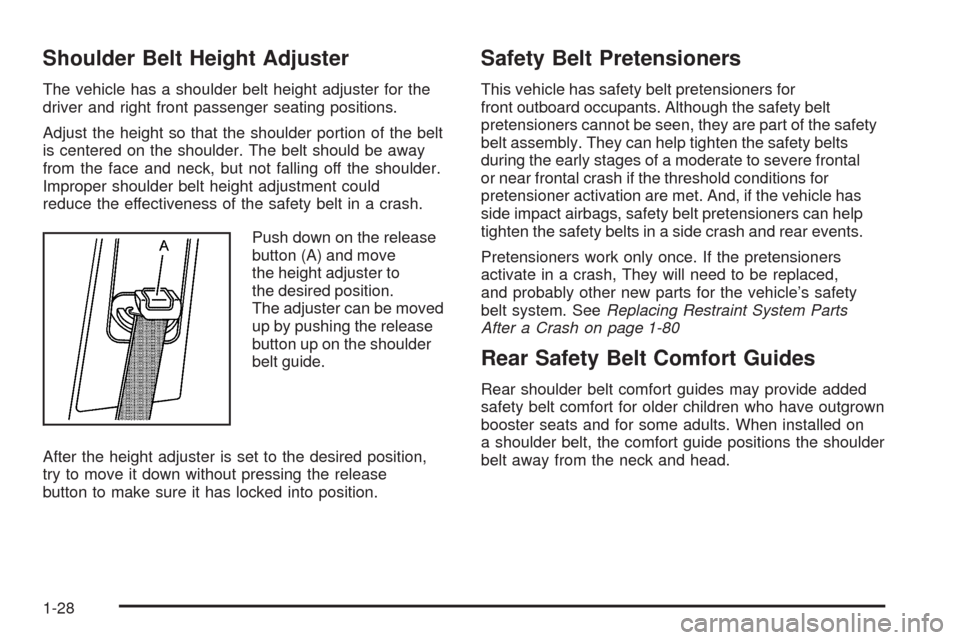
Push down on the release
button (A) and move
the height adjuster to
the desired position.
The adjuster can be moved
up by pushing the release
button up on the shoulder
belt guide.
After the height adjuster is set to the desired position,
try to move it down without pressing the release
button to make sure it has locked into position.
Safety Belt Pretensioners
This vehicle has safety belt pretensioners for
front outboard occupants. Although the safety belt
pretensioners cannot be seen, they are part of the safety
belt assembly. They can help tighten the safety belts
during the early stages of a moderate to severe frontal
or near frontal crash if the threshold conditions for
pretensioner activation are met. And, if the vehicle has
side impact airbags, safety belt pretensioners can help
tighten the safety belts in a side crash and rear events.
Pretensioners work only once. If the pretensioners
activate in a crash, They will need to be replaced,
and probably other new parts for the vehicle’s safety
belt system. SeeReplacing Restraint System Parts
After a Crash on page 1-80
Rear Safety Belt Comfort Guides
Rear shoulder belt comfort guides may provide added
safety belt comfort for older children who have outgrown
booster seats and for some adults. When installed on
a shoulder belt, the comfort guide positions the shoulder
belt away from the neck and head.
1-28
Page 164 of 450
If the vehicle speed is greater than 50 mph (80 km/h)
and the rear defogger is on, it remains on as long as the
speed is greater than 50 mph (80 km/h). The defogger
can also be turned off by turning off the engine.
For vehicles with the remote start feature, the rear
defogger automatically turns on if it is cold outside. When
the vehicle transitions out of the remote start mode, the
rear defogger turns off. SeeRemote Keyless Entry (RKE)
System Operation on page 2-4
Notice:Do not use anything sharp on the inside
of the rear window. If you do, you could cut or
damage the warming grid, and the repairs would not
be covered by the vehicle warranty. Do not attach a
temporary vehicle license, tape, a decal or anything
similar to the defogger grid.
Outlet Adjustment
Turn the outlets and move the outlet vanes to change
the direction of the airow and to open and close
the outlets.
Operation Tips
Clear away any ice, snow or leaves from the air
inlets at the base of the windshield that may
block the ow of air into the vehicle.
Use of non-GM approved hood deectors may
adversely affect the performance of the system.
Keep the path under the front seats clear of objects
to help circulate the air inside of the vehicle more
effectively.
Passenger Compartment Air Filter
The lter removes dust and pollen from the air which is
drawn into the vehicle. Airow reduction is an indication
that the lter needs to be replaced.
The lter should be replaced as part of routine scheduled
maintenance. SeeScheduled Maintenance on page 6-4
for replacement intervals. To nd out what type of lter to
use, seeMaintenance Replacement Parts on page 6-16.
3-24
Page 236 of 450
XM™ Satellite Radio Service
XM Satellite Radio Service gives digital radio reception
from coast-to-coast in the 48 contiguous United States,
and in Canada. Just as with FM, tall buildings or hills can
interfere with satellite radio signals, causing the sound to
fade in and out. In addition, traveling or standing under
heavy foliage, bridges, garages, or tunnels may cause
loss of the XM signal for a period of time.
Cellular Phone Usage
Cellular phone usage may cause interference with the
vehicle’s radio. This interference may occur when making
or receiving phone calls, charging the phone’s battery,
or simply having the phone on. This interference causes
an increased level of static while listening to the radio.
If static is received while listening to the radio, unplug
the cellular phone and turn it off.
Fixed Mast Antenna
The xed mast antenna can withstand most car washes
without being damaged as long as it is securely attached
to the base. If the mast becomes slightly bent, straighten
it out by hand. If the mast is badly bent, replace it.Occasionally check to make sure the antenna is
tightened to its base. If tightening is required, tighten by
hand until fully seated plus one quarter turn.
XM™ Satellite Radio Antenna
System
The XM Satellite Radio antenna is located on the roof of
the vehicle. Keep the antenna clear of obstructions for
clear radio reception.
If the vehicle has a sunroof, the performance of the XM
system may be affected if the sunroof is open.
Chime Level Adjustment
The radio may be used to adjust the vehicle’s chime
level. If the radio can be used to change the volume
level of the chime, press and hold the sixth numbered
pushbutton or the sixth FAV pushbutton with the ignition
on and the radio power off. The volume level changes
between Normal and Loud. The selected volume
level appears on the radio display.
Removing the radio and not replacing it with a factory
radio or chime module will disable vehicle chimes.
3-96
Page 322 of 450
Headlamp Aiming
The vehicle has a visual optical headlamp aiming
system. The aim has been preset at the factory and
should need no further adjustment.
However, if the vehicle is damaged in a crash, the
headlamp aim may be affected and adjustment may be
necessary.
If oncoming vehicles ash their high beams at you, this
may also mean the vertical aim needs to be adjusted.
It is recommended that the vehicle is taken to your
dealer/retailer for service if the headlamps need to
be re-aimed. It is possible however, to re-aim the
headlamps as described.
The vehicle should:
Be placed so the headlamps are 25 ft. (7.6 m) from
a light colored wall.
Have all four tires on a level surface which is level
all the way to the wall.
Be placed so it is perpendicular to the wall or other
at surface.
Not have any snow, ice, or mud on it.
Be fully assembled and all other work stopped while
headlamp aiming is being performed.
Normally loaded with a full tank of fuel and one
person or 160 lbs (75 kg) sitting on the driver seat.
Have all tires properly inated.
Have the spare tire is in its original location in the
vehicle.
Headlamp aiming is done with the vehicle’s low-beam
headlamps. The high-beam headlamps will be correctly
aimed if the low-beam headlamps are aimed properly.
5-44
Page 437 of 450
Bulb Replacement...........................................5-51
Center High-Mounted Stoplamp (CHMSL)........5-49
Fog Lamp ..................................................3-16
Halogen Bulbs............................................5-47
Headlamp Aiming........................................5-44
Headlamps.................................................5-47
Headlamps, Front Turn Signal,
and Parking Lamps..................................5-47
License Plate Lamps....................................5-51
Taillamps, Turn Signal, Stoplamps and
Back-up Lamps........................................5-50
Buying New Tires...........................................5-70
C
Calibration.....................................................2-39
California
Perchlorate Materials Requirements................. 5-4
California Fuel.................................................. 5-6
California Proposition 65 Warning....................... 5-4
Camera, Rear Vision.......................................2-44
Canadian Owners................................................ ii
Capacities and Specications..........................5-114
Carbon Monoxide
Engine Exhaust...........................................2-37
Liftgate......................................................2-12
Winter Driving.............................................4-22Care of
Safety Belts..............................................5-102
Cargo, Rear Side Door....................................2-12
CD, MP3 .......................................................3-74
Center High-Mounted Stoplamp (CHMSL)...........5-49
Chains, Tire...................................................5-74
Charging System Light....................................3-32
Check
Engine Lamp..............................................3-37
Checking Things Under the Hood......................5-12
Chemical Paint Spotting.................................5-106
Child Restraints
Infants and Young Children...........................1-35
Lower Anchors and Tethers for Children..........1-43
Older Children.............................................1-32
Securing a Child Restraint in a
Rear Seat Position...................................1-51
Securing a Child Restraint in the
Right Front Seat Position..........................1-54
Systems.....................................................1-39
Where to Put the Restraint...........................1-42
Chime Level Adjustment..................................3-96
Cigarette Lighter.............................................3-21
Circuit Breakers............................................5-109
3
Page 441 of 450
Fuel............................................................... 5-5
Additives...................................................... 5-6
California Fuel.............................................. 5-6
E85 (85% Ethanol)........................................ 5-7
Economy Driving........................................... 4-2
Filling a Portable Fuel Container....................5-12
Filling the Tank............................................. 5-9
Fuels in Foreign Countries.............................. 5-8
Gage .........................................................3-42
Gasoline Octane........................................... 5-5
Gasoline Specications.................................. 5-6
Fuses
Engine Compartment Fuse Block.................5-111
Floor Console Fuse Block...........................5-109
Fuses and Circuit Breakers.........................5-109
Windshield Wiper.......................................5-108
G
Gage
Speedometer..............................................3-28
Tachometer.................................................3-28
Gages
Boost.........................................................3-42
Engine Coolant Temperature.........................3-36
Fuel..........................................................3-42Gasoline
Octane........................................................ 5-5
Specications............................................... 5-6
Glove Box.....................................................2-51
GM Mobility Reimbursement Program.................. 7-7
H
Halogen Bulbs................................................5-47
Hazard Warning Flashers................................... 3-6
Head Restraints............................................... 1-7
Headlamp
Aiming .......................................................5-44
Headlamp Wiring...........................................5-108
Headlamps....................................................3-14
Bulb Replacement.......................................5-47
Daytime Running Lamps (DRL).....................3-15
Flash-to-Pass............................................... 3-8
Headlamps, Front Turn Signal,
and Parking Lamps..................................5-47
High/Low Beam Changer................................ 3-8
On Reminder..............................................3-15
Range Adjustment......................................... 1-7
Wiper Activated...........................................3-15
Heated Seats................................................... 1-4
7
Page 445 of 450
P
Paint, Damage..............................................5-106
Park
Shifting Into................................................2-34
Shifting Out of............................................2-35
Parking
Over Things That Burn.................................2-36
Parking Brake................................................2-33
Parking Your Vehicle.......................................2-36
Passenger Airbag Status Indicator.....................3-31
Passenger Compartment Air Filter.....................3-24
Passenger Sensing System......................1-66, 1-72
Passing.........................................................4-16
PASS-Key
®III+ Electronic Immobilizer...............2-20
PASS-Key®III+ Electronic Immobilizer
Operation...................................................2-21
Perchlorate Materials Requirements, California...... 5-4
Phone
Bluetooth
®..................................................3-82
Power
Door Locks.................................................. 2-9
Electrical System.......................................5-108
Lumbar Controls........................................... 1-4
Retained Accessory (RAP)............................2-25
Seat ............................................................ 1-3
Windows....................................................2-17
Pregnancy, Using Safety Belts..........................1-31
Pressure Cap.................................................5-32Privacy..........................................................7-18
Navigation System.......................................7-19
OnStar.......................................................7-19
Radio Frequency Identication (RFID).............7-19
Programmable Automatic Door Unlock...............2-10
Proposition 65 Warning, California....................... 5-4
R
Racing or Other Competitive Driving..................4-18
Radio Frequency Identication (RFID), Privacy....7-19
Radio(s)........................................................3-63
Radios
Reception...................................................3-95
Setting the Clock.........................................3-62
Theft-Deterrent............................................3-94
Range Adjustment, Headlamps........................... 1-7
Rear Compartment Storage Panel/Cover............2-52
Rear Door Security Locks................................2-11
Rear Reading Lamps......................................3-17
Rear Side Cargo Door.....................................2-12
Rear Storage Areas........................................2-51
Rear Vision Camera (RVC)..............................2-44
Rear Window Washer/Wiper.............................3-10
Rearview Mirror, Automatic Dimming..................2-39
Rearview Mirrors.............................................2-39
Reclining Seatbacks.......................................... 1-5
Recommended Fluids and Lubricants.................6-14
11