Page 230 of 354

Then, without shutting off the engine, follow these steps:
1. Locate the automatic transmission dipstick which
is located toward the front of the engine
compartment, near the power steering uid
reservoir.
SeeEngine Compartment Overview on page 5-14
for more information on location.
2. Pull out the dipstick and wipe it with a clean rag or
paper towel.
3. Push the dipstick back in all the way, wait three
seconds, and then pull it back out again.
4. Check both sides of the dipstick. The uid should
be between MIN (A) and MAX (B) mark of the hot
area of the dipstick.
5. If the uid level is in the acceptable range, push the
dipstick back in all the way.How to Add Automatic Transmission
Fluid
Refer to the Maintenance Schedule to determine what
kind of transmission uid to use. SeeRecommended
Fluids and Lubricants on page 6-13.
If the uid level is low, add only enough of the proper
uid to bring the level into the area between the
two dimples in the hot range on the dipstick.
1. Pull out the dipstick.
2. Using a long-neck funnel, add enough uid at the
dipstick hole to bring it to the proper level.
It does not take much uid, generally less than one
pint (0.5 L). Do not overll.
Notice:Use of the incorrect automatic transmission
uid may damage the vehicle, and the damages
may not be covered by the vehicle’s warranty.
Always use the automatic transmission uid listed
inRecommended Fluids and Lubricants on
page 6-13.
3. After adding uid, recheck the uid level as
described under “How to Check Automatic
Transmission Fluid” earlier in this section.
4. When the correct uid level is obtained, push the
dipstick back in all the way.
5-22
Page 231 of 354

Manual Transmission Fluid
It is not necessary to check the transmission uid level.
A transmission uid leak is the only reason for uid
loss. If a leak occurs, take the vehicle to the
dealer/retailer service department and have it repaired
as soon as possible. SeeRecommended Fluids
and Lubricants on page 6-13for the proper uid to use.
Hydraulic Clutch
There is one reservoir for both the brake and the
hydraulic clutch uid. SeeBrakes on page 5-34for more
information.
The hydraulic clutch linkage in the vehicle is
self-adjusting. The master cylinder reservoir is lled
with hydraulic uid.
A uid loss in this system could indicate a problem.
Have the system inspected and repaired.
When to Check and What to Use
Refer to the Maintenance Schedule to determine how
often to check the uid level in the master cylinder
reservoir and for the proper uid. SeeOwner Checks
and Services on page 6-9andRecommended
Fluids and Lubricants on page 6-13.
How to Check and Add Fluid
The reservoir is located near the back of the engine
compartment on the driver side of the vehicle. See
Engine Compartment Overview on page 5-14for more
information on location.
To check the uid level, look on the side of the reservoir.
If the uid reaches the MAX (A) mark on the reservoir,
the uid level is correct. If the uid does not reach
the MIN (B) mark on the reservoir, then uid needs to
be added.
5-23
Page 232 of 354
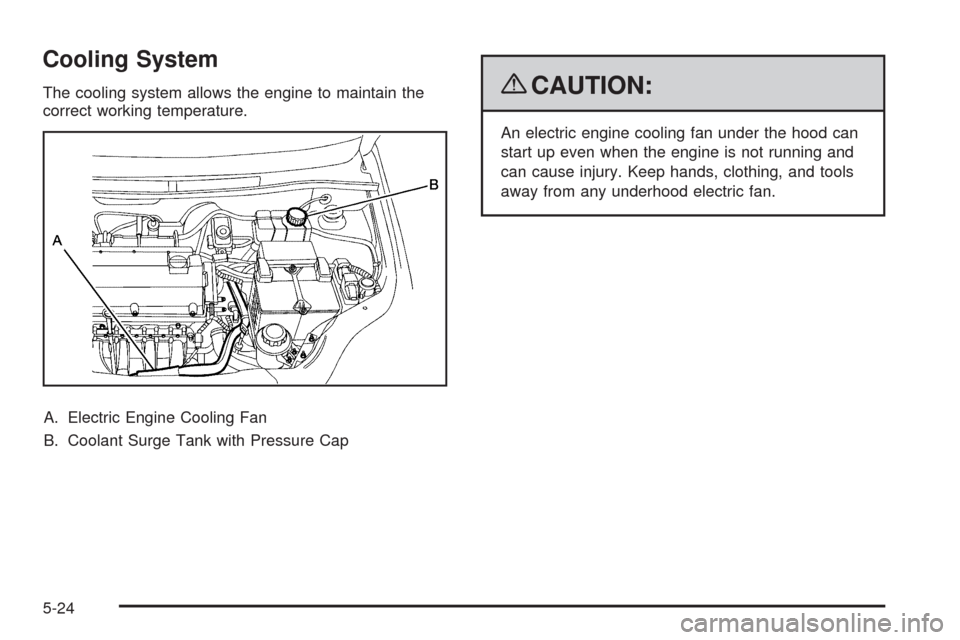
Cooling System
The cooling system allows the engine to maintain the
correct working temperature.
A. Electric Engine Cooling Fan
B. Coolant Surge Tank with Pressure Cap{CAUTION:
An electric engine cooling fan under the hood can
start up even when the engine is not running and
can cause injury. Keep hands, clothing, and tools
away from any underhood electric fan.
5-24
Page 233 of 354

{CAUTION:
Heater and radiator hoses, and other engine parts,
can be very hot. Do not touch them. If you do, you
can be burned.
Do not run the engine if there is a leak. If you run
the engine, it could lose all coolant. That could
cause an engine re, and you could be burned.
Get any leak xed before you drive the vehicle.Notice:Using coolant other than DEX-COOL
®can
cause premature engine, heater core, or radiator
corrosion. In addition, the engine coolant may
require changing sooner, at the rst maintenance
service after each 30,000 miles (50 000 km) or
24 months, whichever occurs rst. Any repairs
would not be covered by the vehicle warranty.
Always use DEX-COOL
®(silicate-free) coolant in
the vehicle.
Engine Coolant
The cooling system in the vehicle is lled with
DEX-COOL®engine coolant. This coolant is designed to
remain in the vehicle for ve years or 150,000 miles
(240 000 km), whichever occurs rst.
The following explains the cooling system and how to
check and add coolant when it is low. If there is a
problem with engine overheating, seeEngine
Overheating on page 5-30.
5-25
Page 234 of 354
What to Use
{CAUTION:
Adding only plain water to the cooling system can
be dangerous. Plain water, or some other liquid
such as alcohol, can boil before the proper coolant
mixture will. The vehicle’s coolant warning system
is set for the proper coolant mixture. With plain
water or the wrong mixture, the engine could get
too hot but you would not get the overheat
warning. The engine could catch re and you or
others could be burned. Use a 50/50 mixture of
clean, drinkable water and DEX-COOL
®coolant.
Use a 50/50 mixture of clean, drinkable water and
DEX-COOL
®coolant. If using this mixture, nothing else
needs to be added. This mixture:
Gives freezing protection down to−34°F (−37°C),
outside temperature.
Gives boiling protection up to 265°F (129°C), engine
temperature.
Protects against rust and corrosion.
Will not damage aluminum parts.
Helps keep the proper engine temperature.
Notice:If an improper coolant mixture is used,
the engine could overheat and be badly damaged.
The repair cost would not be covered by the vehicle
warranty. Too much water in the mixture can freeze
and crack the engine, radiator, heater core, and
other parts.
Notice:If extra inhibitors and/or additives are used
in the vehicle’s cooling system, the vehicle could be
damaged. Use only the proper mixture of the engine
coolant listed in this manual for the cooling system.
SeeRecommended Fluids and Lubricants on
page 6-13for more information.
Checking Coolant
The vehicle must be on a level surface when checking the
coolant level.
Check to see if coolant is visible in the coolant surge tank.
If the coolant inside the coolant surge tank is boiling, do
not do anything else until it cools down. If coolant is
visible but the coolant level is not between the Minimum
and Maximum marks, add a 50/50 mixture of clean,
drinkable water and DEX-COOL
®coolant at the coolant
surge tank, but be sure the cooling system is cool before
this is done. SeeEngine Coolant on page 5-25for more
information.
5-26
Page 235 of 354
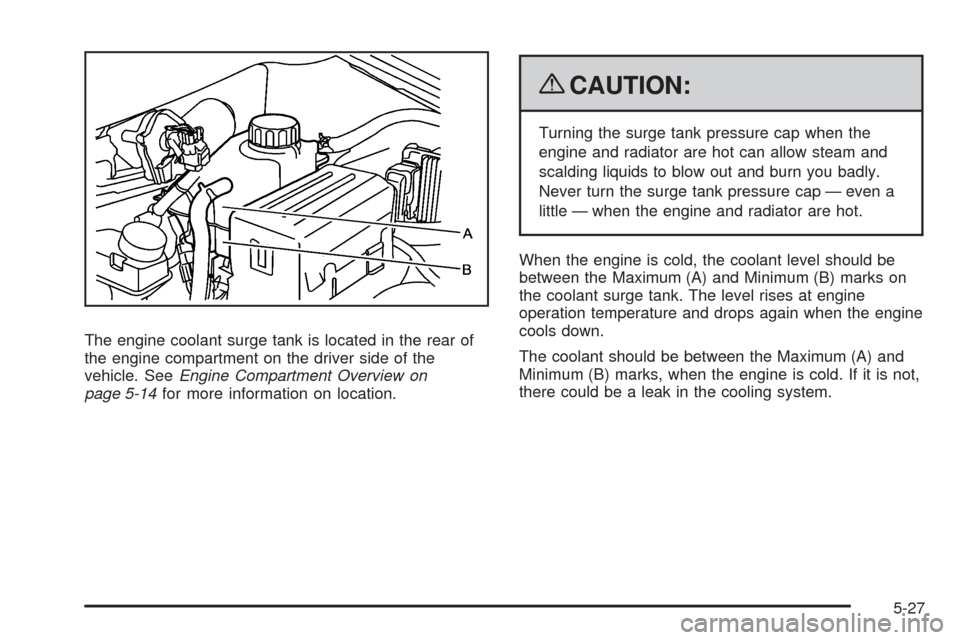
The engine coolant surge tank is located in the rear of
the engine compartment on the driver side of the
vehicle. SeeEngine Compartment Overview on
page 5-14for more information on location.
{CAUTION:
Turning the surge tank pressure cap when the
engine and radiator are hot can allow steam and
scalding liquids to blow out and burn you badly.
Never turn the surge tank pressure cap — even a
little — when the engine and radiator are hot.
When the engine is cold, the coolant level should be
between the Maximum (A) and Minimum (B) marks on
the coolant surge tank. The level rises at engine
operation temperature and drops again when the engine
cools down.
The coolant should be between the Maximum (A) and
Minimum (B) marks, when the engine is cold. If it is not,
there could be a leak in the cooling system.
5-27
Page 236 of 354
How to Add Coolant to the Coolant
Surge Tank
{CAUTION:
You can be burned if you spill coolant on hot
engine parts. Coolant contains ethylene glycol and
it will burn if the engine parts are hot enough. Do
not spill coolant on a hot engine.
Notice:This vehicle has a specic coolant ll
procedure. Failure to follow this procedure could
cause the engine to overheat and be severely
damaged.
{CAUTION:
An electric engine cooling fan under the hood can
start up even when the engine is not running and
can cause injury. Keep hands, clothing, and tools
away from any underhood electric fan.
{CAUTION:
Steam and scalding liquids from a hot cooling
system can blow out and burn you badly. They are
under pressure, and if you turn the surge tank
pressure cap — even a little — they can come out
at high speed. Never turn the cap when the
cooling system, including the surge tank pressure
cap, is hot. Wait for the cooling system and surge
tank pressure cap to cool if you ever have to turn
the pressure cap.
If no coolant is visible in the surge tank, add coolant as
follows:
1. Remove the coolant surge tank pressure cap when
the cooling system, including the coolant surge tank
pressure cap and upper radiator hose, is no longer
hot. Turn the pressure cap slowly counterclockwise
about two or two and one-half turns.
If you hear a hiss, wait for that to stop. This will
allow any pressure still left to be vented out
the discharge hose.
5-28
Page 238 of 354
4. With the coolant surge tank pressure cap off, start
the engine and let it run until you can feel the upper
radiator hose getting hot. Watch out for the
engine cooling fan.
By this time, the coolant level inside the coolant
surge tank may be lower. If the level is lower than
the Maximum mark, add more of the proper mixture
to the coolant surge tank until the level reaches
the mark.
5. Replace the pressure cap. Be sure the pressure
cap is hand-tight and fully seated.
Notice:If the pressure cap is not tightly installed,
coolant loss and possible engine damage may
occur. Be sure the cap is properly and tightly
secured.Engine Overheating
The vehicle has an indicator to warn of the engine
overheating.
There is a coolant temperature gage on the instrument
panel cluster. SeeEngine Coolant Temperature
Gage on page 3-31.
You may decide not to lift the hood when this warning
appears, but instead get service help right away.
SeeRoadside Assistance Program on page 7-7.
If you do decide to lift the hood, make sure the vehicle
is parked on a level surface.
Then check to see if the engine cooling fan is running.
If the engine is overheating, the fan should be
running. If it is not, do not continue to run the engine
and have the vehicle serviced.
Notice:Engine damage from running the engine
without coolant is not covered by the warranty.
Notice:If the engine catches re because of being
driven with no coolant, your vehicle can be badly
damaged. The costly repairs would not be covered
by the vehicle warranty.
5-30