2009 CHERY TIGGO heating
[x] Cancel search: heatingPage 712 of 1903

Downloaded from www.Manualslib.com manuals search engine 6. Installation is in the reverse order of removal.
NOTE :
After installing the engine coolant temperature sensor, check the coolant level.
Knock Sensor
Description
The knock sensor is attached to the cylinder block. The knock sensor is designed to detect engine vibration that is
caused by detonation.
Operation
When the knock sensor detects a knock in one of the cylinders, it sends an input signal to the Engine Control Module
(ECM). In response, the ECM retards ignition timing for all cylinders by a specified amount.
The knock sensor contains a piezoelectric material which constantly vibrates and sends an input voltage (signal) to
the ECM while the engine operates. As the intensity of the vibration increases, the knock sensor output voltage also
increases.
The ECM ignores knock sensor input during engine idle conditions. Once the engine speed exceeds a specified
value, knock retard is allowed.
Removal & Installation
1. Disconnect and isolate the negative battery cable.
2. Disconnect the knock sensor electrical connector.
3. Remove the knock sensor retaining bolt (1) and
remove the knock sensor.
(Tighten: Knock sensor retaining bolt to 20 N·m)
4. Installation is in the reverse order of removal.
Oxygen Sensor
Description
This vehicle is equipped with two oxygen sensors (upstream oxygen sensor & downstream oxygen sensor). The oxy-
gen sensors are located before and after the three way catalyst. The oxygen sensors continually monitor the oxygen
level in the exhaust gas. The sensor is made of ceramic zirconia. The zirconia generates voltage from approximately
1 volt in richer conditions to 0 volt in leaner conditions.
Operation
The O2 sensors produce voltages from 0 to 1 volt, depending upon the oxygen content of the exhaust gas. When a
large amount of oxygen is present (caused by a lean air/fuel mixture, can be caused by misfire and exhaust leaks),
the sensors produces a low voltage. When there is a lesser amount of oxygen present (caused by a rich air/fuel
mixture, can be caused by internal engine problems) it produces a higher voltage. By monitoring the oxygen content
and converting it to electrical voltage, the sensors act as a rich-lean switch.
The oxygen sensors are equipped with a heating element that keeps the sensors at proper operating temperature
during all operating modes. Maintaining correct sensor temperature at all times allows the system to enter into closed
loop operation sooner. Also, it allows the system to remain in closed loop operation during periods of extended idle.
ON-VEHICLE SERVICE
BESM030018
03–428Chery Automobile Co., Ltd.
Page 726 of 1903

Downloaded from www.Manualslib.com manuals search engine GENERAL INFORMATION
Description
The Engine Control Module (ECM) consists of a microcomputer and connectors for signal input and output and for
power supply. The ECM controls the engine.
The following are the input and output components monitored by the ECM. The monitored functions include compo-
nents from the engine, ignition, transaxle, air conditioning, or any other ECM supported subsystem.
ECM Inputs
•Brake Switch Sensor
• Camshaft Position (CMP) Sensor
• Crankshaft Position (CKP) Sensor
• Engine Coolant Temperature (ECT) Sensor
• Air Flow Sensor
• Coolant Temperature Sensor (For Instrument Cluster)
• Throttle Position Sensor (Integral with Electronic Throttle Control Actuator)
• Power Steering Switch
• Knock Sensor
• Oxygen Sensor (Upstream & Downstream)
• Clutch Pedal Switch (Manual transmission only)
ECM Outputs
• Canister Control Valve
• Fuel Injectors
• Fuel Pump Relay
• Electronic Throttle Control Actuator
• Ignition Coil
• A/C Compressor
• Cooling Fan
• Oxygen Sensor heating coil (Upstream & Downstream)
Operation
The ECM monitors components and circuits and tests them in various ways depending on the hardware, function,
and type of signal. For example, analog inputs such as throttle position or engine coolant temperature are typically
checked for opens, shorts and out-of-range values. This type of monitoring is carried out continuously. Some digital
inputs like vehicle speed or crankshaft position rely on rationality checks - checking to see if the input value makes
sense at the current engine operating conditions. These types of tests may require monitoring several components
and can only be carried out under appropriate test conditions.
The ECM is a pre-programmed, microprocessor-based digital computer. It regulates ignition timing, air-fuel ratio,
emission control devices, charging system, certain transmission features, speed control, air conditioning compressor
clutch engagement and idle speed. The ECM can adapt its programming to meet changing operating conditions.
03–442Chery Automobile Co., Ltd.
Page 755 of 1903

Downloaded from www.Manualslib.com manuals search engine ECM TERMINAL NO.ITEMCONDITIONDATA (DC VOLTAGE)
52 Upstream oxygen sensor
heating •
Warm-up condition
• Idle 0-3V
• Engine is running
• Keep the engine speed
5000 RPM System voltage
59 Downstream oxygen
sensor •
Engine is running
• Warm-up condition
• Keep the engine speed
2000 RPM 0 - 0.8 V (recycle)
60 Upstream oxygen sensor •
Engine is running
• Warm-up condition
• Keep the engine speed
2000 RPM 0 - 0.8 V (recycle)
76 Sensor (GND)•
Warm-up condition
• Idle Approximately 0 V
On Board Diagnostic Logic
• Self-diagnosis detection logic.
DTC NO. DTC DEFINITION DTC DETECTION
CONDITION POSSIBLE CAUSE
11 Oxygen sensor Engine is running•
Fuel quality
• Oxygen sensor
• Harness or connectors
• ECM
DTC Confirmation Procedure:
Before performing the following procedure, confirm that battery voltage is more than 12 V.
• Turn ignition switch off.
• Connect the X-431 scan tool to the Data Link Connector (DLC) - use the most current software available.
• Turn ignition switch on.
• With the scan tool, record and erase stored DTCs in the ECM.
• Start engine and warm it up to the normal operating temperature.
• Turn ignition switch off and wait at least 10 seconds.
• Start engine and keep the engine speed 2000 RPM for at least 1 minute.
• Let engine idle for 2 minutes and select view DTC.
• If DTC is detected, go to Diagnostic Procedure - Step 1.
• If the DTC is not detected, the DTC condition is intermittent (See Diagnosis & Testing Diagnostic Help in Sec-
tion 03 Electronic Engine Controls).
NOTE :
Before performing the following procedure, make sure that ECM ground connections are in good condition.
NOTE :
While performing electrical diagnosis & testing, always refer to the electrical schematics for specific circuit
and component information.
DIAGNOSIS & TESTING
03
03–471Chery Automobile Co., Ltd.
Page 818 of 1903

Downloaded from www.Manualslib.com manuals search engine The oxygen sensors are equipped with a heating element that keeps the sensors at proper operating temperature
during all operating modes. Maintaining correct sensor temperature at all times allows the system to enter into closed
loop operation sooner. Also, it allows the system to remain in closed loop operation during periods of extended idle.
Upstream Oxygen Sensor
The input from the upstream heated oxygen sensor tells the Engine Control Module (ECM) the oxygen content of the
exhaust gas. Based on this input, the ECM fine tunes the air-fuel ratio by adjusting injector pulse width.
Downstream Oxygen Sensor
The downstream heated oxygen sensor signal is used to detect catalytic convertor deterioration. As the convertor
deteriorates, the signal from the downstream sensor begins to match the upstream sensor signal except for a slight
time delay. By comparing the downstream heated oxygen sensor signal to the signal from the upstream sensor, the
ECM calculates catalytic convertor efficiency. This calculation is also used to establish the upstream O2 goal voltage
(switching point).
Removal & Installation - Upstream Oxygen Sensor
1. Disconnect the negative battery cable.
2. Disconnect the oxygen sensor electrical connector.
CAUTION:
Remove the oxygen sensor after the exhaust pipe has cooled.
3. Remove the upstream oxygen sensor (1).(Tighten: Upstream oxygen sensor to 45 N·m)
4. Installation is in the reverse order of removal.
Installation Notes:
• Before installing the oxygen sensor, coat the threads with rust inhibiting lubricant.
ON-VEHICLE SERVICE
LTSM030004
03–534Chery Automobile Co., Ltd.
Page 834 of 1903

Downloaded from www.Manualslib.com manuals search engine 4.CHECK FUEL SYSTEM PRESSURE
• Release the fuel system pressure (See Fuel Pressure Relief Procedure in Section 04 Fuel Delivery).
• Check fuel system pressure (See Fuel Pressure Test in Section 04 Fuel Delivery).
Is fuel pressure correct?
Ye s>>Go to the next step.
No
>>If the fuel pressure is greater than 400 kPa (4.0 bar):
Replace the fuel pressure regulator.
If the fuel pressure is less than 400 kPa (4.0 bar):
Check the fuel supply system for restrictions or leaks.
If no problems, repair or replace fuel filter, pressure regulator or fuel pump assembly.
5.CHECK EXHAUST SYSTEM
• Check the exhaust system for restrictions.
Is there a restriction in the exhaust system?
Ye s>>Repair as necessary.
No
>>Go to the next step.
6.CHECK ENGINE OVERHEATING
• Is the engine overheating (hot start concern only)?
For hot start concerns, does engine appear to be overheating?
Ye s>>Repair the engine cooling system.
No
>>Go to the next step.
7.CHECK POSITIVE CRANKCASE VENTILATION (PCV) SYSTEM
• Remove the PCV valve and shake it.
Does PCV valve rattle?
Ye s>>Go to the next step.
No
>>Replace the PCV valve.
ELECTRONIC ENGINE CONTROLS - 2.4L ENGINE SYMPTOM DIAGNOSIS
03–550Chery Automobile Co., Ltd.
Page 836 of 1903

Downloaded from www.Manualslib.com manuals search engine Fast Idle
The following conditions apply to this symptom:
•The engine idles at a higher than recommended speed.
1.VERIFY ENGINE OPERATES AT NORMAL OPERATING TEMPERATURE
• Check the engine operating temperature.
Does the engine appear to be either overheating or not reaching normal operating temperature?
Ye s>>Repair the engine cooling system.
No
>>Go to the next step.
2.PRELIMINARY CHECKS
• Carry out the following preliminary checks:
Vacuum leaks
Throttle plate and linkage
Intake air tube (leaks)
Correct sealing of intake manifold and components attached to intake air tube
Are all checks OK?
Ye s>>Go to the next step.
No
>>Repair as necessary.
Verify the symptom no longer exists.
3.CHECK ECM DTC
• Turn the ignition switch on.
• With the scan tool X-431, select view DTC and data stream in ECM.
Are there any DTCs present?
Ye s>>See the Diagnostic Trouble Code (DTC) List.
Go to the specific diagnostic test to troubleshoot the DTC.
No
>>See Diagnostic Help for additional information.
ELECTRONIC ENGINE CONTROLS - 2.4L ENGINE SYMPTOM DIAGNOSIS
03–552Chery Automobile Co., Ltd.
Page 918 of 1903

Downloaded from www.Manualslib.com manuals search engine The cooling system regulates engine operating temperature. It allows the engine to reach normal operating temper-
ature as soon as possible, maintains normal operating temperature and prevents overheating.
The cooling system also provides a means of heating the passenger compartment. The cooling system is pressurized
and uses a centrifugal water pump to circulate coolant throughout the system.
The cooling system consists of the following components:
•Radiator
• Coolant
• Coolant pump
• Electric cooling fans
• Electric cooling fans control module
• Thermostat
• Coolant reservoir
Thermostat Housing Assembly - 1.6L & 1.8L & 2.0L
1 - Gasket
2 - Coolant Temperature Sensor
3 - Thermostat Housing Assembly
4 - Thermostat Housing Mounting Bolts5 - Minor Cycle Water Hose
6 - Thermostat Housing Cover
7 - Thermostat Housing Cover Mounting Bolts
8 - Thermostat Assembly
GENERAL INFORMATION
LTSM060007
06
06–3Chery Automobile Co., Ltd.
Page 928 of 1903
Downloaded from www.Manualslib.com manuals search engine ON-VEHICLE SERVICE
Cooling System Draining and Filling
Cooling System Draining Procedure
WARNING!
Never remove the pressure relief cap, under any conditions, while the engine is operating or hot. Failure to fol-
low these instructions could result in personal injury or damage to the cooling system or engine. To avoid hav-
ing scalding hot coolant or steam blow out of the cooling system, use extreme care when removing the pressure
relief cap. Wait until the engine has cooled, then wrap a thick cloth around the pressure relief cap and turn it
slowly one turn (counterclockwise). Step back while the pressure is released from the cooling system. When you
are certain all the pressure has been released, using a cloth turn and remove the pressure relief cap. Failure to
follow these instructions may result in serious personal injury.
Perform the following procedure when draining the cooling system.1. Do not remove the pressure cap first.
2. With the engine cold, remove the pressure cap.
3. Raise and support the vehicle and locate the radiator drain plug.
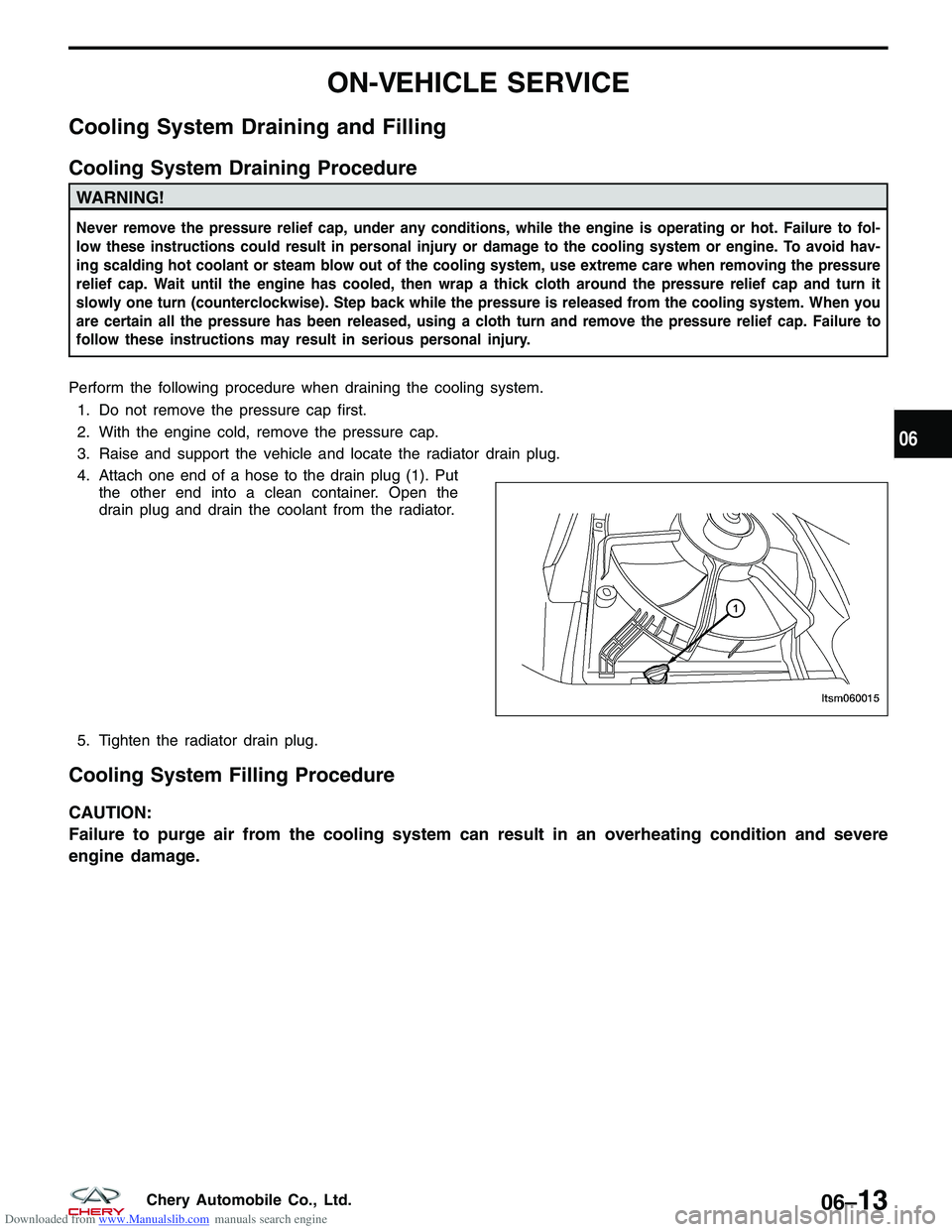
4. Attach one end of a hose to the drain plug (1). Put the other end into a clean container. Open the
drain plug and drain the coolant from the radiator.
5. Tighten the radiator drain plug.
Cooling System Filling Procedure
CAUTION:
Failure to purge air from the cooling system can result in an overheating condition and severe
engine damage.
LTSM060015
06
06–13Chery Automobile Co., Ltd.