2009 CHERY TIGGO seats
[x] Cancel search: seatsPage 4 of 1903

Downloaded from www.Manualslib.com manuals search engine VEHICLE SERVICE PREPARATION
Preparation For Vehicle Service
•Always be sure to cover fenders, seats and floor
areas before starting work.
Tools and Testing Equipment
•Be sure that all necessary tools and measuring
equipment are available before starting any work.
• Inspect the vehicle and reference any needed ser-
vice information before starting any work.
Special Tools
•Use special tools when they are required.
BESM010004
BESM010005
BESM010006T
01
01–3Chery Automobile Co., Ltd.
Page 32 of 1903

Downloaded from www.Manualslib.com manuals search engine GENERAL INFORMATION
Description
The 1.6L & 1.8L in-line four cylinder engines have the following features:
•Dual overhead camshafts
• Four valves per cylinder
• Aluminum cylinder head
• Cast iron cylinder block (1.8L Engine)
• Aluminum cylinder block (1.6L Engine)
Operation
The 1.6L & 1.8L engines utilize 4 valve-per-cylinder and a dual overhead camshaft design. The engines use an indi-
vidual coil ignition system. The 1.6L engine uses an aluminum cylinder block, and the 1.8L engine is made of cast
iron. The bearing caps are integrated into the lower cylinder block assembly. An aluminum oil pan bolts to the bottom
of the lower cylinder block. The camshafts are mounted in the cylinder head and act against valve tappets to open
and close the valves. The camshafts are driven off the front of the cylinder head by one timing belt. The belt is driven
by a sprocket that is located on the crankshaft. The piston assembly is an aluminum piston with a cast iron con-
necting rod.
The aluminum cylinder head contains dual overhead camshafts with 4 valve-per-cylinder construction. The valves are
arranged in two in-line banks. The cylinder head incorporates powdered metal valve guides and seats. The cylinder
head is sealed to the block using a multi-layer steel head gasket and retaining bolts.
Specifications
1.6L Engine Specifications
DESCRIPTION SPECIFICATION
Type In-Line OHV, DOHC
Number of Cylinders 4
Compression Ratio 10.5:1
Compression Pressure 10 - 15 bar
Max. Compression Pressure Variation Between
Cylinders 25%
Stroke 77.5 mm
Bore 81 mm
Displacement 1597 cc
Firing Order 1-3-4-2
1.8L Engine Specifications
DESCRIPTIONSPECIFICATION
Type In-Line OHV, DOHC
Number of Cylinders 4
Compression Ratio 10.5:1
Compression Pressure 10 - 15 bar
Max. Compression Pressure Variation Between
Cylinders 25%
Stroke 89.5 mm
Bore 81 mm
Displacement 1845 cc
Firing Order 1-3-4-2
02
02–3Chery Automobile Co., Ltd.
Page 43 of 1903
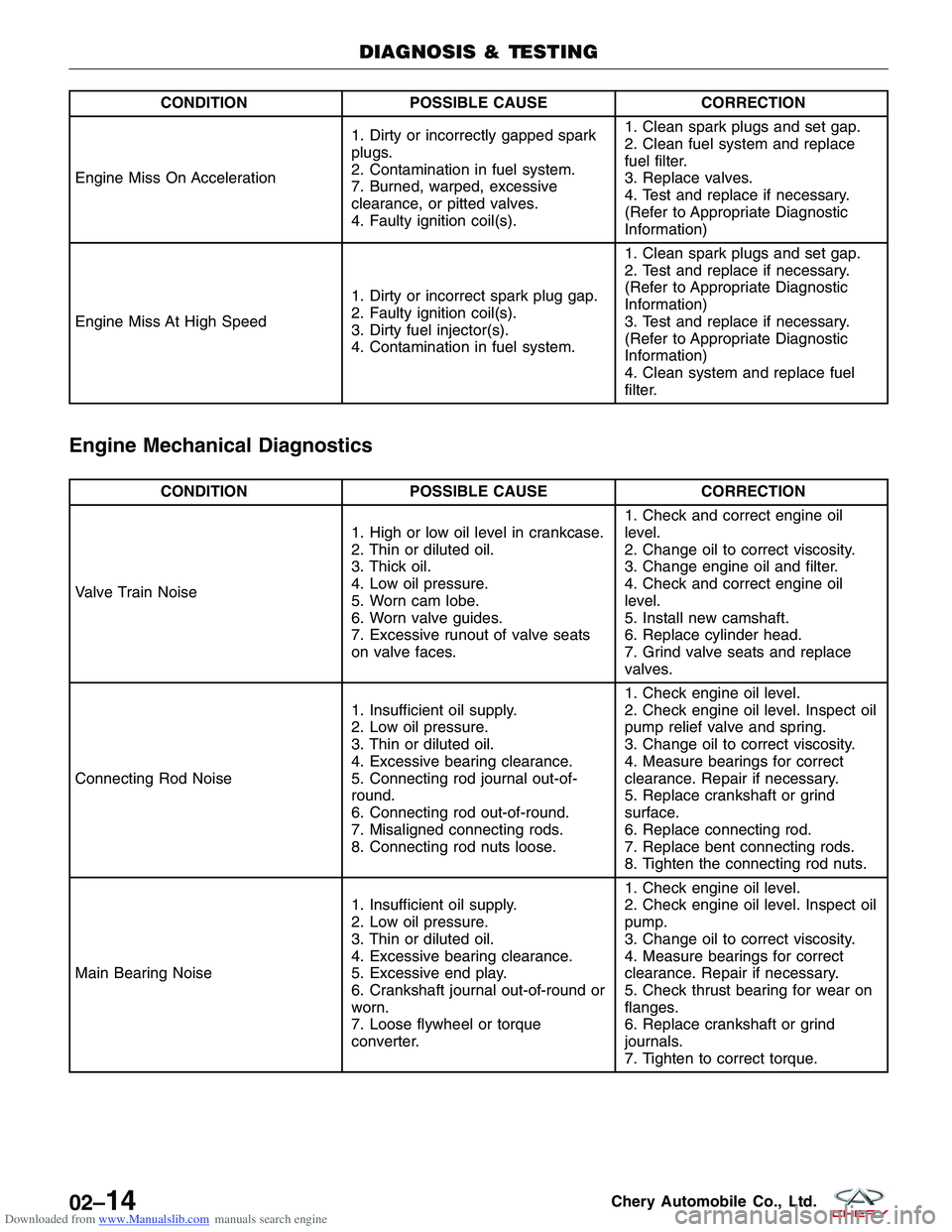
Downloaded from www.Manualslib.com manuals search engine CONDITIONPOSSIBLE CAUSE CORRECTION
Engine Miss On Acceleration 1. Dirty or incorrectly gapped spark
plugs.
2. Contamination in fuel system.
7. Burned, warped, excessive
clearance, or pitted valves.
4. Faulty ignition coil(s).1. Clean spark plugs and set gap.
2. Clean fuel system and replace
fuel filter.
3. Replace valves.
4. Test and replace if necessary.
(Refer to Appropriate Diagnostic
Information)
Engine Miss At High Speed 1. Dirty or incorrect spark plug gap.
2. Faulty ignition coil(s).
3. Dirty fuel injector(s).
4. Contamination in fuel system.1. Clean spark plugs and set gap.
2. Test and replace if necessary.
(Refer to Appropriate Diagnostic
Information)
3. Test and replace if necessary.
(Refer to Appropriate Diagnostic
Information)
4. Clean system and replace fuel
filter.
Engine Mechanical Diagnostics
CONDITION
POSSIBLE CAUSE CORRECTION
Valve Train Noise 1. High or low oil level in crankcase.
2. Thin or diluted oil.
3. Thick oil.
4. Low oil pressure.
5. Worn cam lobe.
6. Worn valve guides.
7. Excessive runout of valve seats
on valve faces.1. Check and correct engine oil
level.
2. Change oil to correct viscosity.
3. Change engine oil and filter.
4. Check and correct engine oil
level.
5. Install new camshaft.
6. Replace cylinder head.
7. Grind valve seats and replace
valves.
Connecting Rod Noise 1. Insufficient oil supply.
2. Low oil pressure.
3. Thin or diluted oil.
4. Excessive bearing clearance.
5. Connecting rod journal out-of-
round.
6. Connecting rod out-of-round.
7. Misaligned connecting rods.
8. Connecting rod nuts loose.1. Check engine oil level.
2. Check engine oil level. Inspect oil
pump relief valve and spring.
3. Change oil to correct viscosity.
4. Measure bearings for correct
clearance. Repair if necessary.
5. Replace crankshaft or grind
surface.
6. Replace connecting rod.
7. Replace bent connecting rods.
8. Tighten the connecting rod nuts.
Main Bearing Noise 1. Insufficient oil supply.
2. Low oil pressure.
3. Thin or diluted oil.
4. Excessive bearing clearance.
5. Excessive end play.
6. Crankshaft journal out-of-round or
worn.
7. Loose flywheel or torque
converter.1. Check engine oil level.
2. Check engine oil level. Inspect oil
pump.
3. Change oil to correct viscosity.
4. Measure bearings for correct
clearance. Repair if necessary.
5. Check thrust bearing for wear on
flanges.
6. Replace crankshaft or grind
journals.
7. Tighten to correct torque.
DIAGNOSIS & TESTING
02–14Chery Automobile Co., Ltd.
Page 100 of 1903

Downloaded from www.Manualslib.com manuals search engine 2. Remove the valve keeper (1), valve spring retainer(2) and valve spring (3).
3. Remove valves (4) from the cylinder head.
Inspection
Inspect the valves for the following:
• Clean all valves thoroughly and discard burned,
warped and cracked valves.
• Check valve seats and valve faces for damage.
• When reconditioning valves follow the specifications
outlined for both intake and exhaust valves.
CYLINDER HEAD UNIT REPAIR
VISM080041
BESM020066
02
02–71Chery Automobile Co., Ltd.
Page 106 of 1903

Downloaded from www.Manualslib.com manuals search engine GENERAL INFORMATION
Description
The 2.0L in-line four cylinder engine has the following features:
•Dual overhead camshafts
• Four valves per cylinder
• Aluminum cylinder head
• Aluminum cylinder block
Operation
The 2.0L engine utilizes 4 valve-per-cylinders and a dual overhead camshaft design. The engine uses an individual
coil ignition system. The cylinder block is made of aluminum and the bearing caps are integrated into the lower cyl-
inder block assembly. An aluminum oil pan bolts to the bottom of the lower cylinder block. The camshafts are
mounted in the cylinder head and act against valve tappets to open and close the valves. The camshafts are driven
off the front of the cylinder head by one timing belt. The belt is driven by a sprocket that is located on the crankshaft.
The piston assembly is an aluminum piston with a cast iron connecting rod.
The aluminum cylinder head contains dual overhead camshafts with 4 valve-per-cylinder construction. The valves are
arranged in two in-line banks. The cylinder head incorporates powdered metal valve guides and seats. The cylinder
head is sealed to the block using a multi-layer steel head gasket and retaining bolts.
Specifications
2.0L Engine Specifications
DESCRIPTION SPECIFICATION
Type In-Line OHV, DOHC
Number of Cylinders 4
Compression Ratio 10:1
Compression Pressure 10 - 15 bar
Max. Compression Pressure Variation Between
Cylinders 25%
Stroke 90 mm
Bore 83.5 mm
Displacement 1971 cc
Firing Order 1-3-4-2
Mechanical Specifications
DESCRIPTIONITEMSTANDARD LIMIT
Engine Oil Pressure Lower Idle Speed (800 ±
50 RPM) 1.2 - 1.5 bar
-
High Idle Speed (2000 RPM) 3.2 - 3.5 bar
-
High Speed (4000 RPM) 3.7 ± 0.5 bar -
Engine Block Clearance Surface Distortion
-0.15 mm
Inner Diameter 83.500 - 83.510 mm -
Out-Of-Round -< 0.008 mm
Taper -< 0.01 mm
Piston Ring Groove
Clearance First Ring
0.04 - 0.08 mm -
Second Ring 0.0251 - 0.01 mm -
02
02–77Chery Automobile Co., Ltd.
Page 117 of 1903

Downloaded from www.Manualslib.com manuals search engine CONDITIONPOSSIBLE CAUSE CORRECTION
Engine Miss On Acceleration 1. Dirty or incorrectly gapped spark
plugs.
2. Contamination in fuel system.
7. Burned, warped, excessive
clearance, or pitted valves.
4. Faulty ignition coil(s).1. Clean spark plugs and set gap.
2. Clean fuel system and replace
fuel filter.
3. Replace valves.
4. Test and replace if necessary.
(Refer to Appropriate Diagnostic
Information)
Engine Miss At High Speed 1. Dirty or incorrect spark plug gap.
2. Faulty ignition coil(s).
3. Dirty fuel injector(s).
4. Contamination in fuel system.1. Clean spark plugs and set gap.
2. Test and replace if necessary.
(Refer to Appropriate Diagnostic
Information)
3. Test and replace if necessary.
(Refer to Appropriate Diagnostic
Information)
4. Clean system and replace fuel
filter.
Engine Mechanical Diagnostics
CONDITION
POSSIBLE CAUSE CORRECTION
Valve Train Noise 1. High or low oil level in crankcase.
2. Thin or diluted oil.
3. Thick oil.
4. Low oil pressure.
5. Worn cam lobe.
6. Worn valve guides.
7. Excessive runout of valve seats
on valve faces.1. Check and correct engine oil
level.
2. Change oil to correct viscosity.
3. Change engine oil and filter.
4. Check and correct engine oil
level.
5. Install new camshaft.
6. Replace cylinder head.
7. Grind valve seats and replace
valves.
Connecting Rod Noise 1. Insufficient oil supply.
2. Low oil pressure.
3. Thin or diluted oil.
4. Excessive bearing clearance.
5. Connecting rod journal out-of-
round.
6. Connecting rod out-of-round.
7. Misaligned connecting rods.
8. Connecting rod nuts loose.1. Check engine oil level.
2. Check engine oil level. Inspect oil
pump relief valve and spring.
3. Change oil to correct viscosity.
4. Measure bearings for correct
clearance. Repair if necessary.
5. Replace crankshaft or grind
surface.
6. Replace connecting rod.
7. Replace bent connecting rods.
8. Tighten the connecting rod nuts.
Main Bearing Noise 1. Insufficient oil supply.
2. Low oil pressure.
3. Thin or diluted oil.
4. Excessive bearing clearance.
5. Excessive end play.
6. Crankshaft journal out-of-round or
worn.
7. Loose flywheel or torque
converter.1. Check engine oil level.
2. Check engine oil level. Inspect oil
pump.
3. Change oil to correct viscosity.
4. Measure bearings for correct
clearance. Repair if necessary.
5. Check thrust bearing for wear on
flanges.
6. Replace crankshaft or grind
journals.
7. Tighten to correct torque.
DIAGNOSIS & TESTING
02–88Chery Automobile Co., Ltd.
Page 173 of 1903
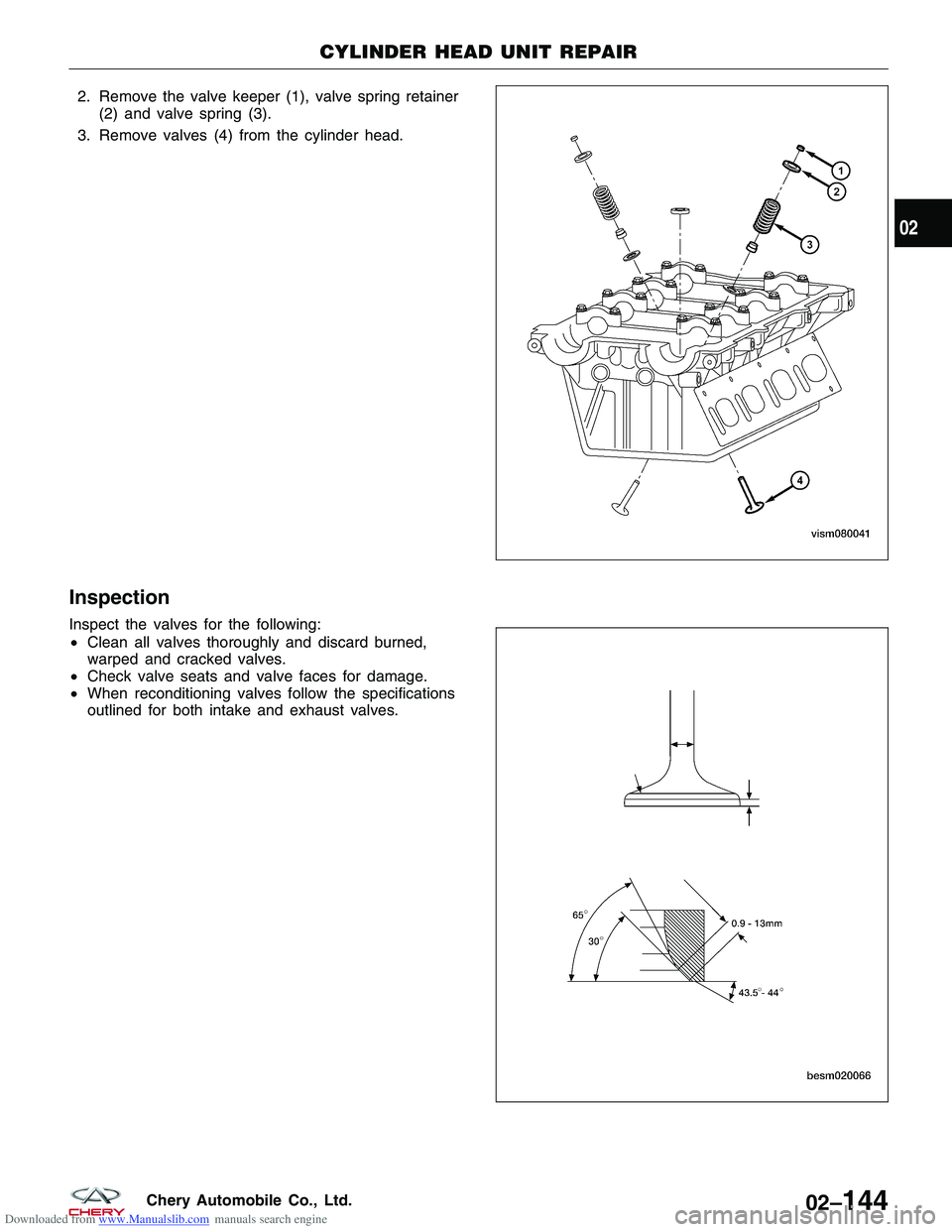
Downloaded from www.Manualslib.com manuals search engine 2. Remove the valve keeper (1), valve spring retainer(2) and valve spring (3).
3. Remove valves (4) from the cylinder head.
Inspection
Inspect the valves for the following:
• Clean all valves thoroughly and discard burned,
warped and cracked valves.
• Check valve seats and valve faces for damage.
• When reconditioning valves follow the specifications
outlined for both intake and exhaust valves.
CYLINDER HEAD UNIT REPAIR
VISM080041
BESM020066
02
02–144Chery Automobile Co., Ltd.
Page 179 of 1903

Downloaded from www.Manualslib.com manuals search engine CYLINDER HEAD UNIT REPAIR02-241
Cylinder Head 02-241
Specifications 02-241
Disassembly 02-241
Inspection 02-242
Assembly 02-242
Camshaft 02-243
Specifications 02-243
Disassembly 02-244
Camshaft 02-245
Hydraulic Adjusters 02-245
Rocker Arms 02-246Valve & Valve Guides
02-246
Specifications 02-246
Disassembly 02-247
Valves 02-248
Valve Guides 02-250
Valve Seats 02-251
Assembly 02-252
Valve Springs 02-252
Specifications 02-252
Disassembly 02-253
Inspection 02-254
Assembly 02-255
ENGINE - 2.4L ENGINE MECHANICAL
02
02–150Chery Automobile Co., Ltd.